 简体中文
 繁體中文
 English
regulatory agency
Central Bank of Bahrain (CBB)
The specific acceptance units and authorities are subject to the latest public information of the Central Bank of Bahrain (CBB)..
Arrange the scope of permissions according to the current rules of the Central Bank of Bahrain (CBB), Application conditions, Cost budgeting and ongoing monitoring.
The CBB regulates crypto-asset services according to actual activities and licence conditions; a higher category number does not automatically authorise every service.
Category 1 permits reception and transmission of orders and investment advice, but not holding client assets or money or operating an exchange.
When providing those services, a Category 1 licensee must not receive fees or commissions from anyone other than the client.
Category 2 may provide agency trading, portfolio management, custody and investment advice as licensed, but must not deal as principal or operate an exchange.
Category 3 may provide agency or principal trading, portfolio management, custody, investment advice and digital token advisory services as licensed, but must not operate an exchange.
Category 4 may operate a crypto-asset exchange and provide custody and digital token advisory services as licensed.
An exchange must generally not execute client orders against proprietary capital or engage in matched principal trading; the separate exception for digital tokens under a CBB-approved OTC framework must be checked independently.
Categories 1 to 3 must not use public order books, price discovery or exchange-type automatic matching to create the impression of operating a licensed exchange.
CBB crypto-asset licence categories and activity boundaries
Customer type should be determined before applying, Token, Transaction or matching method, Whether to hold client assets, Fiat currency settlement, market making, Outsourcing and cross-border services. Crypto asset service provider license does not automatically cover banks, pay, Securities offerings or Islamic financial activities.

Important tips: Application Category, Minimum capital and personnel arrangements should be confirmed based on actual activities in the CBB Rulebook.
Central Bank of Bahrain (CBB)
The specific acceptance units and authorities are subject to the latest public information of the Central Bank of Bahrain (CBB)..
Crypto-asset Service License
Application Category, Minimum capital and personnel arrangements should be confirmed based on actual activities in the CBB Rulebook.
Authorised scope and ongoing obligations
This page cross-checks public rules, application-document structures and practical business processes.
The following content is used to delimit the project scope of the Bahrain cryptocurrency license; The actual business and official determination remain controlling.
Application documents should describe the products of the cryptoasset trading platform, client, channel, transaction flows, revenue model and controls.
Application documents should state the broker, Portfolio management or advisory products, client, channel, transaction flows, revenue model and controls.
The application must explain the products, clients, channels, transaction flows, revenue model and controls for custody and related services.
Submit a completed Form 1 with a covering letter signed by an authorised signatory and supporting documents required by the current CBB rules.
CRA Section 1.2.4 lists the relevant shareholder and proposed management forms, a comprehensive business plan, commercial registration evidence and the board resolution to apply.
Group applicants must also provide, where applicable, a non-objection letter and good-standing confirmation from the lead supervisor, together with the group’s audited financial statements for the preceding three years.
Where that group provision does not apply, provide the substantial corporate shareholder’s audited financial statements for the preceding three years as applicable.
The memorandum and articles of association are also required; applicants forming a new company may submit a draft as provided by the rules.
Documents must be in English or Arabic; documents in another language require a certified English or Arabic translation.
The applicant may appoint a representative to prepare and submit the application, but remains fully responsible for its accuracy and completeness and may be contacted directly by the CBB.
The business plan must cover shareholder and ultimate beneficial owner backgrounds, products and services, websites, operating jurisdictions and the intended customer base.
Describe KYC and onboarding, the end-to-end business cycle, organisational reporting lines, risk controls and arrangements for transferring funds.
Provide an opening balance sheet and three-year financial projections with clear assumptions, together with business continuity, IT systems and backup arrangements.
A Category 1, 2 or 3 applicant must be a Bahraini company with limited liability (W.L.L.) or a Bahraini joint stock company (B.S.C.).
A Category 4 crypto-asset exchange applicant must be a Bahraini joint stock company (B.S.C.).
Substantial shareholders must be acceptable to the CBB; CRA defines a substantial shareholder to include a person who alone or with associates holds at least 5% of the shares or controls at least 5% of the votes.
CBB crypto-asset legal entity and local substance conditions
Establish responsibilities, conflict of interest, complaints, outsourcing, business continuity, cyber security and financial controls.
Establish customer due diligence based on the risk assessment, Continuous monitoring, Sanctions Screening, suspicious transaction report, recordkeeping and training.
Under CRA Chapter 3, minimum capital comprises paid-up share capital unimpaired by losses and must be checked against the actual licence category.
Category 1 requires minimum capital of BD 25,000.
Category 2 requires minimum capital of BD 100,000.
Category 3 requires minimum capital of BD 200,000.
Category 4 requires minimum capital of BD 300,000.
Minimum capital must be paid into a retail bank licensed to operate in Bahrain, with evidence of the deposit provided to the CBB on request.
The CBB may require additional capital according to risk, and the firm must also hold eligible liquid assets covering at least three months of estimated expenditure.
Eligible liquid assets comprise cash, cash equivalents, and placements or deposits maturing within 30 days.
Capital and liquidity requirements are not application fees, and they do not replace the full operating budget or client asset protection requirements.
The categories are not freely cumulative service permissions; check the permitted activities separately under CRA Section 1.1.
Nominees to the board and senior management functions must comply with the CBB Common Volume’s current Fit and Proper Requirements Module.
Staff collectively must have sufficient skills and experience to manage the business soundly and prudently and meet the training and competency requirements specified by the CBB.
Responsibilities must be adequately segregated so that no single individual controls every stage of a transaction.
Following the May 2026 changes, do not continue to treat the deleted CRA Section 1.7 as the current personnel approval regime.
CBB crypto-asset legal entity and local substance conditions
A licensee must have a designated place of business in Bahrain; a licensee with its registered office in Bahrain must also maintain its head office in Bahrain.
These conditions are not satisfied merely by an overseas company and a mail-forwarding address.
A Category 1, 2 or 3 applicant must be a Bahraini company with limited liability (W.L.L.) or a Bahraini joint stock company (B.S.C.).
A Category 4 crypto-asset exchange applicant must be a Bahraini joint stock company (B.S.C.).
Substantial shareholders must be acceptable to the CBB; CRA defines a substantial shareholder to include a person who alone or with associates holds at least 5% of the shares or controls at least 5% of the votes.
CBB crypto-asset legal entity and local substance conditions
The budget should differentiate between statutory expenses, Capital or margin, corporate and premises costs, staffing and professional fees. Do not quote a fixed total cost or guarantee an approval timeframe without an official basis.
| Budget item | Basis of calculation | Checkpoints |
|---|---|---|
| Regulatory application and annual fees | A non-refundable application fee of BD 100 is payable when formally submitting an application for a regulated crypto-asset service licence. The annual licence fee is 0.25% of relevant operating expenses, subject to the minimum and maximum for the licence category. Category 1: minimum BD 2,000 and maximum BD 6,000 per year. Category 2: minimum BD 3,000 and maximum BD 8,000 per year. Category 3: minimum BD 4,000 and maximum BD 10,000 per year. Category 4: minimum BD 5,000 and maximum BD 12,000 per year. Relevant operating expenses must be calculated using the audited financial statements and adjustments specified in the current rules, rather than gross revenue. Exclude training costs, charitable donations, CBB fees paid and non-executive directors’ remuneration. Operating expenses for this section also exclude items such as depreciation, provisions, interest expense and dividends. A newly licensed firm pays its first annual fee on issuance at the category minimum, and the first full year of operation is also charged at the minimum. Cancellation does not entitle the licensee to a refund for the remaining months of that calendar year. | The annual licence fee for the following calendar year is payable on 1 December of the preceding year. Form ALF must be submitted no later than 15 October of the year preceding the fee year. Annual fees are paid by direct debit, and the Direct Debit Authorisation Form must be submitted by 15 September. |
| capital, security deposits and insurance | Check the category-specific minimum paid-up capital, any additional capital and liquid assets covering at least three months of estimated expenditure separately. | Capital is not a service fee, and must not be met with temporary loans or funds of unexplained origin. |
| Company formation and statutory maintenance | Budget separately according to the place of registration, share capital, registered agent, secretary, Registered address, annual return and tax filings. | Company formation does not mean that a licence or bank account has been approved. |
| Office and personnel | Calculate according to the lease, deposit, floor area, use, local remuneration, visa and local-presence requirements.. | Confirm the substantive requirement accepted by the regulator, before signing a lease or hiring staff.. |
| Policies, systems and professional services | Calculate AML/KYC,, Sanctions Screening, transaction monitoring, network security, audit, legal advice, translation and notarisation according to business complexity.. | Quotes should set out the scope, hypothesis, third-party costs and the number of response rounds. |
The timeline depends on business complexity,, Data completeness and inquiries from the Central Bank of Bahrain (CBB) or the receiving institution, so a fixed approval time should not be promised..
put product, client, regions, Channels and capital flows are mapped to the scope of the Crypto-asset Service License.
Determine the applicant, Equity, director, key personnel, premises and outsourcing arrangements.
Prepare the business plan, financial forecasts, organisational structure, risk assessments and compliance policies.
Submit application to the Central Bank of Bahrain (CBB), respond to information requests, Interview, system demonstrations or inspections.
Check the licence conditions, and complete the capital, personnel, system, client-asset and filing arrangements.
Licensees are required to maintain capital and insurance by class, Customer asset isolation, Wallet security, market conduct, AML/CFT, Audit and regulatory reporting. Token, trading rules, hosting, Changes in liquidity or control should be subject to CBB prior approval.
Cryptoasset business controls can be combinedClient Assets and Continuous Risk Control Service ScopePrepare, Not describing the cryptoasset license as a universal banking or payments license. Licensed, registration or membership maintenance can be assessed withLicense renewal, filing and maintenance service scopetidy.
Licensees should include the following fee and capital matters in their compliance calendar and check all other ongoing regulatory duties separately.
The annual licence fee for the following calendar year is payable on 1 December of the preceding year.
Form ALF must be submitted no later than 15 October of the year preceding the fee year.
Annual fees are paid by direct debit, and the Direct Debit Authorisation Form must be submitted by 15 September.
A breach of the minimum capital requirements must be notified to the CBB immediately in writing.
Unless otherwise directed by the CBB, a plan demonstrating how compliance will be restored must be submitted within 30 calendar days of the notification.
CBB approval is required before modifying issued or paid-up capital; after an approved increase, the external auditor must confirm that the amount has been deposited in the bank account.
CBB crypto-asset licence application fee rules
CBB crypto-asset annual licence fee and filing rules
CBB crypto-asset minimum capital and liquid asset rules
Appointment of the external auditor requires prior CBB approval, and details of the proposed auditor must be submitted with the application.
Relevant books and information must be kept for at least 10 years and be available at any time for inspection in Bahrain by the CBB or its appointees.
Client assets must be held through separate client accounts segregated from the firm’s own funds in accordance with the applicable rules.
CBB crypto-asset legal entity and local substance conditions
In 2026, the category and capital requirements should be determined according to the current Crypto-asset Module in Volume 6 of the CBB Rulebook; Any fixed capital figure may only be used if it accurately corresponds to the application category and rule version.
Official sources to check: Bahrain CBB Rulebook Volume 6: CRA Crypto Asset Module.
Crypto asset licensing should be checkedBahrain CBB Rulebook Volume 6: CRA Crypto Asset Module, These includeCRA Section 1.2: License application, CRA Section 1.5: Licence application feeandCRA Section 1.6: Annual license fee. The rule book is linked from the official website of the Central Bank of Bahrain to its regulations publishing platform, Please check applicable categories and current provisions before handling.
The 60-calendar-day period for a CBB decision applies only once the application is deemed complete and all required information and documents, including requested clarifications, have been supplied.
This is not a guaranteed approval period running from the first submission; allow separate time for preparation, additional information and the readiness assessment.
The CBB encourages early written pre-application contact and normally expects at least one pre-application meeting.
CBB crypto-asset licence application and readiness rules
Do not represent the applicant as licensed by the CBB before the formal licensing decision has been issued.
Before commencing operations, appoint an independent third party with the CBB’s prior written approval to conduct a readiness assessment and submit its report.
The assessment must cover risk management, capital adequacy, organisational structure, operational manuals, IT, information security, policies and internal controls.
Complete applicable pre-commencement documents, including bank confirmations on capital and account arrangements, the auditor’s acceptance and professional indemnity insurance.
Material changes to application information must be reported before licensing; services not covered by the original application require the CBB’s prior written approval.
Update note: regulatory scope, capital, personnel, cost, timelines and ongoing obligations may change, Before proceeding, follow the authority’s current rules, forms and case-specific determination.
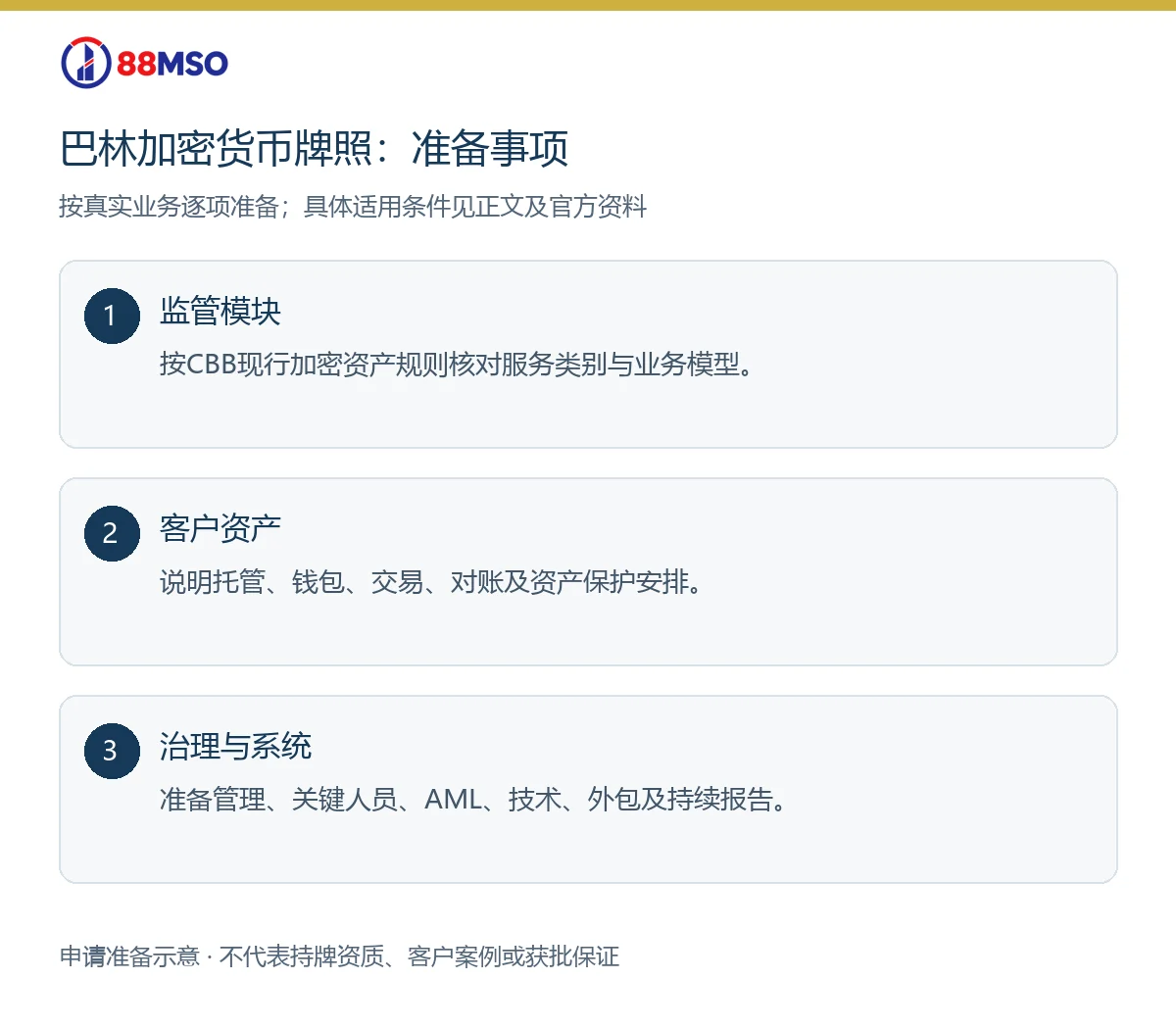
The following checklist is for preparation and communication of a Bahrain cryptocurrency license, and maps the business description to verifiable evidence; the final submission items depend on the requirements of the applicable authority.
The CBB regulates crypto-asset services according to actual activities and licence conditions; a higher category number does not automatically authorise every service.
Category 1 permits reception and transmission of orders and investment advice, but not holding client assets or money or operating an exchange.
When providing those services, a Category 1 licensee must not receive fees or commissions from anyone other than the client.
Category 2 may provide agency trading, portfolio management, custody and investment advice as licensed, but must not deal as principal or operate an exchange.
Category 3 may provide agency or principal trading, portfolio management, custody, investment advice and digital token advisory services as licensed, but must not operate an exchange.
Category 4 may operate a crypto-asset exchange and provide custody and digital token advisory services as licensed.
An exchange must generally not execute client orders against proprietary capital or engage in matched principal trading; the separate exception for digital tokens under a CBB-approved OTC framework must be checked independently.
Categories 1 to 3 must not use public order books, price discovery or exchange-type automatic matching to create the impression of operating a licensed exchange.
CBB crypto-asset licence categories and activity boundaries
Customer type should be determined before applying, Token, Transaction or matching method, Whether to hold client assets, Fiat currency settlement, market making, Outsourcing and cross-border services. Crypto asset service provider license does not automatically cover banks, pay, Securities offerings or Islamic financial activities.
Submit a completed Form 1 with a covering letter signed by an authorised signatory and supporting documents required by the current CBB rules.
CRA Section 1.2.4 lists the relevant shareholder and proposed management forms, a comprehensive business plan, commercial registration evidence and the board resolution to apply.
Group applicants must also provide, where applicable, a non-objection letter and good-standing confirmation from the lead supervisor, together with the group’s audited financial statements for the preceding three years.
Where that group provision does not apply, provide the substantial corporate shareholder’s audited financial statements for the preceding three years as applicable.
The memorandum and articles of association are also required; applicants forming a new company may submit a draft as provided by the rules.
Documents must be in English or Arabic; documents in another language require a certified English or Arabic translation.
The applicant may appoint a representative to prepare and submit the application, but remains fully responsible for its accuracy and completeness and may be contacted directly by the CBB.
CBB crypto-asset licence application and readiness rules
The business plan must cover shareholder and ultimate beneficial owner backgrounds, products and services, websites, operating jurisdictions and the intended customer base.
Describe KYC and onboarding, the end-to-end business cycle, organisational reporting lines, risk controls and arrangements for transferring funds.
Provide an opening balance sheet and three-year financial projections with clear assumptions, together with business continuity, IT systems and backup arrangements.
Licensees are required to maintain capital and insurance by class, Customer asset isolation, Wallet security, market conduct, AML/CFT, Audit and regulatory reporting. Token, trading rules, hosting, Changes in liquidity or control should be subject to CBB prior approval.
Appointment of the external auditor requires prior CBB approval, and details of the proposed auditor must be submitted with the application.
Relevant books and information must be kept for at least 10 years and be available at any time for inspection in Bahrain by the CBB or its appointees.
Client assets must be held through separate client accounts segregated from the firm’s own funds in accordance with the applicable rules.
CBB crypto-asset legal entity and local substance conditions
In 2026, the category and capital requirements should be determined according to the current Crypto-asset Module in Volume 6 of the CBB Rulebook; Any fixed capital figure may only be used if it accurately corresponds to the application category and rule version. See the latest rulesBahrain CBB Rulebook Volume 6: CRA Crypto Asset Module.
Policies should be based on the firm’s customers, Country or region, product, channels and transaction characteristics to form the business risk assessment, and implemented through customer due diligence, beneficial-owner identification, ongoing monitoring, sanctions and politically exposed person screening, escalation and reporting of suspicious transactions, record keeping, staff training and independent testing. A generic template, without justified thresholds or operational records, is usually insufficient to show that the framework operates.
Under CRA Chapter 3, minimum capital comprises paid-up share capital unimpaired by losses and must be checked against the actual licence category.
Category 1 requires minimum capital of BD 25,000.
Category 2 requires minimum capital of BD 100,000.
Category 3 requires minimum capital of BD 200,000.
Category 4 requires minimum capital of BD 300,000.
Minimum capital must be paid into a retail bank licensed to operate in Bahrain, with evidence of the deposit provided to the CBB on request.
The CBB may require additional capital according to risk, and the firm must also hold eligible liquid assets covering at least three months of estimated expenditure.
Eligible liquid assets comprise cash, cash equivalents, and placements or deposits maturing within 30 days.
Capital and liquidity requirements are not application fees, and they do not replace the full operating budget or client asset protection requirements.
The categories are not freely cumulative service permissions; check the permitted activities separately under CRA Section 1.1.
A licensee must have a designated place of business in Bahrain; a licensee with its registered office in Bahrain must also maintain its head office in Bahrain.
These conditions are not satisfied merely by an overseas company and a mail-forwarding address.
A Category 1, 2 or 3 applicant must be a Bahraini company with limited liability (W.L.L.) or a Bahraini joint stock company (B.S.C.).
A Category 4 crypto-asset exchange applicant must be a Bahraini joint stock company (B.S.C.).
Substantial shareholders must be acceptable to the CBB; CRA defines a substantial shareholder to include a person who alone or with associates holds at least 5% of the shares or controls at least 5% of the votes.
CBB crypto-asset legal entity and local substance conditions
Nominees to the board and senior management functions must comply with the CBB Common Volume’s current Fit and Proper Requirements Module.
Staff collectively must have sufficient skills and experience to manage the business soundly and prudently and meet the training and competency requirements specified by the CBB.
Responsibilities must be adequately segregated so that no single individual controls every stage of a transaction.
Following the May 2026 changes, do not continue to treat the deleted CRA Section 1.7 as the current personnel approval regime.
CBB crypto-asset legal entity and local substance conditions
The 60-calendar-day period for a CBB decision applies only once the application is deemed complete and all required information and documents, including requested clarifications, have been supplied.
This is not a guaranteed approval period running from the first submission; allow separate time for preparation, additional information and the readiness assessment.
The CBB encourages early written pre-application contact and normally expects at least one pre-application meeting.
Generally not. The applicant should complete provider due diligence, explain data flows, service levels, Audit right, subcontracting, information security, business continuity and exit arrangements, and retain oversight of rules, thresholds, alerts and major incidents. Whether outsourcing is permitted and what notification or approval is needed, Should be checked against the current regulations of the Central Bank of Bahrain (CBB).
Do not represent the applicant as licensed by the CBB before the formal licensing decision has been issued.
Before commencing operations, appoint an independent third party with the CBB’s prior written approval to conduct a readiness assessment and submit its report.
The assessment must cover risk management, capital adequacy, organisational structure, operational manuals, IT, information security, policies and internal controls.
Complete applicable pre-commencement documents, including bank confirmations on capital and account arrangements, the auditor’s acceptance and professional indemnity insurance.
Material changes to application information must be reported before licensing; services not covered by the original application require the CBB’s prior written approval.
Licensees should include the following fee and capital matters in their compliance calendar and check all other ongoing regulatory duties separately.
Common obligations include renewals or annual fees, Regulatory filing, financial or compliance audits, training, record keeping, complaint handling, client-asset and capital monitoring, and notification or approval for changes in ownership, director, key personnel, address, Business scope, systems and major incidents. Maintain a compliance calendar and change-approval process, and get regular rule updates from the Central Bank of Bahrain (CBB).
The annual licence fee for the following calendar year is payable on 1 December of the preceding year.
Form ALF must be submitted no later than 15 October of the year preceding the fee year.
Annual fees are paid by direct debit, and the Direct Debit Authorisation Form must be submitted by 15 September.
A breach of the minimum capital requirements must be notified to the CBB immediately in writing.
Unless otherwise directed by the CBB, a plan demonstrating how compliance will be restored must be submitted within 30 calendar days of the notification.
CBB approval is required before modifying issued or paid-up capital; after an approved increase, the external auditor must confirm that the amount has been deposited in the bank account.
CBB crypto-asset licence application fee rules
Crypto asset licensing should be checkedBahrain CBB Rulebook Volume 6: CRA Crypto Asset Module, These includeCRA Section 1.2: License application, CRA Section 1.5: Licence application feeandCRA Section 1.6: Annual license fee. The rule book is linked from the official website of the Central Bank of Bahrain to its regulations publishing platform, Please check applicable categories and current provisions before handling.
Cryptoasset business controls can be combinedClient Assets and Continuous Risk Control Service ScopePrepare, Not describing the cryptoasset license as a universal banking or payments license. Licensed, registration or membership maintenance can be assessed withLicense renewal, filing and maintenance service scopetidy.
A non-refundable application fee of BD 100 is payable when formally submitting an application for a regulated crypto-asset service licence.
The annual licence fee is 0.25% of relevant operating expenses, subject to the minimum and maximum for the licence category.
Category 1: minimum BD 2,000 and maximum BD 6,000 per year.
Category 2: minimum BD 3,000 and maximum BD 8,000 per year.
Category 3: minimum BD 4,000 and maximum BD 10,000 per year.
Category 4: minimum BD 5,000 and maximum BD 12,000 per year.
Relevant operating expenses must be calculated using the audited financial statements and adjustments specified in the current rules, rather than gross revenue.
Exclude training costs, charitable donations, CBB fees paid and non-executive directors’ remuneration.
Operating expenses for this section also exclude items such as depreciation, provisions, interest expense and dividends.
A newly licensed firm pays its first annual fee on issuance at the category minimum, and the first full year of operation is also charged at the minimum.
Cancellation does not entitle the licensee to a refund for the remaining months of that calendar year.
Budget application and annual fees separately from capital, liquid assets, premises, staff, systems and professional service costs.
The applicant should be confirmed first, statutory registered office, actual management location, and distinguish these from customer reception and recordkeeping locations, then budget for registration fees, agent or secretary, rent, deposit, furnish, communications, Insurance, visas and local staff. Leasing before defining the regulatory boundary, may create unrecoverable costs.
Can't understand this. Should be checked according to CBB specific license category and conditions, bank, pay, Investment and crypto asset services are different business judgments.
A trading platform and custody must be described separately, including client-asset and wallet permissions, reconciliations, risks and responsibilities, and must match the specific licence category.
A licensee authorised to hold client assets must place client money and crypto-assets in specially created accounts segregated from the licensee’s own assets and identify them separately.
Client-money reconciliations must be performed at least monthly and completed within 10 business days from the end of the month; differences and shortfalls must be investigated and corrected.
When using a third-party crypto-asset custodian, the licensee must conduct an appropriate risk assessment and retain ultimate responsibility for the safe custody of client assets.
The assessment should consider the custodian’s expertise and reputation, cyber-security, legal protection in insolvency, regulatory status, capital and financial resources, and other activities.
CBB CRA module: client-asset segregation and custody rules CBB Volume 6 CRA official rulebook PDF
Custody systems and controls must ensure that client crypto-assets are properly safeguarded, identifiable and secure at all times, and protected against loss, theft and hacking.
The custody function must be appropriately separated from other activities and handled by staff without conflicting responsibilities.
A licensee controlling crypto-assets for clients must keep at least 90% of client crypto-assets in cold wallets, calculated separately for each crypto-asset.
No single person or signatory may be able to fully authorise the movement, withdrawal or transfer of client crypto-assets, and the licensee must mitigate collusion risk among authorised persons.
The licensee must maintain an up-to-date list of all past and present persons able to view, initiate, authorise, sign, approve or complete transfers or withdrawals of client crypto-assets, with procedures for granting and revoking authority.
The licensee must have written incident procedures for hacking, theft, fraud or suspected compromise of keys or assets, including steps to protect client assets and the ability to halt further transactions involving the affected crypto-assets immediately.
At least once every calendar month, the licensee must reconcile all client crypto-assets held by it or a third-party custodian and individual client balances, record discrepancies and remedial measures, and retain custody-account records for ten years after the account is closed.
Institutions should have a board-approved listing policy; Before planning to list new assets, Should notify CBB and provide risk assessment and board resolution, Confirm compliance with this policy. Corresponding monitoring capabilities are also required, Keep audit records for each department, And continue to review and deal with delisting risks. See the sourceCBB CRA-4.3 Token Listing Policy and Risk Assessment Terms.
This cannot be inferred. CRA-4.3.2B allows the listing and trading of derivatives at the discretion of the CBB, and requires a comprehensive derivatives risk management framework, Market covered, Credit, Liquidity, Settlement, Operational and legal risks, and stress testing, Arrangements such as margin and client suitability. See the sourceCBB Crypto Asset Spot and Derivatives Trading Scope Terms.
Written confirmation should be made within 5 working days after receipt of written complaint, and respond within 4 weeks; When unable to respond in time, The reason and expected time should be stated. Complaints and correspondence must be recorded, and keep it for 10 years from the date of receipt of the complaint.; Quarterly complaint reports are also required, Zero report still required when there are no complaints. See the sourceCBB CRA-4.7 Complaint Response, Quarterly Reports and Retention Period.