 简体中文
 繁體中文
 English
regulatory agency
New Zealand Financial Markets Authority (FMA)
The specific acceptance units and authorities are subject to the latest public information of the New Zealand Financial Markets Authority (FMA)..
Arrange the scope of permissions according to the current rules of the New Zealand Financial Markets Authority (FMA), Application conditions, Cost budgeting and ongoing monitoring.
New Zealand FSP registration andFMALicensing is not the same concept. Financial Service Providers Register records service providers and links dispute resolution, But the issuance of derivatives, managed investment plan, Activities such as financial advice may require specific permission from the FMA.
The project should first confirm the service, Client and New Zealand business contacts, Re-judge FSP registration, Dispute Resolution Scheme and FMA Licensing. Only obtaining an FSP number cannot declare "FMA license" to the outside world., Overseas companies cannot use registration to enhance their credibility without having real New Zealand business..

Important tips: FSPR registration itself is not an FMA licence, and does not indicate regulatory endorsement..
New Zealand Financial Markets Authority (FMA)
The specific acceptance units and authorities are subject to the latest public information of the New Zealand Financial Markets Authority (FMA)..
Apply for derivatives issuers by activity, License to manage investment plans etc.
FSPR registration itself is not an FMA licence, and does not indicate regulatory endorsement..
Authorised scope and ongoing obligations
This page cross-checks public rules, application-document structures and practical business processes.
The following content is used to delineate the project scope of the New Zealand FMA financial license; The actual business and official determination remain controlling.
Application documents should describe the products of derivatives issuance or trading services, client, channel, transaction flows, revenue model and controls.
Application documents should describe the products of the managed investment scheme, client, channel, transaction flows, revenue model and controls.
Application documents should describe the offering of financial advice or other regulated services, client, channel, transaction flows, revenue model and controls.
The New Zealand Financial Markets Authority (FMA) generally assesses the applicant entity, personnel, business substance and risk controls; The required depth of documentation varies by project.
It is usually necessary to first stabilize the applicant, Equity chain, ultimate beneficial owner, Directors and key personnel responsible for business and compliance, and prepare identity, Resume, Integrity, Proof of professional experience and financial resources. The New Zealand Financial Markets Authority (FMA) will consider whether the duties are genuine, Do the personnel have sufficient authority and time?, Conflicts of Interest and Reporting Relationship Judgments Governance Arrangements, Rather than just looking at the job title.
office, Registered office and recordkeeping locations should be checked separately. Where the regulator requires local substance, a mail-forwarding address cannot substitute for actual management, client service, systems control and access to records.
The budget must separate FSPR fees from the fees for a specific FMA licence.
| License category | Current basic application fee (including GST) | budget boundary |
|---|---|---|
| Derivatives issuer | NZ$10,695 | Additional assessment beyond 70 hours may be charged atNZ$178.25 per hour. |
| DIMS | NZ$2,139 | Additional assessment beyond 15 hours may be charged atNZ$178.25 per hour. |
| Manager of a registered managed investment scheme | NZ$3,565 | Additional assessment beyond 25 hours may be charged atNZ$178.25 per hour. |
| Financial advice provider | NZ$703.80 / NZ$882.05 / NZ$1,060.30 | Class 1 / 2 / 3 respectively; time beyond the included assessment may be charged separately. |
| Variation of licence conditions | NZ$115plus assessment time | This is not the same as adding a new licence class or a new licence. |
FMA charges by the specific market-services licence class, There is no single fixed-price licence covering every FMA market service.
The current basic application fees include GST. If assessment exceeds the hours included for the relevant class, additional time may be charged at the FMA’s current rate; an application to vary licence conditions isNZ$115plus assessment-time charges.
FSPR registration and annual confirmation fees are separate, the applicable FMA levies must also be calculated for the actual class at annual confirmation. FMA licence application fees do not include annual fees, FSPR fees, capital, professional services or operating costs.
Current FSPR fees and levies schedule · FMA levies and waivers guidance · Derivatives issuer · DIMS · Manager of a registered managed investment scheme · Financial advice provider
The timeline depends on business complexity,, Data completeness and inquiries from the New Zealand Financial Markets Authority (FMA) or receiving agency, so a fixed approval time should not be promised..
put product, client, area, Channels and fund flows are mapped to derivatives issuers applying by activity, Scope of licenses for managed investment plans, etc..
Determine the applicant, Equity, director, key personnel, premises and outsourcing arrangements.
Prepare the business plan, financial forecasts, organisational structure, risk assessments and compliance policies.
Submit an application to the New Zealand Financial Markets Authority (FMA), respond to information requests, Interview, system demonstrations or inspections.
Check the licence conditions, and complete the capital, personnel, system, client-asset and filing arrangements.
Registrants must keep their FSPR information and dispute resolution membership valid; Licensees must also comply with license conditions, audit, Report, Customer Assets and Significant Change Requests. May be deregistered if not providing services in New Zealand.
Application and operation control can be combinedContinuous compliance and risk control service scopecomb; FSP registration and specific FMA license still need to be judged separately.. Licensed, registration or membership maintenance can be assessed withLicense renewal, filing and maintenance service scopetidy.
The applicable route in 2026 must be determined from the actual business activity: FSPR registration, a specific FMA licence, or both where applicable. An FSPR number is not an FMA market-services licence covering every financial service.
From 1 July 2026, the Department of Internal Affairs (DIA) became the sole AML/CFT supervisor for all reporting entities in New Zealand, while the FMA continues to supervise the market services it licenses.
DIA current single-supervisor AML/CFT guidance · FMA licensing requirements by service class
Official sources to check: Standard conditions for a derivatives issuer · FMA levies and waivers guidance
Update note: regulatory scope, capital, personnel, cost, timelines and ongoing obligations may change, Before proceeding, follow the authority’s current rules, forms and case-specific determination.
The following checklist is used for preparation and communication of the New Zealand FMA financial license, and maps the business description to verifiable evidence; the final submission items depend on the requirements of the applicable authority.
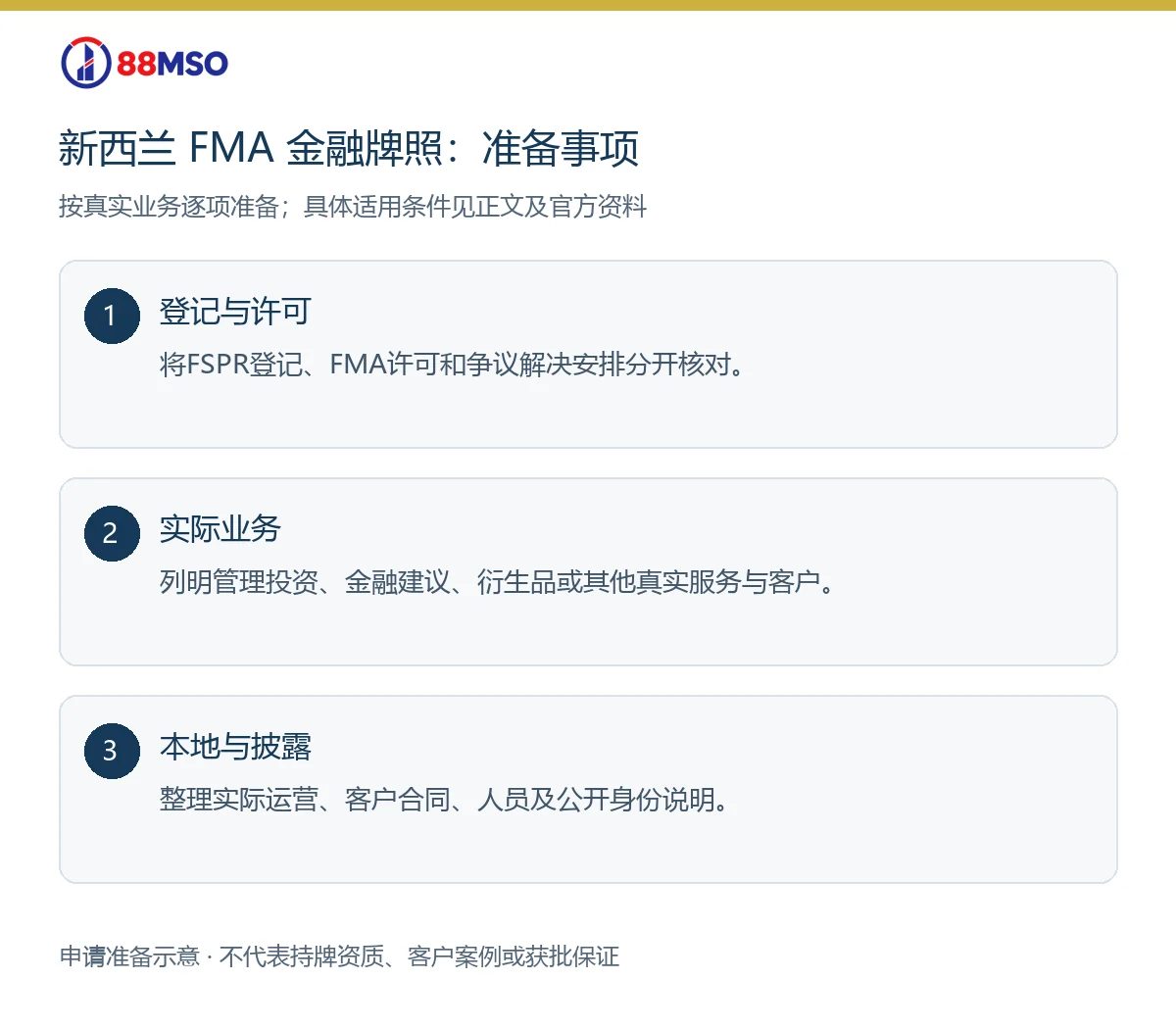
New Zealand FSP registration and FMA license are not the same concept. Financial Service Providers Register records service providers and links dispute resolution, But the issuance of derivatives, managed investment plan, Activities such as financial advice may require specific permission from the FMA. The project should first confirm the service, Client and New Zealand business contacts, Re-judge FSP registration, Dispute Resolution Scheme and FMA Licensing. Only obtaining an FSP number cannot declare "FMA license" to the outside world., Overseas companies cannot use registration to enhance their credibility without having real New Zealand business..
Official source: New Zealand FMA official licensing and regulatory guidance
Application information should include New Zealand entities or business contacts, Directors and Officers, business plan, financial resources, client funds, governance, AML/CFT, Complaints and Dispute Resolution, Outsourcing and systems. Specific FMA licenses have additional capabilities, Capital and operating requirements.
Registrants must keep their FSPR information and dispute resolution membership valid; Licensees must also comply with license conditions, audit, Report, Customer Assets and Significant Change Requests. May be deregistered if not providing services in New Zealand.
The applicable route in 2026 must be determined from the actual business activity: FSPR registration, a specific FMA licence, or both where applicable. An FSPR number is not an FMA market-services licence covering every financial service.
From 1 July 2026, the Department of Internal Affairs (DIA) became the sole AML/CFT supervisor for all reporting entities in New Zealand, while the FMA continues to supervise the market services it licenses.
DIA current single-supervisor AML/CFT guidance · FMA licensing requirements by service class
Official sources to check: Standard conditions for a derivatives issuer · FMA levies and waivers guidance
Policies should be based on the firm’s customers, Country or region, product, channels and transaction characteristics to form the business risk assessment, and implemented through customer due diligence, beneficial-owner identification, ongoing monitoring, sanctions and politically exposed person screening, escalation and reporting of suspicious transactions, record keeping, staff training and independent testing. A generic template, without justified thresholds or operational records, is usually insufficient to show that the framework operates.
Capital conditions differ between FMA licence classes
Derivatives issuers must maintain net tangible assets at all times
This formula applies under the standard conditions for derivatives issuers, not to every FMA licence
DIMS providers and managers of registered managed investment schemes must check their own licence conditions
FMA regulatory capital is distinct from application fees, bonds, insurance, client-asset safeguards and the operating budget
FSPR registration is not an FMA licence or regulatory endorsement
The answer depends on local law, Apply for derivatives issuers by activity, Eligibility to apply for licenses such as managed investment schemes, the proposed activities and outsourcing model. Even where the rules do not prescribe one universal job title or office size, New Zealand's Financial Markets Authority (FMA) may still focus on decisions, Record, client service, risk management and regulatory communications have sufficient local substance; Before leasing premises or hiring personnel, check the requirements for the particular case.
Review time depends on application completeness, business complexity, key-person suitability, Regulatory inquiries, interviews, demonstrations and third-party evidence, No fixed approval date should be promised. The project plan should separate preparation, submission, Supplementary parts, technical remediation and post-authorisation launch, and retain sufficient contingency; Only the competent authority decides whether to accept and authorise the application.
Generally not. The applicant should complete provider due diligence, explain data flows, service levels, Audit right, subcontracting, information security, business continuity and exit arrangements, and retain oversight of rules, thresholds, alerts and major incidents. Whether outsourcing is permitted and what notification or approval is needed, Should be checked against current regulations of the New Zealand Financial Markets Authority (FMA).
A filed application, under review or completed company registration should not be described as approval. Before formally conducting regulated activities,, actively soliciting clients,, accepting client funds or publishing potentially misleading licence statements,, confirm that authorisation is effective, the business does not exceed the authorised scope, and check the cross-border marketing rules in the locations of the target clients..
Common obligations include renewals or annual fees, Regulatory filing, financial or compliance audits, training, record keeping, complaint handling, client-asset and capital monitoring, and notification or approval for changes in ownership, director, key personnel, address, Business scope, systems and major incidents. Maintain a compliance calendar and change-approval process, and get regular rule updates from the New Zealand Financial Markets Authority (FMA).
should beFMA licensing requirements by service classpublished there, application forms, guidance, fee schedules and notices as the current reference. 88MSO helps organise questions and materials, but does not represent a regulator, and cannot replace advice from local counsel, a tax adviser or the regulator on a particular case.
Application and operation control can be combinedContinuous compliance and risk control service scopecomb; FSP registration and specific FMA license still need to be judged separately.. Licensed, registration or membership maintenance can be assessed withLicense renewal, filing and maintenance service scopetidy.
FMA charges by the specific market-services licence class, There is no single fixed-price licence covering every FMA market service.
The current basic application fees include GST. If assessment exceeds the hours included for the relevant class, additional time may be charged at the FMA’s current rate; an application to vary licence conditions isNZ$115plus assessment-time charges.
FSPR registration and annual confirmation fees are separate, the applicable FMA levies must also be calculated for the actual class at annual confirmation. FMA licence application fees do not include annual fees, FSPR fees, capital, professional services or operating costs.
Current FSPR fees and levies schedule · FMA levies and waivers guidance · Derivatives issuer · DIMS · Manager of a registered managed investment scheme · Financial advice provider
The applicant should be confirmed first, statutory registered office, actual management location, and distinguish these from customer reception and recordkeeping locations, then budget for registration fees, agent or secretary, rent, deposit, furnish, communications, Insurance, visas and local staff. Leasing before defining the regulatory boundary, may create unrecoverable costs.
no. Registration is different from specific financial services license, Legal entity should be checked, Activities, Licenses and Applicable Dispute Resolution Arrangements.
Specify the exact registration or license category according to the public list, Approved business and conditions, Avoid using organization names, Numbers or logos imply government approval of business results.
Generally required to join an approved Dispute Resolution Scheme (DRS), and update FSPR membership information within 10 working days after registering or becoming an advisor employed by a financial advice provider. Exceptions apply and whether covered by the person or the plan to which the FAP belongs, Should be checked by service status; DRS members are not licensed by the FMA. SeeNew Zealand FSPR Retail Services Dispute Resolution Scheme Requirements.
no. Financial service providers maintain registration, FSP information and service scope must be confirmed every year; Company registration and declaration are another set of records. Both types of deadlines should be tracked separately, Corporate record updates cannot be considered completion of the FSPR annual confirmation. SeeAnnual confirmation guidance for New Zealand financial services providers.
Government registration guidelines set out, FMA license scope includes derivatives issuance, DIMS, Registration plan management, Financial advice providers and certain intermediary services, etc.; bank, Insurance and non-bank deposit-taking business involve corresponding systems of the Reserve Bank. The competent authority should be determined by activity, You cannot use a general "FMA license" to summarize everything. SeeNew Zealand Government Financial Services Registration and Independent License Category Description.