简体中文
简体中文 繁體中文
繁體中文 English
U.K.FCA AR (Authorized Representative) mode practical sharing:How can a foreign exchange start-up platform start with low cost and compliance?
For many foreign exchange start-up teams,The real difficulty is never just “making a trading system”,RatherHow to cross the regulatory threshold、financial pressure、time windowFind a balance between the three。Especially if the team wants to reach European or international customers,UK Financial Conduct Authority (FCA)System is often a topic that cannot be avoided。
At this time,FCA AR(Appointed Representative,Authorized representative) model,Often seen as “getting on the bus first”、The realistic path to further upgrade:You don’t need to bear the full costs and responsibilities of a fully licensed institution from the outset,Instead, it is through affiliation with a Principal (main licensing agency) authorized by the FCA.,Carry out specific financial activities within its regulatory framework。
But AR is not a “regulatory shortcut”,It’s not even “zero compliance cost”。It is essentially aCompliance outsourcing + capability co-buildingmode。This article will take a practical perspective,Dismantling how a foreign exchange start-up platform started using AR mode at low cost、Avoid detours,And complete the upgrade from AR to independent license at the right time。
one、First clarify:What exactly is FCA AR mode?
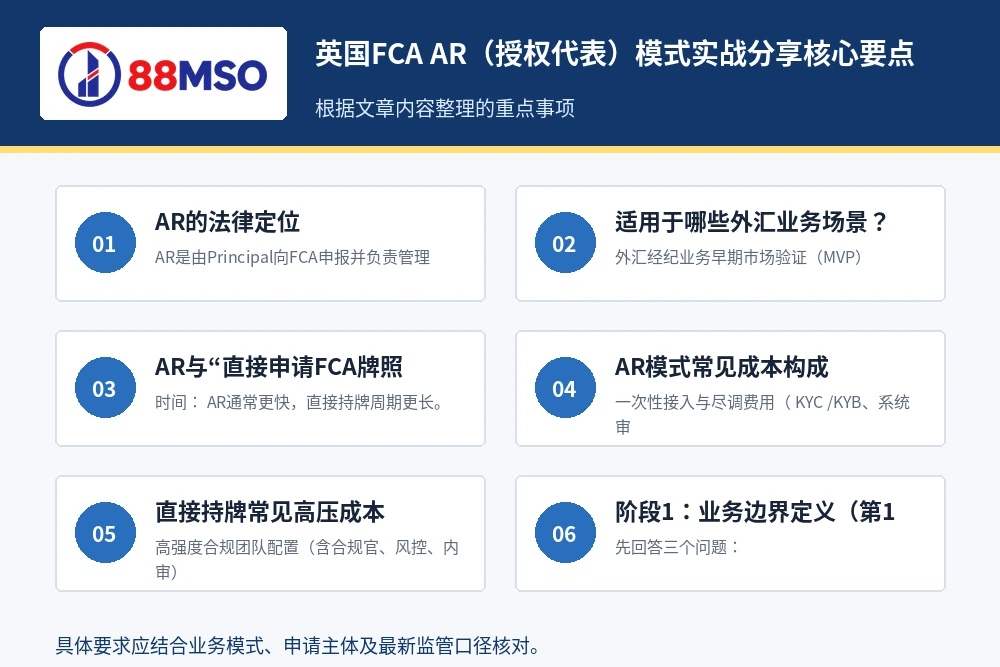
1. The legal positioning of AR
AR is a "regulated representative" declared and managed by the Principal to the FCA。AR itself usually does not directly hold a full FCA license,Instead, conduct business within the scope of the Principal’s license。It looks like you are doing compliance business to the outside world,But internally you must accept continuous supervision from the Principal。
2. What foreign exchange business scenarios is it applicable to?
- Early Market Validation (MVP) for Forex Brokerage
- customer development、marketing、Introducing Broker (IB) Extension
- trading signals、Compliance of investment research services and customer diversion
- Prepare for "transitional operations" before applying for a self-owned license
3. The core difference between AR and “direct application for FCA license”
- time:AR is usually faster,Direct licensing period is longer。
- cost:AR has lighter upfront investment,But there are ongoing service fees and sharing。
- control:AR is bound by Principal,The degree of business freedom is lower than that of a self-held license。
- brand independence:Self-held licenses have more advantages in market trust and capital cooperation。
two、Why FX startup teams prefer AR:Not cheap,But "cash flow friendly"
Many entrepreneurs only see “AR is cheap”,but ignores that the real value isA healthier cash flow structure。For startup platforms,The biggest risk is not "making money slowly",But "live without making a profit"。
Common cost components of AR mode
- One-time access and due diligence fees (KYC/KYB、Systematic review、contract)
- Monthly/Quarterly Compliance Management Fee
- Transaction volume or revenue share (depending on Principal policy)
- audit、law、Technical docking and other special expenses
Common high-pressure costs for direct licensing
- High-intensity compliance team configuration (including compliance officer、Risk control、internal audit)
- Capital and ongoing regulatory reporting costs
- Systematic policy documents、audit、Long-term investment from external consultants
- Opportunity costs caused by the approval cycle (market windows may be missed)
therefore,The AR model is not the “lowest total cost”,Rather"Fixed costs are the most controllable" in the early stages,More suitable for customer acquisition models that are still being verified、Product Matching and Capital Efficiency Team。
three、0Roadmap to implementation in 90 days:Practical steps for implementing AR on the foreign exchange platform
Stage 1:Business Boundary Definition (Weeks 1-2)
Answer three questions first:
- What exactly do you do to "match up"?、implement、market making、Asset management、Which paragraph in "Counsellor"?
- Which countries do the customers come from? Are high-risk jurisdictions involved?
- How to design the funding path? Will it trigger customer fund supervision requirements?
This step determines which type of Principal you are looking for,and the scope of business that can be carried out in subsequent contracts。
Stage 2:Screening Principal (Weeks 2-4)
When filtering Principal, don’t just look for “quick listing” or “low price”,Should focus on:
- Past AR management record and FCA compliance history
- Do you have relevant regulatory experience in foreign exchange/CFDs?
- AML、monitor、Complaint handling、Is the marketing approval process mature?
- Is the exit mechanism clear (migration、self-hosted cards、contract termination)
Stage 3:Due Diligence and Contract Negotiation (Weeks 4-8)
This is the stage where it’s easiest to step into a trap.。The contract must at least be clear:
- Business Permit Scope and Prohibited Matters
- Customer ownership and data usage rights
- Marketing Material Approval Timeline and Responsibility Boundaries
- Fee structure (flat fee、Variation fee、hidden fees)
- Violation handling and emergency suspension provisions
Stage 4:System and Compliance Go Online (Weeks 8-12)
The core is "system first",File synchronization":
- The account opening process embeds KYC due diligence and risk stratification
- Transaction monitoring and suspicious behavior warnings (including abnormal deposits)、Abnormal transactions)
- Customer communication、marketing copy、Risk disclosure unified template
- Complaint and dispute handling mechanism (SLA time limit is clear)
Four、Four high-risk minefields in AR mode (the most common for foreign exchange startups)
Minefield 1:Treat AR as "license rental"
AR is not license rental。Principal has the obligation to supervise AR,If your business gets out of control,Principal will directly tighten or suspend authorization。The result is often that the business is forced to shut down。
Minefield 2:Marketing first、Compliance lags
Many teams invest first to gain customers,Additional disclosure documents。reality is:Under the FCA system,Financial Promotions have high compliance requirements,exaggerate earnings、weaken risk、Misleading statements can have regulatory consequences。
Minefield 3:KYC "Only collect information,No judgment”
Effective KYC is more than just uploading an ID card,RatherIdentity verification + fund source assessment + transaction behavior consistency。If a customer’s risk rating deviates from actual behavior,No review was triggered,The follow-up risk is extremely high。
Minefield 4:Ignore cross-border restrictions
Foreign exchange business is naturally cross-border,But it doesn’t mean “it can be done globally”。Different countries have different opinions on CFD、lever、Retail customer marketing restrictions vary widely,If the cross-border strategy gets out of control during the AR stage,Will quickly amplify compliance risks。
five、Practical case (anonymous):How a foreign exchange startup used AR to run its model in 6 months
background:Team of 10 people,technology driven,Limited budget,Hope to test foreign exchange + gold CFD trading services for the English market。
their key moves
- Segment your customer base first:Only focus on retail customers in non-high-risk areas
- Cooperate with a Principal with experience in foreign exchange supervision,rather than the lowest bidder
- Open an account、payment、trade、The entire withdrawal process is made into an "auditable link"
- Conduct compliance review once a month:Complaint rate、rejection rate、suspicious transaction ratio
6 month results
- Customer acquisition costs steadily decrease,Conversion rate increased
- No major compliance incidents occurred,Improved marketing approval efficiency
- Form replicable SOP,Prepare materials for subsequent independent license applications
Such case descriptions:The value of the AR model is not in “saving money itself”,But lies inBuild sustainable compliance operation capabilities at limited costs。
six、From AR to independent license plate:When should I upgrade?
When the following signals appear,It is recommended to evaluate "AR removal":
- Monthly transaction volume grows steadily,Sharing costs are significantly higher than self-construction compliance costs
- You need more business freedom (product、lever、market strategy)
- Cooperation with institutional clients requires you to have your own regulatory qualifications
- During the financing or merger and acquisition process,Investors prefer self-owned license structures
in practice,Many mature teams will adopt a "dual-track strategy":While continuing to operate in the AR framework,While preparing application materials for your own license,Minimize business shock during handover。
seven、Inspiration for Chinese-speaking teams:British AR is just the starting point,The global license plate layout needs to be designed in advance
After more and more teams started in the UK,Will expand business to Hong Kong、middle East、Southeast Asia and other markets。at this time,Is the early compliance architecture transferable?,Determines your future expansion efficiency。
Take Hong Kong as an example,Whether it is MSO、SFC related licenses、Insurance broker or money lender license,Different business lines correspond to different regulatory logics。If the company has established a complete AML during the UK AR stage、KYC、Internal control and audit trace mechanisms,Subsequent entry into other jurisdictions will be much smoother。
This is why more and more cross-border financial teams choose to cooperate with consultants with multi-license practical experience in the long term - not only to solve the "current implementation",We must also serve the “next stage of expansion”。in this regard,Like 88MSO and the professional team behind it,Long-term experience in financial compliance practices in Hong Kong and overseas,Able to provide enterprises with continuous solutions from start-up to upgrade,Reduce institutional friction in cross-jurisdictional operations。
eight、Conclusion:Low cost to start,Does not equal low standard compliance
The essence of FCA AR mode,It is to give foreign exchange start-up platforms a more pragmatic "compliance starting point"。It is suitable for limited budget、Teams that need to quickly validate the market,But the premise is:You must treat compliance as part of your product capabilities,Rather than a patch after it goes online。
If you are in the decision-making period of "should you go to AR first?",It is recommended to do three things first:Clarify business boundaries、Choose the right Principal、Set up AML/KYC and monitoring system。This way you can not only start at a low cost,It can also lay a solid foundation for future independent licensing and global layout.。
FAQ:5 issues that foreign exchange startups are most concerned about
Q1:Does AR equal full legal coverage of all foreign exchange businesses?
no。AR can only operate within the scope authorized by the Principal.,Business beyond the scope may still constitute a violation。
Q2:In AR mode,Who is responsible for customer complaints?
Usually AR handles it first,However, the Principal has the responsibility for supervision,The details are subject to the contract and regulatory arrangements.。
Q3:Is AR necessarily cheaper than holding a license directly?
Early fixed costs are usually lower,But in the long run, it depends on the transaction size and sharing structure.,It may not always be cheaper。
Q4:Can AR be done without a mature compliance team?
Can start,But there must be at least a basic compliance person,And receive continuous training and review by Principal。
Q5:Is it difficult to switch to an independent license after AR?
If the previous compliance records are complete、System traces are clear,The difficulty of upgrading will be significantly reduced,Otherwise, the censorship pressure will be amplified。