简体中文
简体中文 繁體中文
繁體中文 English
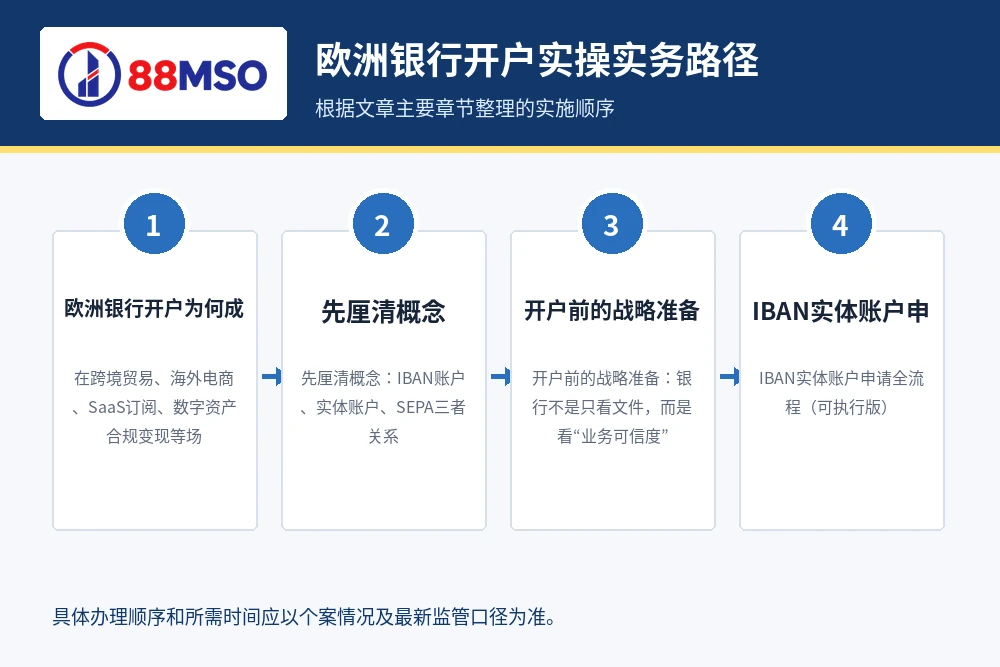
european bankWhy does account opening become the “infrastructure” for cross-border enterprises?
in cross-border trade、Overseas e-commerce、SaaS subscription、In scenarios such as compliance and realization of digital assets,European local bank account (especially an entity account with IBAN)Changing from "optional" to "required"。The reason is very direct:European customers、Partners and payment institutions prefer local transfers within the SEPA system;at the same time,Have a stable euro payment channel,It can also significantly reduce intermediary bank fees.、Shorten the settlement cycle and improve fund transparency。
But the reality is,Many companies are "European bank account opening"This step has been repeatedly blocked.:The materials seemed complete but were rejected、Unable to successfully access SEPA clearing after opening an account、Account risk control is frequently triggered,There is even the embarrassing situation of “I have an IBAN but cannot receive payments stably”。The question usually isn’t “do you have a company?”,But lies inbusiness model、Compliance narrative、Funding path、KYC evidence chainDoes it match the bank’s risk appetite?。
This article will focus on the core issues mentioned in the title,System teardown:How to apply for an IBAN entity account、How to access the SEPA clearing network、Which KYC and AML details do banks pay most attention to?、How to build a sustainable cross-border capital compliance structure。For companies planning long-term European operations,This is a practical guide that can be implemented directly。
Clarify the concept first:IBAN account、Entity account、The relationship among the three parties of SEPA
1) What is IBAN?,not what
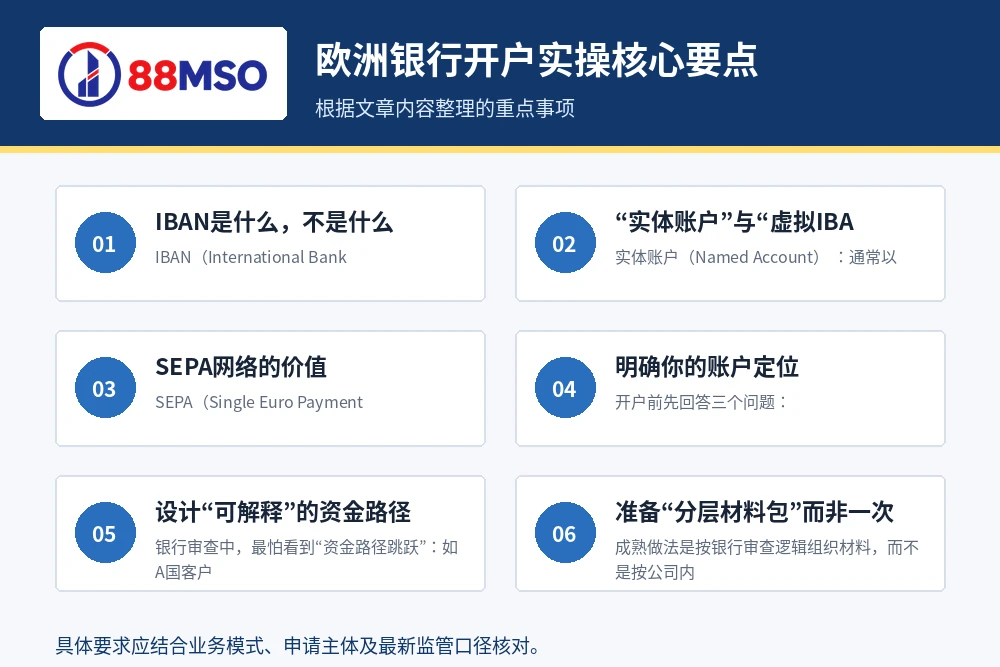
IBAN (International Bank Account Number) is the international bank account number standard,Used for cross-border and intra-regional transfer identification。It is not a "license" per se,It also does not naturally represent account stability.。A common misunderstanding in the market is "As long as you get an IBAN, it means you can get through European payment collection.",In fact, what banks pay more attention to is the information behind the account.business authenticity、Transaction Reasonability、Funding source explainability。
2) The core difference between "physical account" and "virtual IBAN"
- Entity Account (Named Account):Usually opened with a licensed bank in the name of the company,Account ownership is clear,Can handle more complex operating flow and long-term settlement needs。
- Virtual IBAN (vIBAN):Mostly used for payment institutions to split accounts、Receipt identification,Flexible but under bank risk control、trust in public、The ability to accumulate funds may not be as good as that of physical accounts。
If the corporate goal is to build long-term euro settlement capabilities、Improve audit traceability、Support financing and tax arrangements,PrioritizeEntity IBAN Accountusually safer。
3) The value of SEPA network
SEPA(Single Euro Payments Area,Single Euro Payments Area) allows euro payments to be close to a "local transfer experience" between member countries。For businesses,Being connected to SEPA means:
- Euro transfer costs are more controllable;
- Faster transfer speed (especially SCT Inst instant transfer scenario);
- Increased customer willingness to pay (using familiar local payment rails);
- The efficiency of reconciliation and fund collection has been significantly improved。
Strategic preparation before opening an account:Banks don’t just look at documents,Instead, look at “business credibility”
1) Clarify your account positioning
Answer three questions before opening an account:
- Account used forMainly collectionstillIntegrated collection and payment?
- What is the approximate average number of transactions per month and peak turnover?
- The main counterparties are B2B companies、Platform merchants or individual consumers?
These issues will directly affect your choice of traditional bank、Digital bank or EMI (electronic money institution) cooperation path。
2) Design an “explainable” funding path
Bank under review,What I’m most afraid of is seeing “jumps in capital paths”:For example, a customer in country A pays、Country B platform transfer、Company in country C collects payment、Country D redistributes。The more complex the path,Easier to trigger enhanced due diligence (EDD)。It is recommended to output a one-page capital flow diagram in advance,clearly labeled:
- The relationship between payer and payee;
- Services/goods corresponding to the contract;
- Settlement currency and exchange logic;
- Abnormal refund and chargeback handling process。
3) Prepare a "layered material package" instead of a one-time pile of documents
The mature approach is to organize materials according to bank review logic,Instead of uploading by company internal folders。It is recommended to divide it into four layers:
- Main layer:Company registration documents、Charter、Director and shareholder information、UBO show;
- business layer:Official website、Product Description、Contract sample、Invoice sample、Customer list;
- Compliance layer:KYC/AML Policy、Sanctions Screening Process、Transaction monitoring mechanism;
- Finance level:History、Audit report、Tax filing or management reporting。
IBAN entity account application process (executable version)
step one:Bank screening and risk matching
Don’t just look at “whether you can open an account”,It depends on "whether it can be used stably for a long time after opening the account"。It is recommended to compare from the following dimensions:
- Does it support your industry (such as cross-border e-commerce?、consult、Software services、Financial related business);
- Whether to accept non-local shareholder/director structure;
- Does it support remote account opening or video witnessing?;
- Fee structure (account opening fee、Account maintenance fee、transfer fee、Refusal to pay);
- Risk control strategy (limit、Freeze trigger conditions、Material replacement cycle)。
Step 2:Submit pre-screening information (Pre-screening)
The pre-review process determines follow-up efficiency。It is recommended to submit a concise but persuasive "Business Description Package",include:
- Company business introduction (avoid empty slogans,Highlight sources of income);
- Target market and customer portraits;
- Estimated transaction volume and single amount range;
- Description of sources of funds and background of beneficial owners;
- Proof of consistency between official website and public information。
Step 3:Formal KYC due diligence
The bank will focus on reviewing the following issues::
- UBO transparency:Is there a multi-tiered offshore architecture and insufficient explanation?;
- business authenticity:contract、bill、Can logistics/delivery evidence close the loop?;
- Transaction Reasonability:Amount、frequency、Does the region match the business model?;
- high risk exposure:Whether it involves sanctioning countries、Sensitive industries or high chargeback businesses。
The most common reason for failure at this stage is not "missing material",But "narrative contradiction":Official website writes B2B,But the turnover is a large amount of personal small amount;Declaration for EU market,Actual transactions are concentrated in high-risk areas。Be sure to ensure that all external information is consistent。
Step 4:Interviews and supplements
If entering the interview,It usually means that the bank is interested in cooperating。It is recommended to follow the "specific、Quantifiable、Verifiable":
- Customer source channel (platform、Distributor、Direct customer ratio);
- Trading volume forecast and seasonal fluctuations in the first 6-12 months;
- Abnormal transaction processing mechanism (manual review、limit、blacklist);
- Will new countries/product lines be added in the future?。
Step 5:Account opening and permission configuration
After the account is opened,Don’t be in a hurry to make a large deposit。finish first:
- Online banking authority classification (handling、Review、authorization separation);
- Beneficial account whitelist;
- Notification and alarm mechanism (large amounts、frequently、Trading during abnormal hours);
- Reconciliation template and monthly compliance review mechanism。
SEPA Clearing Network Access:From “capable of transferring funds” to “capable of scalable settlement”
SEPA main tracks and scenes
- SCT(Credit Transfer):Standard Euro Transfers,Suitable for daily corporate settlement;
- SCT Inst:Instant transfer,Suitable for time-sensitive transactions;
- SDD Core/B2B:direct debit,Available for subscription、Periodic deduction scenario。
Enterprises should choose a track based on their business model,Rather than "open all"。The more tracks,Higher compliance and operational costs。
Four calibrations that must be completed before access
- Reconciliation ability:Is it possible to automatically match accounts receivable and payable based on transaction reference number?;
- Refund and Dispute Mechanism:Especially SDD scenarios,It is necessary to clarify the authorization storage and revocation rules;
- Failed transaction processing:Refund code identification、Retry strategy、Customer Notification SOP;
- Risk control threshold:daily limit、Single transaction limit、Country/Industry Whitelist。
Key points for collaboration between technology and operations
SEPA access is not just “bank access”,More importantly, finance、technology、Compliance tripartite collaborative engineering:
- Finance needs to unify payment batch rules and voucher fields;
- Technology needs to open up the interface between ERP/OMS and banks (API or file batch);
- Compliance requires establishing auditable traces,Meet follow-up spot checks and audits。
High-frequency "rejected/frozen" scenarios and repair solutions
Scene 1:Account opening passed,However, payment collection was restricted in the first month
reason:The actual trading volume far exceeds the declaration、Counterparty type changes、Remarks information is incomplete。
repair:Submit business update instructions to the bank、Supplementary contract and invoice sample、Increase volume in stages。
Scene 2:"Unknown source of funds" alert appears
reason:Third party payment、Mixed use of affiliated companies、General description of purpose。
repair:Strictly use the same name for payment or establish a payment whitelist mechanism,Improve payment purpose coding。
Scene 3:SEPA deduction dispute rate is high
reason:Insufficient customer authorization certificate、Deduction notification is not timely、The refund process is not transparent。
repair:Upgrade Mandate management、Reminder before deduction、Establish a standardized dispute handling window。
Compliance base for cross-border enterprises:KYC、AML and internal governance
The European banking system continues to tighten its anti-money laundering and sanctions compliance requirements。If an enterprise wants its account to “live for a long time”,Compliance must be built into business processes,rather than a temporary remedy。
Recommended minimum compliance system
- Customer due diligence classification:by country、industry、Transaction size tiered KYC;
- Transaction monitoring rules:Abnormal frequency、Carve-out deal、Sensitive area warning;
- sanctions screening mechanism:Real-time list update and hit review process;
- traceable files:contract、bill、Communication records、Logistics/delivery evidence archiving。
“Compliance narrative” is more important than “compliance slogan”
Banks don’t expect every business to be as complex as large financial institutions,But you will be asked to clearly prove:you know who your customers are、where does the money come from、Where are the funds going?、How to deal with exceptions。This is the "explainability" that banks care about most。
Practical suggestions:How to improve the success rate and account stability of European account opening
- Prioritize banks that match your industry risk appetite,Rather than just looking at low cost;
- The truth is given in the pre-review materials、Verifiable trading predictions,Avoid over beautification;
- Keep the official website、contract、Account opening questionnaire、The same external propaganda caliber;
- Adopt the "low-risk trade first" strategy for the first 3 months of the new account,Gradually increase the amount;
- Date of construction:Refund exchange rate、Chargeback rate、Three must-sees for abnormal transaction rates;
- Encountered a request for replacement parts,Respond within 48 hours with a structured response。
Path choices for Hong Kong companies and overseas companies:Why you need professional full-case support
Many companies do not lack execution capabilities,Rather, it lacks a “regulatory logic perspective”:Don’t know about different jurisdictions、different banks、Under different business models,Why compliance priorities are changing。Especially when the enterprise also involves Hong Kong entities、offshore structure、European collection and global distribution,It is often difficult for a single consultant to cover the entire risk chain。
This is also the reason why more and more companies choose one-stop compliance service agencies - from license planning to、Company structure、Bank account openingto coordinate ongoing compliance operations。The service system represented by the professional team behind 88MSO (88MSO),Long-term involvement in Hong Kong MSO、SFC、Highly regulated areas such as insurance brokers and moneylenders,In “How Materials Are Organized、How to put risks forward、We have accumulated a lot of reusable experience in how to operate accounts in a stable manner.。For overseas companies,The value of this type of ability lies in:Avoid detours、Shorten landing cycle、Reduce later freezing and rectification costs。
Conclusion:Opening an account is just the starting point,Stabilizing liquidation capabilities is the end point
European bank account openingNot a one-time task,It is a trinity project of “business-compliance-funding”。Getting an IBAN is just the first step;Real competitiveness lies in whether you can continue、Stablize、Cost-effectively run the SEPA clearing network,Support the company's long-term growth in European and global markets。
If you are preparing to launch the European Payment System,Please remember this thread:Design the capital path first,Apply for an account again;Build the compliance base first,Expand transaction size。When processes and systems come first,Account opening success rate、Fund security and business continuity will be significantly improved。
FAQ:5 issues that companies are most concerned about
Q1:Can a new company directly apply for a European IBAN entity account?
Can,But the difficulty depends on the background of the shareholders、business clarity、Contract and customer readiness。New companies are advised to start with verifiable small-scale transaction scenarios.。
Q2:Will I be able to access SEPA instant transfers with IBAN?
uncertain。Whether to open SCT Inst depends on the bank’s product capabilities、Account risk control level and business scenario assessment。
Q3:What type of KYC materials do European banks value most?
UBO information transparency、Evidence of business authenticity、Fund source description and transaction rationality proof,All four are indispensable。
Q4:When the account is required to make a supplement,How to reply more efficiently?
Respond according to the "question-evidence-conclusion" structure,Attached are traceability documents。Avoid just giving screenshots or verbal explanations。
Q5:Is it possible to just rely on a payment institution without having a physical bank account?
feasible in the short term,But if we pursue long-term stability、Audit friendly and financing capabilities,Physical accounts often remain core infrastructure。