简体中文
简体中文 繁體中文
繁體中文 English
Official verification (August 2026):MAS's current "Payment Service Provider Licensing Guidelines" PS-G01 will take effect from October 8, 2025,for SPI、Application for MPI and Money Changer License。When choosing SPI or MPI, don’t just compare the common quota tables in the market.,The payment services to be provided must first be、Client Funding Arrangement、Business scale and governance structure are mapped to the Payment Services Act and current application guidelines。See detailsMAS Payment Service Provider Licensing Guidelines (PS-G01)。
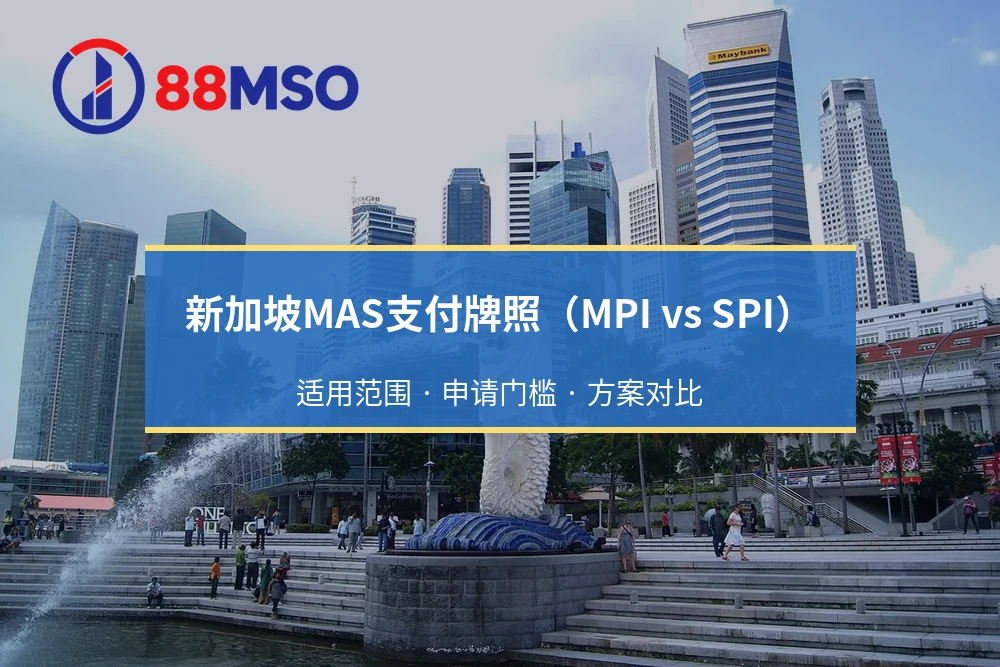
SingaporeBUTPayment license (MPI vs SPI):Why isn’t this “selecting a license plate”?,But "choose the growth path"
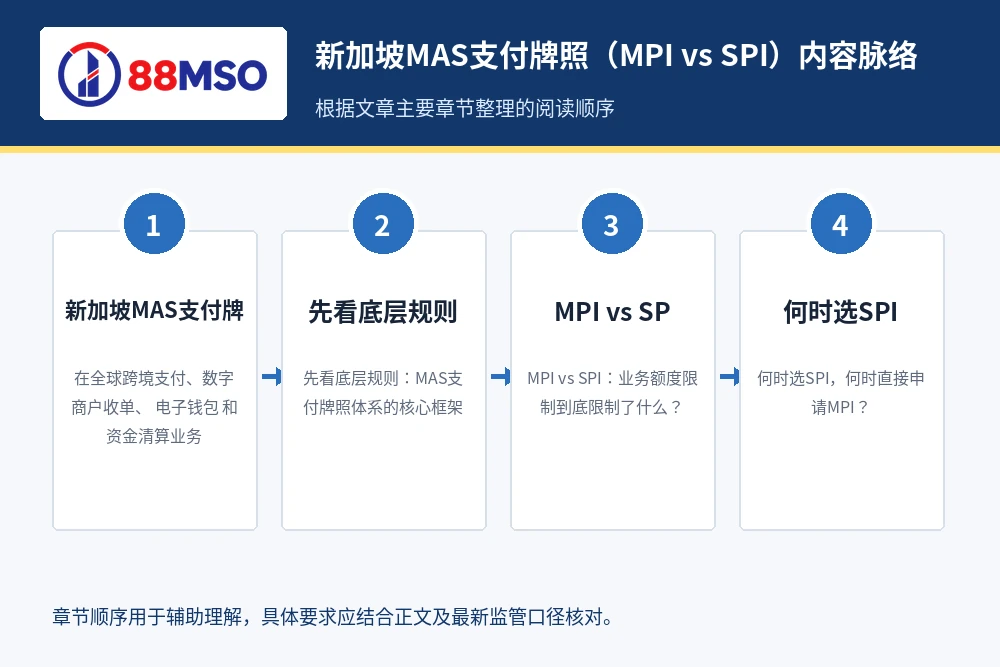
Pay across borders around the world、Digital merchant acquiring、Against the backdrop of continued expansion of e-wallet and fund clearing businesses,Singapore relies on stable regulation、Open financial ecology and international legal environment,Become a priority location for a large number of financial technology companies’ “regional headquarters + license center”。For institutions preparing to enter the Singapore payments market,The core question is often not “should I apply for a license?”,RatherShould I get SPI first or go directly to MPI?,And when the business is approaching the upper limit,How to upgrade smoothly、Avoid triggering regulatory risks。
Many teams only look at application speed and upfront costs during the business planning stage.,Ignore subsequent quota limits、Anti-money laundering (AML/CFT) system strength、Audit and governance structure requirements,As a result, the embarrassing situation of "getting the license but not being able to run the business" emerged.。This article will focus on Singapore’s Payment Services Act, Two types of core payment institution licenses under PSA -Standard Payment Institution(SPI)andMajor Payment Institution(MPI),System disassembly business quota limit、Upgrade logic、Regulatory concerns and practical response strategies。
For financial companies with both Hong Kong and Singapore presence,Like 88MSO, which has been deeply involved in financial compliance for a long time、Professional team for license structure design and cross-border business operations,It is usually recommended that companies incorporate license selection into the unified planning of the "regional compliance map",Rather than making decisions in isolation,In order to maintain consistency and scalability when subsequent capital overseas and multi-jurisdiction linkage。
one、Let’s look at the underlying rules first:The core framework of the MAS payment license system
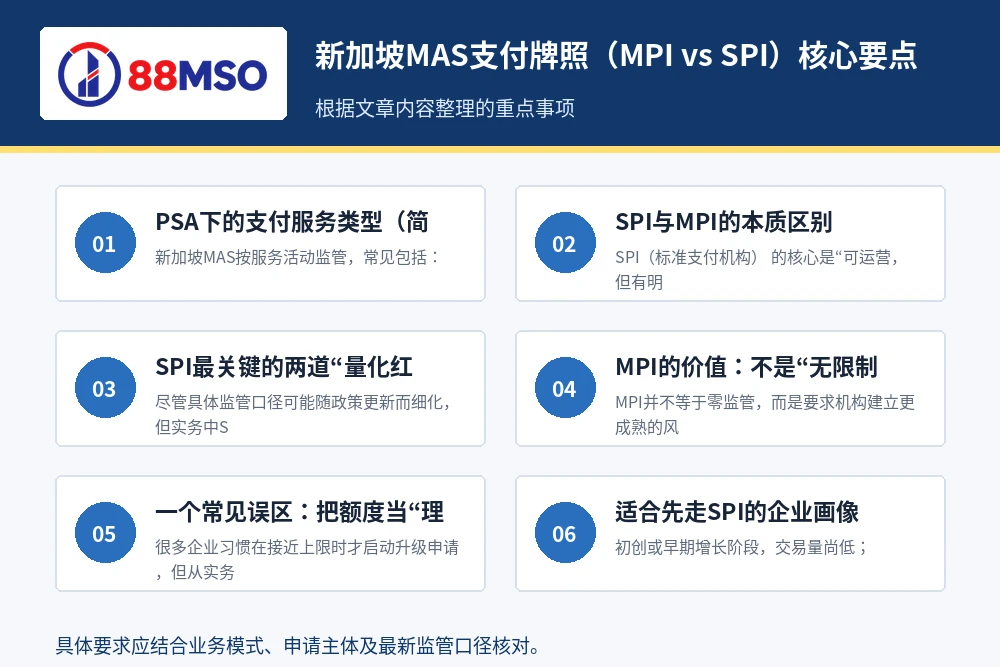
1. Payment service types under PSA (simplified understanding)
Singapore MAS regulates by service activities,Common include:
- Account issuance service(such as e-wallet account)
- Domestic transfer services
- Cross-border remittance services
- Merchant Acquiring Services
- Electronic money issuance service (e-money)
- Digital Payment Token Service (DPT,Involving encryption related)
Enterprises should first clarify which service activities their business involves,Then match the license plate type and restrictions。The most common comparison here is SPI and MPI。
2. The essential difference between SPI and MPI
SPI (Standard Payment Institution)The core is "operable,But there is a clear upper limit on business scale.”;MPI (Major Payment Institution)after meeting higher compliance standards,Gain greater business capacity and greater freedom for market expansion。in other words,SPI is more like a "restricted growth version",MPI is closer to the "scale operation version"。
two、MPI vs SPI:What exactly is the business quota limit?
1. The two most critical "quantitative red lines" of SPI
Although the specific regulatory scope may be refined with policy updates,,However, in practice, SPI is usually constrained by the following dimensions:
- Maximum monthly transaction volume for a single payment service(For example, the monthly transaction volume of a certain type of service must not exceed the regulatory threshold)
- Overall payment service monthly transaction volume limit(Multi-service combined calculations also have total control)
this means:Even if your single line of business has not yet exceeded its limits,As long as the overall transaction size increases too fast,It may also approach the total red line。Once out of line but not upgraded in time,May face regulatory challenges、Rectification and even enforcement risks。
2. The value of MPI:Not "unlimited",But "scalable"
MPI does not equal zero regulation,Instead, it requires institutions to establish more mature risk control、Customer fund protection、Compliance reporting and governance mechanisms,In exchange for higher business carrying capacity。For the goal is regional clearing、Cross-border payment network expansion、Enterprises with platform-based capital flow management,MPI is usually the only path to take in the medium to long term。
3. A common misunderstanding:Treat the amount as a “theoretical upper limit”,Improper “early warning indicators”
Many companies are accustomed to starting upgrade applications when they are close to the upper limit.,But from a practical point of view,License plate upgrade involves material preparation、Governance reinforcement、System transformation、Regulatory Q&A,The cycle is not short。A more prudent approach would be:
- set up70%-80% quota warning line;
- Reserve at least6-12 monthsUpgrade preparation window;
- Establish monthly compliance dashboard for management,Linkage monitoring of transaction growth and license status。
three、When to choose SPI,When should I apply directly for MPI?
1. Corporate portraits suitable for SPI first
- Start-up or early growth stage,Trading volume is still low;
- Mainly based on single scenario verification (such as vertical industry acquisition);
- Want to get to market quickly with low upfront complexity;
- The management team is willing to simultaneously build subsequent upgrade capabilities。
2. More suitable for direct MPI corporate portrait
- Already have mature overseas business and stable transaction flow;
- Plan to quickly increase volume or coordinate liquidation in multiple countries in the short term;
- Products include high-frequency cross-border or platform-based fund collection;
- Can invest in more complete compliance、audit、Technology and Governance Resources。
3. decision model:Three-dimensional assessment method
It is recommended to quantify decisions from the following three dimensions:
- Business growth rate:Forecast of transaction size in the next 12-18 months;
- product complexity:Number of service types、Cross-border links、proxy network;
- Compliance carrying capacity:AML/KYC capabilities、internal control、Management team experience。
When "high growth rate + many scenarios + sufficient compliance resources",Direct MPI usually saves overall cost and time。
Four、Upgrading MPI from SPI:Practical paths for standard organizations to upgrade large organizations
1. Upgrading is not "filling in the form",But "reconstruction ability"
Regulators are not just concerned about you “wanting to upgrade”,It’s about whether you have “sustainable、Safety、Auditable” large-scale operation capabilities。Common upgrade workflows include:
- Gap Analysis
- Governance structure upgrade (board supervision、three lines of defense)
- AML/CFT system strengthening (customer risk stratification、Transaction monitoring、Suspicious Transaction Report)
- Technology and Data Governance (Log Traces、Model explanation、Permission control)
- Improved customer fund protection and isolation mechanism
- Establishment of supervisory communication and Q&A response mechanism
2. The four most frequently asked questions in supervision
- How do you identify high-risk customers and unusual transactions?
- When trading volume doubles,Can the system and compliance teams be hosted simultaneously?
- How to protect customer funds,Are there verifiable quarantine arrangements?
- How does management ensure compliance is not a “paper system”?
These questions essentially point to the same thing:Is your growth based on sound internal controls?。
3. Upgrade time management:Avoid "Business exceeds limit first",Post-licensing remediation”
The ideal rhythm is:Complete the main preparations before applying for upgrade before the business reaches the early warning level.。In practice, "parallel advancement" can be used:
- Legal compliance team improves system text and regulatory mapping;
- Product technical team synchronously transforms monitoring and reporting capabilities;
- Management's quarterly review of transaction forecasts and license status。
five、High-frequency risk points in MPI/SPI application and upgrade
1. Use AML as a template project,Ignore differences in business scenarios
Cross-border remittance、Merchant Acquirer、The money laundering risk structure of e-wallets is not the same。If only the general system is applied,Lack of scenario-based parameters and alarm rules,In subsequent reviews, it is easy to point out that "the system is out of touch with reality"。
2. KYC is only for admission,Not doing continuous due diligence
Regulation increasingly emphasizes ongoing customer due diligence (Ongoing CDD)。Changes in customer risk levels、Deviation in trading behavior、Change of beneficial owner,All require dynamic updates,Rather than "open an account once and it will be valid forever"。
3. Over-reliance on outsourcing,Hollowing out of internal governance
Can use third-party systems or consultants,But key responsibilities cannot be outsourced and get out of control。Management must be able to explain model logic、Approval chain and risk event handling mechanism。
4. Ignore multi-jurisdiction collaborative compliance
Many payment institutions do not only operate in Singapore。If it also involves Hong Kong、European or North American market,Need to unify the design of transaction monitoring caliber、Sanctions Screening Standards and Data Retention Policy,Avoid “One Region Compliance、Global imbalance"。This is why many companies choose to,Will work with a team with practical experience in cross-regional licensing,Make an overall compliance blueprint first,Implemented in stages。
six、Strategic suggestions for cross-border payment companies:Build an “upgradeable architecture” first and then scale it up
1. Simultaneous design of license strategy and business model
Don’t finish the product first and then find a license to “fit” it.。The correct order should be:Target market—Funding path—Settlement mechanism—License requirements—System capabilities,form a closed loop。
2. Establish a dual-indicator dashboard of "Transaction Growth-Compliance Capacity"
It is recommended to monitor at least:
- Monthly transaction volume and quarterly growth rate
- Proportion of high-risk customers
- Alarm processing timeliness and false alarm rate
- Suspicious transaction reporting (STR) closed-loop efficiency
3. Let compliance front-end participate in product iterations
Every time a new channel is launched online、new country、New merchant type,must first undergo a compliance assessment。This can reduce rework costs,It can also demonstrate the management culture of “internal control first” in regulatory communications.。
4. Use "regional linkage" thinking to allocate license assets
If the company’s goal is to expand to multiple locations in Asia,Singapore payment license and Hong Kong related financial license can be combined、bank account system、Integrated consideration of offshore structures and tax arrangements。Like 88MSO and its professional team when serving overseas companies,It is often emphasized that "a license is not the end,Compliance management capabilities are the moat.”,This is especially critical in the payments industry。
Conclusion:SPI is the starting point,MPI is proficiency verification,Long-term success lies in compliance operations
Singapore’s MAS payment license system is not simply an administrative threshold,It is a layered examination of the operational maturity of payment institutions.。SPI is suitable for testing and verification,MPI is suitable for scale and ecological expansion。What truly determines whether an enterprise can cross the threshold from "operable" to "sustainable growth",Not the application action itself,It’s about whether you have built risk control in advance that matches the business growth rate、KYC、AML and governance systems。
If you are in the critical decision-making period of "SPI is about to peak" or "whether to directly MPI",It is recommended to carry out quota prediction as early as possible、Compliance gap assessment and upgrade route planning。The sooner regulatory requirements are embedded into business design,The better you can maintain both speed and stability in cross-border payment competition。
FAQ:Frequently asked questions about MPI and SPI
Q1:Already got SPI,How soon should you consider upgrading MPI?
Preparations should be started when it is expected to approach the quota warning line in the next 6-12 months.,It is not recommended to wait until the critical point before taking action。
Q2:What is the biggest difficulty in converting SPI to MPI?
Usually not the application form itself,But AML/KYC、governance structure、Comprehensive upgrade of customer fund protection and system auditability。
Q3:Can we “make up for” compliance while expanding rapidly?
high risk。Payment business is capital flow sensitive,It is recommended that “compliance first、Growth follows”,Otherwise, the later rectification costs will be much higher than the upfront construction costs.。
Q4:Why should cross-border payment companies pay attention to multi-regional license synergy?
Because of the financial link、Customer structure、Regulatory reports are often linked across borders。Compliance in a single jurisdiction is not sufficient to cover group-level risks,Need to unify strategies and execution standards。