简体中文
简体中文 繁體中文
繁體中文 English
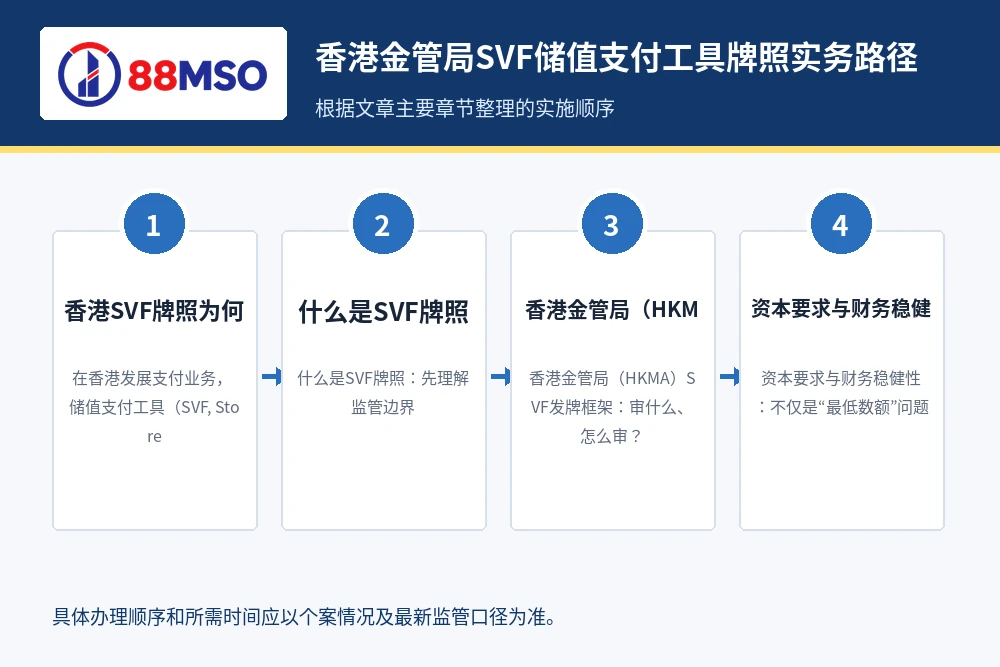
香港SVFWhy has a license become a key threshold for cross-border payments and digital finance?
Develop payment business in Hong Kong,Stored Value Facility (SVF), Stored Value Facility) licenseIt has become a core compliance threshold that cannot be avoided.。Whether it is an e-wallet、prepaid card、Platform balance、Membership stored value,Or with cross-border e-commerce?、Closed loop of funds combined with digital asset scenarios,As long as the business involves "collecting user funds in advance and allowing subsequent payments or transfers",There is a high probability of falling into the regulatory scope of Hong Kong’s Payment Systems and Stored Value Facilities Ordinance (PSSVFO)。
Compared with "do business first"、The high-risk path of "replacing licenses later",Hong Kong’s regulatory logic puts more emphasis on:First identify business attributes,Match license plate again,Rebuilding the risk control and AML system。This is also the reason why more and more institutions are considering entering the Hong Kong market.,Reasons to Prioritize Consulting with a Professional Compliance Team。Judging from the long-term service experience of 88MSO and its 88MSO team,Can the project successfully obtain the license?,It often does not depend on "how thick the data is",Rather, it depends on whether the applicant has actually established an executable、auditable、Sustainable operation and risk control mechanism。
one、What is SVF license:Understand regulatory boundaries first
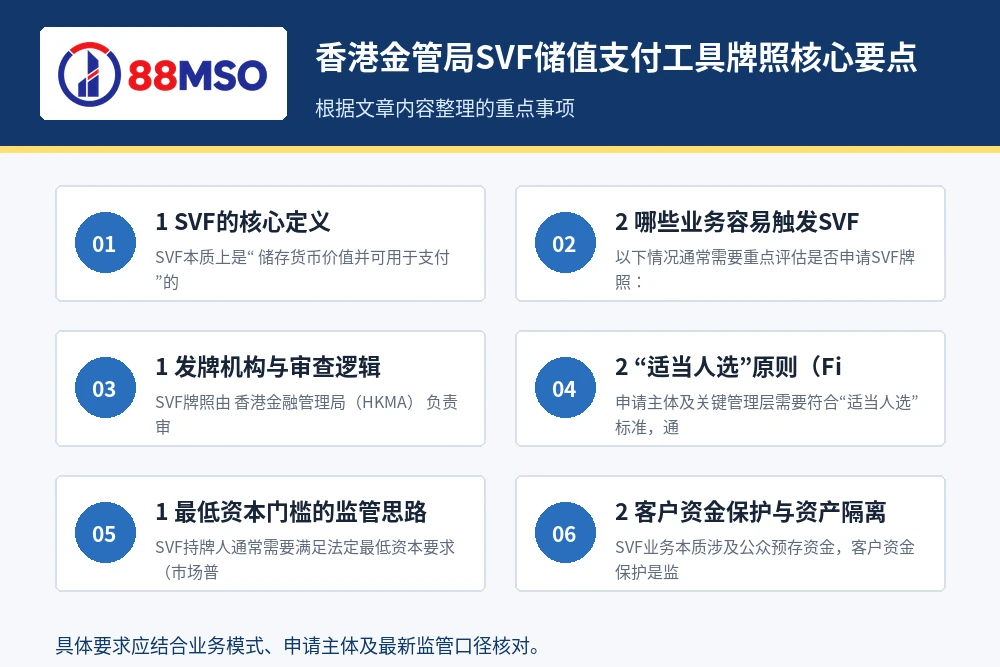
1.1 Core definition of SVF
SVF is essentially "Stores monetary value and can be used for payments” facilities。Users recharge first,Later used to purchase goods、Serve,Or transfer within a certain range。Common manifestations include:
- Mobile Wallet (App Wallet Balance)
- prepaid card、gift card、transportation card
- Account balance within the platform (can be used for consumption or settlement)
- Stored value payment products integrated with merchant network
1.2 Which businesses are likely to trigger SVF supervision?
The following situations usually require focus on evaluating whether to apply for an SVF license::
- Issue electronic balances to the public that can be recharged and consumed repeatedly
- Allow balances to be circulated in different merchant scenarios
- Provide P2P transfers、Share accounts、Pay to a third party
- Receive cross-border payments through the wallet and then distribute them locally.
If only for single use、Closed loop and strictly restricted scenarios,There may be room for discussion of exemptions,However, substantial legal and compliance judgments must be made,You cannot avoid supervision simply by relying on “technical architecture arguments”。
two、Hong Kong Monetary Authority (HKMA) SVF Licensing Framework:What to interrogate?、How to judge?
2.1 Licensing agency and review logic
SVF license is issued byHong Kong Monetary Authority (HKMA)Responsible for approval and ongoing supervision。The core of supervision is not just “whether there is financial strength”,Rather, it comprehensively assesses the following abilities:
- financial soundness:Whether there is sufficient capital and the ability to continue operating
- governance structure:Board of Directors、Management、Are the three lines of defense clear?
- Risk control:operational risk、Liquidity risk、Fraud risk control capabilities
- Technology and Cybersecurity:System availability、Data security、emergency recovery mechanism
- Anti-Money Laundering and Sanctions Compliance:KYC、Transaction monitoring、Suspicious Transaction Reporting Mechanism
- Customer fund protection:Whether customer stored value is isolated?、How to host and protect
2.2 “Fit and Proper” principle
The applicant and key management personnel need to meet the "fit and proper candidate" standard,usually include:
- Directors and senior management have good integrity records
- Have payment、finance、Risk control or technology operation experience
- There is no history of major violations of laws or regulations or breach of trust
- Can demonstrate practical understanding and ability to implement Hong Kong regulatory requirements
in practice,Team resume and position matchingIt is a high-frequency inquiry point。Supervision does not just look at “business card titles”,It depends more on whether the responsibilities are implemented。
three、Capital requirements and financial soundness:Not just a “minimum amount” issue
3.1 Supervision ideas for minimum capital thresholds
SVF licensees usually need to meet statutory minimum capital requirements (the market generally focuses on the standard of "paid-in capital not less than HK$25 million"),However, a common misunderstanding among enterprises is to understand obtaining a license as a "one-time capital injection action"。actually,HKMA pays more attention to:
- Is the source of capital clear?、Compliance、traceable
- Is capital sufficient to cover risks during business expansion?
- Are cash flow forecasts reasonable for the next 12-24 months?
- Do you have financial buffers to deal with stress scenarios?
3.2 Customer fund protection and asset isolation
The nature of SVF's business involves public deposits of funds,Protection of customer funds is the bottom line of supervision。Usually should be established:
- Separate account management of client funds and own funds
- Arrange a custody or protection mechanism with a qualified bank
- daily reconciliation、Abnormal monitoring and fund allocation approval process
- Emergency response plan for financial security incidents
If the design of this part is not clear,Even if the technical system is perfect,The application may also be questioned repeatedly.。
Four、Full breakdown of application conditions:From company establishment to system implementation
4.1 Company and shareholding structure requirements
Usually a Hong Kong company is required as the licensed entity,and disclose the complete equity penetration structure。Regulatory focus:
- The ultimate beneficiary (UBO) is identifiable
- The shareholder background is legal、No major compliance deficiencies
- Transparent capital flows and transaction arrangements within the group
- There is no concealment of control or high-risk related arrangements
4.2 Management team and local operation capabilities
Applicants should demonstrate real operational capabilities,Rather than a "shell application"。Key elements include:
- Clear organizational structure and job responsibilities
- Compliance、Risk control、Configuration of key functions such as internal audit
- Local management and decision-making mechanisms (including authorization matrix)
- Outsourcing management systems (such as technology、customer service、clearing and settlement)
4.3 AML/KYC and Sanctions Compliance System
SVF license under review,AML is a hard indicator。should cover at least:
- Customer Risk Rating (Individual/Business、region、scene)
- KYC and Continuous Due Diligence (CDD/EDD)
- Transaction monitoring rules and threshold model
- Suspicious transaction identification、Upgrade and reporting process
- Sanctions List Screening and Hit Disposal Mechanism
- Staff training and independent testing arrangements
Supervision pays more attention to "Enforceability”:Whether the process can leave traces in the system、Review、audit,Rather than just staying at the document level。
4.4 Technology governance and network security
For digital payment institutions,System stability and security are the “main battlefield” for license application。should be prepared:
- System architecture diagram、data flow diagram、Permission control mechanism
- Information Security Policy (Encryption、Key management、access management)
- Business Continuity Plan (BCP) and Disaster Recovery (DR)
- Penetration testing、Vulnerability management and third-party security assessment
- Compliance due diligence and contract control for outsourced cloud services
five、Application process and timeline:How to improve pass rate?
5.1 Common stages
- Stage 1:Business compliance diagnostics——Confirm whether it falls under SVF supervision、Identify license plate boundaries
- Stage 2:Structural and schematic design——Company structure、Funding path、Product and risk control model
- Stage 3:Institutional documents and system preparation——Policy Manual、process、Report、technical material
- Stage 4:Formal submission and inquiry response——Multiple rounds of patches、Management interviews、Detail verification
- Stage 5:Landed after getting the license——Continuous compliance、reporting obligations、Audit and annual inspection
5.2 Key influencing factors on approval time
There is no "fixed short-term guarantee" for SVF approval,The time mainly depends on:
- Business model complexity (cross-border、Multiple scenes、Multiple currencies)
- Consistency and completeness of application materials
- Management’s professionalism and timeliness in responding to inquiries
- Is AML and technology control really operational?
Experience shows,The more solid the preparation in advance,The lower the cost of follow-up inquiries。88MSO often adopts the “pre-inquiry list + mock review” mechanism in practice.,Help companies fix high-frequency regulatory issues in advance,Reduce back-and-forth repairs。
six、Common misunderstandings:Why do so many applications get stuck in the middle and late stages?
- Myth 1:Treat licenses as industrial and commercial procedures
SVF is a continuing supervision license,Not a single registration action。 - Myth 2:Only focus on legal documents,Don’t focus on system implementation
Supervision will look at the system、Report、log、Permissions and evidence of emergency drills。 - Myth 3:AML templated replication
Different customer groups and scenarios should have differentiated risk models。 - Myth 4:Ignoring cross-border funding and clearing compliance
Especially when multiple jurisdictions are involved,Need to link local and overseas regulatory requirements。 - Myth 5:Relaxation after getting the license
Ongoing reporting after licensing、Auditing and rectification are equally critical。
seven、Post-licensing obligations:The real challenge has just begun
Obtaining an SVF license is not the end,It is the starting point for compliance operations。Licensed institutions are usually required to continue to perform:
- Regular regulatory filings and financial disclosures
- AML system update and independent review
- Declaration of changes in major matters (equity、Management、business model)
- Customer fund protection and daily reconciliation
- System security testing and operational resilience improvement
If the business expands to securities、Insurance、Money Lending or MSO Scenario,It is also necessary to simultaneously evaluate whether other license requirements are triggered.。For organizations that plan to deeply explore Hong Kong and overseas markets in the long term,Establish"License + risk control + operation"Integrated mechanism,More strategic value than taking cards at a single point。
Conclusion:SVF license is the “admission ticket”,It is also a “proof of business capabilities”
The core of Hong Kong’s SVF regulatory system,It’s not about setting the threshold itself,It is about selecting payment institutions with long-term stable operating capabilities.。If companies want to build sustainable payment and cross-border financial businesses in Hong Kong,Products need to be designed to regulatory standards from day one、Process and Organization。
from the licensing framework、Capital requirements to AML and tech governance,SVF application is a systematic project。For teams lacking local experience,Use professional institutions familiar with Hong Kong’s financial compliance practices to conduct full case custody,Often can significantly reduce trial and error costs、Improve approval efficiency。The practical experience accumulated by 88MSO and 88MSO in the field of financial licenses in Hong Kong shows that:Applications with a really high pass rate,Not "material stacking",But "compliance capabilities front-loaded"。
If you are planning an e-wallet、Platform stored value、Cross-border payment or digital payment ecosystem,It is recommended to complete the license adaptation assessment and implementation roadmap as soon as possible,Ensure business develops quickly in the Hong Kong market,Walking steadily too。
Read more:Global Payment and Electronic Money License Special Topic。