简体中文
简体中文 繁體中文
繁體中文 English
introduction:Why has the “149 license combination” become a standard issue for cross-border asset management institutions?
recent years,More and more Chinese-funded institutions、family office、Wealth management platform and cross-border asset allocation team,Regard Hong Kong as an important hub for global financial business。The reason is not complicated:Hong Kong’s legal system、Capital market depth、tax environment、International investor base and regulatory transparency,Has the advantage of long-term stability。In this context,Hong Kong Securities and Futures Commission(SFC) No. 1、No. 4、No. 9 license plateGradually changing from “optional” to “strategic item”。
Many institutions initially focus only on the cost of applying for a single license,But ignored the more critical issue:How to collaborate between licenses,In order to enable the business to have the ability to sustainably expand。No. 1 (Securities Trading)、No. 4 (advising on securities)、No. 9 plate (providing asset management) does not exist in isolation,The three form the link capability of "recruiting-considering-managing-distribution"。If designed properly,Can significantly improve customer stickiness、Income structure stability and cross-border product carrying capacity。
This article will start from the regulatory definition、synergy、Organizational structure、RO configuration、Compliance risk control、Seven dimensions of cross-border business extension and practical misunderstandings,Systematic dismantling of the true value and implementation methods of the "149 license combination" in Hong Kong's asset management landscape。
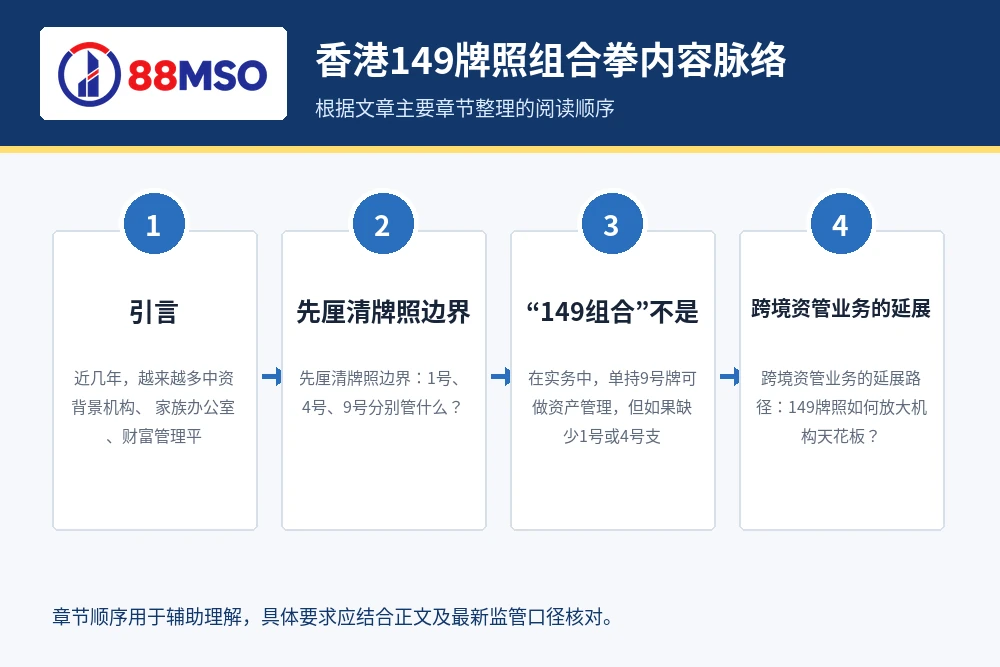
one、First clarify the license boundaries:No. 1、No. 4、What does No. 9 manage?
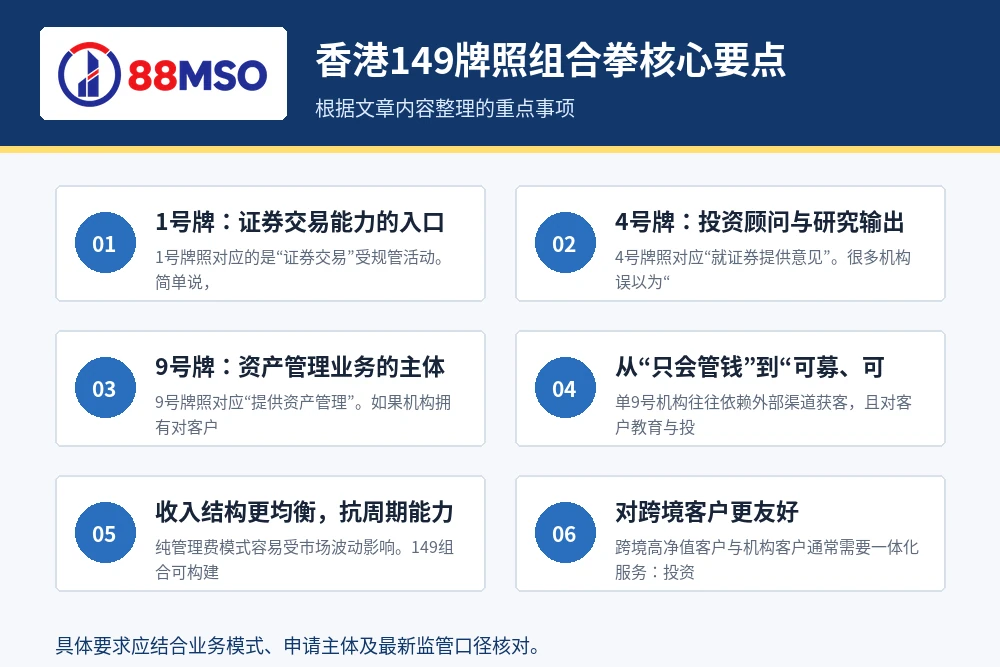
1. No.1 plate:Entrance to securities trading capabilities
License No. 1 corresponds to the regulated activity of "securities trading"。Simply put,Any securities trading intermediary involved、Execute trade、Introduce actions such as transaction arrangements,Usually they may fall into the regulatory scope of No. 1 plate。For many organizations,No. 1 plate is the key entrance connecting market liquidity and customer account execution capabilities。
- core value:Establish transaction execution and distribution connectivity capabilities。
- Common scenarios:Execute stocks for clients、bond、Fund and other securities trading;Connect with brokerage channels。
- Regulatory focus:client suitability、Transaction record keeping、Conflict of Interest Management、internal control。
2. No. 4:Compliance guide for investment advisory and research output
License No. 4 corresponds to “providing advice on securities”。Many institutions mistakenly believe that “as long as no consulting fees are charged, it is not a licensed activity.”,This is a high-risk misunderstanding。So long as the institution continues、Providing securities-related advice on a business basis (whether through investment advisory reports)、strategy meeting、Online content or advice during the sales process),All need to carefully evaluate whether to trigger No. 4 license plate supervision。
- core value:Communicate investment research capabilities with customers in compliance。
- Common scenarios:Market Strategy Report、Asset allocation advice、Portfolio rebalancing suggestions。
- Regulatory focus:Suggestion basis、Information disclosure、Appropriateness matching、Consultant records are traceable。
3. No. 9:Asset management business entity license
License No. 9 corresponds to “providing asset management”。If the institution has the authority to make management decisions on client assets (including discretionary management),Or manage a collective investment scheme as a fund manager,Number 9 is usually a core requirement。For institutions looking to build a long-term management fee income model,No. 9 is the business center。
- core value:Precipitating AUM (assets under management) and long-term management relationships。
- Common scenarios:Manage private equity funds、discretionary account、Cross-border multi-asset portfolio。
- Regulatory focus:Investment authority、Valuation and risk control、Escrow arrangements、Continuous Disclosure and Reporting。
two、"149 combination" is not superposition,Instead, the business link is closed loop
in practice,Holding No. 9 license plate alone can be used for asset management,But if No. 1 or No. 4 support is missing,Breakpoints often occur in business undertakings。149 combination value,lies in the "transaction execution"、investment advice、The three links of "asset management" are connected into a closed loop,Improve customer experience and operational efficiency。
1. From "only managing money" to "can raise money"、Can be considered、"Manageable"
Single No. 9 institutions often rely on external channels to acquire customers,And has limited control over the communication chain of customer education and investment advice.。After joining No. 4,Organizations can export strategies and advisory content in compliance with regulations;After joining No. 1,Can enhance execution and service capabilities on the transaction side,Thus forming a more complete customer life cycle management。
2. A more balanced income structure,Stronger ability to withstand cycles
The pure management fee model is easily affected by market fluctuations。The 149 portfolio can build a composite structure of "management fees + advisory fees + transaction service-related income" (specifically subject to regulatory license and business model),More resilient during market shocks。
3. More friendly to cross-border customers
Cross-border high-net-worth clients and institutional clients often require integrated services:Investment framework recommendations、Product configuration、Implementation、Ongoing management。The 149 portfolio is more suitable for undertaking “cross-market、Cross currency、Complex requirements across strategies。
three、Extension paths for cross-border asset management business:How does the 149 license enlarge the institutional ceiling?
Path one:Family office and high net worth advisory business upgrades
Many family office teams initially focus on consulting,As the complexity of customer assets increases,Gradually move towards trusteeship。No. 4 + No. 9 can support the upgrade from "suggestion" to "management";After filling up No. 1,The efficiency of transaction execution and product docking is further improved。
Path two:RMB asset allocation moves towards multi-currency global allocation
As customers’ overseas configuration needs grow,,Institutions need to cover Hong Kong stocks、US stocks、bond、private placement credit、Assets such as structured notes。149 Portfolio can more easily achieve multi-asset collaborative services under the compliance framework,And establish a standardized investment committee and risk control process。
Path three:Fund platform operation
With No. 9 as the core,Institutions can gradually build a fund management platform;Enhance the compliance capabilities of investment research and fundraising communication through No. 4;Optimize transaction connection and execution efficiency through No. 1,Form a more complete platform-based asset management structure。
Four、What is supervision most concerned about? RO and core functional configuration are the watershed between success and failure
Many cases of failed applications or subsequent regulatory inquiries,It’s not that “the business logic is invalid”,Ratherpersonnel、Responsibilities、Governance and systems cannot prove “sustainable compliance operations”。in,Responsible Personnel (RO) allocation and actual performance of duties are particularly critical。
1. RO is not "in name",It is the subject of regulatory responsibility
1、4、No. 9 license for RO’s professional background、Industry experience、There are clear requirements for management ability。Supervision will pay attention to whether RO is truly involved in decision-making、Do you understand the business model?、Can risks be monitored?。Strong resume on paper but not involved in management in practice,Very high risk。
2. Three lines of defense must be demonstrably “working”
- first course:Business front desk (sales、investment advisory、Transactions) are executed according to the system。
- Second course:Compliance and risk management (including appropriateness、Anti-money laundering、Conflict of Interest Management)。
- The third course:Internal audit or independent review mechanism,Make sure the problem is identifiable、Correctable。
3. License maintenance tests the agency’s ability more than application
annual review、financial reporting、Continuous training、Compliance Report、Policy updates、System traces、Outsourcing supervision and other tasks,Determines whether the license plate can be stably "available" in the long term。Many institutions had to make corrections after receiving the license due to weak maintenance systems.,Influence the pace of business advancement。
five、Common misunderstandings about 149 combinations:Seems cost-effective,In fact, it amplifies compliance risks
Misunderstanding 1:Take the cheapest card first,More to come later
If preliminary business promotion、There is a mismatch between customer contact patterns and actual regulated activities,Even if "I plan to replenish my cards in the future",It may also trigger the risk of operating without a license。The correct approach is to do business boundary mapping first,Redetermine the license plate path。
Misunderstanding 2:Treat outsourcing as “risk transfer”
trade、Investment research、Compliance、KYC and other aspects can be outsourced and partially executed.,But regulatory responsibilities cannot be outsourced。Agencies must retain substantial oversight capabilities、Documentary evidence and decision-making authority。
Misunderstanding 3:Reapply、Light operation
Invest a large amount of budget in the application stage,Lack of institutional implementation after getting the license、Training mechanism and systematic ledger,The problem is eventually exposed during on-site inspection or inquiry。Compliance is “operational engineering”,Not a "one-off project"。
six、Practical suggestions:How to design a 149 license plate roadmap that can be implemented?
Stage 1:Business diagnosis and regulatory mapping
Sorting out target customers、product type、Charging model、transaction link、marketing action,Mapping to regulated activities on an item-by-item basis,Confirm the necessity and sequence of 1/4/9。
Stage 2:Entity and governance structure establishment
Clarify Hong Kong licensed entities、Division of labor between parent and subsidiary companies、Board Responsibilities、investment committee mechanism、Authorization Matrix and Information Isolation Wall,Avoid unclear responsibilities caused by mixed business between different entities。
Stage 3:RO and key position allocation
Configure RO around business complexity、Compliance、Risk control、finance、Core roles such as operations,Establish duty performance records and regular meeting mechanisms that can be verified by supervision。
Stage 4:Institutional and system linkage
Establish KYC/appropriateness、Transaction monitoring、Consultant Notes、Complaint handling、conflict of interest、AML monitoring、Outsourcing management and other systems,And open up traces with the IT system。
Stage 5:Continuous maintenance and optimization
Pass annual compliance assessment、staff training、Internal control stress testing、Supervisory dynamic tracking and continuous optimization model,Ensure business expansion does not breach compliance boundaries。
seven、Why are more and more institutions choosing “whole-case trusteeship” promotion?
149 license involves laws、Compliance、organize、personnel、Finance and taxation、Multi-dimensional collaboration such as operations,It is often difficult for single-point consultants to cover the entire cycle。Mature institutions in the market are more inclined to adopt the full-case model of "program design + application execution + implementation + continuous maintenance",Reduce cross-team communication losses。
Judging from the practice of customers served by 88MSO,What cross-border financial institutions need most is not “quick form delivery”,RatherCompliance management system that can operate for a long time。Especially in Hong Kong, supervision has become stricter、In the context of improving information transparency,Only by converting license capabilities into organizational capabilities,Only in this way can we truly support the overseas expansion of capital and global asset management layout.。
Conclusion:The nature of 149 license,It is the "compliance compound interest" that builds cross-border asset management.
Hong Kong 1、4、Collaboration of License No. 9,It’s not about “the number of license plates looks good”,But to establish a sustainable business closed loop:Able to serve customers、Able to carry products、Able to travel through cycles、able to cope with regulation。For asset management and wealth management institutions planning long-term development in Hong Kong,The sooner we complete the transformation from "application thinking" to "operation thinking",The better you can take the initiative in future competition。
If you look at it for a longer time,What really determines victory or defeat is never who gets the card first.,But who can continue to create customer value within the compliance framework?。149 Combination Boxing,It is the starting point of this competency system。
FAQ:5 issues that organizations are most concerned about
Q1:Is it necessary to apply once for 1、4、Number 9?
uncertain。Can be promoted step by step according to business stages,But the premise is that the current actual business behavior strictly matches the scope of the license,Avoid the risk of "operate first and then replenish the license"。
Q2:Only number 9,Can you give investment advice?
It depends on the nature of the suggestion and the way of reaching it.。If it constitutes a regulated activity of “advising on securities”,Usually requires No. 4 plate support,It is recommended to do a professional compliance assessment。
Q3:Can RO be concurrently held by overseas personnel?
Feasibility depends on their qualifications、Arrangements in Hong Kong、Comprehensive judgment on actual performance of duties and regulatory requirements。The core is not "nominal appointment",But "verifiable performance of duties"。
Q4:What is the risk point that is most easily overlooked after getting a card?
Common is license plate maintenance:The system is not implemented、Incomplete records、Insufficient training、Lack of outsourcing supervision、Annual review and declaration node management is loose。
Q5:Which institutions are suitable for the 149 combination?
Suitable for those who want to have transaction connections at the same time、An institution that exports investment advisory and asset management capabilities,Especially the asset management platform for cross-border high net worth and institutional clients、Family office upgrade team and global configuration service provider。