简体中文
简体中文 繁體中文
繁體中文 English
Hongkonginsurance brokerLegal qualifications and financial management background requirements for company CEOs (chief executive officers)
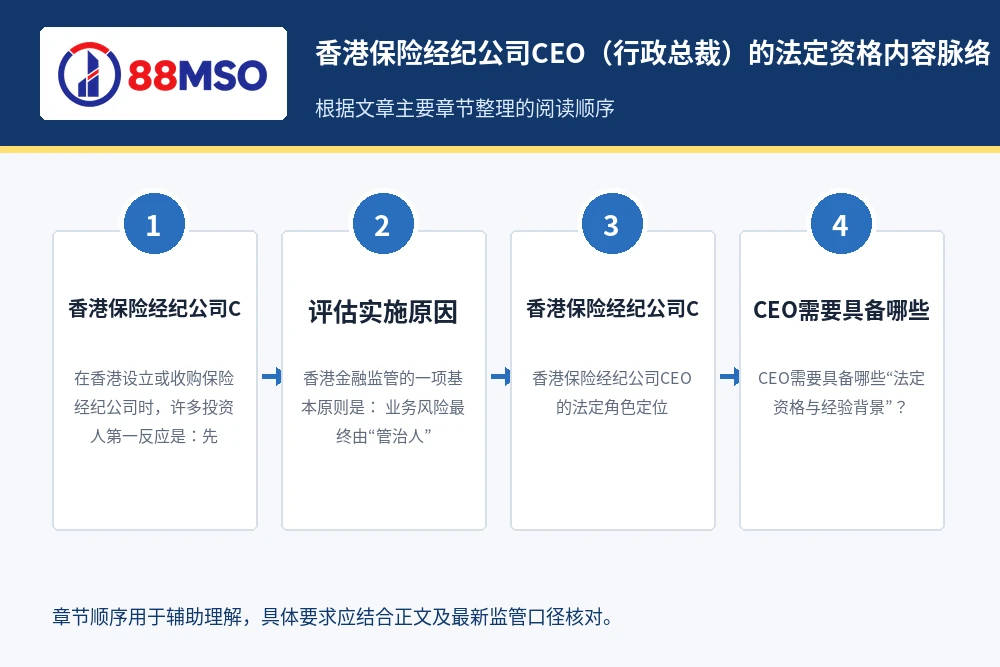
When establishing or acquiring an insurance brokerage company in Hong Kong,The first reaction of many investors is:Apply for the license first,Replenish the management team。The reality is just the opposite - in the eyes of regulators,“Who will run the company?”is often more important than "what products the company intends to sell"。Especially the core position of Chief Executive Officer (CEO),Not only related to the company's business strategy,It also directly affects compliance culture、Customer protection、Financial security and ability to continue to hold a license。
For companies planning to enter the Hong Kong insurance brokerage market,Understand the statutory requirements for the CEO position,It is by no means a formal preparation,It is the key node that determines the success or failure of the project.。This article will start from the regulatory logic、Qualification threshold、Financial management background、Corporate Governance Responsibilities、Common reasons for rejection、Practical preparation checklist and other perspectives,Comprehensive analysis of the job standards for CEOs of Hong Kong insurance brokerage companies,And provide practical suggestions based on industry practices。
one、Why is CEO qualification a "high-weighted item" in license approval?
A basic principle of Hong Kong’s financial supervision is:Business risks are ultimately borne by the “governing person”。Insurance brokerage business involves customer interests、Policy sales suitability、Commission Arrangement Disclosure、Potential conflicts of interest、Complaint handling and anti-money laundering mechanisms and other highly sensitive areas,Therefore, regulatory agencies will focus on examining whether company executives have "substantial management capabilities."。
Simply put,Supervision is not satisfied with “nominal CEO”,Instead, the person is required to be able to prove the following three things:
- Understand business:Understand insurance brokerage products、Channel and customer risks;
- Understand management:able to establish systems、Supervise execution、Correction and accountability;
- Understand compliance:Understand Hong Kong’s regulatory framework,Ability to make correct decisions under pressure。
two、The statutory role of CEO of Hong Kong insurance brokerage companies
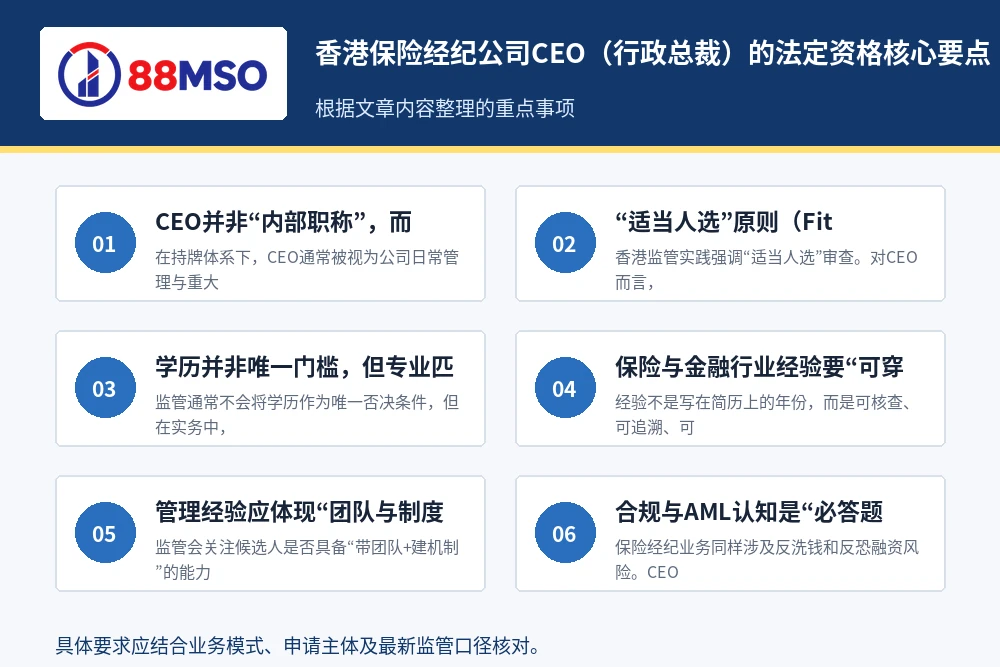
1) CEO is not an “internal title”,It is the subject of regulatory responsibility
Under the licensing system,The CEO is usually regarded as one of the first persons responsible for the company's daily management and major business decisions.。Supervision is not concerned with what is written on the business card,But whether they actually assume management responsibilities,For example:
- Approval of key policies (sales、Compliance、risk、complaint、Data confidentiality, etc.);
- Supervise senior management and key functional leaders in the performance of their duties;
- Ensure board resolutions are properly implemented;
- When major compliance incidents occur,Timely handling and reporting。
2) The principle of “Fit and Proper” is the core judgment criterion
Hong Kong’s regulatory practice emphasizes “fit and proper person” review。For CEOs,Mainly evaluated from the following dimensions:
- Integrity and Reputation:Are there any major violations?、Fraud、Breach of trust、Bankruptcy and other records;
- Ability and experience:Do you have industry qualifications and management experience that match the position?;
- financial soundness:Whether there are serious instability factors in the personal financial situation;
- Compliance awareness:Do you understand and be willing to implement regulatory requirements?。
That is to say,A CEO does not “just have management experience”,Rather, it is necessary to have verifiable financial compliance capabilities.。
three、What "legal qualifications and experience background" does a CEO need to have?
1) Academic qualifications are not the only threshold,But professional matching is important
Supervision usually does not use academic qualifications as the only disqualifying condition,But in practice,Have finance、Insurance、law、Accounting、risk management、Business management and other related educational background,will significantly enhance credibility。If your academic qualifications are not in a related major,You need to use stronger professional experience and management performance to make up for it.。
2) Experience in the insurance and financial industry must be “transmissible proof”
Experience is not the year written on the resume,but verifiable、traceable、explainable。ideally,Candidates should possess:
- insurance broker、insurance agency、underwriting、Claims、Distribution management and other front-line or management experience;
- Compliance in financial institutions、Risk control、audit、Management experience in operational governance;
- Cross-border business or high-net-worth client service experience (e.g. company targeting international clients);
- Actual participation in system construction、regulatory communications、Records of internal rectification projects。
3) Management experience should reflect “dual capabilities of team and system”
Supervision will focus on whether candidates have the ability to "lead a team + build a mechanism",Rather than just sales talents。It is recommended to present it clearly in the application materials:
- Managed team size and organizational structure;
- Key process optimization results (such as reduced complaint rate、Reduced audit deficiencies);
- Experience in handling major risk events;
- with the board of directors、external audit、Regulatory agency collaboration experience。
4) Compliance and AML awareness are “must-answer questions”
Insurance brokerage business also involves anti-money laundering and counter-terrorism financing risks。The CEO should be able to explain how the company performs:
- KYC customer due diligence and ongoing review;
- High-risk customer classification and enhanced review;
- Suspicious transaction identification、Internal and external reporting mechanisms;
- staff training、Spot check、Accountability and Record Keeping System。
If the CEO has a vague understanding of the AML framework,Often viewed as a major governance shortcoming。
Four、What exactly is the “financial management background” that supervision values most?
Many applicants mistakenly believe that "working in a bank for a few years" means having a financial management background.。actually,Supervision pays more attention to the following four levels::
1) Risk identification ability
Can you identify structural risks in your business model?,For example, aggressive sales incentives lead to misleading sales、Commission orientation leads to unsuitable products、Incomplete cross-border customer information, etc.。
2) System building capabilities
Can the “compliance slogan” be implemented into system text?、Approval process、Job responsibilities、System permissions and evidence traces。
3) Supervision and execution ability
Can it pass the KPI?、Sampling review、internal audit、Continuous supervision through training and assessment,Instead of just "temporarily filling in documents" before the inspection。
4) Rectification and communication skills
After a problem occurs,Can a rectification plan be quickly formed?、Identify responsible persons、Set time limit,and communicate with regulators for real、whole、timely communication。
The above four abilities,This is the true meaning of “financial management background” in the regulatory context.。
five、CEO and Board of Directors、Compliance officer、Relationship Boundaries for Key Function Leaders
In order to avoid governance failure caused by unclear rights and responsibilities,Insurance brokerage companies should clarify management boundaries as early as possible:
- Board of Directors:Responsible for strategic direction and major supervision;
- CEO:Responsible for strategic execution and daily management coordination;
- Compliance/Risk Control Function:Responsible for rule interpretation、monitor、Early warning and rectification suggestions;
- Business leader:sales behavior、Responsible for customer adaptation and front-line execution。
The ideal governance structure is not one where the CEO does everything.,Rather, it creates checks and balances:CEO has decision-making power,But must accept the institutional and supervisory framework constraints。
six、Common application misunderstandings:Why are seemingly “strong” candidates still questioned?
Misunderstanding 1:Only emphasize sales performance,Failure to demonstrate governance capabilities
High performance does not equal high compliance。If there is only “increase in premium scale” in the material,But there are no cases of internal control construction and risk management,The persuasiveness of approval will obviously be insufficient。
Misunderstanding 2:resume generalization,lack of verifiable evidence
Statements such as "responsible for overall management of the company" are too general。It is recommended to supplement the organizational chart、Job description、Project results、Supporting evidence such as letters of recommendation or certificate of resignation。
Misunderstanding 3:Ignoring AML and Complaint Handling System
Some teams treat anti-money laundering and complaints mechanisms as “backend documentation”,This is often seen in reviews as weak governance awareness。
Misunderstanding 4:The cross-border structure is complex but management authorization is unclear
If the group parent company、Hong Kong entity、Blurred authority boundaries between outsourced teams,Supervisors will worry that responsibilities will not be implemented,and then asked for repeated clarifications。
seven、Practical suggestions:How to systematically prepare CEO appointment review materials?
1) Prepare a “competency narrative” rather than a single point document
Tie personal background to company business model,form a complete logic:
- Who are the company’s target customers?;
- What are the main risks?;
- How CEOs have responded to similar risks in the past;
- How to implement the system and team management in the future。
2) Establish an “evidence package” to enhance credibility
- Detailed CV (including responsibilities)、Team size、KPI);
- Key employment certificates and recommendation materials;
- Summary of past project results (desensitization treatment);
- Training and professional continuing education records。
3) Synchronously build company-level governance documents
Don’t wait for the CEO’s review and approval before supplementing the system。should be prepared in advance:
- Corporate Governance Handbook;
- Anti-Money Laundering and Sanctions Compliance Policy;
- Customer Engagement and Sales Code of Conduct;
- Complaint handling SOP and escalation mechanism;
- Annual review and internal training program。
4) Conduct “Regulatory Q&A Preview”
It is recommended to conduct simulations around high-frequency issues,For example:
- How to deal with conflicts between high-commission products and customer adaptation?
- How to identify suspicious customer behavior and perform internal reporting?
- In the event of a misleading sales complaint,How does the CEO intervene?
- How to ensure that the outsourced team meets company compliance standards?
The value of rehearsal is:Ask the CEO to answer "principles + process + evidence",Rather than making empty statements。
eight、It’s also important to have a license:CEO’s Ongoing Compliance Responsibilities
Many institutions focus on “getting cards”,But ignores that "licensed operation" is the long-term challenge。For CEOs,The core tasks after obtaining a license include:
- Regularly review policy effectiveness and update it;
- Promote annual training and assessment mechanisms;
- Supervisory Complaints、audit、Abnormal transactions and other key indicators;
- Conduct root cause analysis and system rectification of major incidents;
- Cooperate with annual review、License renewal and regulatory communication。
This is why more and more companies choose to cooperate with professional service teams with practical experience in financial compliance in Hong Kong:Not only improves the quality of early declarations,It can better establish a stable governance closed loop in subsequent operations.。Judging from 88MSO and the long-term service experience of 88MSO behind it,Really reduce regulatory risks,Not a "template file",Instead, the system is implemented based on the actual business model of the enterprise.、Role training and continuous review。
Nine、Conclusion:Qualified CEO is the “ballast stone” of the licensing project
CEO qualifications of Hong Kong insurance brokerage companies,It is by no means a simple personnel arrangement,It is the first test of supervision on the quality of corporate governance.。A truly qualified CEO,Should have bothIndustry understanding、management ability、Compliance awareness、Risk judgment and execution resilience。When these five abilities form a closed loop,Not only is it easier for companies to pass approval,It also has more opportunities to expand steadily in subsequent operations.。
If you are planningHong Kong Insurance Broker LicenseApplication or team reorganization,It is recommended to carry out the four-in-one preparation of "qualifications-responsibilities-evidence-system" around the CEO position as early as possible。The sooner you establish a compliance governance framework,The better you can communicate in supervision、Take the initiative in business implementation and cross-border development。
FAQ:The 4 issues that companies are most concerned about
Q1:Does the CEO have to be a permanent resident of Hong Kong?
Usually not an absolute requirement,However, candidates must meet regulatory requirements for performance of duties、Regulatorability and actual management capabilities requirements。The key is whether it can prove its true participation in the management of Hong Kong entities,rather than "in name"。
Q2:No pure insurance background,Is it sufficient to have only banking or asset management experience?
Can,However, it is necessary to supplement the knowledge and practical arrangements related to the insurance brokerage business.,Especially customer adaptation、sales compliance、Complaint handling and product disclosure mechanism。
Q3:Can the CEO also hold other key positions?
In theory, it depends on the specific structure and regulatory acceptability.。If concurrent duties lead to the failure of checks and balances、Conflict of interest or weakened oversight,Usually asked to adjust。
Q4:Will it be "once and for all" after approval?
no。After obtaining a license, you still need to continue to meet regulatory requirements.,Including annual review、System update、training records、Risk event handling and compliance traces。CEOs must continue to assume governance responsibilities。