 简体中文
简体中文 繁體中文
繁體中文 English
What should I do if my application for a Hong Kong insurance brokerage license is rejected? Don't panic yet,Do the "Rejection Diagnosis" first
Operating insurance brokerage business in Hong Kong,License is the starting point for compliance operations。Many applicants think that “you can pass if you submit all the information”,But the regulatory trends in 2026 are very clear:Regulators don’t just look at “whether the documents are complete”,See moreGovernance ability、business sustainability、Risk control implementation。therefore,Hong Kong Insurance Broker LicenseRejection is not uncommon,The key is how to quickly、Systematically remedy。
In practice,Many companies were rejected for the first time,A common response is “make up a few more documents and try again”。Such approaches usually have limited effectiveness。The truly effective method is to first conduct a round of "root cause analysis of rejection":Is it a matter of shareholder background? Is the person in charge insufficiently qualified? Is the anti-money laundering system not up to standard? Or is there a mismatch between the business model and actual resources? Only clear lesions,Only a second application or reconsideration is possible.。
For companies that want to launch insurance business in Hong Kong as soon as possible,It is recommended to introduce a professional team with Hong Kong financial compliance experience as soon as possible。Take the 88MSO (88MSO) service case,Many “seemingly minor issues” disapproval points,Often involves deviations between regulatory logic and material expression,Early correction can significantly reduce the probability of secondary failure.。
one、8 high-frequency reasons for refusal of Hong Kong insurance brokerage license in 2026
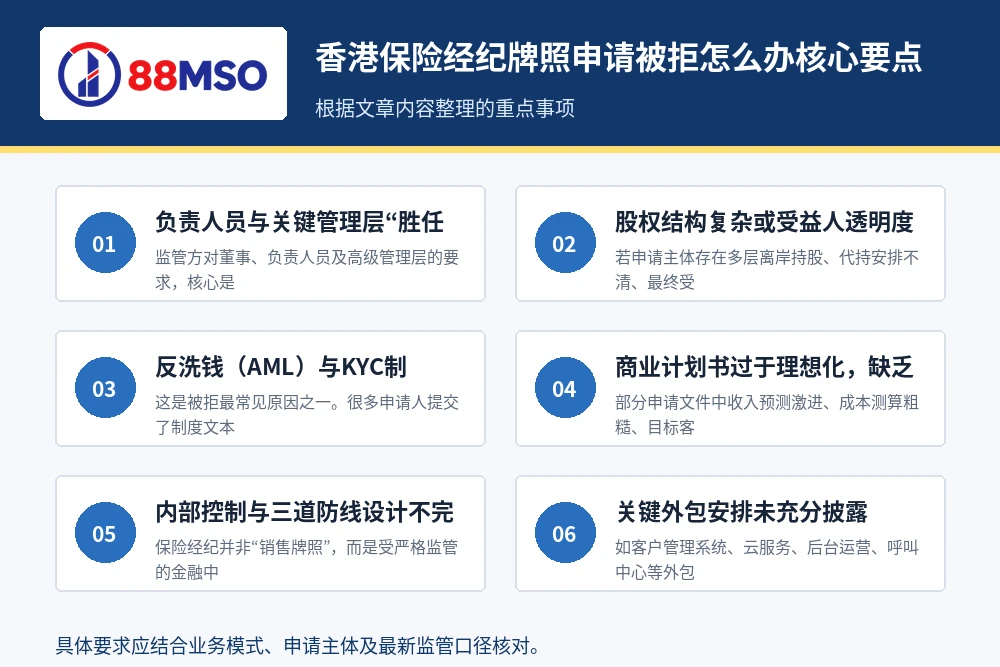
1) Insufficient “competence” of responsible personnel and key management
Regulators on directors、Requirements from Responsible Personnel and Senior Management,The core is "Fit and Proper”。If the resume does not match the job responsibilities,For example:
- Management lacks practical experience in insurance brokerage;
- Only sales background,Lack of risk control、Compliance、Claims management capabilities;
- Overlapping or vacant responsibilities in key positions (such as compliance、internal audit、No one is responsible for handling complaints)。
Even if the company's capital and business plans look good,It may also be deemed "unable to operate stably"。
2) Complex shareholding structure or insufficient transparency of beneficiaries
If the applicant has multiple levels of offshore shareholdings、Unclear holding arrangement、Incomplete identification of ultimate beneficiary (UBO),Regulators will pay close attention to potential anti-money laundering and governance risks。Frequently asked questions include:
- The shareholder chain documents are inconsistent with the actual control relationship;
- Proof of insufficient funds;
- Historically affiliated companies have compliance disputes but have not fully disclosed them。
3) Anti-money laundering (AML) and KYC systems “have templates”、No execution”
This is one of the most common reasons for rejection。Many applicants submitted institutional texts,but cannot prove enforceability。Regulators will look at:
- Is the customer risk rating model operational?;
- Are the triggering conditions for high-risk customer due diligence (EDD) clear?;
- Suspicious transaction reporting mechanism、Are the traces and upgrade paths complete?;
- staff training、Whether the spot check and accountability mechanism is implemented。
'Paper compliance' getting harder to pass in 2026 review。
4) The business plan is too idealistic,Lack of data support
Some filings include aggressive revenue forecasts、Rough cost calculation、Target customer groups are vaguely defined。Regulators often question:
- Insufficient basis for forecasting the scale of first-year premiums;
- Channel strategy does not match staffing;
- There are no corresponding compliance measures for cross-border customer service processes;
- IT system、Complaint handling、Record-keeping capabilities cannot keep up with the scale of the business。
5) Incomplete internal control and three lines of defense design
Insurance brokerage is not a "sales license",It is a strictly regulated financial intermediary business.。If the application materials lack the following content:,Easily triggers disapproval:
- Board of Directors Supervision Mechanism and Management Delegation Boundaries;
- Compliance、risk、Division of Internal Audit Responsibilities;
- Conflict of Interest Management and Commission Disclosure Mechanism;
- Customer Complaint and Dispute Handling SOP。
6) Key outsourcing arrangements are not fully disclosed
Such as customer management system、cloud services、Backend operations、Outsourcing content such as call centers is not disclosed or risk control measures are insufficient,Regulators will worry about data security and business continuity risks。
7) Insufficient financial resources and ability to continue operating
Regulators attach importance to “sustainable operations”,It’s not just whether the registered capital meets the standard,Also includes:
- Cash flow coverage ability in the next 12-24 months;
- Shareholders’ ability to continue to inject capital;
- The company’s response plan under pressure scenarios (sales do not meet expectations)。
8) Incomplete disclosure of historical flaws
If a team member has ever received administrative sanctions、civil dispute、Regulatory inquiries, etc.,Failure to truthfully disclose or provide insufficient explanation,May be considered a integrity risk,Directly affects the approval conclusion。
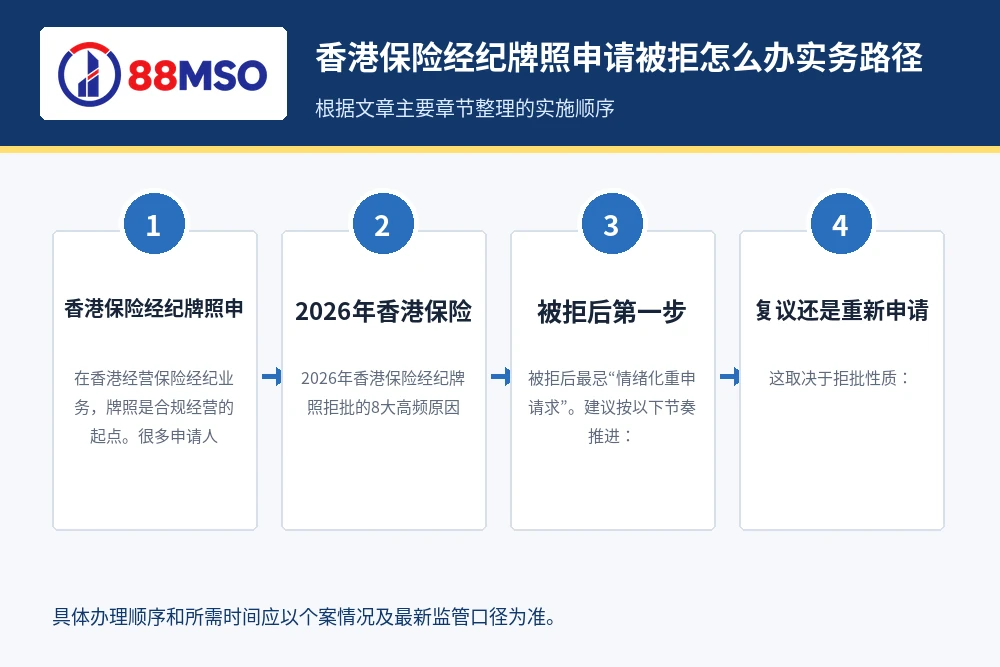
two、The first step after being rejected:Establish a “30-day remediation timeline”
The worst thing to avoid after being rejected is "emotional restatement of the request"。It is recommended to proceed at the following pace:
Days 1-5:Obtain and disassemble disapproval opinions
- Prepare formal rejection letters、Email correspondence、Replacement records;
- The reasons for rejection are divided into three categories: "hard inconsistency", "insufficient evidence" and "unclear expression";
- Identify whether there is scope for reconsideration。
Day 6-15:Form a "correction matrix"
Create table,Correspondence one by one:
- Regulatory concerns;
- Insufficient materials available;
- To strengthen the evidence;
- Responsible person and completion time。
Days 16-25:Refactor core files
- Revised business plan (conservative and verifiable);
- Rewrite the AML/KYC playbook and embed flowcharts;
- Complete governance structure、Job description、Meeting mechanism;
- Improve funding sources and financial soundness certificates。
Day 26-30:Pre-trial and Mock Questions and Answers
Before formal reconsideration or re-reporting,Do a round of "Regulatory Q&A Simulation",Focus on testing whether management can be consistent、Answer core questions clearly。
three、Reconsideration or reapply? How to choose a better path
It depends on the nature of the rejection:
- Suitable for reconsideration:The main problem is insufficient interpretation of data、Lack of individual documentary evidence,And the main structure is basically compliant。
- Suitable for restatement:Involving equity restructuring、Management change、Major adjustments to business model、AML framework reconstruction and other substantial changes。
Simply put:If it's just "not convincing enough",Can be reviewed with priority;If "there is a problem with the underlying structure",Recommend re-reporting。In practice, many companies confuse these two paths.,Leading to a waste of time and expense。
Four、Key Strategies to Improve Second Pass Rate (Practical Version)
Strategy 1:Change "template file" to "enterprise file"
It is easiest for regulatory agencies to identify “templates”:Correct industry terminology,But it’s out of touch with the company’s business scenario。High pass rate materials must embody:
- Target customer group portrait and risk level logic;
- Real channels and customer contact process;
- Complaints and Claims Dispute Handling Mechanism;
- Data in cross-border business、Privacy and record-keeping arrangements。
Strategy 2:Supplement organizational skills first,Supplementary documents
If the team itself lacks compliance and risk control experience,It’s difficult to pass by just writing the materials。It is recommended to give priority to improvement:
- Compliance Officer/MLRO Function Arrangement;
- Board of Directors Supervision and Regular Review Mechanism;
- Training plan and assessment traces。
Strategy 3:Use the “evidence chain” to prove the ability to continue operating
For example, bank credit、Shareholder Commitment Letter、budget model、Stress test report, etc.,Let regulators see that the company can still operate stably in a low-growth scenario。
Strategy 4:Proactively disclose historical issues and provide a closed loop for rectification
Historical flaws are not necessarily “fatal”,The key is to be honest、Is there any rectification?。It is recommended to adopt a four-stage disclosure of “facts-impact-measures-verification”。
Strategy 5:Conducting “mock interviews” from a supervisory perspective
Many applications are stuck on the expression "people"。Management’s responses are inconsistent,Or just memorize documents,will undermine credibility。Mock interviews significantly improve consistency。
five、Details that are often overlooked:Why is it rejected even though “everything looks right”?
- terminology conflation:Confusing the duties of an insurance agent with an insurance broker;
- process breakpoint:There is no ongoing monitoring arrangement after KYC is completed;
- role conflict:The sales manager also serves as the final reviewer of complaints,Lack of independence;
- record missing:training、Spot check、Risk assessment leaves no auditable traces;
- Time logic is inconsistent:The business launch time is earlier than the system deployment and personnel arrival time。
These details are often not "errors in legal provisions",But "Insufficient governance credibility"。On the approval side,This also poses a substantial risk。
six、2026 Regulatory Trends:From "Access Review" to "Full Life Cycle Supervision"
Future applications require more than just “getting a license”,It is also necessary to prove that "it can operate in compliance with regulations for a long time after receiving it."。this means:
- annual review、Continuous reporting and system updates will be more frequent;
- Anti-money laundering、data governance、Outsourced management will be subject to continuous spot checks;
- The board’s involvement in compliance will become a key indicator to watch。
therefore,Annual review and ongoing maintenance should be taken into consideration during the application stage.。88MSO often emphasizes in projects that “application is the starting point for maintenance”,This is also a key method to reduce subsequent regulatory frictions。
Conclusion:Rejection is not the end,System rectification is the turning point
Hong Kong Insurance Broker LicenseApplication rejected,It doesn’t mean the business can’t move forward。What really determines the outcome,Not “whether you have been rejected”,It’s about whether you can build a set ofVerifiable、Executable、sustainableCompliance and business system。
If you are in the critical stage after rejection,It is recommended to complete three things first:First,Make root cause diagnosis;second,Refactoring governance and the AML framework;third,Choose the correct path (reconsideration or reaffirmation) and conduct a mock review。Promote collaboratively with a professional team,Usually can significantly improve the second pass rate,It can also lay the foundation for subsequent license plate maintenance.。
FAQ:High-frequency problems after the Hong Kong insurance brokerage license was refused
Q1:How long does it take to reapply after being rejected?
Depends on disapproval opinions and completion of rectification。If there is a slight lack of information,The pace of patching can be faster;If equity is involved、Management or system restructuring,It is recommended to complete substantive rectification before submitting,Avoid rejection twice。
Q2:Do I have to change the person in charge to get through?
uncertain。The key is to see whether the current person in charge meets the competency requirements,And whether they can provide sufficient evidence to prove their ability to perform their duties and governance experience。
Q3:Can the AML system directly use the group template?
Can refer to,But you can't copy it。Localization transformation must be carried out in conjunction with Hong Kong’s local regulatory requirements and the company’s actual business processes.。
Q4:Is the success rate of reconsideration high?
If the rejection is mainly due to "insufficient explanation" rather than "structural defects",There is a chance for reconsideration;If the underlying problem is obvious,Restating is usually safer。
Q5:Will I still be subject to critical review after getting the license?
meeting。The trend in 2026 is continued regulation。License plate maintenance、annual review、Compliance training and trace management are equally critical,Compliance cannot be regarded as just “application actions”。
The conditions for obtaining a license must include a record of continued operations.
Hong Kong Insurance Broker LicenseWhat to do if your application is rejected is not just a one-time application issue。The company should assign the responsibilities of the person in charge and business representatives、Customer needs analysis、product comparison、Commission or Interest Disclosure、Customer payment processing、Complaints and file saving are written into executable processes,and leave training、Spot checks and rectification records。
Financial aspects should continuously check capital and net assets、professional indemnity insurance、Separate Client Accounts and Bookkeeping Requirements。When comparing insurance brokerage and insurance agency models,The focus should be on who is represented、What products are available?、How to assume ethical responsibilities and how customer payments are handled,Rather than just comparing license plate names。
Industry references:Hong Kong Insurance Authority:Supervision Code for Licensed Insurance Brokers。