
 简体中文
简体中文 繁體中文
繁體中文 English
Hong Kong TCSP Secretary License Registration Process:Why CDD and anti-money laundering are the key to success or failure?
Start a company secretarial business in Hong Kong、Trust or Company Services (TCSP) Business,Holding a license is not a “formal requirement”,It is the bottom threshold for whether the business can operate in the long term.。Many applicants mistakenly believe that "complete information will lead to approval",But in practice,Regulators are more concerned about:Are you truly equipped to identify customer risks?、Block suspicious transactions、Ability to continue to enforce anti-money laundering (AML) and counter-terrorism financing (CFT) obligations。This is why customer due diligence (CDD) and anti-money laundering review regulations,often decidedTCSP licenseApplication efficiency、Subsequent annual review quality,Will it even trigger enforcement action?。
For institutions planning to enter Hong Kong’s financial and corporate services market,Establish a compliance framework as early as possible,More secure than the "get the cards first and then replenish them" system。Judging from the long-term service experience of 88MSO and the professional team behind it,Regulatory agencies are paying more and more attention to "system authenticity" and "execution verifiability" - it does not depend on how many pages of policies you have written.,It depends on whether the policy can be implemented、Whether to leave traces、Whether it can withstand spot inspections。
one、The regulatory logic and full application process of Hong Kong TCSP secretary license
1.1 Scope of application of TCSP license
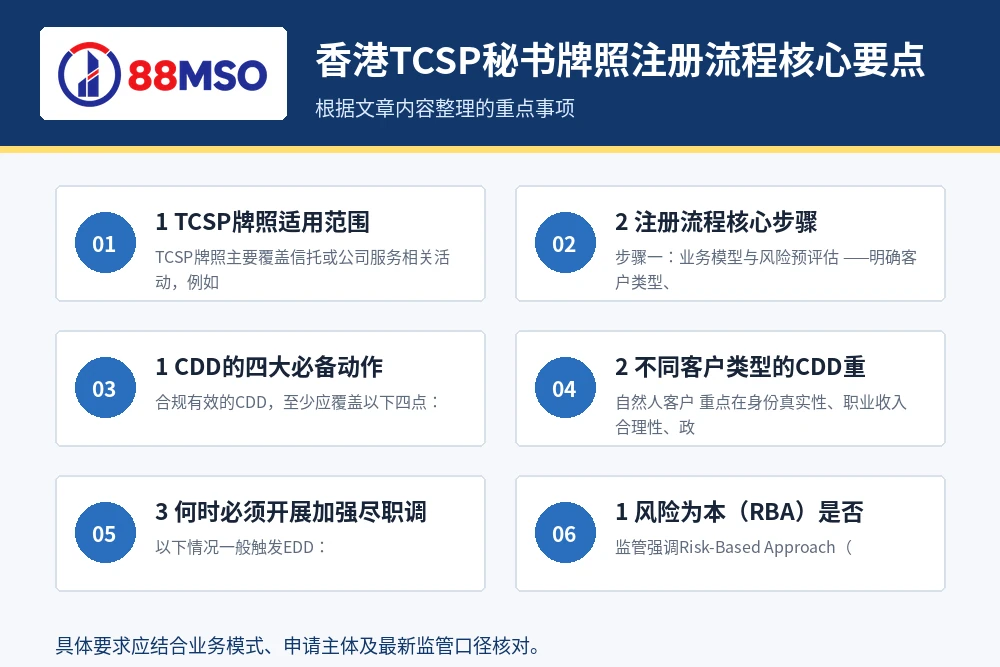
The TCSP license mainly covers trust or company service-related activities,For example:
- Establish a Hong Kong or overseas company;
- Serve as company secretary or provide registered address;
- Serve as nominee shareholder/director arrangement (subject to strict compliance);
- Provide trust-related administrative services, etc.。
Since the above services may naturally be used to hide beneficial owners (UBO) or transfer funds across borders,Regulators generally have higher AML requirements for TCSP licensees。
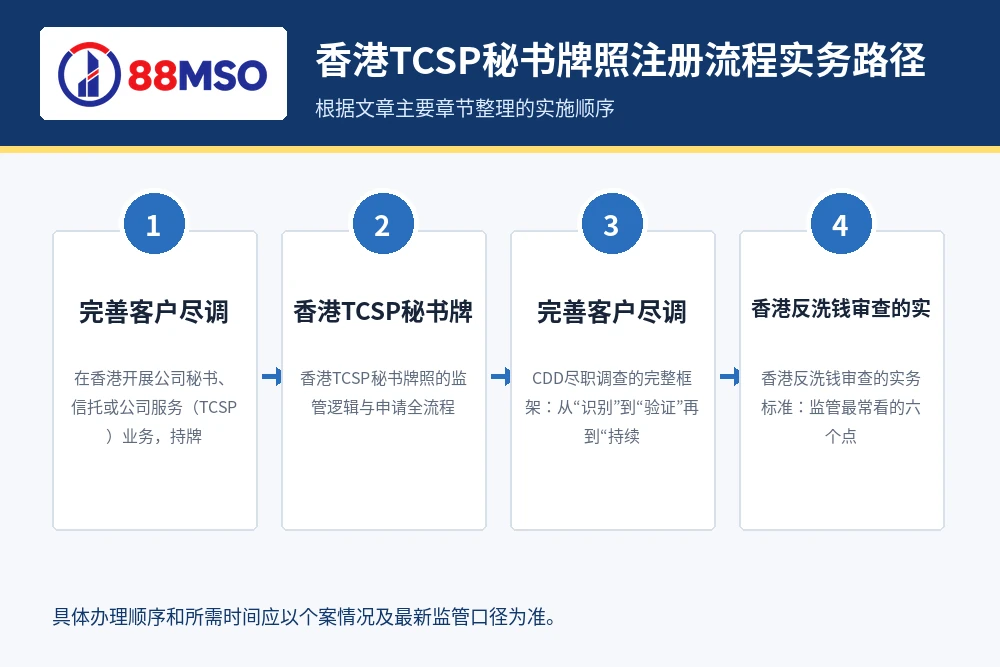
1.2 Core steps of registration process
- step one:Business model and risk pre-assessment——Clear customer types、Service scope、Geographic exposure and capital routing;
- Step 2:Company structure and person in charge qualification review--director、shareholder、Management background、Credibility and professionalism;
- Step 3:Write and implement AML/CFT policy——Includes CDD、EDD、Continuous monitoring、Suspicious Transaction Reporting (STR) Mechanism;
- Step 4:Submit license application information——Company documents、Controller information、internal control system、Training records, etc.;
- Step 5:Regulatory inquiries and supplements——Common focus on customer risk rating methods、Sanctions Screening Process、retention mechanism;
- Step 6:Continue to comply with regulations after being licensed——Annual review、Regular review、staff training、Independent testing and audit trail。
Notice:Many applications are delayed in the "replenishment stage",The root cause is not incomplete documentation,Rather, the institutional logic is inconsistent。For example,The risk rating reads "Monthly review of high-risk customers",But the system and manpower cannot support it,Regulators will consider it unenforceable。
two、A complete framework for CDD due diligence:From "identification" to "verification" to "continuous monitoring"
2.1 Four essential actions of CDD
Compliant and effective CDD,At least the following four points should be covered:
- Identify customers:Collection of basic information of natural persons or legal persons;
- Verify identity authenticity:Use reliable、Verified by independent sources;
- Identify and verify ultimate beneficial owner (UBO):Penetrate the shareholding structure to natural persons;
- Understand the purpose and nature of the business relationship:Why structure、Are the expected activities and funding scale reasonable?。
2.2 Key differences in CDD for different customer types
natural person customerFocus on identity authenticity、Reasonable professional income、Politically Exposed Person (PEP) Screening and Adverse Media Checking。
Legal person customerthen it must penetrate to UBO,and check company registration documents、Charter、List of Directors、Shareholder structure chart,Especially the actual control link under the multi-layer offshore architecture。
trust clientUsually the principal needs to be identified、trustee、protector、Key roles such as beneficiary categories,and clarify control rights and capital control methods。
2.3 When is enhanced due diligence (EDD) necessary?
The following situations generally trigger EDD:
- The client or UBO is from a high-risk jurisdiction;
- involves complex、A multi-tiered shareholding structure with no obvious commercial purpose;
- The customer belongs to or is closely related to the PEP;
- Abnormal transaction characteristics appear,If there is a clear mismatch between service needs and background。
EDD is not just about “collecting a few more documents”,Management approval should also be included、Strengthened verification of funding sources、Increased review frequency and stricter ongoing monitoring。
three、Practical Standards for Anti-Money Laundering Reviews in Hong Kong:The six most common points in supervision
3.1 Is risk-based approach (RBA) truly implemented?
Supervision emphasizes Risk-Based Approach,The core is not "everyone has the same standards",Rather, “the higher the risk,"The deeper the scrutiny"。If your policy fails to reduce the、middle、Clear stratification of high-risk customers,There is no difference in the corresponding measures,Often considered formal compliance。
3.2 Is the customer risk rating model interpretable?
A qualified model should contain at least:geographical risk、Industry risks、Product/service risks、Delivery channel risk、Five types of behavioral risk indicators,And have the basis for scoring、Threshold description and manual review mechanism。
3.3 Sanctions list and negative information screening mechanism
Mechanisms should be established for pre-account opening screening and periodic screening during the period of existence,Covers international sanctions、Law enforcement notices and major negative news。If hit list,There must be an upgrade process、Freeze/deny mechanism and disposal record。
3.4 Suspicious transaction identification and reporting (STR) process
Supervision does not require “zero suspicious cases”,Instead, we focus more on whether you can identify、Report and leave traces。Missing internal reporting links (front line – compliance officer – management) are common flaws。
3.5 Record keeping and audit trail
CDD archive、transaction history、risk assessment、Approval comments、Screening results must be properly stored in accordance with regulations,And it can be "retrieved at any time"、Reducible decision-making process”。
3.6 Compliance Officer (MLRO) and training mechanism
A more perfect system,It is meaningless without personnel to implement it.。MLRO roles should have clear boundaries of responsibilities,Frontline staff need to receive layered training (induction training、annual update、case review)。
Four、The most easily overlooked “high-risk details” in TCSP applications
- Only collect files,No authenticity check:For example, only save a copy of your passport,No independent verification source;
- UBO identification stays on the first level of shareholders:No offshore company or trust layer has been penetrated;
- Risk ratings are “one size fits all”:Same template for all customers,Unable to reflect RBA;
- The system is out of touch with the business:Policies are written strictly,But the actual service process is not executed;
- Lack of continuous monitoring:Be compliant when opening an account,No one follows up during the duration;
- No independent review mechanism:Key approvals are handled by the same position,lack of checks and balances。
Such problems are easily exposed during the initial application and subsequent on-site inspections。In practice,Conducting a "mock review" in advance is often more cost-effective than remediation afterwards.。
five、How to build an executable TCSP compliance system?
5.1 Institutional layer:Set standards first,Redefine the template
First clarify risk appetite and customer access principles,Redesign the corresponding form,Don’t go the other way and “use a template to build a system”。The system should include:Customer access、risk rating、EDD trigger、Sanctions Screening、STR reporting、File retention、Accountability for violations。
5.2 Process layer:Embed compliance into business nodes
It is recommended to embed compliance actions into the entire process of "contact-signing-delivery-renewal"。For example, UBO verification must be completed before signing a contract.、PEP screening and risk scoring,Failure to meet the standards will not allow entry into service delivery。
5.3 Personnel layer:Identify three lines of defense
- first course:Business frontline is responsible for identification and preliminary screening;
- Second course:The compliance team is responsible for reviewing、Upgrades and training;
- The third course:Independent audit/external evaluation is responsible for effectiveness verification。
5.4 Technical layer:Improve traceability and consistency
Use digital tools for list screening、Expiration reminder、Review schedule and file management,Can significantly reduce "missed review"、Mistrial、Operational risk of “no record”。
six、It’s not the end after holding the license:Annual review and continuous compliance are the long-term moat
After obtaining the license, many institutions turn their energy to business development.,Ignoring “continuing compliance” requirements,This may lead to rectification or even punishment in the future.。TCSP licensed institutions should at least do:
- Review AML/CFT policy annually and update high risk parameters;
- Regularly review existing customer information,Ensure information does not expire;
- Conduct annual training and keep sign-ins、take an exam、Case record;
- Perform more frequent ongoing monitoring of high-risk customers;
- Conduct internal sampling inspections,Identify system execution breakpoints。
From industry practice,An institution that can operate stably in the long term,There is generally a mindset of “setting up a system based on annual review standards during the application stage”。This is also what 88MSO and 88MSO emphasized in the project implementation.:Reverse business processes from a supervisory perspective,Transform compliance from cost center to reputational asset。
Conclusion:Make CDD and AML “real”,Only TCSP license has commercial value
Hong Kong TCSP secretary license is not a simple administrative license,It is a “passport” for enterprises to enter the international corporate services and financial compliance ecosystem.。In the context of tightening regulations,What really widens the gap,It’s not who submits the application first,But who first builds a verifiable、Can be reviewed、Sustainable CDD and AML system。
If you are in the license planning or replacement stage,It is recommended to start with the five steps of "risk map - system design - process embedding - personnel training - continuous auditing",Fix shortcomings item by item。Only through thorough customer due diligence and anti-money laundering review,Only the value of the license can be converted into certainty of business growth。
FAQ:The 4 most frequently asked questions by companies
Q1:Does applying for a TCSP license require a complete AML system?
Yes。At least there must be an executable framework and supporting processes。Supervision focuses on “system + execution capabilities”,Not just the document itself。
Q2:Can small teams streamline the CDD process?
Steps can be streamlined for low-risk customers by risk stratification,But identification cannot be omitted、UBO identification、Core obligations such as screening and record keeping。
Q3:What should I do if the customer refuses to provide UBO information?
In principle, you should refuse to establish or continue a business relationship。Failure to identify the actual controller is a major compliance red line。
Q4:How often does it take a compliance review after obtaining a license?
It is recommended that a comprehensive review be conducted at least once a year;High-risk customers and high-risk businesses should be re-inspected more frequently,and form a written trace。
First determine the registration type based on transaction and service content
When preparing for the Hong Kong TCSP secretary license registration process,The actual service should be put first、Customer type、Please clearly state the payment method and transaction amount,Double check the applicable registration or licensing category。TCSP focuses on trust or company services and customer due diligence,DPMS focuses on precious metals and gemstone transactions and corresponding anti-money laundering obligations.,The two cannot share a set of business descriptions just because they are provided by the same company.。
Application and ongoing records should cover the ultimate owner、fit and proper person、risk assessment、Customer and transaction due diligence、Sanctions Screening、Report suspicious transactions、Record keeping and employee training。When using third-party referrals or cash to receive and pay,It should be clear in the process who identifies the customer、Who saves files and how exceptions are escalated。
Industry references:Hong Kong Companies Registry:Trust or company service provider licensing regime。
