 简体中文
简体中文 繁體中文
繁體中文 English
Frequently Asked Questions about Hong Kong Insurance Brokerage License (IA) Application:Compliance red lines you need to pay attention to
With cross-border wealth management、Demand for services to family offices and high-net-worth clients continues to rise,More and more institutions regard Hong Kong as an important hub for insurance distribution and risk management businesses。at the same time,Regulatory scrutiny of the insurance brokerage industry continues to escalate。Many companies are asking "how to getHong Kong Insurance Broker License (IA)"hour,The most common misunderstanding is:Only focus on “whether the application can be approved”,But ignores "how to continue to operate in compliance after obtaining the license"。
in fact,Hong Kong Insurance Authority(Insurance Authority,(referred to as IA) review of the applicant,It’s no longer just about looking at forms and documents that are all in order,Pay more attention to corporate governance、Competencies of responsible personnel、sales behavior management、Whether anti-money laundering and customer due diligence (KYC) mechanisms are enforceable、traceable、auditable。This article will be in FAQ format,Systematically sort out high-frequency issues and key red lines in the application process,Help you avoid detours in the early planning stage。
one、First clarify:What is a Hong Kong insurance broker license? Who must apply?
FAQ 1:Do I need a license to just "introduce clients"?
The core judgment criterion is “whether regulated insurance intermediary activities are carried out”。If your business involves insurance product recommendations、Interpretation clause、broker a deal、Assistance with insurance arrangements、Provide professional advice related to insurance,Usually may fall within the scope of regulation。A lot of teams think “I just refer,Not considered an agent”,But from a regulatory perspective,If you have a real influence on customer decisions,Licensing requirements still exist。
FAQ 2:What is the difference between an insurance broker license and an insurance agent?
Simple to understand:
- insurance agency:Usually represents the interests of insurance companies,sell its products;
- insurance broker:Theoretically, one should stand on the customer’s side,Provide more neutral comparisons and suggestions based on customer needs。
Since the brokerage business involves "selecting models for customers"、parity、Recommended professional judgment,Supervise the governance of brokerage institutions、Professional ability、Information disclosure and conflict of interest control requirements are often higher。
two、The most critical preparation before applying:Not "filling in a form",But "architectural design"
FAQ 3:Why do many application cards require due diligence in the early stages?
The common reason is not "the document is not stamped",It’s that the applicant is inconsistent in business logic and compliance logic.。For example:
- Complex shareholding structure,But it is impossible to clearly explain the actual control relationship;
- Resumes of directors and key management are weakly related to the insurance business;
- Plan to launch cross-border business,But there is no matching AML/KYC process;
- There are many channels for cooperation,But the third-party management policy is missing。
What regulators want to see is a “regulated institution that operates sustainably”,Rather than a shell application of the "get the license first and then replenish the system"。
FAQ 4:What materials does IA usually focus on?
There will be differences between projects,But usually the focus is on the following modules:
- Corporate governance structure and organization chart (board of directors、Management、Division of Compliance Functions);
- Resumes of Responsible Personnel and Key Positions、Qualifications and proof of competency;
- Business plan (target customers、Product range、Distribution model、revenue model);
- Internal Control Policy (Sales Process、Complaint handling、record keeping、Conflict of Interest Management);
- Anti-money laundering and counter-terrorism financing (AML/CFT) framework and KYC due diligence process。
three、The most common compliance red line (application stage + licensing stage)
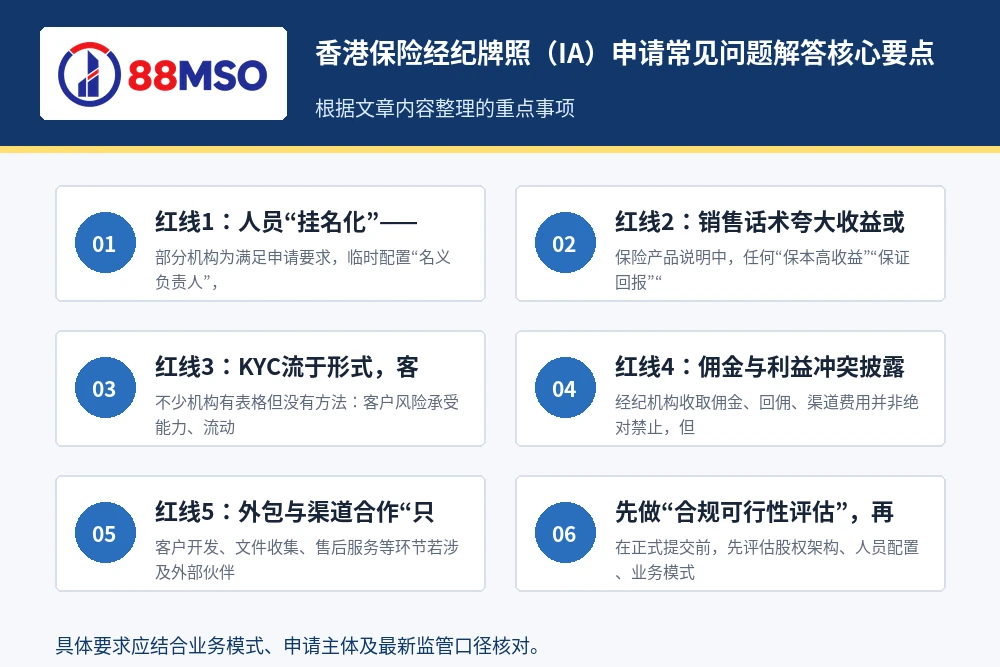
Red line 1:Personnel are "nominated" - have titles,No real job
In order to meet the application requirements, some institutions,Temporarily configure the "nominal responsible person",However, this person does not actually participate in the operation and management。This is a high risk approach。Supervision can be through interviews、Document review、Actual operation spot checks to determine the authenticity of positions。Once "nominal management" is recognized,Not only affects the application approval rate,It may also trigger subsequent disciplinary action。
Red line 2:Sales rhetoric exaggerates benefits or downplays risks
Insurance product description,Any expressions such as "guaranteed capital and high returns", "guaranteed returns" and "almost zero risk" may be misleading.。Especially when it comes to investment-linked life insurance (ILAS) or cross-border allocation products.,Must doAdequate risk disclosure、Full fee disclosure、Suitability assessment can leave a mark。
red line 3:KYC is just a formality,Customer portrait does not match product
Many organizations have forms but no methods:Customer risk tolerance、Liquidity needs、Guarantee goal filling template,Ultimately leading to “high-risk products being sold to low-risk customers”。Supervision is not just concerned about “whether you have done KYC”,Care more about you "How to use KYC results to form explainable product recommendations"。
red line 4:Untransparent disclosure of commissions and conflicts of interest
Brokers charge commission、commission、Channel fees are not absolutely prohibited,However, clear disclosure must be made under applicable rules,and establish a conflict of interest management mechanism。Hidden fees、selective disclosure、induced recommendation,They are all high-frequency violations.。
red line 5:Outsourcing and channel cooperation "only sign contracts",Not managing”
customer development、Document collection、If external partners are involved in after-sales service and other aspects,Licensed institutions still bear the main responsibility。No due diligence from partners、training、Monitoring and Auditing Mechanism,It is equivalent to outsourcing compliance risks to yourself.。
Four、Anti-Money Laundering (AML) and KYC:"Hard indicators" in IA review
FAQ 5:Do insurance brokers also have to do strict AML?
Yes。Insurance brokers do not have “no AML obligations unless the funds are deployed”。Supervision emphasizes risk-based approach,Especially more sensitive to the following scenarios:
- high premium、One-time large payment;
- Complex beneficiary arrangements or multi-tier holding structures;
- Clients in high-risk jurisdictions;
- Frequent policy surrenders、Change beneficiary、Abnormal trading behavior。
FAQ 6:What are the minimum points that KYC due diligence should cover?
- Customer identification and verification (individual/company);
- Beneficial owner identification;
- Rational verification of sources of funds and wealth;
- sanctions list、Negative public opinion、PEP screening;
- Continuous due diligence and transaction monitoring mechanism。
It is recommended to connect the KYC process with the sales process:Get customers from、consult、Product suggestion sign-in sheet、After-sales,Each node should have a leaving trace mechanism,Ensure traceability、Can be reviewed、Auditable"。
five、After the application is approved,Why can I still be punished?
FAQ 7:Where do the most common violations come from after taking a card?
Many penalties are not due to "significant fraud",But "long-term lax management"。Typical questions include:
- Internal policies have not been updated for many years,Out of step with the latest regulatory requirements;
- Employee training flows into signature,Lack of practical assessment;
- No hierarchical mechanism for handling complaints,No closed loop of rectification has been formed;
- Incomplete record keeping,Insufficient evidence during regulatory spot checks。
FAQ 8:How to establish a continuous compliance mechanism?
You can start with the “three lines of defense” idea:
- first course:Business department self-control (sales code of conduct、KYC execution、Discourse management);
- Second course:Compliance/risk control supervision (sampling review、Abnormal warning、System iteration);
- The third course:Internal audit or independent assessment (periodic physical examination、Issue tracking、Accountability and implementation)。
For cross-border exhibition teams,It is recommended to bring in external compliance consultants to conduct periodic reviews,Avoid "the system is well written"、Execution can’t keep up”。
six、Practical suggestions:How to improve the pass rate and reduce subsequent regulatory risks?
1) First do a “compliance feasibility assessment”,Restart application
before formal submission,Evaluate the shareholding structure first、Staffing、Whether the business model and target customer groups match regulatory requirements。Spend 1 extra month up front,Often can reduce subsequent rounds of replacement parts and communication costs。
2) Institutional documents must be “implementable”,Don’t just pursue a complete template
It is becoming easier for regulators to identify “templated policies”。Truly effective documentation should reflect your business processes、System capabilities and personnel division of labor。For example,Does the complaint handling policy specify time limits? Are there any triggering conditions for KYC review? Are there upgrade approvals for high-risk customers?
3) Turn compliance training into “scenario-based training”
Instead of conducting centralized propaganda once a year,It is better to conduct short-frequency and quick training around high-risk scenarios.:misleading sales、fee disclosure、Cross-border communication、Customer information protection, etc.,Supplemented by spot-check recording and case review,better effect。
4) Plan your bank account as early as possible、Capital flow and tax matching
Insurance brokerage business must operate stably,Inseparable from the account system、Coordination of capital traces and tax arrangements。If relevant supporting facilities lag behind,It is easy to lead to a decrease in delivery efficiency after signing the order.,Even trigger compliance doubts。
seven、Reminders for entrepreneurial teams and cross-border institutions
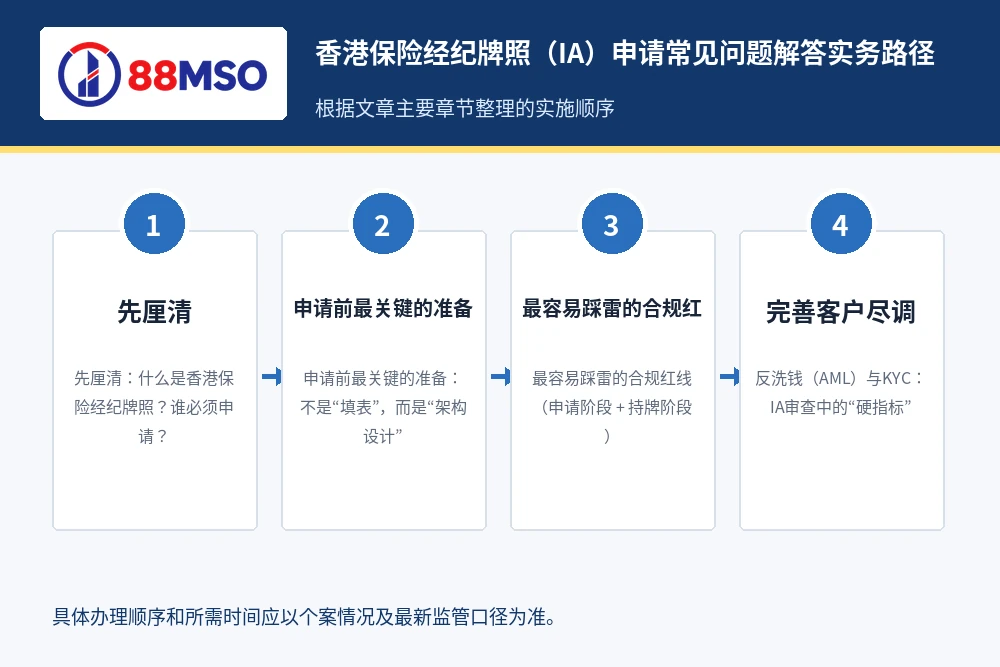
If you are entering the Hong Kong financial services market for the first time,It is recommended not to regard the IA license as a "single point approval matter",rather as part of an overall compliance program。A mature path usually includes:Company structure design、License application、AML/KYC system establishment、Personnel training、Continuous auditing and annual maintenance。For those who wish to lay out MSO simultaneously、SFC or Money Lender Business Institution,There is a greater need for a unified compliance base。
at this point,In the market, there are teams like 88MSO and its service system (88MSO) that have been deeply involved in Hong Kong’s financial licensing and compliance practices for a long time.,The value is often not just in “submission on behalf of others”,It is also about helping companies connect license applications with subsequent operations.,Reduce hidden compliance costs and regulatory friction。
Conclusion:real risk,It’s not “can’t get the card”,But "losing control after taking the card"
Hong Kong Insurance Broker License(IA) Difficulties in applying,It’s never just complicated procedures,Rather, regulatory requirements for “long-term compliance capabilities” are getting higher and higher.。What you need to build is a system that can stand up to scrutiny、Can support business growth、A compliance system that can continuously iterate。
If you sum it up in one sentence:Treat compliance first as business capabilities,Think of license plates as business tickets again。so,Not only can you increase your application approval rate,Better able to develop steadily in the subsequent regulatory environment,Truly regard Hong Kong as a long-term base for international insurance business and wealth management layout。
attached:High frequency FAQ quick check
- Q:How long does it usually take to apply for an IA license?
A:Depends on case complexity,Material quality、The frequency of replacement parts and the readiness of personnel for interviews will significantly affect the cycle time.。 - Q:Is it possible to start insurance sales while applying?
A:Generally not recommended。Carrying out regulated activities before meeting licensing requirements,There are obvious legal and regulatory risks。 - Q:Can an out-of-town team manage Hong Kong brokerage operations remotely?
A:Cross-border collaboration is possible,But key functions、Control responsibilities and local compliance arrangements need to meet regulatory expectations,Cannot "operate in a hollow manner"。 - Q:What compliance modules should be prioritized for investment?
A:Usually KYC/AML、sales suitability、Four modules of complaint handling and record keeping。
The conditions for obtaining a license must include a record of continued operations.
Hong Kong Insurance Broker License(IA) Application FAQs are not just one-time application questions。The company should assign the responsibilities of the person in charge and business representatives、Customer needs analysis、product comparison、Commission or Interest Disclosure、Customer payment processing、Complaints and file saving are written into executable processes,and leave training、Spot checks and rectification records。
Financial aspects should continuously check capital and net assets、professional indemnity insurance、Separate Client Accounts and Bookkeeping Requirements。When comparing insurance brokerage and insurance agency models,The focus should be on who is represented、What products are available?、How to assume ethical responsibilities and how customer payments are handled,Rather than just comparing license plate names。