 简体中文
简体中文 繁體中文
繁體中文 English
introduction:Doing "selling insurance" together,Why are the license plate paths so different?
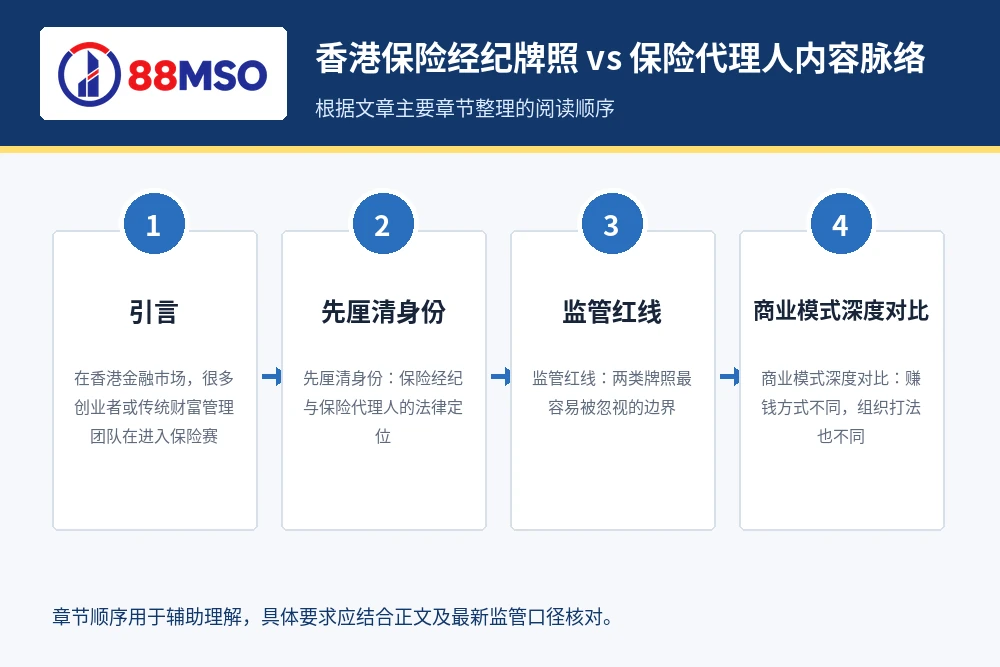
in Hong Kong financial markets,Many entrepreneurs or traditional wealth management teams enter the insurance track,The first multiple choice question is:DoInsurance Broker,Still do itInsurance agent?
On the surface,Both sell insurance products,All need to be licensed and supervised;But from a legal perspective、Customer Responsibilities、product neutrality、revenue structure to subsequent scalability,Two paths are almost two business models。Wrong path chosen,At worst, profit margins are locked up,If it is serious, it will step on the red line of compliance.,Affecting license renewal and even triggering regulatory penalties。
This article will start from the regulatory framework、business boundaries、Profit model、Five dimensions of compliance costs and transformation difficulty,depth contrastHong Kong Insurance Broker License vs insurance agent,And combine it with practical perspectives to give decision-making suggestions that are suitable for different teams.。For plans to simultaneously lay out MSO、SFC or Money Lender Business Institutions,This is also a key part of the financial license portfolio design。
one、Clarify your identity first:The legal positioning of insurance brokers and insurance agents
1. insurance broker:"Independent consultant" representing client's interests
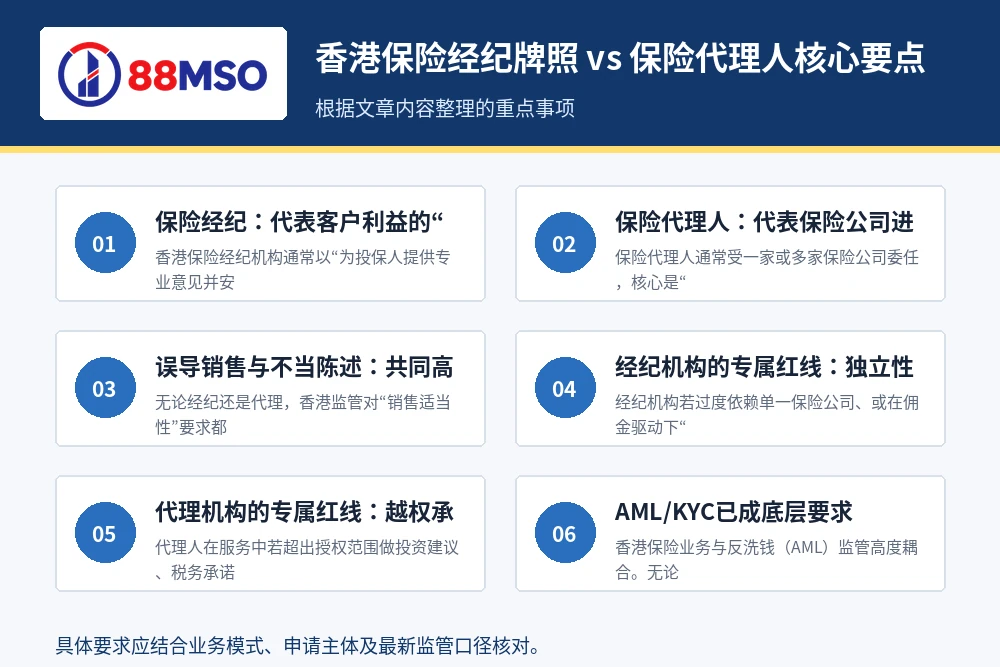
Hong Kong insurance brokerage institutions usually have “providing professional advice to policyholders and arranging insurance contracts” as their core responsibilities。Its key features are:
- The service object is the customer,rather than a single insurance company;
- Can be connected to multiple insurance companies’ products,Has a relatively neutral product screening space;
- Analysis of needs、Plan comparison、Continuous service assumes higher professional responsibility。
this means,The brand value of a brokerage company comes from "independence + professionalism",Configurable through complex policies、Cross-border protection plan、Corporate group insurance and high-net-worth wealth inheritance and other services establish long-term barriers。
2. insurance agent:Distribution on behalf of insurance companies
Insurance agents are usually appointed by one or more insurance companies,The core is “selling products on behalf of insurance companies”。Its key features are:
- The essence is distribution channel,Closer relationship with the appointing company;
- The range of products that can be sold is limited by the appointment relationship;
- Speech skills、training、The business development process is more dominated by the insurance company system。
The agency path is common in individual business development teams、Traffic-based sales organizations or start-up teams looking to get to market quickly,Fast initial setup,However, long-term “independent product capabilities” and brand independence are weak。
two、Regulatory red line:The most easily overlooked boundary between the two types of license plates
1. Misleading sales and misrepresentation:common high voltage line
No matter broker or agent,Hong Kong regulations have very strict requirements on “sales suitability”,Especially when it comes to savings insurance、investment linked insurance、More sensitive when dealing with cross-border customers。The following behaviors are considered high risk:
- exaggerate earnings、downplay risks;
- cost of policy、lock-in period、Insufficient explanation of surrender losses;
- The assessment of a client’s financial situation and risk tolerance is a mere formality;
- Not enough traces,It is impossible to prove afterwards that suitability procedures were completed。
Many institutional problems do not lie in “intentional violations”,It’s about front-end performance、Backend compliance capabilities cannot keep up。Especially teams that have transitioned from wealth management,It is easy to apply “financial management sales habits” directly to the insurance business,leading to an increase in complaints and disputes。
2. The exclusive red line of brokerage institutions:Independence and Conflict of Interest Management
If a brokerage institution relies too much on a single insurance company、or in a commission-driven "named brokerage"、Really an agent”,Will trigger regulatory attention。Common risk points:
- Failure to fully disclose interest relationships with product providers;
- Recommendation logic cannot reflect "multiple options comparison";
- Internal reward mechanisms are overly oriented toward high-commission products。
The brokerage model is most afraid of "formal independence"、Not essentially independent”。once questioned,Brand reputation and license renewal evaluation will be affected。
3. The agency’s exclusive red line:Ultra vires promises and "consultation" misleading
If the agent provides investment advice beyond the scope of authorization during the service,、tax commitments、legal interpretation,There are compliance risks。Especially in the scenario of high net worth customers,Agency teams often over-commit because they “want to enhance their sense of professionalism”,It is easy to cause controversy in the future。
4. AML/KYC has become a low-level requirement,rather than "additional actions"
Hong Kong’s insurance business and anti-money laundering (AML) supervision are highly coupled。Regardless of broker or agent,Enforceable KYC should be established、Suspicious transaction identification、Customer risk classification and continuous monitoring mechanism。Supervision is not only concerned with “whether there is a system”,It’s more about “whether the system is implemented?”。
three、Business model comparison:Different ways of making money,The organizational style of play is also different
1. income structure:One-time commission vs ongoing service value
proxy modeUsually more dependent on policy sales commissions,Suitable for "high execution、A team that converts quickly;Brokerage modelIn addition to commission,Easier to add consulting services、enterprise risk management、Long-term income such as insurance renewal management。
Simply put:
- Agent emphasizes "large-scale distribution capabilities";
- Brokers emphasize “customer lifetime value (LTV) and professional premium”。
2. Customer relationship ownership:Channel relationship or consultant relationship?
Agency-client relationships tend to be more closely tied to the insurance company system;Brokerage-client relationships are more biased towards the institution’s own assets。This determines the logic of corporate valuation:
- Agency team valuation often depends on premium size、conversion efficiency、manpower expansion capability;
- Brokerage team valuation depends more on customer retention、Solution complexity、Cross-category synergy capabilities。
3. Scalability:Is it suitable to be a "license combination"?
If the company’s mid- to long-term goal is to build an “insurance + securities + payment + cross-border wealth” ecosystem,Brokerage models are often more collaborative,Because it naturally requires multi-product comparison and customer demand analysis capabilities,Facilitates future access to other licensed service modules。
This is also the time when many institutions are conducting compliance layout in Hong Kong.,We will first put the insurance license strategy into the overall framework and design it.,rather than looking at a single business line in isolation。
Four、Costs and Thresholds:Don’t just look at application speed,It also depends on long-term maintenance capabilities
1. Applying for a license is just the starting point,Annual review and maintenance is the main battlefield
Many teams focus on “how long it will take to get the certificate”,But what really affects long-term operations is:
- Do the internal compliance systems and process documents match the real business?;
- Are key personnel (including compliance and management roles) stable?;
- training、Complaint handling、Whether sales traces form a closed loop;
- Can the chain of evidence be quickly provided during regulatory inspections?。
From practical experience,Poor maintenance of licenses is the source of later risks for most institutions,Especially during periods of rapid business growth,Disconnect between front and back is the most common。
2. Differences in talent structure:Sales driven vs professional driven
Agency model replicates sales force faster,But it requires high training and behavior management;Brokerage model versus professional advisor、product research、Compliance operation requirements are higher,The initial organizational setup cost is heavier,But long-term moats are more stable。
3. Technology and system investment:Brokers rely more on “demonstrable compliance”
Brokerage models usually require stronger data and process management capabilities,For example, requirements analysis records、Plan comparison leaving traces、Customer confirmation mechanism, etc.。No systematic support,Compliance costs will increase sharply as scale increases。
five、Which teams are suitable for brokerage licenses? Which ones are better suited for the proxy path?
A more typical portrait for an insurance broker license
- Existing wealth management customer base,Hope to strengthen professional service capabilities;
- Target customers are high net worth、business owner、cross-border families;
- Plan to deploy multiple licenses in the medium and long term、Multi-product line collaboration;
- Willingness to invest in compliance、Training and system construction,Build a long-term brand。
A typical portrait more suitable for the insurance agency path
- Taking sales execution and channel expansion as core competitiveness;
- Want to start your business quickly、Shorten the payback period of initial investment;
- The team focuses on personal IP or traffic conversion,Product complexity is low;
- The stage goal is to verify the market,Consider upgrading to a more independent mode again。
six、Upgrade from agent to broker,Is it feasible? Three key things to look at
The answer is yes,But it’s not as simple as “changing the name of the license plate”。The upgrade path usually involves completing the following refactorings:
- organizational restructuring:Shift from sales orientation to "sales + consulting + compliance" trinity;
- process refactoring:Establish a standardized requirements analysis、Product screening and disclosure mechanism;
- rebranding:Upgrading from "people who sell products" to "people who manage risks and security"。
in this process,Seek assistance from a team with practical experience in local supervision in Hong Kong,Often significantly reduces trial and error costs。Service organizations like 88MSO/88MSO that have long been involved in the custody of Hong Kong financial licenses,Its value often goes beyond “application on behalf of others”,It’s about helping companies build a sustainable compliance management framework.。
seven、Practical suggestions:6 actions to avoid stepping on the red line
- Decide on business model first,Redetermine the license plate path:Don't do the other way around。
- Establish a chain of evidence for sales suitability:Every recommendation can be traced back to the reason。
- Put AML/KYC in the customer acquisition process:Instead of supplementing information after signing the order。
- Design conflict of interest disclosure mechanisms:Especially brokerage agencies。
- Treat annual review and compliance inspection as “quarterly projects”:Don't improvise。
- Reserve space for upgrades:organize、system、Talent allocation according to three-year target。
Conclusion:A license is not a ticket,It’s the underlying code of the business model
“Hong Kong Insurance Broker License vs insurance agent” It’s not about who is more advanced,But who is more suitable for your strategic stage?。
If you pursue rapid distribution and short-cycle growth,The agency model has practical advantages;If you are aiming for a long-term brand、Cross-border family asset allocation and multi-license coordination,The brokerage model is more scalable。real key,It’s not about which license plate you got.,But whether a license plate matching theCompliance capabilities、Organizational capabilities and customer value delivery capabilities。
In Hong Kong, this regulation is mature、highly competitive market,Compliance is not a cost center,But a growth moat。The sooner you can clearly see the red lines of your business、Make the business model a reality,The better you can take the initiative in the future global wealth management competition。
The conditions for obtaining a license must include a record of continued operations.
Hong Kong Insurance Broker License vs insurance agent is not just a one-time application issue。The company should assign the responsibilities of the person in charge and business representatives、Customer needs analysis、product comparison、Commission or Interest Disclosure、Customer payment processing、Complaints and file saving are written into executable processes,and leave training、Spot checks and rectification records。
Financial aspects should continuously check capital and net assets、professional indemnity insurance、Separate Client Accounts and Bookkeeping Requirements。When comparing insurance brokerage and insurance agency models,The focus should be on who is represented、What products are available?、How to assume ethical responsibilities and how customer payments are handled,Rather than just comparing license plate names。
Industry references:Hong Kong Insurance Authority:Supervision Code for Licensed Insurance Brokers。