 简体中文
简体中文 繁體中文
繁體中文 English
Hong Kong MSO license renewal,It’s not as simple as “handing in a form”
Many institutions are gettingHong Kong MSO Licenseback,The most common misunderstanding is:Understand renewal as an "administrative action",I think it is enough to submit license renewal documents on time。The reality is just the opposite。forHong Kong Customs and Excise DepartmentIn terms of,Whether the MSO licensee continues to comply with regulatory requirements,The core is not “whether or not the materials have been handed in”,But lies inIs your business truly operating in compliance with anti-money laundering and counter-terrorism financing requirements?,And whether it can be completed during random inspections、traceable、Logical closed-loop compliance evidence。
This article will focus on the three most critical issues:How to arrange the renewal timeline、What are the key points to look for in customs on-site inspections?、How to transform compliance ledgers from “formal” to “auditable”。If you want to manage license renewal risks in advance,rather than temporary fire-fighting,This practical guide can be implemented directly。
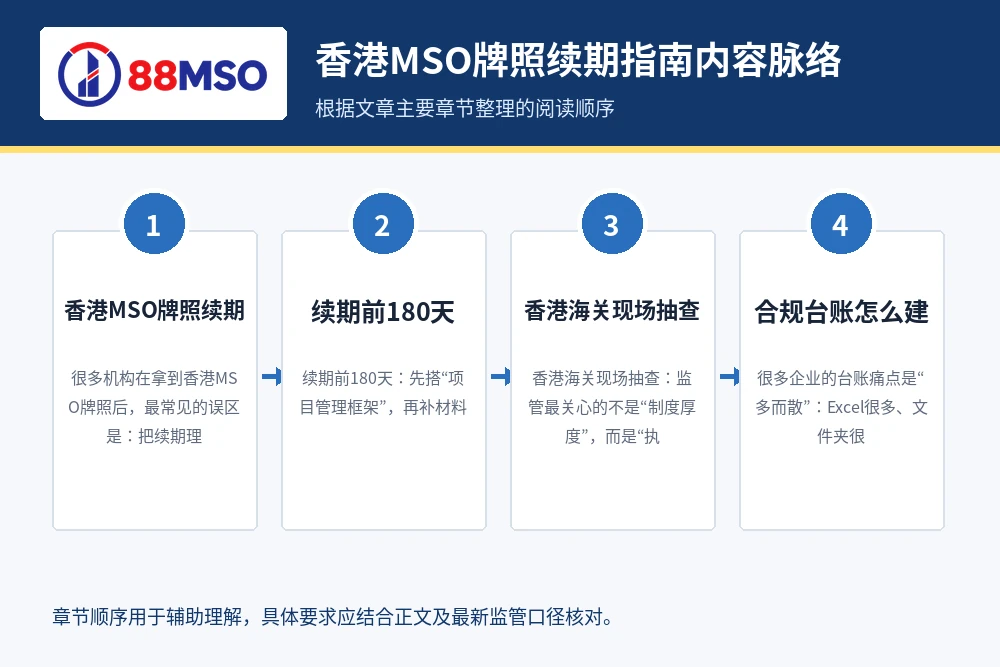
one、180 days before renewal:First build a “project management framework”,Replenish materials
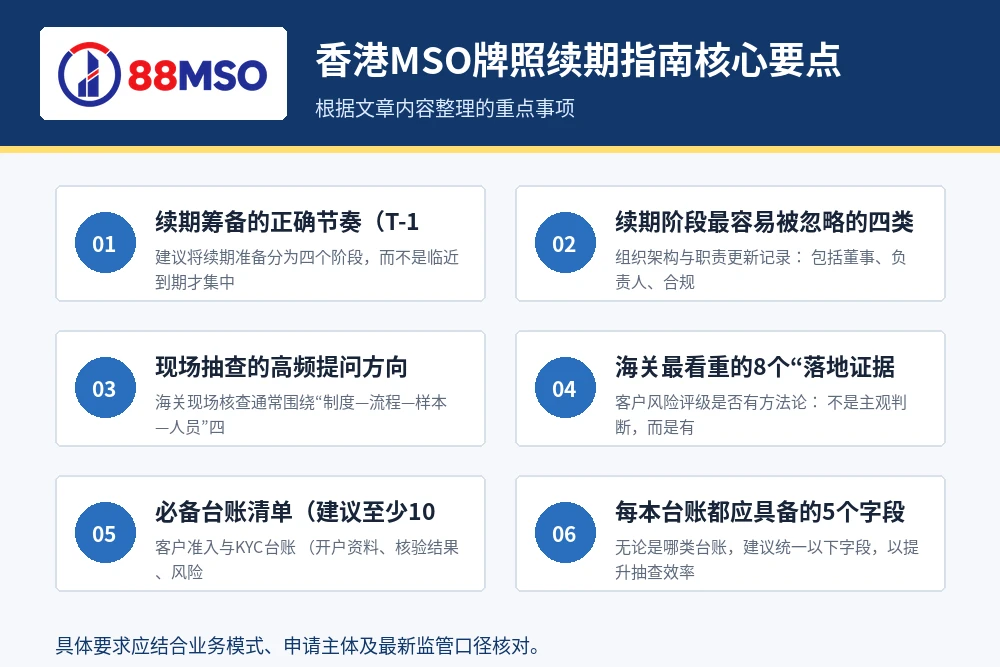
1. The correct pace of renewal preparations (T-180 to T-0)
It is recommended that renewal preparations be divided into four stages,Instead of focusing on processing when the expiry is approaching:
- T-180~T-120:Compliance Health Check (System、Ledger、Transaction monitoring、training、audit records)。
- T-120~T-90:Gap rectification (supplementary evidence chain、Revision policy、Supplementary training、Supplementary penetration verification)。
- T-90~T-45:Compilation of renewal documents and management approval,Prepare a list of possible replacement parts。
- T-45~T-0:Simulated spot check drills and on-site speech skills are unified,Make sure the front desk、operations、Compliance、Management has the same voice。
In practice,What really takes time is not filling out the form,Rather"Evidence Consistency" Calibration。For example, your AML policy says "review high-risk customers once a year.",Then you must be able to show:customer list、Review date、reviewer、Review conclusion、Follow-up measures。any link missing,may be regarded as implementation deviations。
2. The four types of information that are most easily ignored during the renewal stage
- Organizational Structure and Responsibilities Update Record:including directors、person in charge、Is the division of responsibilities of the Compliance Officer (MLRO) consistent with reality?。
- Business model change description:If new cross-border payment corridors are added、Agency channel、Customer type,There should be records of risk assessment and control upgrades。
- Evidence of outsourcing management:If sanctions screen、System monitoring、Customer verification is outsourced,Requires due diligence、SLA、Supervision mechanism。
- Proof of training “effectiveness”:Not just a sign-in sheet,Exam results should also be included、Retraining for wrong questions、Job differentiated course records。
two、Hong Kong Customs on-site inspection:What supervision is most concerned about is not the “thickness of the system”,But "execution depth"
1. High-frequency questioning directions for on-site spot checks
Customs on-site inspections usually revolve around the four levels of "system-process-sample-personnel":
- Institutional level:AML/CFT Policy、KYC policy、risk rating method、Is the suspicious transaction reporting mechanism up to date and enforceable?。
- process layer:Open an account、Transaction monitoring、Review、Upgrade Approval、Does the freezing/rejection transaction process work?。
- sample layer:Extract customer files and transaction records,Check whether the due diligence evidence is complete、consistent。
- Personnel level:Do the frontline and backend know "when to upgrade compliance", "who approves" and "how long it takes to complete"。
The problem of many organizations is that "the documents are beautiful but the processes are broken":Policy requires high-risk customers to strengthen due diligence,But there are no high-risk labels in the system;Or the label has,But no review reminder was triggered。Such faults are very sensitive during spot checks.。
2. The 8 "landing evidence points" that the customs values most
- Is there a methodology for customer risk rating?:Not a subjective judgment,Instead, there is a rating dimension (region、industry、trading behavior、beneficiary complexity, etc.)。
- Whether beneficial owner identification “penetrates to natural persons”:Complex shareholding structures especially require complete links。
- Do high-risk clients trigger EDD?:Strengthen due diligence to see if there is actual implementation evidence and approval points。
- Are transaction monitoring rules dynamically updated?:threshold、scene、Is the false positive processing logic reviewed regularly?。
- Does suspicious transaction processing leave traces?:identify、Research and judge、Report、internal communication、The reasons for closing the case must be traceable。
- Is sanctions list screening ongoing?:Not only account opening screening,There should also be existing customer and pre-transaction screening mechanisms。
- Whether records are kept within the statutory time limit and are retrievable:It is necessary to be able to quickly retrieve the original records during spot checks。
- Is management truly involved in compliance governance?:meeting minutes、Risk report annotation、Recording of resource investment is key。
three、How to create a compliance ledger,Only then can "license renewal be available"、Can be audited by random inspection、Management is manageable”
The pain point of many companies’ ledgers is that they are “too many and too scattered”:Excel a lot、Many folders,But no key evidence could be found。It is recommended to build a ledger based on “supervisory question and answer logic”,Rather than dispersing storage according to departmental habits。The ledger framework that can be directly applied is given below。
1. List of necessary ledgers (recommended at least 10)
- Customer access and KYC ledger(Account opening information、Verification results、risk rating、Approval path)
- Beneficial owner (UBO) penetration ledger(Ownership structure chart、supporting documents、Update time)
- High-risk customer EDD ledger(Trigger reason、Supplementary material、management approval)
- Transaction monitoring and early warning disposal ledger(Alert number、disposer、in conclusion、review)
- Internal reporting and external reporting ledger of suspicious transactions(timestamp、node、confidentiality control)
- Sanctions Screening Ledger(Screening tool、List version、hit handling)
- Employee training and assessment ledger(job courses、Test results、Supplementary training records)
- Internal audit and rectification closed-loop ledger(question、Responsible person、Rectification period、Review results)
- Complaints and abnormal event ledger(Event rating、investigation、corrective and preventive measures)
- License maintenance and annual review milestone ledger(Legal deadline、person in charge、completion status)
2. 5 field logic that every ledger should have
No matter what kind of account it is,It is recommended to unify the following fields,To improve the efficiency of spot checks:
- unique number:Guaranteed to be searchable、Can be associated。
- Trigger basis:regulatory provisions、Internal policy clause or system rule number。
- Processing:Who made what decision when。
- Review conclusion:Second-line compliance or management confirmation。
- Evidence attachment:file path、Original location、System screenshot index。
The value of these five fields lies in:When the customs asks about any case,You can complete the "fact restoration" within 1-3 minutes。
3. Collaboration between ledger and system:Avoid the risk of "manual supplementary registration"
If the ledger is completely dependent on manual labor,A common problem is lag、Omissions and inconsistent caliber。A better approach would be:Let the business system automatically push key fields to the compliance ledger,The compliance team will then review and mark the。Even if it cannot be fully systematized in the short term,Three semi-automatic functions should also be implemented first:
- Automatic reminders for changes in customer risk levels;
- Automatic recording of high-amount/high-frequency transaction trigger warnings;
- List screening hit results are automatically archived。
Four、"48-hour sprint checklist" before on-site inspection
1. Personnel preparation:Unifying the caliber is more important than "going against the system"
- Frontline staff know when to reject a deal、When to upgrade compliance;
- Operations staff can demonstrate transaction monitoring and trace paths;
- MLRO can explain the processing logic of high-risk cases in the past 12 months;
- Management can explain compliance resource investment and rectification mechanism。
2. Document preparation:Organized by "question path",rather than by department directory
It is recommended to create a "spot check master index package",The first-level directory can be set to:Customer due diligence、Transaction monitoring、suspicious transactions、Sanctions Screening、training audit、Closed loop of rectification、License renewal documents。Each directory comes with a "document map",Indicate file name、Update time、Responsible person。
3. Scenario walkthrough:Do at least one "reverse questioning"
Let the compliance team simulate regulatory questions,Working backwards from a high-risk transaction:Customer access—Risk rating—Transaction warning—Research and judgment—Management knowledge—Follow-up measures。As long as one of the nodes is unclear,This shows that the ledger is not “supervisory friendly” enough.。
five、Common failure causes and repair strategies
- Failure reason 1:Policy version is too old。
repair:Set up an annual policy review mechanism,Major regulatory updates trigger temporary revisions。 - Failure reason 2:High-risk customers “have a list but no action”。
repair:Set up review SLAs for high-risk customers,Automatically upgrade management after expiration。 - Failure reason 3:Ambiguous criteria for judging suspicious transactions。
repair:Develop a library of red flag scenarios,Combining historical cases to train frontline judgment。 - Failure reason 4:Training becomes a mere formality。
repair:Position-level training + examination + questioning,Incorporate training results into performance and authority management。 - Failure reason 5:Data is scattered,Unable to respond quickly during spot checks。
repair:Establish a unified evidence base and ledger master index,Monthly random inspection of "timeliness of retrieval"。
six、Treat renewal as “business capability upgrade”,rather than compliance costs
High-quality MSO compliance system,It brings more than just "passing the spot check"。It can also significantly improve three business indicators:Customer access quality、Abnormal transaction identification efficiency、Cross-border partner trust。Especially now, cross-border capital flows are more transparent、Against the backdrop of a more complex international sanctions environment,Compliance capabilities have become the basic competitiveness of financial business。
From industry practice,More and more institutions choose to introduce external experts to conduct a closed loop of "pre-review + rectification + drill" before renewal.,The core purpose is not to process documents,Instead, establish a compliant operating system that can sustainably operate。Take the sample of enterprises served by 88MSO as an example,Mature practices often include:License renewal reverse plan、Spot check Q&A database、Ledger template standardization、Accompanying training for key positions, etc.。This kind of preliminary work,Often can significantly reduce on-the-spot uncertainty。
Conclusion:A truly reliable license renewal,From "Verifiable Daily Compliance"
The essence of Hong Kong MSO license renewal,It is a comprehensive physical examination of the company’s compliance and governance capabilities.。Customs on-site inspections are not scary,The scary thing is that companies usually do not form a closed loop of "system - execution - leaving traces - review"。As long as you advance the timeline、Make the chain of evidence solid、Turn ledgers into auditable assets,Renewal is no longer a stress point,It will become a milestone in upgrading organizational capabilities.。
If you are preparing to renew your license in the next cycle,Let’s do one thing first from today:Randomly select 3 high-risk customer files,Check whether the due diligence and transaction monitoring process can be completely restored within 5 minutes。this little test,often says more about your compliance maturity than any slogan。
First determine whether the business falls within the scope of MSO based on capital flow.
When evaluating Hong Kong MSO license renewal guidelines,What should be handed over from the customer to the company?、How the company exchanges or remits、Which accounts do the funds go through?、What assets are finally delivered to start drawing the capital flow?。Just looking at the product name is not enough to determine the scope of regulation;Involving legal currency exchange、Cross-border remittance、When collecting and paying virtual assets or third parties,It is also necessary to check separately whether other regulatory systems are applicable at the same time.。
Application and going concern information should cover actual business location、Equity and ultimate owners、fit and proper person、business plan、risk assessment、Customer due diligence、Sanctions Screening、Transaction monitoring、Report suspicious transactions、Record keeping and staff training。During on-site inspection,Institutional documents、Sampled customer files and bank statements must be mutually corroborative。
Read more:How do exchange shops deal with surprise inspections by Hong Kong Customs? money service operator(MSO)Crisis Response Guide、VASP license combined with MSO license:Compliance plan for stablecoin exchange business。