 简体中文
简体中文 繁體中文
繁體中文 English
US MSB vs Canadian MSB license:Why is this comparison important for cross-border businesses?
Pay globally、exchange、Crypto-assets and cross-border financial services are developing rapidly,The North American market is still dominated by many fintech companies、The "first stop" for priority layout of payment institutions and Web3 projects。And before entering North America,One of the core problems that companies most often encounter is:Should I apply for a US MSB first?,Or Canadian MSB?
Many entrepreneurial teams will simply understand the two as "both are called MSB",Not much difference”,However, in practice, the regulatory logic of the two、Depth of compliance、cost structure、There is a clear difference in business scalability。Wrong path chosen,Repeat investment、Delayed launch,In severe cases, regulatory investigations will be triggered.、Bank account restricted,It may even affect subsequent financing and institutional cooperation.。
This article will start from the application threshold、Compliance requirements、Cost structure、Five dimensions of operation, maintenance and strategic adaptation,Make a comprehensive, actionable comparison。For companies that want to simultaneously expand into the Hong Kong and North American markets,It will also give more practical linkage suggestions.,Helping you find the balance between regulatory compliance and business growth。
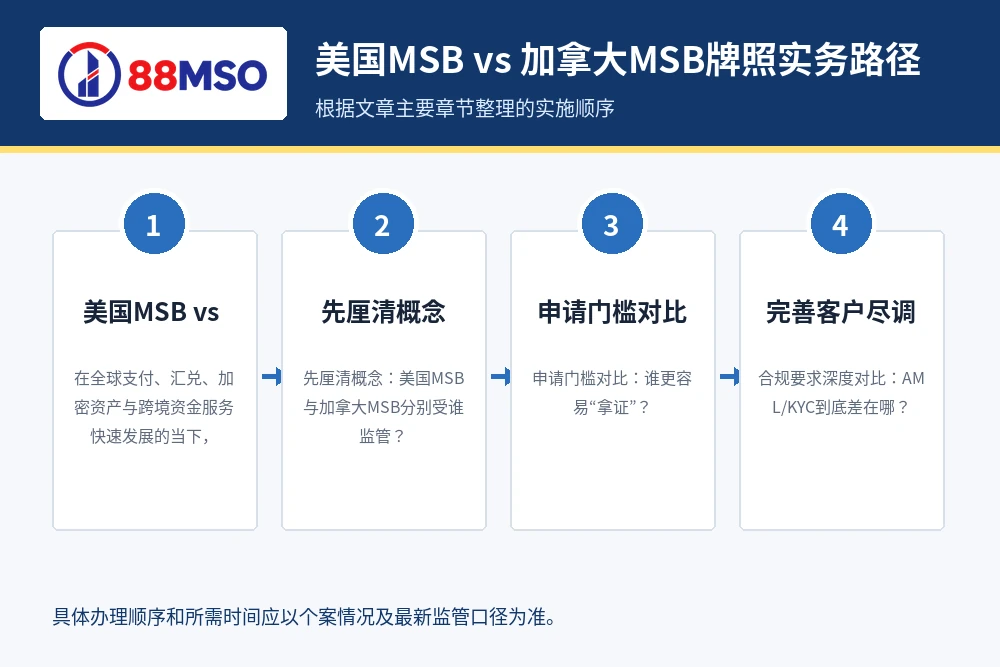
one、Clarify the concept first:Who regulates US MSBs and Canadian MSBs respectively?
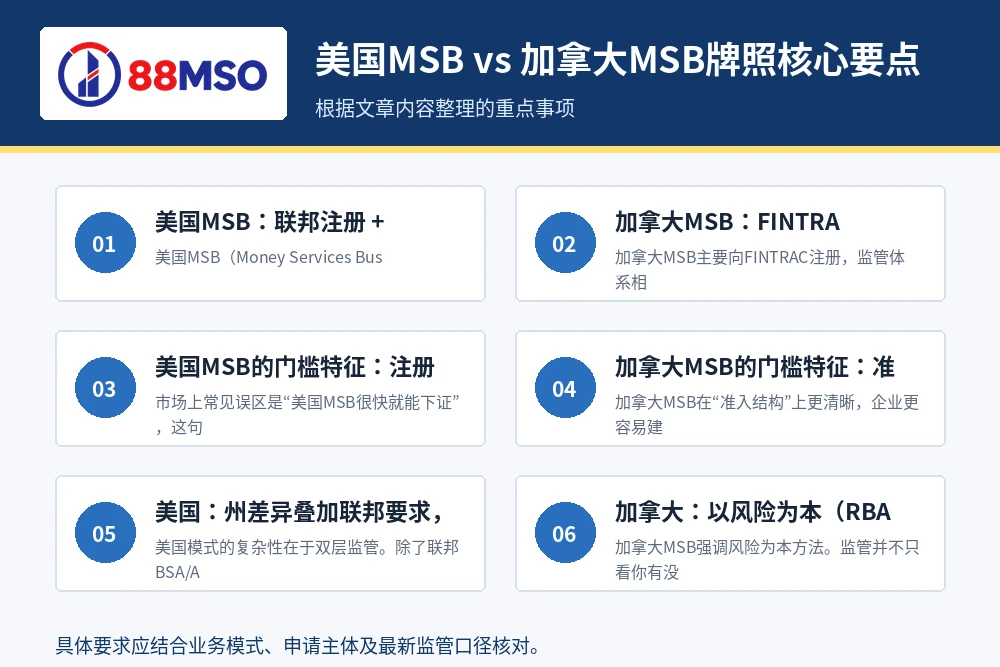
1. MSB USA:Federal registration + state license concurrent
MSB (Money Services Business) in the United States usually first completes registration at the federal level with FinCEN,This is only the first step。What really determines whether you can do business in a particular state,Often state Money Transmitter License (MTL) or similar licensing requirements。
- federal level:FinCEN Registration、BSA/AML requirements、Suspicious Transaction Report (SAR), etc.。
- state level:Application standards for each state、margin、net capital、audit、Filing systems vary。
- result:The “National Exhibition of Business” in the United States cannot be accomplished with just one license plate,Instead, they attacked the state in stages.、Gradually expand。
2. Canadian MSB:FINTRAC dominates,A more centralized federal regulatory framework
Canadian MSBs are primarily registered with FINTRAC,The regulatory system is more centralized than in the United States,Institutional synergy is usually higher for cross-provincial operations。For businesses,The system is more predictable,Especially suitable for limited initial resources、A team that hopes to quickly verify the North American market first。
- core regulatory agencies:FINTRAC (Financial Transactions and Reports Analysis Center of Canada)。
- Key obligations:KYC、Transaction monitoring、record keeping、Suspicious transaction/large transaction report。
- result:Compliance paths are relatively unified,But it doesn’t mean “loose”,Substantive examination becomes more and more detailed。
two、Application threshold comparison:Who is easier to "get the certificate"?
1. Threshold characteristics of US MSB:Registration is easy,The real difficulty lies in state licenses
A common misunderstanding in the market is that "US MSB will be certified soon",This sentence is only half true。The federal registration process is indeed controllable,But if your business involves transferring money、money transfer、Wallet service、Legal currency deposits and withdrawals, etc.,State licensing requirements will become a core difficulty。
Typical challenges include:
- Application document standards vary widely across states;
- background on executives、Compliance history、Business model explanation requires high requirements;
- Net capital and margin pressure are obvious;
- Review cycle is affected by state regulatory schedules,Time uncertainty is high。
2. Threshold Characteristics of Canadian MSBs:Clear access,However, compliance materials must be systematic
Canadian MSB is clearer on “access structure”,Make it easier for businesses to establish project timelines。However, FINTRAC attaches great importance to the integrity of the anti-money laundering system.,especially:
- Is there an enforceable AML policy?,rather than templated files;
- Is the person responsible for compliance clearly designated and has a training mechanism in place?;
- Whether there is a customer risk rating、Continuous due diligence、Suspicious transaction reporting mechanism;
- Whether it can cooperate with subsequent spot checks and audits。
In other words,Canada is not a “low-threshold gateway”,But "the rules are more unified"、"Execution needs to be authentic" model。
three、In-depth comparison of compliance requirements:What is the difference between AML/KYC?
1. USA:State differences overlay federal requirements,Compliance granularity is finer
The complexity of the U.S. model lies in double-layer regulation。In addition to federal BSA/AML requirements,State regulators on consumer protection、Fund isolation、Complaint handling、Business disclosures may also impose additional requirements。For internal enterprises,this means:
- Compliance systems need to support “configuration by state”;
- State-specific legal mapping is required before the product is launched online.;
- Transaction monitoring rules need to be more detailed,Avoid “one set of rules running the country”;
- Reporting and file management require high traceability。
2. Canada:The risk-based (RBA) framework is more prominent
Canadian MSB emphasizes risk-based approach。Supervision does not just look at whether you have documents or not,But it depends on whether you are based on the type of customer、area、Trading behavior dynamically adjusts control intensity。
Practical focus:
- Enhanced due diligence (EDD) for high-risk customers;
- Is the abnormal behavior identification logic clear and explainable?;
- Whether the KYC traces are complete can be verified;
- Is employee compliance training ongoing and documented?。
For cross-border payments、OTC、Web3 related business,If the transaction path is complex,FINTRAC usually pays more attention to the explanation chain of source and use of funds.。
Four、Comprehensive cost comparison:Don’t just look at the “application fee”
1. US MSB Cost Structure
True costs in the U.S. are often determined by “state license expansion strategies”。Common cost items include:
- Company establishment and basic legal costs;
- Federal registration and compliance documentation costs;
- State License Application Fee、NMLS related fees (varies by state);
- Capital tied up due to margin/net capital requirements;
- Compliance team、external consultant、Audit and system investment;
- Subsequent license renewal、annual report、Check response costs。
If the goal is to cover multiple core states in the short term,The U.S. path budget should be planned in “staged increments”,rather than a one-time static budget。
2. Canadian MSB Cost Structure
Canada as a whole has less pressure on “multi-regional coordination”,But it does not mean that the total cost is low。The core lies in whether your business model will trigger higher-level monitoring、System and staffing requirements。
- Registration and entity compliance costs are relatively predictable;
- AML system construction and process implementation are the main investment points;
- Transaction monitoring systems and audit preparation determine long-term costs;
- If virtual asset services are involved,Collaborative investment in technology and compliance will increase。
3. The correct way to determine costs:See "Total Cost of Ownership (TCO)"
Many companies only compare “certificate fees”,Ignoring the continuous compliance investment for 12-24 months after obtaining the certificate。A more scientific way is to compare:
- entry cost(application period)
- expansion costs(New State/New Products/New Cooperative Bank)
- sustaining costs(personnel、system、audit、Report)
- non-compliance cost(rectification、fine、Account freeze、brand loss)
five、Business adaptation comparison:Which side is more suitable for your scene?
More suitable for situations where US MSB is given priority
- You already have a clear US state market strategy (such as 3-5 key states first);
- Target customers are concentrated in payment/remittance scenarios in the United States;
- Have stronger capital and compliance teams,Affordable for state license complexity;
- Medium and long-term plans for in-depth cooperation with large American institutions。
More suitable for situations where Canadian MSB is preferred
- Looking to quickly enter North America with a more centralized regulatory framework;
- The initial team size is limited,Need to reduce the difficulty of parallel supervision;
- Business is based on cross-border collection and payment、Digital asset-related service pilots mainly;
- Pay attention to the "compliance first and run-through model",A sound strategy to further expand the market”。
six、Linkage with Hong Kong’s compliance system:North American license plates are not an isolated project
For many Asian companies,North American licenses and Hong Kong license layouts often occur simultaneously。For example:On the one hand, enterprises promote Hong Kong MSO or SFC-related compliance,On the one hand, try the North American payment or digital asset business。The real challenge at this time is not “single license application”,And inCross-jurisdictional compliance architecture design:
- How group-level AML policies are compatible with multiple regulatory requirements;
- How to achieve “layered unification” of customer due diligence standards;
- How to implement regional implementation of transaction monitoring and reporting system、Headquarters visual management;
- Bank account opening、clearing channel、How to match third-party payment cooperation with license status。
seven、Common Misunderstandings and Risk Tips
Myth 1:Take an MSB first,Available worldwide
MSB is essentially a legalized regulatory license,There is no such thing as “one photo covering the whole world”。Cross-border exhibitions must evaluate target market licensing requirements on a case-by-case basis。
Myth 2:A template AML file is considered compliant
Regulation increasingly emphasizes “enforceability” and “evidence chain”。no actual process、System and training support documentation,It is difficult to pass substantive examination。
Myth 3:Run business first,Replacement license
Operation first and compliance later is extremely risky in the financial field,May cause historical transactions to be reviewed retrospectively,Impact on bank cooperation and subsequent financing due diligence。
Myth 4:Only pay attention to the application time,No follow-up maintenance
What really widens the gap is the ability to continue to comply with regulations after obtaining a license.,including reporting quality、Audit preparation、Supervisory communication response efficiency, etc.。
Conclusion:US MSB and Canadian MSB,There is no "best",Only "best match"
If you are pursuing deep market and long-term scale in the United States,The US MSB route has more strategic value,But the complexity and investment are also higher;If you want to get started with North American compliance faster、Verify business with unified framework,Canadian MSB is often more suitable as the first stop。
No matter which path you choose,The suggestions all follow the same principle:Focus on business model,Based on regulatory enforceability,Make decisions based on long-term maintenance costs。What you get in this way is not just the "license result",Rather, it is a set of sustainable cross-border financial operation capabilities.。
For companies that plan to promote the layout of Hong Kong and North American licenses at the same time,The overall architecture design should be carried out as early as possible。Compliance is not the opposite of growth,It is precisely the cross-border financial business that is moving toward institutionalization.、Scale and Capitalize Infrastructure。
Federal registration and state licensing need to be planned separately
Analysis US MSB vs. Canadian MSB licensehour,A distinction should first be made between MSB registration at the federal level and state money transmission licenses。Whether a business requires a state license cannot just depend on the state in which the company is registered.,And it should be combined with the location of the customer、Fund transmission path、proxy network、Virtual currency activities and state definitions of related conduct are determined on a state-by-state basis。
State-level applications typically review the controller at the same time、business plan、Anti-Money Laundering System、financial statements、net worth、License investment、Guarantees of Guarantee and Company and Personal Data in NMLS。Guarantee amounts and ongoing reporting requirements vary by state and business size,Therefore the fixed amounts in the article can only be used as historical examples,The formal budget should be based on the current requirements of the target state。
Industry references:U.S. Financial Crimes Enforcement Network (FinCEN):MSB registration。
Read more:Detailed explanation of U.S. MTL state-level payment license:Which states give priority to deployment? NMLS registration and bond requirements、US federal MSB license vs state MTL license:Comprehensive comparison of applicable business scope and compliance costs。