简体中文
简体中文 繁體中文
繁體中文 English
Approved in just 3 months,Is it really replicable? Let’s take a look at this “implementation record” first
Official verification update (August 2026):Canadian MSB belongs to FINTRAC registration,Not approval of business model or bank account opening。The so-called "3 months to be approved and open an account" cannot be regarded as a general promise;Registration time、Supplementary documents and bank account review will depend on the application materials、Business Risks and Each Institution’s Independent Decisions。 For specific rules, seeCanadian Financial Transactions and Reports Analysis Center MSB registration information。
Pay across borders、Today, digital assets and Web3 businesses are rapidly integrating,More and more companies are加拿大MSB牌照Serves as an important springboard into the North American compliance market。at the same time,A license is not enough,If there is a lack of stableDigital currency public account,Enterprises will still be stuck in the key link of "being able to do business but unable to receive and settle payments smoothly"。
This article is based on the real project methodology of “3 months approval + account landing”,Complete teardown from early stage assessment、Main structure、Data preparation、Anti-money laundering system construction,The entire process of reporting to FINTRAC and coordinating bank/EMI account opening。you will see:Speed does not depend on luck,But rely onprocess design、Compliance pre-requisite、Material consistencyExecution ability with professional team。
For companies looking to enter the North American market with low risk,This set of paths also applies to "license first"、The strategy of "post-account" or "license account in parallel"。With 88MSO and its 88MSO team in Hong Kong andGlobal LicenseJudging from the experience in full case custody,What really determines success or failure is not “whether you can apply”,It’s about “whether it can pass the review at one time and form sustainable operating capabilities”。
one、Why has the Canadian MSB license become a popular entry point?
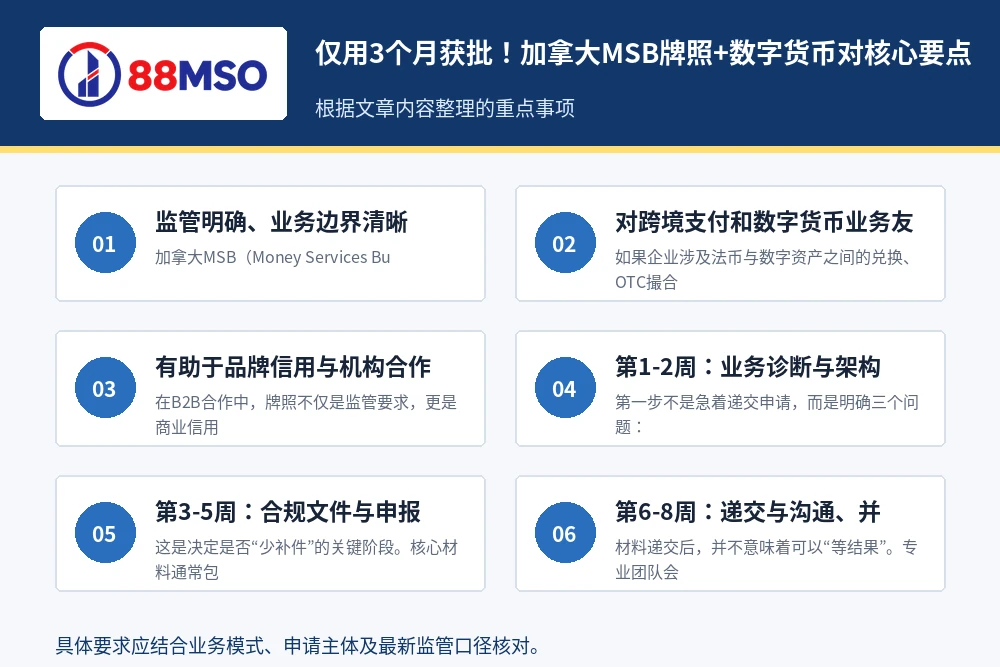
1. Clear supervision、Clear business boundaries
Canadian MSB (Money Services Business) is regulated by FINTRAC,Suitable for money transfer、foreign exchange、Business scenarios such as virtual currency trading services。Compared with some areas with vague regulations or frequent policy fluctuations,Canada is more predictable in its compliance requirements and reporting framework。
2. Friendly to cross-border payments and digital currency businesses
If the enterprise involves the exchange between legal currency and digital assets、OTC matching、Cross-border transfer or settlement services,Canadian MSB can be used as a compliance base status,Facilitate subsequent docking with cooperative banks、Payment institutions and clearing channels。
3. Helps brand credibility and cooperation with institutions
In B2B cooperation,Licensing is not just a regulatory requirement,It’s business credit。Possess MSB license and establish a complete AML/KYC system,Institutional accounts are often easier to obtain、Opportunities for cooperation between liquidity parties and upstream channels。
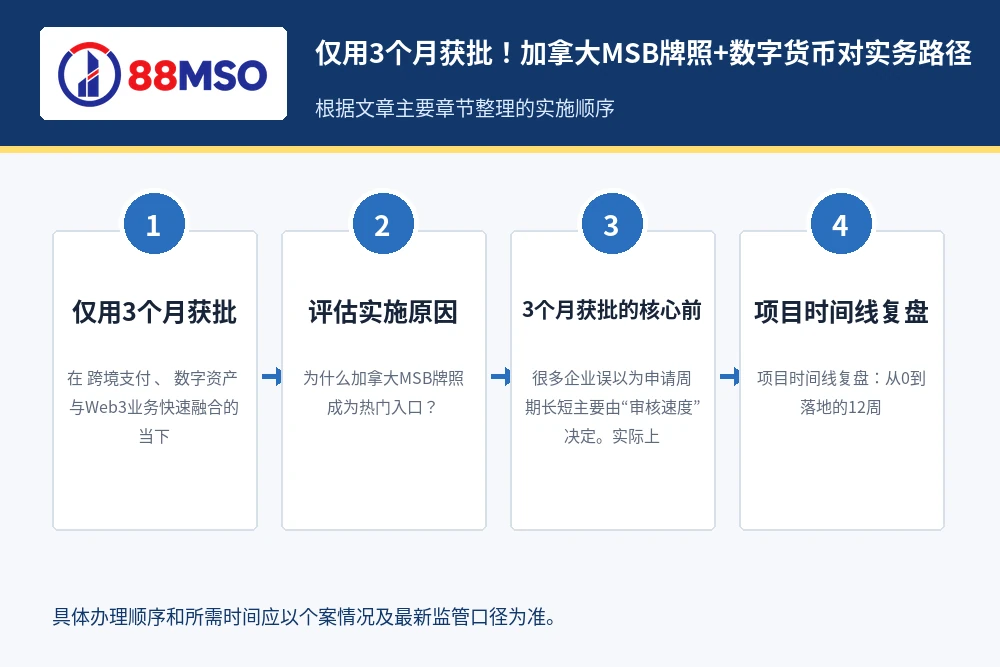
two、Core prerequisites for approval within 3 months:Not "fast",But "accurate"
Many companies mistakenly believe that the length of the application cycle is mainly determined by "review speed"。actually,Review time is just the result,What really affects the cycle is:
- Data completeness:Whether to submit key materials at one time,Reduce the round trip of replacement parts;
- logical consistency:business model、capital flow、Is the risk control strategy consistent?;
- Compliance maturity:Is the AML system enforceable?,rather than templated files;
- Account coordination promotion:Whether the license application and public accounts are designed to be linked。
in other words,3 months is not a “speed case”,It is the reachable interval after standardization。
three、Project timeline review:12 weeks from 0 to landing
Weeks 1-2:Business diagnosis and architecture construction
The first step is not to rush to submit the application.,Rather, three questions should be clarified:
- What exactly is your business? (Remittance/Exchange/Virtual Currency Services)
- Who are the customer groups? (retail、high net worth、mechanism、Merchant)
- How do funds flow? (Deposit、exchange、Withdrawal、hosting、counterparty)
at this stage,Teams often design company structures simultaneously、Shareholder Disclosure Path、Organizing beneficial owner information,and the business documentation framework required for subsequent account opening.。If the structure is not clear,It is very easy to be asked to explain repeatedly during the KYC process later.。
Weeks 3-5:Preparation of compliance documents and application materials
This is the key stage to decide whether to "replenish parts less"。Core materials usually include:
- Company registration and governance documents (Articles of Association、Director information、Equity structure);
- Business Description (Product、customer group、transaction process、geographical scope);
- AML/ATF Policy(Customer due diligence、Transaction monitoring、Suspicious reporting mechanism);
- Risk Assessment Report (Customer Risk、country risk、channel risk);
- Internal control and audit mechanisms (record keeping、training、accountability process)。
The most common question here is:File "looks complete",but lacks executable details。For example, how to set transaction monitoring thresholds、What are the triggering conditions for EDD (enhanced due diligence)?、How to ensure the timeliness of suspicious transaction reports, etc.。Regulators focus on “implementation capabilities”,Not "text length"。
Weeks 6-8:Submit and communicate、Promote account opening in parallel
After submitting the materials,It doesn’t mean you can “wait for the results”。The professional team will proactively follow up on the status,Respond to issues promptly。at the same time,The account opening process should proceed in parallel at this time,Prepare a Checklist of Banking/EMI FAQs,For example:
- Are customers from high-risk jurisdictions involved?
- What is the settlement path between legal currency and digital assets?
- Do you use a third-party escrow wallet? What is the private key control mechanism?
- average monthly trading volume、What is the proof of peak trading volume and funding sources?
If KYC and risk control documents are temporarily made at this stage,,Often the best window is missed。
Weeks 9-12:Approval and account activation、Test before going online
After the license is approved,Companies still need to complete the “last mile”:
- Signing and activating public accounts;
- Joint debugging of payment paths (including limits)、Currency、Reply mechanism);
- Internal SOP online (account opening、Review、release、review);
- First month compliance drill (suspicious transaction identification and reporting process test)。
real landing,Not the moment you get the certificate,But the business is sustainable、auditable、Expandable。
Four、Three major difficulties and cracking strategies for the implementation of digital currency public accounts
Difficulty 1:Banks are most afraid of “not being able to understand your business”
Many companies’ account opening materials are too technical.,Bank compliance teams cannot quickly determine risk boundaries。It is recommended that the business process diagram be made into a "non-technical review version",Make it clear who is responsible for each step、Fund paths and monitoring points。
Difficulty 2:KYC documents are inconsistent with real operations
Commonly seen in “write the material first”、Think about business later”。For example, application documents are mainly written for institutional clients.,Actual but massive retail transactions;Or claim to only work in low-risk areas,Subsequently, it frequently touched high-risk markets.。Such inconsistencies will seriously affect account stability。
Difficulty 3:Lack of ongoing compliance mechanisms
Opening an account is not the end。Without continuous monitoring、periodic review、Exception upgrade mechanism,Even if initially successful,It may also be restricted or closed in the subsequent review.。It is recommended to create at least:
- Customer hierarchical management and periodic review;
- Trading behavior monitoring and early warning rules;
- Manual review mechanism for high-risk transactions;
- Suspicious Transaction Report (STR) internal time limit system。
five、The costs and risks that companies are most concerned about:How to avoid detours?
in terms of budget,Enterprises should break the project into three parts:
- License declaration cost:register、consultant、document、Regulatory related costs;
- Account opening and channel costs:Account maintenance、Transaction rate、Clearing services;
- ongoing compliance costs:personnel、training、system、Audit and annual inspection。
Many projects fail because of “insufficient money”,But the budget structure is wrong:Re-application in the early stage、Light operation,As a result, it is impossible to run the business stably after being approved.。The mature approach is to plan as a "compliant operating company" from the first day,Rather than "a shell company that only gets a license"。
six、Why is "one-stop collaboration" more efficient than "multiple outsourcing"?
MSB license、AML system、Bank account opening、Transaction path design is essentially the same closed loop of compliance。If split among multiple teams,Responsibility gaps often occur:Who will unify the document? Who will take charge of the supplement? Who will explain to the bank?
This is also the reason why more and more companies choose the full-case hosting model.。Judging from the project experience of 88MSO/88MSO,Cross-regional financial compliance is most afraid of "local optimality":Every aspect has been done,But the whole thing can’t run。Only apply for a license、Account landing and subsequent maintenance are connected,Only in this way can a truly scalable global business chassis be formed.。
seven、Practical Checklist:Before preparing a Canadian MSB+ digital currency account,Complete these 10 items first
- Clarify business boundaries and target markets,No vague description;
- Sort out the ownership structure and beneficial owner disclosure path;
- Prepare an enforceable AML/KYC regime,instead of a template file;
- Form a complete illustration of capital flow and transaction flow;
- Set customer stratification and EDD trigger criteria;
- Configure transaction monitoring parameters and manual review process;
- Prepare historical business proof or business plan forecast data;
- Synchronize planning of account opening information,Avoid "secondary rework" after licensing;
- Establish training and accountability mechanisms,Make sure the system is enforced;
- Set aside budget for annual review and ongoing compliance,Avoid subsequent interruptions。
Conclusion:The essence of landing in 3 months,Is "Compliance Engineering Capability"
“Get approved in just 3 months” is not a marketing slogan,It is a reusable project management result:Early diagnosis is accurate、The material logic is consistent、The AML system can be implemented、Account opening is promoted simultaneously。For companies planning to develop payment and digital asset businesses in North America,This method is more important than simply pursuing “the fastest way to get a certificate”。
If your goal is not only to obtain a Canadian MSB license,but to build a sustainable、auditable、Scalable cross-border financial capabilities,Then please upgrade your perspective from "application action" to "full life cycle compliance operation"。This is also something that 88MSO and 88MSO have insisted on for a long time.:Use practical experience to help companies cross regulatory thresholds,Turn compliance into an infrastructure for business growth。
FAQ:Quick answers to frequently asked questions
Q1:After Canadian MSB is approved,Is it 100% possible to open a digital currency public account?
Not guaranteed 100%。License is an important prerequisite,But opening an account also depends on the bank’s risk appetite、Business model transparency andOngoing Compliance Capabilities。
Q2:Can I open an account first and then apply for MSB?
Some institutions support pre-review or advance contact,However, formal opening usually still requires compliance identity support.。It is recommended to "license + account opening in parallel",More efficient。
Q3:Is the 3-month cycle suitable for all businesses?
uncertain。If the equity is complicated、Historical transactions are unclear or there is more exposure to high-risk markets,The cycle may be extended。The key lies in the quality of preliminary preparation。
Q4:Is subsequent maintenance difficult?
The core is to establish a daily mechanism:Customer review、Transaction monitoring、suspicious report、Record retention and training。After the system is on track,Maintenance costs controllable。