简体中文
简体中文 繁體中文
繁體中文 English
Hong Kong Money Lender Licensed Company Acquisition:Change of control、Due Diligence and Licensing Court Process
Official verification update (August 2026):The money lender license is attached to the licensed entity and approved information,Not an independently freely transferable asset。After equity acquisition, shareholders must still be dealt with in accordance with the law、director、ultimate control、Change of business location and license information;The cases in this article do not constitute a guarantee of regulatory approval。 For specific rules, seeHong Kong Companies Registry Money Lender License Publications and Application Guidelines。
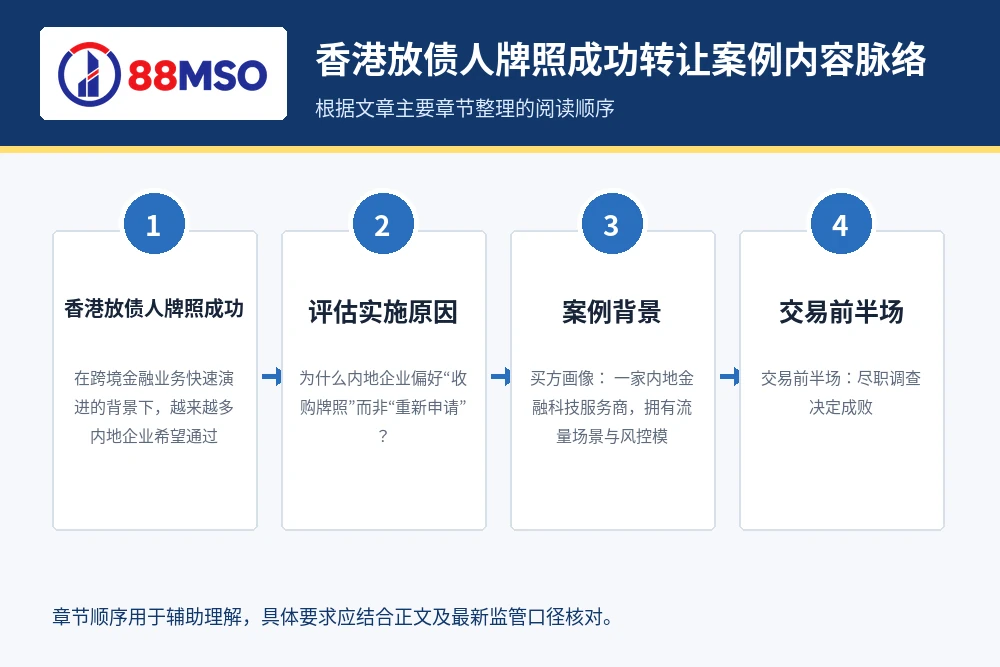
In the context of the rapid evolution of cross-border financial services,More and more mainland enterprises hope to carry out compliant lending through Hong Kong licensed entities、Consumer finance matching、Supply chain financing or credit services for specific scenarios。Compared with “applying for a new license from scratch”,By acquiring stockHong Kong Money Lenders Licensecompany,Usually more efficient in terms of time and business implementation。But in reality,Many deals are not lost due to “price negotiations”,But lose inCompliance path design for change of control、Funding source description、Arrangement of key personnelandPost-closing continuous supervision capabilities。
This article will be broken down through a typical case framework (based on practical scenario abstraction):How do mainland enterprises complete the acquisition of 100% equity of a Hong Kong money lender license company?,and successfully realize the change of control without triggering major compliance risks.。The article will also incorporate practical experience,Explain the key value of professional institutions in transactions。
one、Why do mainland companies prefer “acquiring a license” rather than “reapplying”?
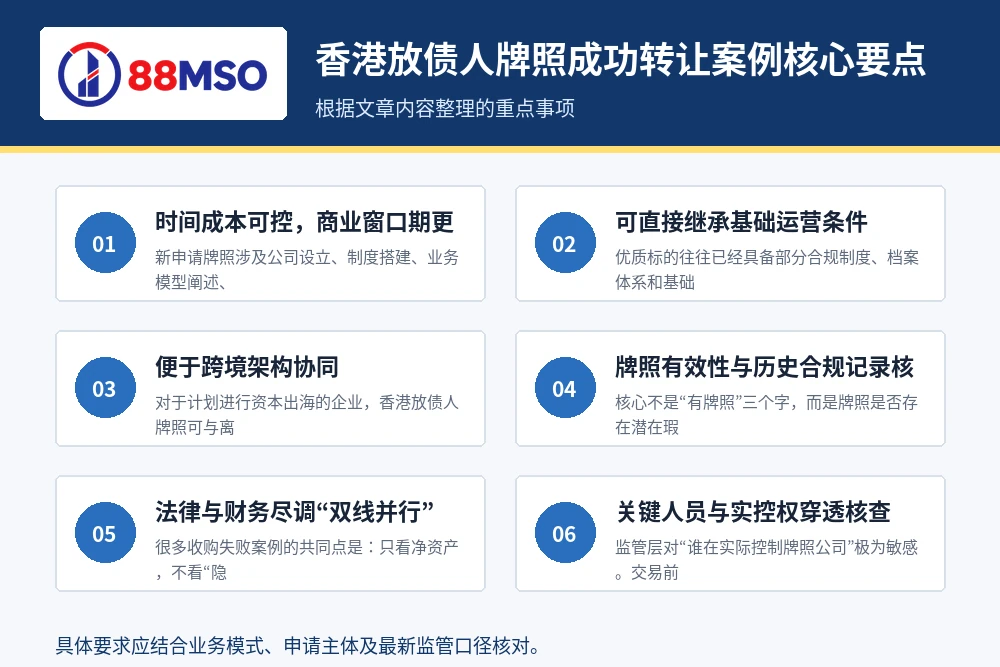
1. Time and cost controllable,Business windows are easier to grasp
New application for license involves company establishment、System building、Business model elaboration、Staffing、Various preparations including site and system construction,There is uncertainty about the review cycle。If the enterprise has locked cooperation channels or funding sources,,Time is often the opportunity cost。Acquisition of mature license entities can significantly shorten the front-end preparation cycle。
2. Can directly inherit basic operating conditions
High-quality targets often already have partial compliance systems in place、Archive system and basic operating structure。The buyer only needs to carry out system upgrades and business restructuring after the closing.,More efficient than “building from scratch”。
3. Facilitate cross-border architecture collaboration
For companies planning to expand capital overseas,Hong Kong money lender license available with offshore holding structure、Overseas settlement arrangements、Linkage between tax planning goals,Become a key node in the overseas financial landscape。
two、Case background:Mainland technology company acquires Hong Kong money lender license
Buyer persona:A mainland financial technology service provider,Have traffic scenarios and risk control models,Plans to deploy compliant lending business in Hong Kong,Subsequent expansion of cross-border financial services。
Seller portrait:A local company holding a money lender's license in Hong Kong,Historical operating scale is limited,License plate status is normal,The ownership structure is relatively clear。
trading target:The buyer completed 100% equity acquisition through an overseas SPV,Post-closing board reorganization、Ultimate Beneficiary (UBO) Update and Business Direction Adjustment,and ensure continued compliance operations in the future。
three、First half of the transaction:Due diligence determines success or failure
1. License validity and historical compliance record verification
The core is not the three words "have a license",It’s about whether there are potential flaws in the license plate。Focus on verification:
- License current status、Are the license renewal records complete?;
- Is there any regulatory inquiry in history?、Penalties or major complaints;
- business contract text、Collection process、Is customer data management compliant?;
- Is the anti-money laundering and suspicious transaction monitoring mechanism truly implemented?,rather than just staying on paper。
2. Legal and financial due diligence run in parallel
What many failed acquisition cases have in common is that:Only look at net assets,Don’t look at “hidden responsibilities”。Buyers should focus on:
- pending litigation、guarantee、Related party transactions and contingent liabilities;
- Whether there are any reservations in tax declarations and audit opinions;
- Authenticity of customer claims and assets、Overdue structure、Bad debt provision caliber;
- Is there any historical fund mixing or irregular shareholder dealings?。
3. Penetrating verification of key personnel and actual control rights
Regulators are extremely sensitive to "who actually controls the licensed company"。Before the transaction, the seller’s shareholders must、director、Executives conduct background checks,Avoid discovering associated risks only after delivery。
Four、Transaction structure design:A wholly-owned acquisition does not mean a simple transfer of ownership
1. common structures:Overseas SPV shareholding
Mainland companies usually set up Hong Kong or other offshore SPVs first,Acquisition of equity interests in licensed companies by SPV。This design helps:
- Isolate legal risks at home and abroad;
- Optimize the introduction of investors or financing arrangements in the future;
- Improve the flexibility of group management and tax planning。
2. Consideration arrangement and installment delivery mechanism
To control risks,It is recommended to adopt the “signing-preconditions-delivery-final payment” mechanism。For example:
- Pay deposit when signing contract;
- Regulatory communication completed、Pay the main price after completing the key information;
- The final payment will be paid after there are no new major risks during the transition period.。
This arrangement can transform "compliance uncertainty" into manageable trading conditions。
3. Representations and warranties must be enforceable
The buyer should lock in the seller's responsibilities in the agreement,Especially historical compliance、tax、litigation、Customer data authenticity and other matters。Otherwise, problems will be discovered after delivery,Recovery costs are extremely high。
five、Regulatory communications regarding changes in control:Rhythm is more important than speed
Regulatory practices related to money lender licenses in Hong Kong,The change of control is not “completed upon transfer of industrial and commercial ownership”。at a practical level,It is recommended to establish"Lawyer + Compliance Consultant + Company Secretary" tripartite collaborationmechanism,Ensure uniform data caliber、Same time point、Enough to show off。
1. Change list management
generally involves:
- Changes in shareholder structure and update of ultimate beneficiaries;
- Change of Directors and Authorized Signatories;
- Registered address、company secretary、Adjustments to audit arrangements;
- Business model updates (e.g. product type、customer groups、risk control strategy)。
2. Funding sources and business rationality statement
For mainland buyers,Regulators and banks are paying close attention to the sources of acquisition funds.。It is recommended to prepare a complete link file:
- Group internal resolutions and authorizations;
- Explanation of Compliance Routes for Fund Outbound Transfers;
- Bank statements and audit supporting documents;
- Description of acquisition purpose and future business plan。
3. Anti-Money Laundering (AML) Framework Simultaneous Upgrade
After change of control,Old systems often fail to match new businesses。Should be completed before and after closing:
- Customer Risk Rating Model Update;
- KYC due diligence and continuous review process reconstruction;
- Optimization of suspicious transaction identification indicators;
- Employee training and internal audit mechanism are online。
six、90 days after delivery:The most easily overlooked “compliance window period”
Many companies think that "Complete transfer = project end",In fact, the real regulatory test begins after delivery.。
1. Reshaping of Corporate Governance and Authorization Matrix
Need to complete charter quickly、board rules、Authorization approval process update,Avoid "New Boss"、"Old processes" lead to failure of internal controls。
2. Contract and customer data migration
Old loan contract、Collection Outsourcing Agreement、Data processing agreements need to be reviewed piece by piece,Ensure compliance with new compliance policies。Historical text about non-compliance,A replacement plan should be developed。
3. Annual review and ongoing reporting calendar
License plate maintenance is a "cyclical project"。It is recommended to establish a compliance calendar,cover:
- Company annual review and business registration update;
- Financial audit and tax filing;
- Internal compliance review and rectification records;
- Regulatory inquiry response mechanism and document archiving。
seven、Review of common failure points:Why do some acquisitions “buy licenses but fail to run the business”?
- Only focus on transactions,Not focused on operations:No dedicated compliance team after closing,The system remains at the template level。
- Funding path unclear:Unable to fully explain the sources of acquisition funds and subsequent lending funds。
- Historical issues underestimated:Ignore existing customer disputes and bad debt asset risks,Causing cash flow pressure。
- Governance fault:Unclear authorization after board reorganization,No one is responsible for key decisions or approvals are repeated。
- Insufficient cross-border coordination:The boundary between the mainland business team and Hong Kong licensed entities is unclear,Trigger compliance conflict。
eight、Practical suggestions:How can mainland companies turn "license acquisition" into "sustainable operations"?
1. First do a “regulatory feasibility assessment”,Let’s talk about valuation again
Valuation models should be built on operational、sustainable、on an auditable basis,Rather than just looking at the scarcity of license plates。
2. Adopt the integrated model of "transaction + compliance custody"
From due diligence、protocol、From communication to post-delivery system construction,It is recommended to have closed-loop management by the same professional team,Reduce information gaps。Like 88MSO and its professional team who have been working hard for a long timeHong Kong financial licenseFull case service,The advantage lies in linking "obtaining a license" with "making good use of the license",Helping companies balance regulatory requirements with commercial efficiency。
3. Build localized compliance capabilities
Including local directors performing their duties、Compliance Officer、outside legal counsel、Audit and Company Secretarial Collaboration。Cross-border business cannot rely solely on remote management。
4. Use data tools to support AML and risk control
admit customers、Transaction monitoring、Post-loan early warning is incorporated into the systematic process,Improve operational efficiency,It also provides a traceable evidence chain for regulatory review。
Nine、Conclusion:The nature of license transfer,It is the overall migration of “control + compliance capabilities”
Hong Kong money lender license acquisition appears to be equity deal,In essence, it is a complex regulatory project:You don't just take over a company,But also to take over its history、Responsibilities and Future Compliance Obligations。For mainland enterprises,The key to success is not "whether you buy it or not",But lies inCan it be audited、explainable、Complete the change of control and stabilize operations in a sustainable manner。
If the project is divided into three phases:Pre-transaction due diligence、Supervisory communication during transactions、Post-transaction license maintenance,Each paragraph requires professional judgment and implementation.。Only the law、finance、tax、Anti-money laundering and governance structures work together,Only then will the license truly become a "growth asset" in the company's global financial layout,rather than “compliance burden”。
FAQ:The 4 most frequently asked questions by companies
Q1:After wholly-owned acquisition,How long does it take to start a new business?
Depends on the completion of the change matters and the readiness of the internal system。In principle,Recommendations on key governance、AML system、The contract template and system process will be fully upgraded before the business can be fully launched.。
Q2:Is it possible to deliver first?、Compliance later?
Not recommended。Delivery first and rectification later often leads to unclear responsibilities、Rising costs,It may even affect subsequent bank cooperation and regulatory evaluation.。
Q3:Is it necessarily cheaper to acquire existing licenses than to apply for new licenses?
not necessarily。If the target has historical burdens,Subsequent rectification and potential liability may significantly increase overall costs.。Full life cycle cost assessment should be done。
Q4:What’s the first most important thing to do after closing?
Establish a "Compliance Operations Center":Identify responsible persons、Go live compliance calendar、Complete system implementation and employee training,Ensure the company enters sustainable regulatory status。