简体中文
简体中文 繁體中文
繁體中文 English
Hong Kong Financial License Application Document List and Frequently Asked Questions
Carrying out financial business in Hong Kong,Whether it is MSO、SFCRelevant regulated activities、Insurance brokerage or money lending business,What companies fear most is not “high demands”,But "asking to be invisible"、Not sure about the rhythm、Incomplete materials”。Many teams were very enthusiastic in the early stage,But when it comes to regulatory inquiries、Document supplement、Frequently get stuck during bank package review。turn out:time is stretched、Costs are magnified,Business launch window missed。
The content of this article is based on"Executable Checklist + High Frequency Questions and Answers"Way,Help enterprises clarify key actions at once,Especially suitable for content layout that hopes to seize search engine featured snippets (Featured Snippet)。you will see:What to prepare before applying、How to avoid repeated supplements during the submission stage、How to operate steadily after obtaining the license,and how to standardize answers to the most frequently asked questions。
For companies that want to improve the efficiency of cross-border financial compliance,Service teams like 88MSO (88MSO) that are deeply involved in Hong Kong’s financial regulatory practices,The value is not just in “agency”,It’s more about translating abstract regulations into implementable processes.,Reduce trial and error costs。
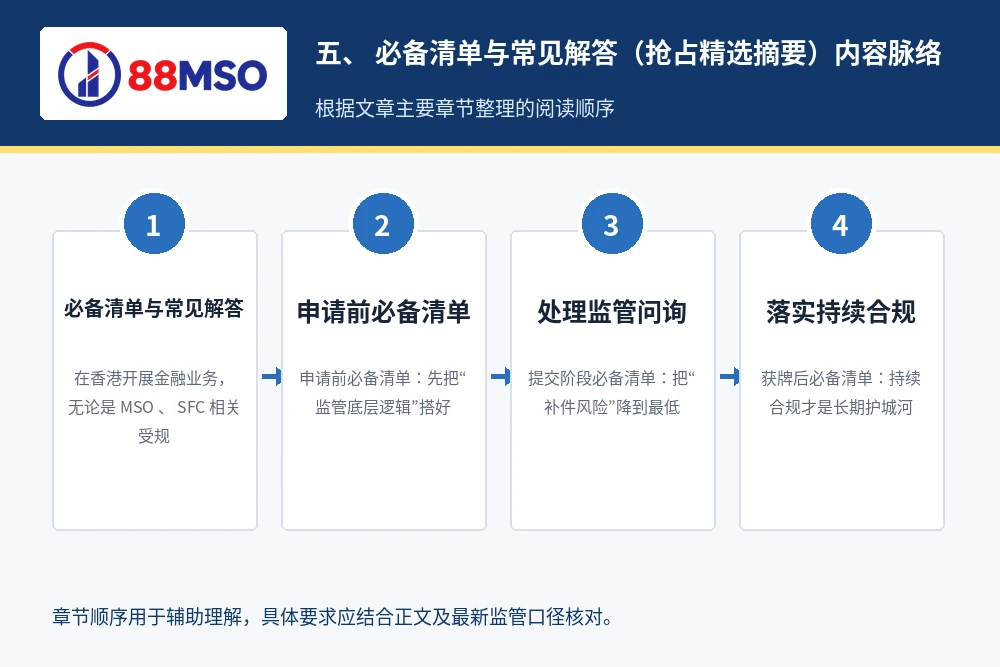
one、Checklist before applying:First, set up the “underlying logic of supervision”
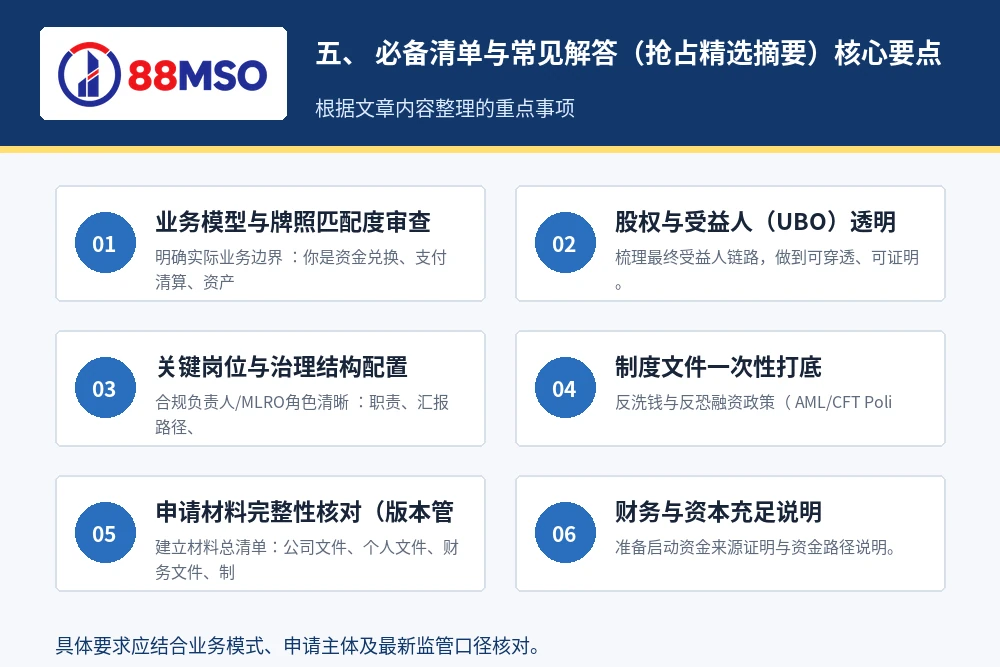
1) Review of business model and license compatibility
- Clarify actual business boundaries:You are a fund exchanger、payment settlement、asset Management、Broker matching,Or lending money?
- Identify the corresponding regulatory framework:Different businesses trigger different license and regulatory agency requirements。
- Avoid inconsistency between "nominal business" and "real business":This is a hot spot for regulatory inquiries。
In practice,Many failure cases are not due to lack of qualifications,But the business narrative and transaction flow diagram are inconsistent。It is recommended to output a complete version before applying.Business flow chart (customer entry—transaction execution—fund flow—risk control monitoring),Align compliance and operational calibers。
2) Transparency of equity and beneficiaries (UBO)
- Sort out the ultimate beneficiary link,be penetrable、provable。
- Prepare company registration documents、Register of shareholders、Directors’ resolutions and historical changes。
- If offshore structures are involved,Prepare compliance explanations and commercial justification statements in advance。
Supervision is not just about “who holds shares”,Pay more attention to "who controls", "who benefits" and "where the funds come from"。The sooner the shareholding structure is explained clearly,Subsequent bank account opening and license review will be smoother.。
3) Configuration of key positions and governance structure
- Clear compliance officer/MLRO role:Responsibilities、reporting path、Independence needs to be made clear。
- Fit and Proper candidates for directors and senior management:Resume、Qualifications、Verifiable integrity record。
- Outsourcing and internal control boundaries:What can be outsourced,What needs to be self-sustaining?。
Supervision is not just about “whether there are people”,Rather, it depends on “whether this person is truly qualified、Does the system really work?”。
4) One-time preparation of institutional documents
- Anti-Money Laundering and Counter-Terrorism Financing Policy (AML/CFT Policy)
- KYC due diligence and customer risk rating procedures
- Suspicious transaction identification、Reporting and leaving trace mechanism
- Data saving、Privacy protection、Sanctions Screening Process
- Employee training and internal audit program
Institutional documents are not a collection of templates。The easiest thing for supervision to ask is:“How do you enforce it?”Therefore, each policy must correspond to the position、System and Recording Samples。
two、Essential checklist for submission phase:Minimize "repair risk"
1) Check the integrity of application materials (version management)
- Create a master list of materials:company documents、personal files、financial documents、Institutional documents。
- Unified naming rules and version numbers,Avoid "different versions of the same name"。
- Do a "cross-check" before submitting:Equity、director、address、Signature dates must match。
Many applications have been delayed,The reason is just that the basic information is inconsistent。It is recommended to set up a "document master" to be responsible for the final document。
2) Financial and capital adequacy description
- Prepare proof of source of start-up capital and description of capital path。
- Provide budget and cash flow plan for the next 12 months。
- Explain business volume assumptions and risk buffer mechanism。
Both regulators and banks are concerned about whether an enterprise has the ability to continue operating。Rather than exaggerating growth,It is better to give verifiable、Implementable financial logic。
3) System and risk control tool certification
- KYC collection and identity verification mechanism (including due diligence for high-risk customer upgrades)。
- Transaction monitoring rules and early warning threshold design。
- Sanctions List Screening and Periodic Review Mechanism。
If the business is in its early stages,The "manual + system transition" solution can also be used,But the timetable must be stated、Owners and upgrade plans。
4) Regulatory inquiry response mechanism
- Set inquiry response SLA (such as 2-3 working days for initial response)。
- Prepare bilingual response templates in Chinese and English,Make sure terminology is consistent。
- Save all replies,Form an “inquiry knowledge base”。
Professional inquiries and responses,It’s not about writing more,But lies inclear、Verifiable、consistent。
three、A must-have checklist after obtaining a license:Continuous compliance is the long-term moat
1) License maintenance and annual review rhythm
- Establish an annual compliance calendar:annual review、Renew license、declare、Audit and other nodes。
- Prepare key documents 90 days in advance,Avoid last minute congestion。
- Major changes (shareholders、director、Business scope、Address) timely declaration。
"Everything will be fine once you get the license" is a common misunderstanding。What really determines whether a company can operate in the long term is its follow-up maintenance capabilities。
2) Dynamic updates on AML and KYC
- Customer risk rating is not a one-time action,Requires regular re-evaluation。
- Enhanced due diligence (EDD) and higher review frequency for high-risk customers。
- Suspicious Transaction Reporting (STR) Process to be Drilled,Not just at the document level。
3) Training、Audit and stress testing
- New employee onboarding compliance training + on-the-job annual refresher training。
- Internal compliance review at least once a year,Form a closed loop of rectification。
- Simulated regulatory inspection,Verify the integrity of the evidence chain。
Signs of maturity in a compliance system,Not "nothing went wrong",Rather, “after discovering problems, we can quickly correct them and leave traces.”。
Four、The 6 most common pitfalls (highly common in practice)
- Pit 1:Only reapply,Not focusing on the implementation of follow-up operation systems。
- Pit 2:KYC only collects information,No risk stratification and continuous monitoring。
- Pit 3:Institutional document copy template,Unable to correspond to real business。
- Pit 4:The ownership structure is complex but lacks commercial rationality.。
- Pit 5:Failure to report major changes in a timely manner,triggering compliance risks。
- Pit 6:Inquiry responses are confusing,leading to a decline in regulatory trust。
These questions seem like details,In fact, it directly affects the speed of approval and subsequent stable operations.。The value of an experienced advisory team,Often reflected in “avoiding foreseeable risks in advance”。
five、FAQ,Adaptation Featured Summary)
Q1:How long does it usually take to apply for a Hong Kong financial license?
A:Depending on the license plate type、The completeness of the materials depends on the round of inquiries.。Generally calculated from "preparation period + post-submission review period",Complete projects typically last several months to longer。The key to determining speed is not "the day of submission",It’s about upfront material quality and inquiry response efficiency.。
Q2:What are the core aspects of KYC due diligence?
A:The core isIdentity authenticity、Reasonable source of funds、Transaction Purpose Clarity、Risk stratification enforceability。Supervision not only depends on whether documents are collected,It also depends on whether differentiated review and continuous monitoring can be carried out based on risks.。
Q3:Is it enough to have a template for the AML system?
A:not enough。Templates can only serve as frames。The real compliance requirement is that the system is consistent with the business,And it can be proved that "actually executed",For example, screening records、Training sign-in、Suspicious transaction analysis and traces, etc.。
Q4:Will I still be inspected after getting the license?
A:meeting。Obtaining a license is just the starting point,Follow-up may involve annual review、Routine regulatory communications、Special inspections, etc.。Companies should establish long-term compliance mechanisms,Rather than one-off project thinking。
Q5:If the business model adjusts,Do I need to reapply?
A:uncertain,However, it is usually necessary to conduct a compliance assessment first and report or make changes as required.。If the change touches the scope of the license、Control or key function arrangements,May require a higher level approval process。
Q6:Do small and medium-sized enterprises also need a complete compliance system?
A:need,But it can be "constructed in stages"。First build the minimum feasible compliance framework (KYC、AML、Report、leaving traces),Then upgrade the system and team configuration as the business grows.。
Q7:How to improve the first-time submission pass rate?
A:Three points are most effective:Business narrative consistent、Material evidence closed loop、Quick and professional response to inquiries。Consultants with practical experience can significantly reduce the replacement rate and communication costs。
Conclusion:Use "list-based management" to create replicable compliance capabilities
Hong Kong’s financial regulatory environment is mature and strict,This is not a threshold,It is a mechanism to screen out long-term companies.。For companies planning to expand into international markets,Real competitiveness is not just about getting a license,Instead, create a set of replicable、auditable、Upgradeable compliance operations system。
If you want to translate complex regulatory requirements into executable paths,Please refer to 88MSO (88MSO) in Hong Kong MSO、SFC related licenses、Project Approach in the Insurance Brokers and Money Lenders Licensing Area:Clear route through early diagnosis,Improving efficiency with mid-term filing,Ensure continued operation with post-maintenance。Make every compliance action "process-based"、Evidence、standardization",Only then can enterprises move more steadily on the cross-border financial track、farther。