简体中文
简体中文 繁體中文
繁體中文 English
Global in 2026Financial licenseregulatory trends:Hongkong、Singapore、Which EU markets are tightening?
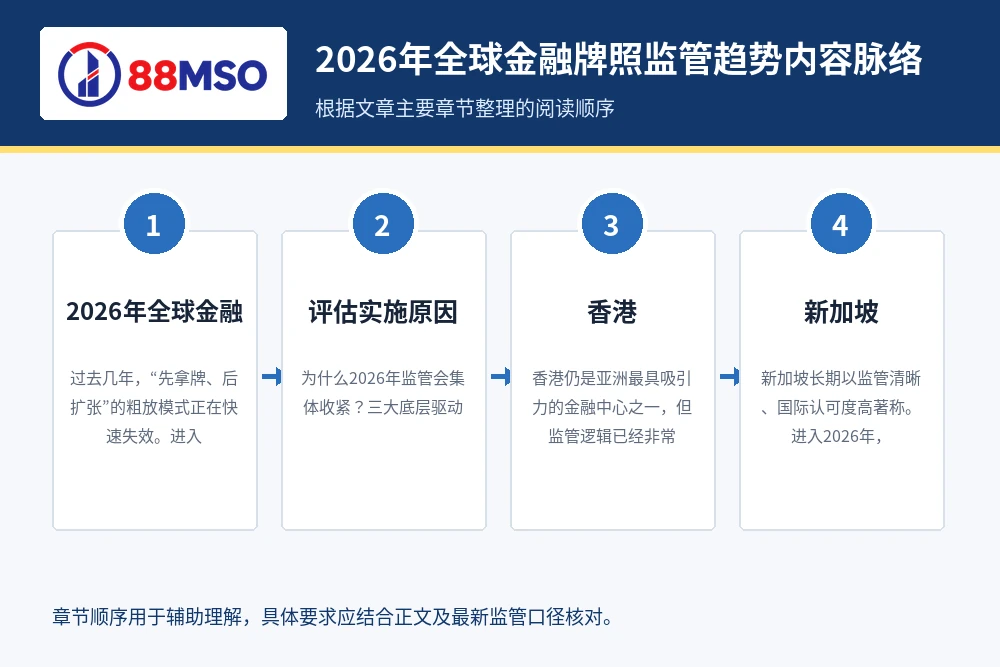
past few years,"Take the card first、The extensive “post-expansion” model is rapidly failing。Entering 2026,Global financial regulation has been upgraded from a "patch-type rule",Shift to “systemic penetrating supervision”:Regulatory agencies not only look at whether a company has a license,See moreWho controls the business、How funds flow、Is the system traceable?、Whether the board of directors truly fulfills its responsibilities。For plans to carry out cross-border payments、virtual assets、wealth management、lending、For institutions engaged in securities distribution or insurance intermediary business,License approval、Continuous Compliance、Annual review maintenance and cross-border data governance,is becoming the core variable that determines business life and death.。
In this cycle,Hongkong、Singapore and the EU are both tightening,But the tightening methods are not the same:Hong Kong emphasizes "risk orientation + continuous supervision",Singapore emphasizes “technology regulation + high-threshold governance”,The EU strengthens "cross-border consistency" through a unified rules system。Understand the difference,Only then can you choose the right license plate path。
one、Why will regulations be collectively tightened in 2026? Three underlying drivers
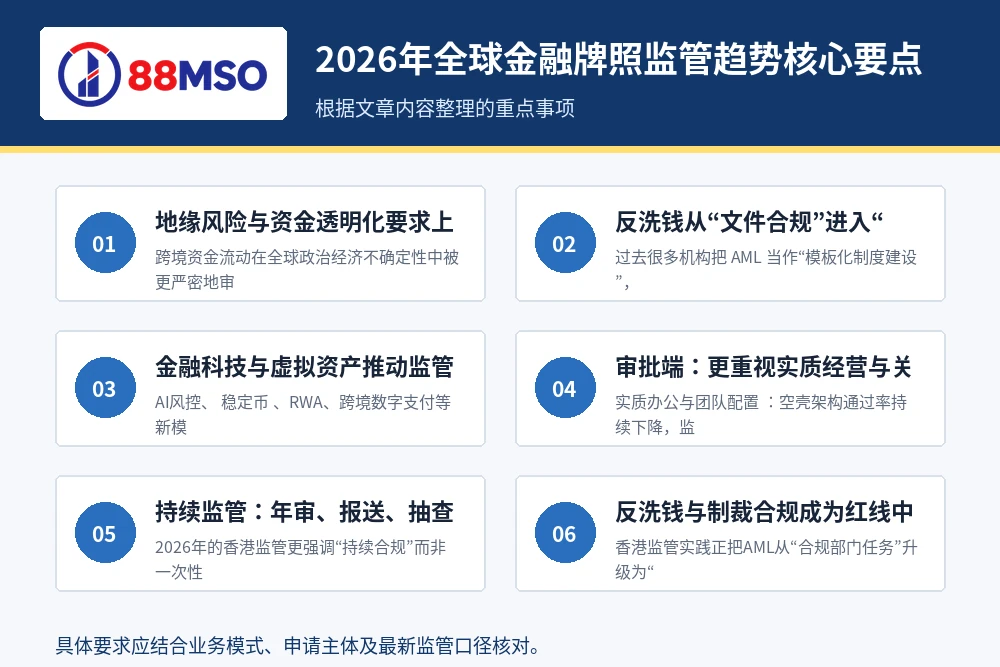
1) Geographical risks and rising requirements for financial transparency
Cross-border financial flows are under closer scrutiny amid global political and economic uncertainty。Regulators generally strengthen their supervision of beneficial owners (UBOs)、Related party transactions、Ability to identify suspicious transaction patterns,Require institutions to have higher precision in KYC and transaction monitoring。
2) Anti-money laundering moves from “document compliance” to “behavioral compliance”
In the past, many institutions regarded AML as "template system construction",Supervision now pays more and more attention to practical results:For example, whether customer risk stratification is dynamically updated?、Are abnormal transactions reported in a timely manner?、Whether the compliance officer and MLRO are substantially involved in decision-making。In other words,Unenforceable compliance documents,Almost equal to no compliance。
3) Fintech and virtual assets promote “front-loading” supervision
AI risk control、Stablecoin、RWA、New models such as cross-border digital payments are developing rapidly,Forcing regulatory agencies to shift from traditional "ex-post punishment" to "pre-event access + in-event monitoring"。The key trends in 2026 are:technical system、Data traces、Model governance will be formally included in the core of license supervision。
two、Hongkong:From “getting a license” to competing in “licensing ability”
Hong Kong remains one of Asia's most attractive financial centers,But the regulatory logic is very clear:Welcome innovation,At the same time, strictly control risk spillovers。Whether it is MSO、SFC related licenses、Insurance brokerage or money lending business,Regulatory commonalities are improving。
1) Approval end:Pay more attention to substantive operations and key position capabilities
- Physical office and team configuration:The passing rate of empty shell architecture continues to decline,Supervision pays more attention to actual business address、local personnel、Separation of key responsibilities。
- Suitability of Responsible Personnel and Management:RO、director、More detailed shareholder background checks,Past compliance records and industry experience become weighted items。
- Business model explainability:Regulatory Commission requires explanation of sources of profit、Customer source、Risk control closed loop,Especially institutions with a high proportion of high-risk customers。
2) Continuous supervision:annual review、Submit、Increased frequency of spot checks
Hong Kong supervision in 2026 will place more emphasis on “continuous compliance” rather than one-time access。Typical changes include:
- Higher frequency of data reporting and compliance records for review;
- Monitor suspicious transactions、Customer due diligence update rhythm puts forward stricter requirements;
- for outsourcing arrangements (technical、customer service、operations) conduct a penetrating review,Prevent "outsourcing means external responsibility"。
3) Anti-money laundering and sanctions compliance become the red line among red lines
Hong Kong’s regulatory practice is upgrading AML from “compliance department tasks” to “board responsibility”。Once there is a disconnect between the system and execution,Penalties may not be limited to institutional level,It will also extend to management accountability。For businesses,EstablishQuantifiable、auditable、AccountableAML system,It has become the basic basis for licensed operations。
three、Singapore:High-standard access + double emphasis on scientific and technological supervision
Singapore has long been known for its clear regulatory、Known for its high international recognition。Entering 2026,Its tightening is not a "quantitative restriction",But "Quality Screening"。Simply put:Licenses can still be applied for,But no longer suitable for low-readiness teams。
1) Greater transparency requirements for management and shareholders
Regulatory agency’s actual controller、Source of funds、Disclosure of related party transactions within the group proposes finer-grained requirements。For multi-tier offshore architecture entities,Significantly increased obligation to explain,And need and audit、tax、Compliance data remains consistent。
2) Technical risk and network security review upgrade
Singapore on payment institutions、The technical resilience requirements of digital financial platforms continue to increase。System availability、Disaster recovery mechanism、Data access rights、The governance of external service providers may become the focus of review。For organizations that rely on API ecosystem and cloud services,Technical compliance is deeply bound to license compliance。
3) “Look at the global footprint” of cross-border business
If the enterprise's business covers customers in multiple countries,Regulators will comprehensively evaluate their compliance records in other jurisdictions。this means:Single market violations may adversely affect the stability of Singapore licenses。Multi-regional joint compliance will be the norm in institutional governance after 2026。
Four、European Union:MiCA and unified regulatory logic reshape license value
The EU’s tightening path is “unification of rules”。With the implementation of frameworks such as MiCA,The threshold for companies to conduct cross-border business operations within the EU is not lowered,Instead, it has shifted from "different adaptation in each country" to "unified high-standard adaptation"。This is an opportunity for mature compliance institutions,Lucky institutions will be eliminated。
1) Local practical requirements under a unified framework are still high
Although the rules are similar,However, member states may have different priorities at the implementation level,Such as regulatory communication methods、review cadence、File details preferences。Enterprises need a dual-track approach of “unified system + localized execution”。
2) Consumer protection and information disclosure requirements are more detailed
EU regulation emphasizes customers’ right to know and product suitability。complex financial products、Cryptoasset related services、cross-border promotion,All require more complete risk disclosure and marketing compliance controls。
3) Capital and liquidity management have become the focus of continuous assessment
Some business lines will face higher capital constraints and reporting obligations。For expanding companies,This means that financial planning must precede,Do not make up for management shortcomings after obtaining the license。
five、Hongkong、Singapore、EU comparison:What is the difference in tightening direction?
- Hongkong:Emphasis on "after holding a licenseOngoing Compliance Capabilities”,Especially AML execution and management accountability。
- Singapore:Emphasis on “high-quality access + scientific and technological governance capabilities”,Pay equal attention to technology and compliance。
- European Union:Emphasis on “cross-border consistency under unified rules”,Heavy show、Focus on consumer protection、Heavy capital constraints。
If the enterprise's goal is to quickly enter the Asian market and take into account the integration of international capital,Hong Kong still has institutional efficiency and financial ecological advantages;If we emphasize technical regulatory maturity and international reputation,Singapore’s appeal remains strong;If you plan to deploy multi-national customers and European business,The EU framework is more suitable for long-term development。The key is not "which one is best",And inWhich one best matches your business model?、Equity Structure and Compliance Budget。
six、How do companies respond to regulatory tightening in 2026? Five-step practical framework
first step:Do a license feasibility diagnosis first,Instead of submitting the application first
Find out whether your business triggers license boundaries、Whether multiple regulations are involved、Are there cross-border conflicts?。Many applications fail due to incomplete information,But the business model does not match the license type。
Step 2:Simultaneous design of "organizational structure + compliance structure"
put the board、RO/MLRO、Compliance、Risk control、audit、IT security responsibilities streamlined at once。Supervision is most worried about "vacant responsibilities" and "formal governance"。
Step 3:Establish a verifiable AML/KYC system
- Customer layered due diligence mechanism (simplified/standard/enhanced due diligence);
- Dynamic adjustment of transaction monitoring rules and thresholds;
- High-risk country/industry list management;
- Suspicious transaction reporting and internal escalation process。
Step 4:Digitalize compliance、Streamlined
Use the system to record due diligence、Approval、Review、training、Submit、Closed loop of rectification。After 2026,“Having a system but no data track” will become increasingly difficult to pass。
Step 5:Establish an external professional collaboration mechanism
Facing multi-jurisdictional regulation,It is not recommended to rely solely on internal part-time teams。Long-term cooperation with consultants familiar with Hong Kong and cross-border regulatory practices,Can significantly reduce communication costs and misjudgment risks。Full-case service model represented by 88MSO (88MSO),Usually covers pre-licensing planning、Document preparation、Responding to regulatory inquiries、Subsequent annual review and compliance custody,More suitable for companies that want long-term stable operations。
seven、Regulatory signals worth paying attention to in 2026
- Signal 1:"Substantial operations" will become a common language for supervision in various places,The era of empty shell licenses is coming to an end quickly。
- Signal 2:Cross-border data and privacy compliance included in license stability assessment。
- Signal number three:The boundaries of personal responsibilities of the board of directors and senior executives continue to tighten。
- Signal 4:Technical systems (monitoring、leave traces、Audit trail) has become a must-answer question in regulatory inspections。
- signal five:Multi-license collaborative operations (such as payment + securities + wealth management) will face higher group-level governance requirements。
Conclusion:future competition,It’s not “whether you have a license plate”,It’s about “whether it can operate in compliance with regulations in the long term”
2026 yearGlobal financial licensemarket,is moving from "incremental competition for licenses" to "competition for existing compliance"。Hongkong、Singapore、The EU is tightening,But they don’t “close the door”,It is about selecting those who truly have governance capabilities.、Market participants with risk control capabilities and long-term operating capabilities。
For business management,The most realistic strategy is not to bet on lax regulation,But do three things in advance:Choose the right jurisdiction、Set up a good structure、Run through compliance。Who can internalize compliance into business capabilities?,Who can take the lead in the next round of global financial restructuring?。
If you are evaluating Hong Kong or other offshore financial license pathways,It is recommended to conduct a round of "regulatory preview" diagnosis as soon as possible,Apply、Put operations and annual review in the same roadmap。This is also the fundamental reason why more and more overseas companies choose professional organizations to accompany them for a long time.。