简体中文
简体中文 繁體中文
繁體中文 English
Beginning:Why “CaymanSPC+ Classified stocks” have become a popular choice for cross-border asset management?
In the context of global asset allocation continuing to heat up,More and more asset management institutions、family office、Web3 fund management team and cross-border enterprises,Start followingCayman SPC (Segregated Portfolio Company,separate portfolio companies)。Especially when combined with the "classified stock" design,This structure segregates funds、strategy parallelism、Outstanding performance in tax neutrality and fundraising flexibility。
For those who want to “build the structure first”、Compliance again、For the team that finally does large-scale operations",Cayman SPC is not just a place of registration choice,It is a complete set of offshore fund projects。in reality,Many projects fail because of poor strategies,But the structure is wrong、Filing rhythm is wrong、No one is responsible for ongoing compliance。therefore,understandStructural advantagesandCIMA filing process,It is the first step to build a sustainable fund platform。
This article will take a practical perspective,The system dismantles the core logic of Cayman SPC Classified Stock Fund,and combined with cross-border compliance experience,Help you create clarity、Executable project path。
one、What is the Cayman SPC Classified Share Fund? Let’s make the concept clear first
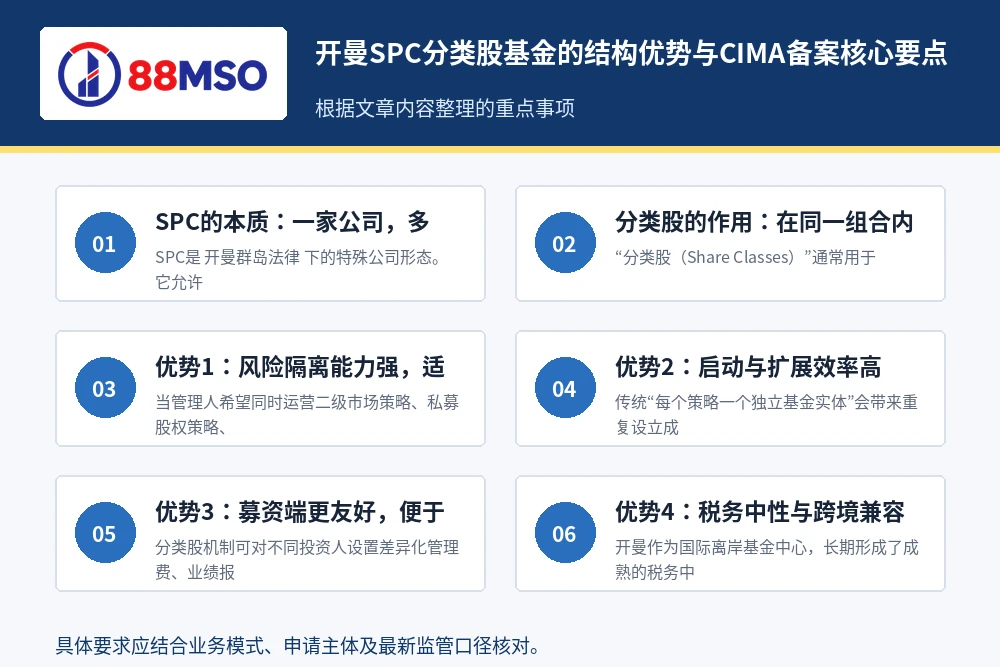
1. The essence of SPC:a company,Multiple groups of "legal isolation warehouses"
SPC is a special company form under the laws of the Cayman Islands。It allows the establishment of multiple "separated investment portfolios (Portfolio)" under the same entity,Each portfolio can have independent assets、Liabilities、Investment strategies and investors。The core value lies in:In principle, the assets and liabilities of each portfolio are segregated.,The risk of Portfolio A should not be passed on to Portfolio B。
2. The role of classified shares:Achieve differentiated interests within the same portfolio
"Share Classes" are often used to stratify equity within the same investment portfolio.,For example:
- Pricing in different currencies (USD type、HKD category、EUR category);
- Different fee mechanisms (institutional type、Retail、Founder category);
- Different dividend policies (cumulative type、distribution type);
- Different lock-up period arrangements (Class A redeemable、Category B (locked for 12 months)。
two、Six major structural advantages of Cayman SPC Classified Stock Funds
Advantage 1:Strong risk isolation ability,Suitable for multi-strategy parallelism
When a manager wishes to simultaneously operate a secondary market strategy、private equity strategy、digital asset strategy,If all are placed in a single company,High risk of crossover、Information disclosure is complex。SPC isolating by combination,Can reduce the spread of risks at the legal level,Improve trust between institutions and LPs。
Advantage 2:High startup and expansion efficiency
The traditional "an independent fund entity for each strategy" will bring repeated establishment costs.。SPC can set the parent body first,Add new combinations as needed。for managers,this means:
- Test strategies early and cheaply;
- Rapidly expand new combinations after maturity;
- Improving operational efficiency under a unified governance framework。
Advantage 3:The fundraising side is more friendly,Easily customize investor terms
The classified stock mechanism can set differentiated management fees for different investors、Performance compensation、Redemption Threshold and Minimum Subscription Amount,This pair of institutional LP、Home office、Strategic investors are very important。Compared to “one size fits all investors”,This model is more conducive to negotiation and fundraising。
Advantage 4:Tax neutrality and high cross-border compatibility
Cayman as an international offshore fund center,A mature tax-neutral environment and professional service ecosystem have been formed over a long period of time。For cross-border investment structures,SPC is often used to undertake funds from different jurisdictions。Cooperate with upper-level shareholding and lower-level SPV arrangements,A clearer income path and tax planning can be achieved (the details still need to be assessed on a case-by-case basis based on the investor’s tax residency status)。
Advantage 5:The service provider system is mature,Facilitates institutional management
Cayman Fund Ecosystem is Complete,Covered legal counsel、auditor、Administrator、Escrow/Brokerage、Independent director and other roles。For management teams preparing for long-term operations,The standardized ecology can significantly reduce the vulnerability caused by "compliance relies on personal memory"。
Advantage 6:Adapt to the "Hong Kong + offshore" dual center layout
Many teams adopt the route of "Hong Kong investment advisory/management + Cayman fund vehicle":Hong Kong side undertaking research、Investment management and investment and financing activities,Cayman undertakes fund entities and international capital pools。This structure is very common in capital overseas,It is also highly consistent with the habits of investors in Greater China.。
three、Checklist of key decisions before setting up a Cayman SPC
Before entering CIMA registration,It is recommended to complete the following structured decisions first:
- investment strategy boundaries:Are there any related transactions or asset sharing in each Portfolio?
- Investor portrait:Proportion of professional investors、Minimum subscription threshold、Lock-up period expected。
- governance structure:Board composition、Investment Committee Rights and Responsibilities、conflict management mechanism。
- Service provider configuration:legal advisor、audit、Fund administrator、Bank/Brokerage Account。
- Information disclosure system:issuance documents、Risk disclosure、Valuation policy、redemption terms。
- Ongoing Compliance Budget:annual review、audit、Regulatory filing、Beneficial owner information maintenance。
This step seems to be a "pre-requisite document",In fact, it determines the subsequent filing speed and operational stability.。Many projects repeatedly add parts,Often this is because the initial design is incomplete。
Four、CIMA filing process:Practical path from establishment to effectiveness
Cayman fund supervision involves different types of fund systems,Does an SPC constitute a regulated fund?、Which registration path is applicable?,Need to be combined with fundraising objects、redeemability、Judgment based on factors such as the number of investors。The general process framework is given below:
Step 1:Clarify fund regulatory classifications and applicable regulations
First determine what type of regulated fund form the fund falls into (e.g. pathways related to the Private Equity Act or the Mutual Fund Framework)。This step is usually led by a Cayman lawyer,Output compliance opinions,Avoid “install now and change later” to increase costs。
Step 2:Company establishment and SPC registration
Complete entity establishment at the Registrar of Companies,and apply for SPC status。Then establish the parent charter、Portfolio establishment mechanism、Classified Share Rules and Directors’ Resolution Template。
Step 3:Prepare issuance and governance documents
- Private Placement Memorandum (PPM) or equivalent disclosure document;
- Subscription Agreement and Investor Statement;
- Valuation policy、redemption policy、Anti-Money Laundering/KYC Policy;
- Director appointment documents、Service Provider Appointment Agreement。
hint:Disclosure documents must be consistent with actual operations,especially the cost、Liquidity restrictions、Side pocket arrangement、Valuation source and other highly controversial terms。
Step 4:Complete CIMA registration/filing submission
The authorized service agency submits materials through the supervision system and pays relevant fees.。Common concerns include:
- Are the fund’s basic information and investment objectives clear?;
- Integrity of information about directors and key personnel;
- Audit arrangements and financial year settings;
- Anti-Money Laundering Responsible Person and Policy Framework。
Step 5:Open an account、Capital flow and operations go online
Filing is not the end。Before the fund actually operates,Requires bank or brokerage account opening、Subscription path design、Investment Valuation Frequency Confirmation、NAV calculation process and investor report template construction。If the funding link does not match the disclosure terms,Subsequent compliance disputes can easily arise。
Step 6:Continuous reporting and annual compliance maintenance
Cayman funds are generally required to perform annual audits、Regulatory reporting and information update obligations。Management teams should establish an “Annual Compliance Calendar”,Avoid missing deadlines and incurring fines or regulatory risks。
five、Common misunderstandings:Why do many teams “get the structure but can’t run it”?
Myth 1:Treat SPC as a “universal risk shield”
SPC provides legal isolation,However, if mixed management occurs in actual operations,、Account mixing、Incomplete records,The isolation effect may be weakened。System design must be implemented into processes and evidence chains。
Myth 2:Excessive pursuit of low cost,Ignore service provider quality
Fund administration、audit quality、The completeness of legal texts directly affects subsequent fundraising and due diligence pass rates。Small upfront cost savings,May be amplified as trust cost in later stage financing。
Myth 3:Once the filing is completed, everything will be fine
The real test comes during the operation period:Investor communication、Valuation consistency、Redemption Stress Management、AML/KYC continuous updates。No ongoing compliance system,It is difficult for funds to be stable in the long term。
Myth 4:Ignoring the joint supervision between "Hong Kong side" and "offshore side"
If the investment management activities actually occur in Hong Kong,Qualifications of personnel involved、Business boundaries and compliance division require advance planning。in practice,More and more institutions are adopting the “multi-jurisdictional collaboration” approach to promote,To avoid a single point of failure affecting the overall architecture。
six、Practical suggestions:How to improve the success rate of CIMA filing and subsequent operations?
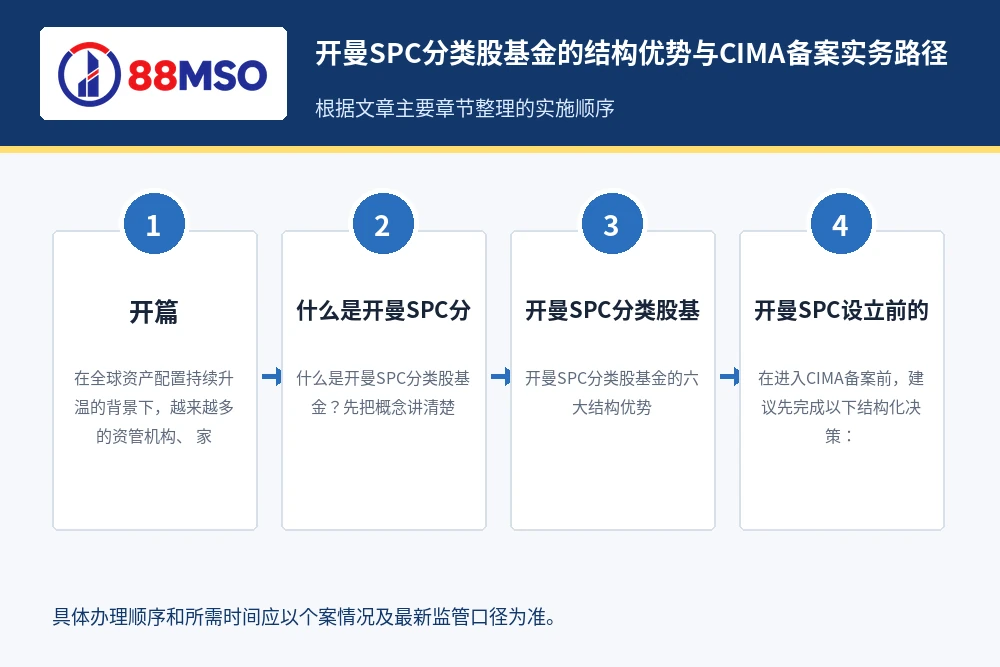
- Make a road map first:Make "Establishment - Filing - Account Opening - Fund Raising - Post-Investment - Annual Review" into a Gantt chart management。
- File consistency first:Charter、PPM、Subscription Agreement、AML policies must be unified。
- Strengthen investor suitability:Establish auditable records on KYC and risk disclosure。
- Design exit mechanisms in advance:redemption gate、Redemption suspended、The side pocket arrangement must state the triggering conditions。
- Choose a team that understands "Hong Kong + offshore" synergy:Can handle structures simultaneously、supervision、Consultant on banking and operational issues,Can shorten the landing cycle。
Judging from 88MSO and its 88MSO cross-border compliance service experience,Successful projects are often not about “a certain link is particularly fast”,But the rhythm of the whole link is controllable:The front-end structure is legal、Chinese and English documents are consistent、Bank path is clear、Someone is responsible for ongoing compliance。This is also a watershed for the institution from "being able to set up" to "sustainable fundraising and operations"。
Conclusion:SPC is a tool,Compliance system is the moat
Why Cayman SPC Classified Stock Funds Are Popular,Because it takes into account risk isolation、Strategy expansion、Investor stratification and international capital adaptation capabilities。But it must be emphasized:Good structure does not mean automatic success。Only CIMA registration、Document management、Fund routing and continuous compliance are integrated into an execution system,Only a fund platform can operate stably in a complex market environment。
If you are planning to buildOffshore Fund Structure,It is recommended to "deduct the legal structure from the business model",A professional team will then coordinate and promote the filing and operation.。This will not only improve the first-round pass rate,It can also raise funds for follow-up、Audit and cross-border cooperation lay a stronger foundation。
FAQ:Quick check on frequently asked questions
Q1:Are SPCs necessarily better than regular Exempted Company funds?
Not absolutely。If you only have a single strategy、single investor group,Ordinary structure may be more concise;If multiple strategies are parallel、Require risk isolation and classification stock customization,SPC usually has the advantage。
Q2:How long is the CIMA filing cycle?
Depends on data completeness、Service provider response efficiency and project complexity。in practice,Sufficient preparation in the early stage is often more important than "progressing after submission"。
Q3:Can classified shares and separated combinations be used at the same time?
Can,And this is a common design:Implement strategic isolation at the portfolio level,Differentiating investor terms at the classified stock level。
Q4:Do we have to consider Hong Kong side compliance?
If management activities、The team or fundraising touchpoint is related to Hong Kong,It is recommended to simultaneously evaluate Hong Kong regulatory requirements,Avoid the disconnect between offshore structures and onshore operations。