简体中文
简体中文 繁體中文
繁體中文 English
Beginning:Why “Cayman+CIMA"Is it still the first choice for cross-border asset management?
In the context of continued internationalization of global capital allocation and asset management,The Cayman Islands remains one of the core jurisdictions for fund establishment and cross-border fundraising。Whether it is a private equity fund for professional investors,Or a mutual fund with public offering attributes?,Cayman Monetary Authority (CIMA)The regulatory framework has matured、clear、executable system。To the China overseas team、family office、For overseas asset management institutions,Understand the linkage logic of “Cayman Fund Structure + License Supervision + Operational Governance”,No longer a plus,But the basic ability。
Especially when the project involves multiple strategies、Multi-asset pool、When multiple investors are layered,SPC(Segregated Portfolio Company,standalone portfolio companies)Architecture enables isolation of risks、Achieve an optimal balance between product iteration and operational efficiency。therefore,"CaymanCIMA financial licenseApplying is often not a single action,but a covering law、tax、hosting、audit、AML/KYC、Continuously declared system engineering。
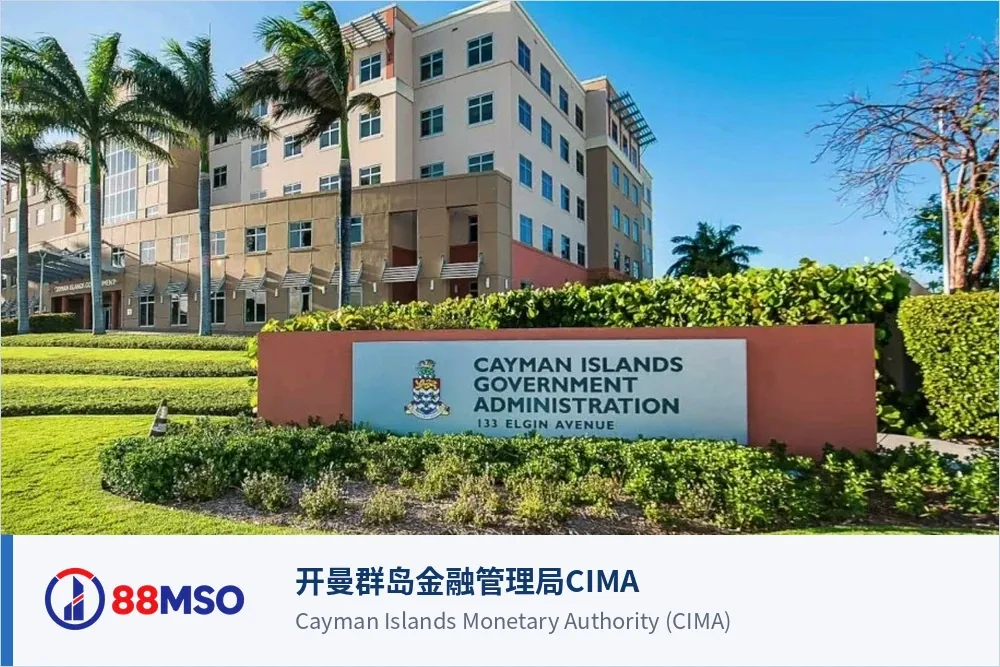
This article will focus on mutual funds、Analysis of three major themes of private equity funds and SPC,combined with practical experience,Help you establish a set of implementable application and compliance ideas。
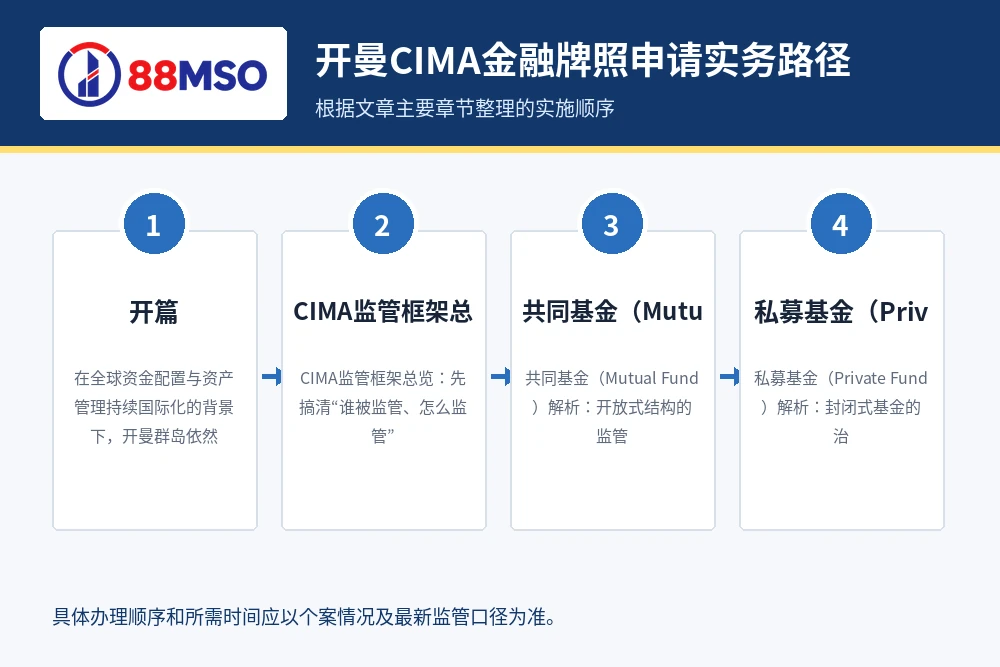
Overview of the CIMA regulatory framework:First figure out “who is being supervised”、How to supervise?”
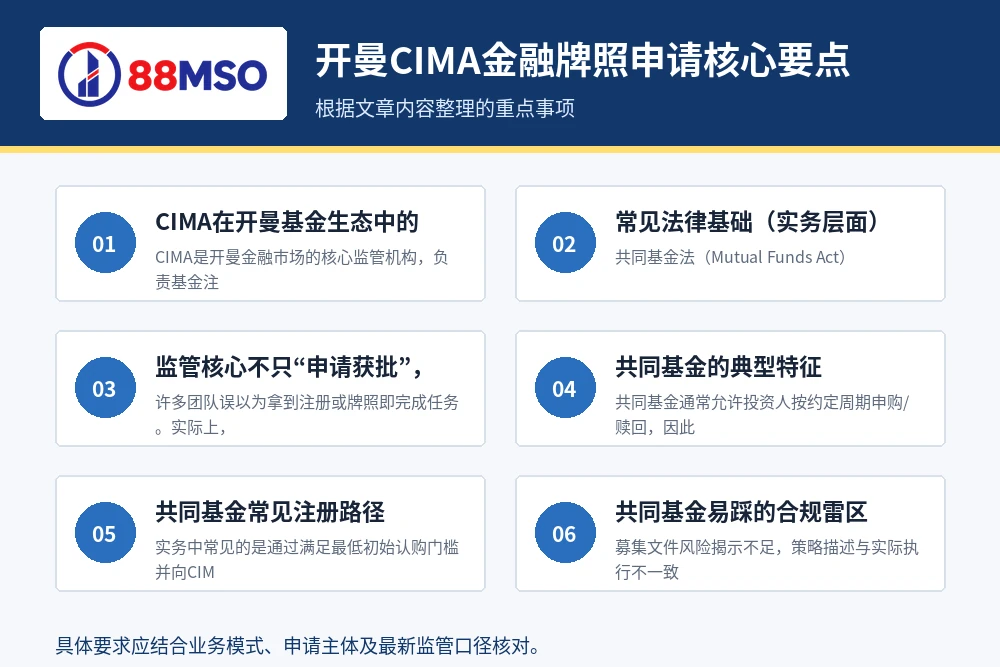
1) CIMA’s role in the Cayman fund ecosystem
CIMA is the core regulator of Cayman’s financial markets,Responsible for fund registration、Regulation of licensed entities、Anti-Money Laundering Review、Ongoing compliance monitoring and other key responsibilities。For fund sponsors,CIMA’s regulatory objective is not to “prevent innovation”,but to ensure market transparency、Investor protection and financial stability。
2) Common legal basis (practical level)
- Mutual Funds Act:Mainly covers open-end funds (redeemable by investors)
- Private Funds Act:Mainly covers closed-end funds (generally no daily redemption arrangements)
- Company Law and Related Supporting Rules:Covers SPC establishment、corporate governance、Information disclosure, etc.
3) The core of supervision is not just “approval of application”,More on “Continuous Compliance”
Many teams mistakenly believe that obtaining a registration or license completes the task。actually,CIMA supervision places more emphasis on follow-up implementation,Includes annual audit、Valuation policy、Anti-money laundering system、Service provider appointment、Reporting of major matters, etc.。Compliance is not a one-time document,It’s about sustainable operating capabilities。
Mutual Fund Analysis:Regulatory Focus on Open Structures
1) Typical characteristics of mutual funds
Mutual funds usually allow investors to subscribe/redempt at an agreed period.,So liquidity management、NAV valuation and information disclosure requirements are higher。Such products are commonly found in hedge funds、macro strategy、Quantitative strategies and other structures。
2) Common registration paths for mutual funds
What is common in practice is by meeting the minimum initial subscription threshold and completing registration with CIMA。Different fund sizes、Investor type and distribution region will affect document complexity and review focus。Core materials usually include:
- Fund establishment documents (Articles of Association、Offering documents/Offering Memorandum)
- Service Provider Agreement (Administrative Manager、auditor、Escrow or related arrangements)
- Information disclosure of directors and actual controllers
- Valuation、risk、Liquidity and Redemption Mechanism Description
3) Compliance minefields that are easy to step on for mutual funds
- Insufficient disclosure of risks in fundraising documents,Strategy description is inconsistent with actual execution
- redemption threshold、The gate and side pocket terms are unclearly designed
- Valuation policies lack independence and auditability
- The AML/KYC process is a formality,Failure to verify the source of the actual investor
Private Fund Analysis:Governance Focus of Closed-End Funds
1) Private equity funds are not “less regulated”,But the regulatory logic is different
Private equity funds generally do not provide frequent redemptions,More emphasis on investment period and exit mechanism。CIMA focuses its attention onValuation procedure、Asset custody、Cash monitoring、Audit and treat investors fairlyetc.。Many PE/VC teams set up main funds or parallel funds in Cayman,will fall into this regulatory framework。
2) Practical concerns about private equity fund registration
- Valuation policy:Valuation frequency needs to be clarified、method、Level of third party involvement
- Asset verification:The ownership and transaction links of underlying assets must be traceable
- Cash monitoring:Avoid opacity in fund transfer and authorization mechanisms
- Audit and reporting:Submit annual audited financial statements as required
3) When to consider private equity funds instead of mutual funds?
If your strategy is based on mid- to long-term equity investment、real estate、Focus on special opportunity assets,And investors are more accepting of lock-up periods,Private equity funds generally better match。However, if investors have strong liquidity preference、Requires periodic redemption arrangements,mutual funds are more common。
Full analysis of SPC architecture:Key tools for risk isolation and product matrixing
1) What is SPC?
SPC can be understood as "multiple independent investment portfolios (Portfolio) under one company shell"。Each portfolio can achieve asset and liability segregation at the legal and accounting levels,Theoretically, the risk of portfolio A does not spill over to portfolio B.。This pair of multi-strategy platforms、Mother-child fund system、The tiered fee structure is especially valuable。
2) Typical application scenarios of SPC
- The same management team operates multi-strategy products (such as long-short stocks、event driven、Fixed income enhancement)
- Split the portfolio according to investor preference (currency、lever、area)
- Develop an "incubation portfolio" and migrate independently when mature
- Control setup costs,More efficient than creating new entities one by one
3) SPC is not everything:Three key constraints
- File complexity is higher:Each combination clause needs to be carefully drafted
- Operational discipline requirements are stricter:Account、trade、Valuations must be portfolio-level isolated
- It is more difficult for service providers to collaborate:Administrative managers and audit processes must support multiple combinations in parallel
Application process and timeline:Complete path from structural design to CIMA registration
Stage one:Early planning (2-4 weeks)
Specify fund type (mutual/private equity)、investment strategy、investor portrait、Fund-raising area、Service provider list and tax path。At this stage, it is recommended to simultaneously evaluate whether to use SPC,To avoid wasting time and costs caused by later reconstruction of files。
Stage 2:Legal and Compliance Document Preparation (3-6 weeks)
- Drafting of charter documents and issuance documents
- AML/KYC Policy、Risk Disclosure and Conflict Management Mechanism
- board governance、Authorization Matrix and Signing Process
- Service Provider Contract (Audit、Administration、Escrow/Cash Monitoring)
Stage three:Submission and regulatory interaction (1-4 weeks,(Depending on the project)
Submit registration application to CIMA and supplement materials based on feedback。If the project structure is clear、The files are logically consistent、Service provider configuration is complete,The process is usually smoother。
Stage four:Implementation and continuous compliance (long-term)
Includes annual audit returns、Investor information update、Registration of changes in important matters、Anti-Money Laundering Mechanism Implementation and Internal Review。The real challenges for many organizations begin at this step。
Cost and team configuration:The budget should not only look at the “registration fee”
A Cayman Fund project budget usually consists of the following components:
- Government fees and CIMA related fees
- Legal advisory fees (structural design、Document drafting、regulatory communications)
- Audit and administrative fees
- Director and company secretarial support costs
- Annual maintenance and compliance operating costs
If using SPC,Single establishment costs may be better,However, the requirements for refined operations and governance are higher,Need to match professional team。in practice,Many sponsors will choose to work with consultants with experience in cross-border financial compliance.,Reduce the risk of “application approved but operation disordered”。
Synergy with Hong Kong architecture:A common “dual-center” strategy for overseas asset management
Many Asian sponsors adopt the combination model of "Hong Kong management + Cayman funds":Hong Kong side responsible for investment advisory、trading or distribution function,Cayman carries fund entities and international investor capital pools。Special attention is required at this time:
- Boundary demarcation between Hong Kong side licensing obligations and Cayman side fund obligations
- Cross-border marketing and investor suitability management
- Bank account opening、Funding path、Tax substance and information exchange requirements
This is why many institutions when preparing Cayman structures,The Hong Kong compliance team will be consulted simultaneously.。Like 88MSO and its 88MSO advisory system,Long-term involvement in Hong Kong MSO、SFC、Highly regulated tracks such as insurance brokerage and moneylender licenses,Collaborating on cross-jurisdictional compliance、A large number of reusable methodologies have been accumulated in terms of document implementation and continuous operation.。For overseas teams,This type of "front-end structure + back-end compliance operations" integrated capabilities,Often more critical than a la carte low-priced services。
Common misunderstandings:90% of projects take detours in these steps
Misunderstanding 1:Treat CIMA registration as a "template to fill in the blanks"
different strategies、Disclosure standards vary widely between investor groups and fundraising regions.。Copying templates is prone to legal conflicts and incomplete disclosure.。
Misunderstanding 2:Only reset,No repeated annual review and continuous compliance
Supervisory spot checks、audit opinion、There is a problem with any aspect of AML record retention,All may affect subsequent fundraising and bank cooperation.。
Misunderstanding 3:SPC accounts are not properly isolated from operations
If transactions or fee sharing occur between portfolios,Lack of clear pricing and recording mechanisms,The advantages of risk isolation will be weakened,even cause controversy。
Misunderstanding 4:Ignore investor communication mechanism
No matter how complete the fundraising document is,,If reported regularly、Valuation description、Weak notification mechanism for major events,It is difficult to stabilize investor relations in the long term。
FAQ:High-frequency issues in Cayman CIMA fund application
Q1:Mutual funds and private equity funds,Which one is easier to apply for?
There is no absolute "easier"。The key depends on your investment strategy、liquidity arrangements、Whether the investor structure and operational capabilities meet regulatory requirements。
Q2:Are SPCs necessarily better than regular companies?
uncertain。If you only do a single strategy、single investor group,Ordinary structures may be simpler;If multiple products are used in parallel,SPC has more obvious advantages。
Q3:How long does the application cycle usually take?
From preparation to submission typically takes anywhere from weeks to months,The core variable is document quality、Service provider cooperation and regulatory feedback efficiency。
Q4:What is the most important follow-up maintenance?
annual audit、AML/KYC enforcement、Valuation policy implementation、Report of major changesIt is the four main lines,It is recommended to establish a fixed compliance calendar。
Conclusion:real threshold,Not "established",And in "sustainable compliance operations"
Cayman’s CIMA system is no mystery,But it requires high professionalism and execution ability。mutual funds、Private equity funds and SPC are not isolated choices,It’s about your fundraising strategy、investment rhythm、Investor management and cross-border regulatory coordination are closely related。Want to build the fund into a long-term brand,Must be structured for “continuous compliance” from day one。
If you are in the stage of building a Cayman fund structure,It is recommended to put “regulatory logic first”、File consistency first、The principle of “putting operational capabilities first”,Avoid subsequent costly rework。In a complex cross-border financial regulatory environment,Choose a professional team that is familiar with the linkage between Hong Kong and offshore systems.,Often it can significantly improve implementation efficiency and compliance certainty。