简体中文
简体中文 繁體中文
繁體中文 English
introduction:Offshore structure is not a “registration place multiple choice question”,But "strategic systems engineering"
At a time when cross-border business is accelerating its development,More and more companies areBVI company registrationandCayman CompanyregisterListed as the first step in international layout。Many entrepreneurs initially ask:“Which one is cheaper?” “Which one is better to open a bank account?” “Which one is better for financing?” – these questions are all important.,But if we only judge based on a single factor,Often subsequent financing、tax、audit、Pay higher costs in compliance filing and even equity restructuring。
Truly mature offshore architecture design,Should focus on business goals、investor preferences、regulatory requirements、Capital flow path and future exit mechanism,Conduct an integrated assessment。Especially for those planning to develop financial services in Hong Kong、pay、Asset management、For insurance intermediary or money lending business teams,Design of the relationship between offshore entities and Hong Kong licensed entities,Directly affects subsequent compliance efficiency and capital operation space。
This article will be based on "5 key elements” System comparison between BVI and Cayman,Help you upgrade from "registration convenience" to "architecture strategy"。
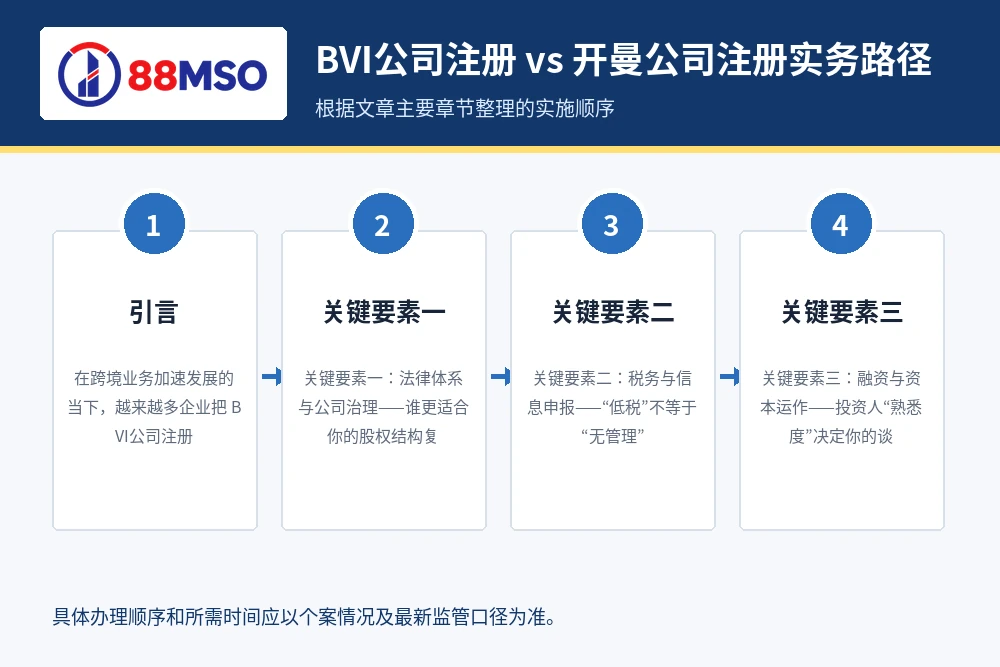
Key element one:Legal system vs. corporate governance – which one is better suited for the complexity of your ownership structure?
1) Common points:All belong to the common law system,High international recognition
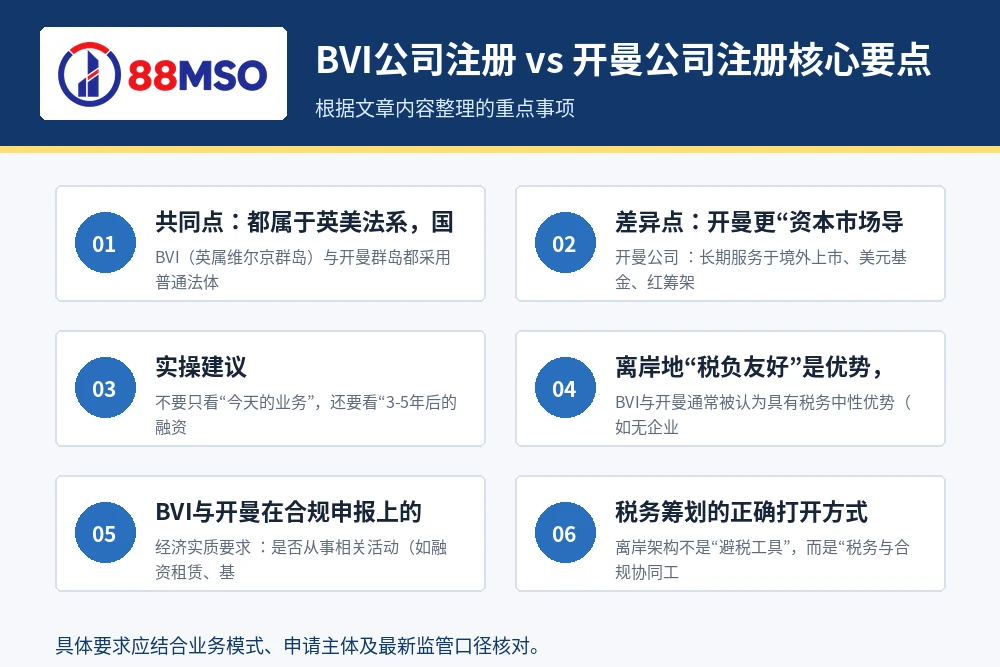
Both the BVI (British Virgin Islands) and the Cayman Islands adopt a common law system,Legal transparency and judicial predictability are high,It is a common offshore jurisdiction in international investment and financing.。For cross-border equity arrangements、Agreement execution、Definition of directors’ responsibilities, etc.,All have a relatively mature practical foundation。
2) Points of difference:Cayman becomes more “capital market oriented”,BVI is more “operationally flexible-oriented”
- Cayman Company:Long-term service in overseas listings、dollar fund、red chip structure,Institutional investors are highly familiar with,Especially in VIE、SPV、Widely used in multi-tier shareholding structures。
- BVI company:More flexible setup and maintenance,Governance documents are highly customizable,Suitable for small and medium enterprises、Family holding、Trading and cross-border shareholding platform。
Simple to understand:If you expect to connect with international institutional capital in the future、IPO or major M&A,Cayman is generally more in line with investor inertia;If you value efficiency and cost more,And the shareholding structure is relatively simple,BVI may be better。
3) Practical suggestions
Don’t just look at “today’s business”,Also look at the “financing script in 3-5 years”。Many companies start using BVI,Relocation or reorganization to Cayman before later financing,Although feasible,but will increase the law、Taxes and time costs。Architecture pre-planning,Far more cost-effective than post-remediation。
Key element two:Taxation and information declaration - "low tax" does not mean "no management"
1) The advantage of offshore locations is that they are “tax-friendly”,But global transparency has become the norm
The BVI and Cayman are generally considered to have tax-neutral advantages (such as no corporate income tax、local direct taxes such as capital gains tax)。But companies must know:International tax compliance has shifted from “whether it is taxable” to “whether it is explainable”。
With CRS、Advancement of Economic Substance (ES) and Beneficial Ownership Disclosure Mechanisms,Offshore entities need to prove their business purpose、Management activities and money flow logic。If the architecture cannot be self-consistent,Instead, they will make due diligence at the bank.、Risks triggered during audit review and tax residence declaration。
2) The concerns of BVI and Cayman on compliance reporting
- Economic substance requirements:Whether engaged in related activities (such as financial leasing、Fund management、Headquarters business, etc.),Whether local management and expenditure requirements are met。
- Annual Maintenance Report:Includes annual fee、Registration update、Necessary financial record keeping, etc.。
- Cross-border tax coordination:Need to be combined with the tax system of the parent company’s location、Comprehensive design of tax residence status of actual controller。
3) The correct way to start tax planning
Offshore structures are not “tax avoidance tools”,Rather, it is a “Tax and Compliance Collaboration Tool”。It is recommended to complete three things before setting up:
- Draw money flow、contract flow、Service flow three-flow diagram;
- Make it clear whether the place where profits are collected matches the place where value is created;
- Default future dividends、Equity transfer、Tax path for M&A exit。
Key element three:Financing and capital operation - investor “familiarity” determines your negotiation efficiency
1) Why is Cayman more common in financing scenarios?
In the VC/PE and USD fund ecosystem,Cayman entity proven long-term,Legal document template、investment terms、liquidation preference arrangement、ESOP mechanisms and so on are more standardized。in other words,investor、law firm、auditor、There is a higher "tacit understanding of collaboration" among underwriting institutions。
2) BVI is not incapable of financing,But the applicable scenarios are different
BVI raises capital at early stage、small-scale mergers and acquisitions、Overseas shareholding platforms are very common。If the project has not yet entered the institutional financing stage,BVI can meet cross-border shareholding and transaction arrangements at a lower cost。But when you get into multiple rounds of financing、Complex preferred stock terms or listing preparation period,Cayman may have advantage。
3) Common misunderstandings:Register casually first,Let’s talk about it when financing
This type of thinking is most likely to lead to:
- Investment Terms Rewritten,Legal fees doubled;
- Historical shareholder documents are not standardized,Impact on due diligence;
- Reconstruction of employee option pool,Incentive program delays;
- Bank KYC re-examination,Fund allocation is blocked。
If your endgame is "capitalization",Please design the structure from a capital market perspective on the first day。
Key element four:Setup and maintenance costs - look at "full life cycle costs",Not a “first year quote”
1) Direct cost:Government fees + registration service fees
Normally,The threshold set by BVI is relatively friendly,Annual maintenance costs are also more controllable;Setup and ongoing maintenance costs are generally higher in Cayman,Especially in the company type、authorized share capital、secretarial services、Obvious differences in compliance support。
2) Hidden costs:The four most underestimated expenses
- Compliance remediation costs:Early files are incomplete,High cost of correction later。
- Bank account openingrecurring costs:Insufficient material preparation leads to multiple rounds of replacement parts。
- Reorganization and relocation costs:Pre-financing structure change to create a lawyer、audit、tax expense。
- Management time cost:Insufficient cross-jurisdictional collaboration leads to delayed decision-making。
3) "Saving money" and "saving trouble" are often incompatible.
Enterprises should match plans according to stages:
- early verification period:Can be biased towards lightweight、low cost structure;
- growth period:Prioritize financing compatibility and governance regulations;
- mature stage:Emphasis on tax coordination、M&A and exit efficiency。
In the long run,The cheapest option is not necessarily the lowest total cost option,The most important thing is to keep pace with business growth。
Key element five:Bank account opening and fund availability - no matter how beautiful the structure is,It’s useless if the account is not easy to use
1) The core of the success or failure of account opening,Not on "which island",And in "Business Explainability"
Whether BVI or Cayman,What banks really care about is:Who are you、do what、where does the money come from、where to go、Why do you want to go like this?。That is, the business substance and risk profile under the KYC/AML framework。
2) Key materials that affect account opening efficiency
- Clear equity penetration diagram and ultimate beneficiary information;
- business contract、Invoice sample、Upstream and downstream instructions;
- Background certificates and funding sources of directors and actual controllers;
- Documentation on separation of functions with Hong Kong or other operating entities。
If you plan to set up financial business in Hong Kong,Fund path between offshore companies and Hong Kong licensed entities、Service Agreement、Pricing basis should be planned in advance。Otherwise, even if the account is opened,It may also be restricted in subsequent transaction monitoring。
3) Why do many companies choose the "offshore + Hong Kong" linkage plan?
Hong Kong’s banking system、Professional service ecology、In terms of regulatory clarity, it has the advantage of connecting with international capital.。In practice,A common practice is to use BVI or Cayman as the top holding platform,Then combine with Hong Kong operating companies or licensed entities to undertake real business。This will preserve the flexibility of the offshore structure,It’s also easier to open an account、Settlement and ongoing compliance。
For those involving MSO、SFC、insurance broker、Regulated industries such as moneylenders,Architectural design needs to be advanced simultaneously with the licensing path。Service organizations like 88MSO and its 88MSO team that have long been involved in financial compliance in Hong Kong,It can usually provide an integrated connection between "registration location selection - license planning - account opening and implementation - ongoing compliance",Avoid gaps caused by repeated communication among multiple consultants。
Practical decision-making model:Is your business better suited to the BVI or Cayman?
5 quick self-test questions
- Are there any clear plans for institutional financing or listing in the next 24 months?
- Whether the ownership structure involves multiple rounds of preferred shares、employee options、Convertible bonds?
- Do you need high-frequency cross-border receipts and payments and a multi-currency account system?
- Are you planning to apply for a financial-related license and conduct regulated business in Hong Kong?
- Do you have the ability to maintain cross-jurisdictional compliance reporting and governance requirements over the long term?
If the first two items are mostly "yes",Cayman is generally more forward-thinking;If the current focus is on operational and cost efficiency,And the structure is relatively simple,BVI may be a better match。The optimal solution is not “who is better?”,And in "Who is more suitable for your stage goals?"。
Common mistakes and risk tips
- Mistake 1:Only compare registration prices,Not Comparing Compliance Maintenance vs Financing Compatibility。
- Mistake 2:Ignore tax residence rules,Causing failure of offshore structures。
- Mistake three:Open an account first and then add materials,Trigger repeated due diligence by banks。
- Mistake four:license、company、Separate accounts and find service providers,Information caliber is inconsistent。
- Mistake five:No exit mechanism design,Tax and legal costs increase sharply when equity transfers。
Cross-border structures are most afraid of “puzzle-like decision-making”。It is recommended to complete a complete roadmap before launching:Place of registration、Physical division of labor、contract system、tax logic、bank path、license plate rhythm、Annual Maintenance Responsible Person,One-time design is clear。
Conclusion:The win and loss of offshore structures,Determined by “pre-design capabilities”
BVI company registration vs Cayman company registration,It’s never a simple matter of choosing one or the other。It is essentially an "underlying architecture test" of an enterprise's internationalization capabilities.。Right choice,You will be financing、Open an account、Compliance、Ongoing tax and exit benefits;Wrong choice,Every step in the future may be passively patched。
therefore,It is recommended that companies before making decisions,Not only look at the feasibility of registration,More attention should be paid to the sustainability of the entire life cycle。Especially if your business has a Hong Kong financial license、Cross-border payment、When related to overseas fund management,The coordination between offshore entities and Hong Kong’s compliance system is particularly critical。Use the ending to work backwards from the starting point,This is the global thinking that mature enterprises should have。
If you are at the intersection of "selecting the place of registration + landing your business in Hong Kong",Priority is given to finding teams with dual experience in offshore structures and Hong Kong financial compliance,Often can significantly reduce trial and error costs,and get into growth faster、auditable、Financable health track。