简体中文
简体中文 繁體中文
繁體中文 English

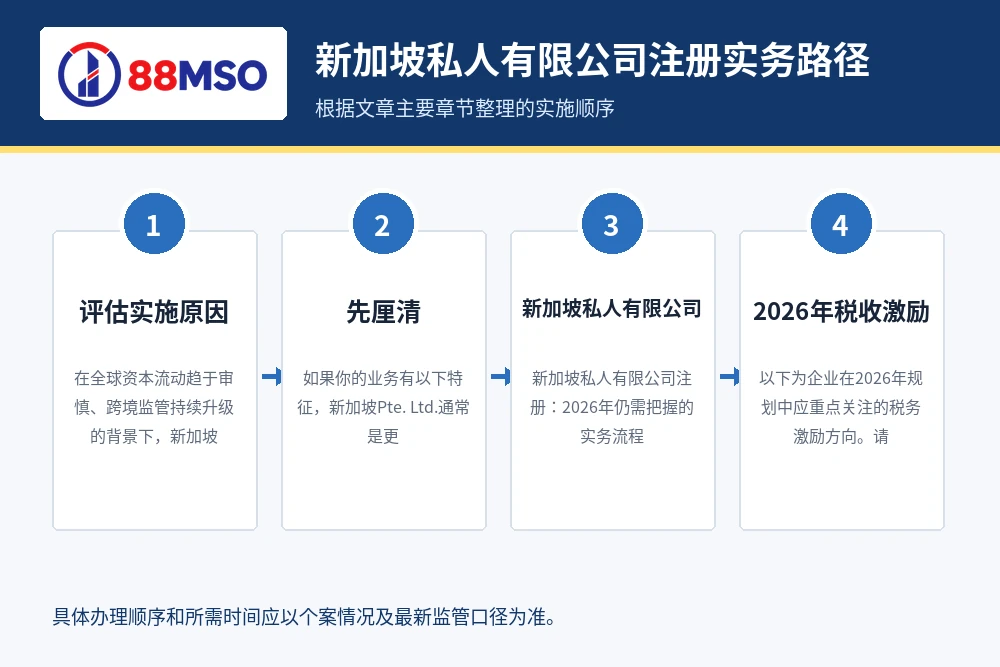
Why is 2026 a key window for setting up a Singapore private limited company?
Global capital flows tend to be cautious、In the context of continued escalation of cross-border supervision,Singapore Private Limited Company(Private Limited Company) is still a high-frequency choice for Asian companies in their “overseas overseas architecture”。on the one hand,Singapore has a mature legal environment、Advantages of international banking system and transparent tax system;on the other hand,Regulatory agenciesSubstantive operations、Anti-money laundering、Cross-border capital flow compliancePut forward higher requirements。Entering 2026,Enterprises must not only “be able to register”,More importantly, "operate stably"、Tax can be obtained、Supervision can withstand scrutiny”。
This article will focus on three main lines:Registration and landing、tax incentives、MAS Compliance。at the same time,Combined with the practice of cross-border financial enterprises served by 88MSO,Help you upgrade "company establishment" to the starting point of "sustainable compliance management system"。
one、First clarify:Which companies are suitable for Singapore private limited companies?
If your business has the following characteristics,Singapore Pte.. Ltd. is usually the more flexible option:
- Cross-border trade and service export:Need a stable international settlement environment and compliant payment channels;
- science and technology、consult、Platform business:Pay attention to intellectual property management and tax efficiency;
- Regional headquarters planning:Hope to use Singapore as the hub of operations in Southeast Asia;
- Future financing or M&A plans:corporate governance、Equity structure and auditing standards are required to be high。
But if it involves payment、digital token、Fund management、Securities advisory and other activities,It is necessary to judge in advance whether it touches the boundary of MAS regulatory license.。Many companies "operate first and then replenish licenses" will result in bank account restrictions、Partner’s due diligence failed,Even regulatory inquiries escalated。
two、Singapore Private Limited Company Registration:Practical processes that still need to be mastered in 2026
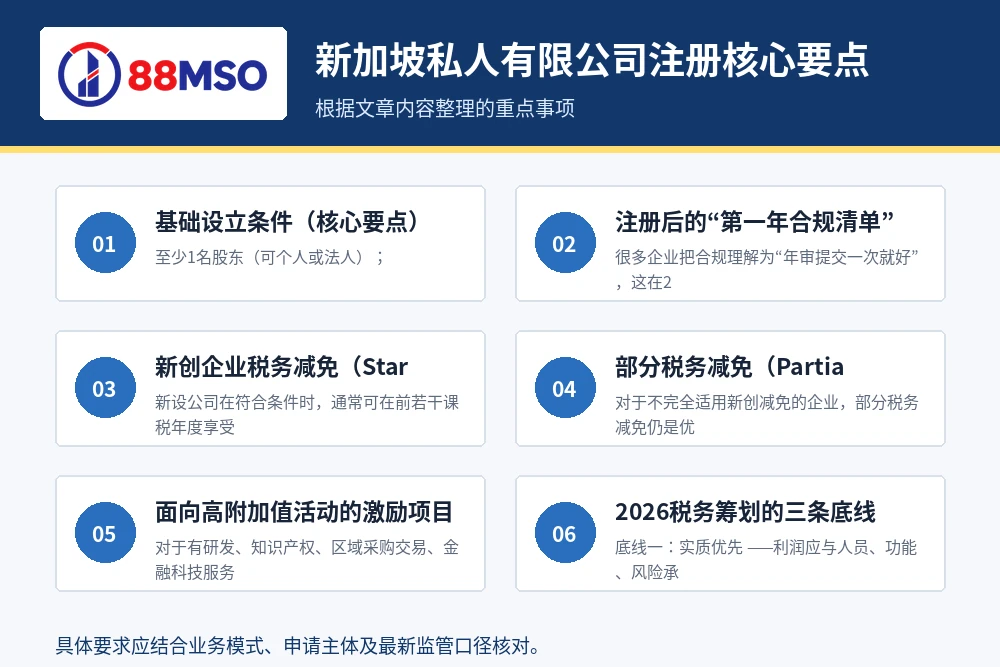
1) Basic establishment conditions (core points)
- At least 1 shareholder (can be an individual or legal person);
- At least 1 local director (usually Singapore resident required);
- Legal company secretary (appointed within the specified period after establishment);
- Singapore local registered address;
- Articles of Association、Equity ratio、Business scope (SSIC) clear。
What is most easily overlooked in practice is:Whether the business description is consistent with future regulatory attributes。For example, the articles of association say "technical consulting",Actual cross-border payment aggregation or collection and payment agency,The risk of "mismatch between business scope and capital flow" will easily arise in subsequent bank KYC and regulatory verifications.。
2) "First Year Compliance Checklist" after registration
Many companies understand compliance as “just submit the annual review once”,This is no longer sufficient in the regulatory context of 2026。It is recommended to complete at least the following actions:
- Establish a board of directors and authorization signing mechanism,Avoid "disconnection between actual controller and legal documents";
- Establish financial accounting and voucher archiving system,Ensure revenue costs are traceable;
- Clarify the pricing logic of related party transactions,Prepare for subsequent tax audits;
- Establish customer access standards (KYC/KYB) based on business risk levels;
- Set up auditable transaction monitoring and exception escalation processes。
For companies that have plans to deploy in both Hong Kong and Singapore,88MSO often recommends "Unified compliance standards in both places”:Equity link、Contract subject、Invoice flow、capital flow、The flow of personnel should confirm each other,This will directly improveBank account openingDue diligence pass rate with the organization。
three、2026 Tax Incentive Policy:What enterprises are most concerned about is “whether it can be used、How to use"
The following are the tax incentive directions that enterprises should focus on in their 2026 planning.。please note,The specific applicable conditions and tax rates are subject to the latest official announcement and case approval.。
1) Startup Tax Exemption
When a newly established company meets the conditions,Generally, a certain amount of taxable income reduction can be enjoyed in the previous tax years.。Such policies are critical to early cash flow,But the premise is:
- Clear ownership structure and beneficial owners;
- The business has real commercial substance,Not "shell profit collection";
- financial accounting standards,Ability to support tax bureau review。
Common misunderstandings:Thinking that “registering in Singapore” will automatically get incentives。actually,Policies applicable tend to vary with company type、Nature of income、Shareholder identity and compliance record related。
2) Partial Tax Exemption
For companies that do not fully apply for new start-up relief,Partial tax exemptions are still an important mechanism to optimize the overall effective tax burden。Enterprises should focus on doing a good job:
- Income classification is consistent with cost aggregation caliber;
- Cross-border service fee、royalties、Management fee contracts and transfer pricing supporting documents;
- Avoid "Profits are on the books"、Structural conflict of "substance outside the country"。
3) Incentive programs for high value-added activities
For those with R&D、intellectual property、Regional purchasing transactions、Companies with financial technology services and other businesses,May be exposed to more targeted incentive frameworks (such as extended investment incentives、Arrangements related to intellectual property development、Industry-specific plans, etc.)。This type of incentive usually has two characteristics::
- High threshold:For staff size、local input、Business plan and KPI have clear requirements;
- Strong supervision:Continuous performance of the contract is required after approval,Failure to meet the promise may affect the continuation of the offer。
therefore,Enterprises should shift from “declaration thinking” to “business cashing out thinking”:Policies are not obtained in one go,But continue to meet the standards。
4) Three bottom lines for 2026 tax planning
- Bottom line one:substance first——Profit should be related to personnel、Function、Risk taking matches;
- Bottom line two:Well documented--contract、bill、Evidence of delivery、Board of Directors’ decision to close the loop;
- Bottom line three:Consistent across borders--Singapore、Hong Kong and other jurisdictions cannot fight with each other。
Four、MAS Compliance Points:Not all companies require a license,But all companies need a “sense of boundaries”
MAS (Monetary Authority of Singapore) supervision focuses on "what financial activities you actually do"。Enterprises should firstRegulatory Activity Mapping,Determine whether licensing requirements are met:
- Whether to operate payment services、Cross-border remittance、Electronic money related activities;
- Whether it involves capital market product transactions、consultant、Fund management;
- Whether digital payment token services or escrow functions are involved;
- Whether to provide "what appears to be technical services" to external parties?、In fact, the function of "financial intermediary"。
1) Common high-risk misjudgment scenarios
- “We are just a technology platform,"Don't touch the funds" - but actually have the ability to command and control funds;
- "We only make introductions,No transaction” - but there is revenue sharing and continuous matching;
- "We only do intra-group settlement" - but the nature changes after opening to external customers。
This kind of misjudgment will be carried out in the bank due diligence、Quickly exposed during compliance review of partner institutions,The consequences are usually not as simple as "replenishing materials",but directly affects business continuity。
2) Even if you don’t hold a license,Also establish a MAS style compliance framework
After 2026,The market pays more attention to the governance capabilities of “quasi-financial companies”。It is recommended to configure at least the following mechanisms:
- Customer identification and beneficiary verification process;
- Transaction monitoring rules (amount threshold、Frequency、geographical risk、behavior pattern);
- Internal reporting of suspicious activity and escalation paths;
- Sanctions screening and high-risk country controls;
- Data retention、Audit trails and employee training records。
These mechanisms are not only to deal with regulatory,It is also a key asset to improve bank account stability and partner trust.。
five、register、tax、Bank account opening:Must be integrated design
Many projects fail not because of a "single point of error",But the three systems are not linked.:
1) Corporate structure and taxation do not match
For example, the holding layer、Operations layer、Confusing responsibilities at the collection level,Leading to difficulties in explaining profit attribution,Tax and audit pressures increase sharply。
2) Bank KYC is inconsistent with business narrative
Banks value real business logic most:Customer source、counterparty、Usage of funds、contract chain。If you are on road show materials、Account opening form、Everyone says their own thing in the description on the official website,Pass rate naturally drops。
3) Compliance documents are “written afterward”
internal system、Risk Control Manual、The authorization matrix should be completed before the business goes online,Don’t wait for due diligence or inquiries before improvising。
in cross-border projects,The value of professional consultants is not just “registration agency”,Instead, we put regulatory logic in front of。88MSO and its 88MSO team have long-term services in Hong Kong’s financial licensing and compliance implementation,When assisting companies to build a Singapore-Hong Kong linkage structure,usually putlicense plate boundaries、AML framework、tax caliber、bank acceptabilityPut it on the same road map,Reduce late rework。
six、Practical recommendations for 2026:An action list for founders and compliance leaders
- Step 1:Conduct regulatory and tax pre-diagnosis——First determine whether the business involves MAS license,Redesign the tax path;
- Step 2:Determine equity and functional stratification——Put the IP、Sale、Settlement、Distinguish between service delivery entities;
- Step 3:Prepare account opening materials simultaneously——Business plan、Contract template、Fund flow description and compliance policy are on the same page;
- Step 4:Establish quarterly compliance reviews——Check the deal structure every quarter for deviations from initial assumptions;
- Step 5:Set aside a budget for regulatory upgrades——Including system modification、Compliance manpower、External review and training。
FAQ:The 5 most frequently asked questions by businesses
Q1:How long does it usually take to register a Singapore private limited company?
If the information is complete、Clear backgrounds for shareholders and directors,The setup process can be completed faster。But it involves complex equity、beneficiary penetration、When reviewing specific industries,The cycle will be significantly extended。
Q2:Is there no problem if I don’t apply for a MAS license?
uncertain。The key lies in "actual business behavior"。As long as the activity actually touches the scope of regulation,may be deemed to be licensed or subject to specific obligations。
Q3:Are tax incentives available to all new companies?
no。Need to meet policy conditions,And continue to maintain compliance and substance in operations and reporting。It is recommended to do an availability assessment before registering。
Q4:Can I use a Singapore company to directly serve global customers?
Can,However, the contract should be configured according to the regulatory requirements of the target market、data、Payment and tax arrangements。Some countries/regions may require local licensing or declarations。
Q5:How can Hong Kong and Singapore structures avoid duplication of compliance costs?
The core is a unified governance framework:Consistent Beneficiary Disclosure、AML standard、Contract template and audit standards。The clearer the early design,Subsequent operation costs will be saved。
Conclusion:Turn "registration completion" into the starting point of "compliance growth"
Singapore market in 2026,The opportunity is still there,But the window for “extensive overseas expansion” is closing。What the business really needs,Not a company registration document,But a set that can pass through the bank、tax、Management system with multiple inspections of supervision and partners。
If you are planning to conduct cross-border business as a Singapore private limited company,please changeAvailability of tax incentives、MAS regulatory boundaries、AML risk control capabilitiesTreat as equal priority。Only the structure、Design in sync with compliance and business goals,Only in this way can we maintain resilient growth in the uncertain cycle ahead.。