简体中文
简体中文 繁體中文
繁體中文 English
introduction:Why “Being Able to Write AML Policies” Determines the Success or Failure of a License Application
Against the backdrop of continued tightening of the financial regulatory environment in Hong Kong and offshore,More and more applicants are finding:Financial license approval no longer only depends on company capital、Team resume or business plan,byFATF "Anti-Money Laundering"、International Standards on Counter-Terrorism Financing and Counter-Proliferation Financing"Completeness and enforceability of AML/CFT policies based on,It has become the focus of regulatory review。Whether it isHong Kong MSO License、SFC related licenses、insurance broker license,Or a moneylender's license?,The regulatory logic is highly consistent - you must prove that you "can see the risks"、Manage risks、Leave evidence behind”。
A common misunderstanding that many companies make during the application stage is that:Download template、Simple replacement of company name、After splicing a few paragraphs of "high-end" terminology, submit it。This approach often triggers regulatory inquiries,Even ask for replacement parts directly,Extend the approval cycle。A truly qualified AML policy,Not "Pretty files",But it can be implemented in real business scenarios.,and form a closed-loop evidence chain。
This article will focus onRisk-Based Approach, RBA)this core principle,Systematically explain how to write AML policies in financial license applications、Framework points、Common minefields and practical examples,Help enterprises upgrade from "payable submission" to "auditable and sustainable"。For institutions planning to launch financial services in Hong Kong,Establish a professional compliance infrastructure in advance,Often more time-saving than later remediation、More cost-effective。
one、What exactly are regulators looking at?:The underlying logic of AML policy review
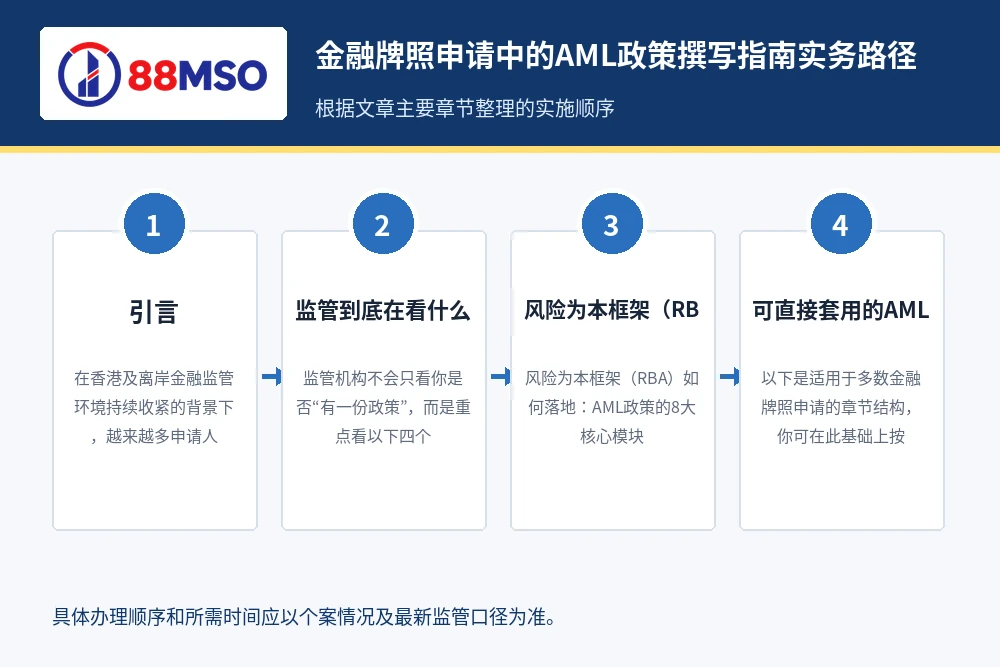
Regulators don’t just look at whether you “have a policy”,Instead, focus on the following four questions::
- Have you identified your own risk profile?:business model、Customer type、area exposed、Are transaction channels objectively evaluated?。
- Do control measures match the risk level?:Whether high-risk customers have enhanced due diligence (EDD),Can the process be streamlined for low-risk customers?。
- Are responsibilities clear and accountable?:Board of Directors、Management、MLRO、Are the boundaries of responsibilities of the frontline team clear?。
- Do you have continuous monitoring capabilities?:Transaction monitoring、Report suspicious transactions、Is there a mechanism for regular review and training?。
in other words,Regulation does not require every institution to be “exactly the same”,Rather, I ask you to "Match the size of your business and risk complexity”。This is the core spirit of the risk-based framework。
two、How to implement the risk-based framework (RBA):8 core modules of AML policy
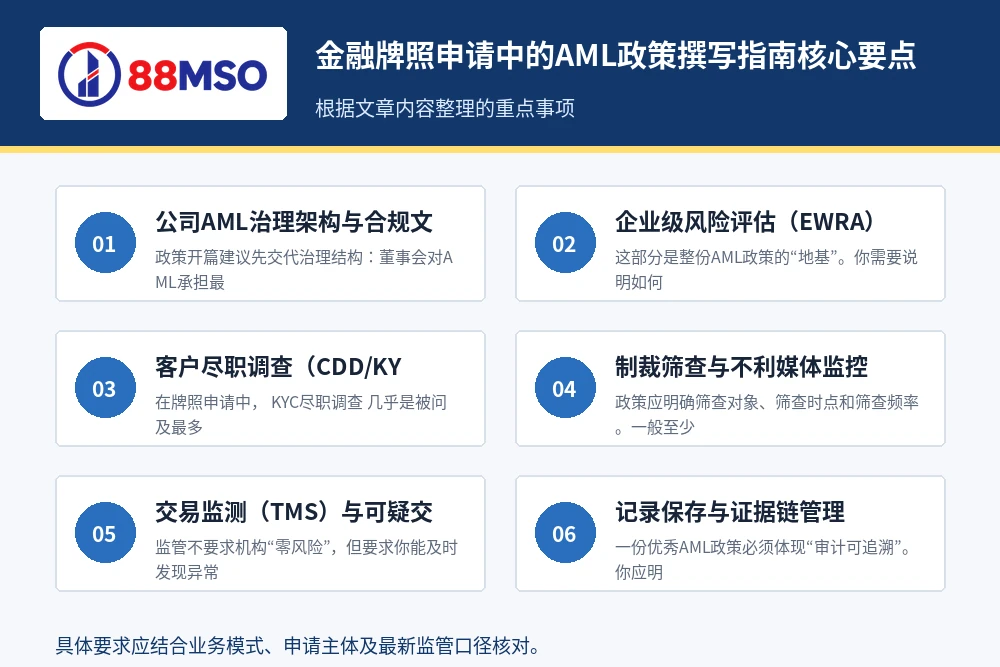
1. Company AML governance structure and compliance culture
At the beginning of the policy, it is recommended to explain the governance structure first:The board of directors bears ultimate responsibility for AML,Management is responsible for resource allocation and implementation supervision,MLRO is responsible for daily compliance management and suspicious transaction reporting mechanism。Don’t just write the job title here,Must be written clearly:
- Reporting path (to whom the MLRO reports,How often to report)
- Conflict avoidance mechanism (how to rule when business KPIs conflict with compliance requirements)
- Escalation mechanism (emergency channel when major suspicious situations are discovered)
The most taboo thing in supervision is “paper compliance”、Practical disconnection”。therefore,It is recommended to attach an organizational chart and responsibility matrix (RACI),Make sure policies are enforceable。
2. Enterprise-Wide Risk Assessment (EWRA) Methodology
This part is the "foundation" of the entire AML policy。You need to describe how you assessed the following four categories of risk:
- customer risk:high net worth、Not face to face、complex equity、Politically Exposed Persons (PEP), etc.。
- Product/service risks:Cross-border remittance、high frequency trading、Cash-intensive businesses, etc.。
- geographical risk:high sanctions、high corruption、Jurisdictions with weak AML regulation。
- Channel risk:acting、Online remote account opening、Third-party traffic channels。
It is recommended to use the "qualitative + quantitative" scoring method,For example, score from 1 to 5 and set weights,Develop interpretable risk stratification criteria。Supervision attaches great importance to "why this customer is classified as high risk",Therefore, the scoring logic must be able to be reviewed。
3. Customer Due Diligence (CDD/KYC) and Enhanced Due Diligence (EDD)
Under license application,KYC due diligenceIt’s almost the most frequently asked question。The policy must contain:
- Natural person customer identification elements (identity、address、Profession、source of funds)
- Legal person customer identification elements (registration information、Ultimate beneficial owner UBO、Controller)
- UBO penetration standard (shareholding threshold、Judgment of control)
- Non-face-to-face verification requirements (video witnessing、Living body、Document authenticity verification)
For high risk customers,EDD actions need to be clarified,For example:Request higher level approval、Obtain more detailed proof of source of wealth、Increase transaction review frequency, etc.。The key is "layered management",Rather than “one size fits all”。
4. Sanctions Screening and Adverse Media Monitoring
Policies should clarify who is screened、Screening time and frequency。Generally covers at least:
- Onboarding screening
- Periodic rescreening of existing customers
- Event-driven screening
List sources may include the United Nations、OFAC、European Union、Major sanctions lists such as the UK,and a list of local regulatory guidance requirements。There should be a hierarchical processing process (true hit/false positive) and manual review mechanism for "hit results"。
5. Transaction Monitoring (TMS) and Suspicious Transaction Reporting (STR) Mechanisms
Regulation does not require institutions to be “zero risk”,But it requires you to detect abnormalities in time。The policy should state:
- Monitoring rules:Threshold rules、behavioral pattern rules、Geographical anomaly rules
- Early warning processing:Who does the first trial?、Who reviews、How long is the time limit?
- STR submission criteria:What circumstances need to be reported?,When to report,To whom to report
- confidentiality requirements:Prevent “tip-off”
It is recommended to add an appendix of typical red flag indicators (Red Flags),For example, multiple split transactions in a short period of time、Large capital inflows and outflows that are clearly inconsistent with the customer profile、Frequent travel to high-risk areas, etc.。
6. Record keeping and evidence chain management
An excellent AML policy must reflect "audit traceability"。You should clarify the storage scope and period,Includes customer KYC profile、Risk assessment record、Transaction monitoring log、Conclusion of internal investigation、Training records, etc.。Can be saved electronically,But it needs to satisfy the completeness、Tamper resistance and readability requirements。
7. training、Testing and independent auditing
Supervision attaches great importance to the “human” factor。Policies should distinguish training paths for different positions:
- Frontline Sales/Customer Service:Identify abnormal behavior and communicate boundaries with customers
- Operations team:Document review、Transaction review、System operation
- Management and Directors:risk appetite、governance responsibilities、accountability mechanism
at the same time,Conduct periodic independent reviews (internal audit or external consultants) at least annually,And output the rectification plan and closed-loop tracking。
8. Policy updates and regulatory response mechanisms
AML policies cannot be "written once and then managed for three years"。It is recommended to set conditions for triggering updates:regulatory changes、Business model changes、Major risk events occur、Audit finds high-risk gaps, etc.。Each revision should have a version record、Approval records and training implementation records。
three、AML policy chapter template (structural template) that can be directly applied
The following is the chapter structure applicable to most financial license applications,On this basis, you can adjust according to license type:
- 1. Purpose and scope of application:policy objectives、Applicable subject、Legal basis。
- 2. Governance and Responsibilities:Board of Directors、Management、MLRO、Compliance team responsibilities。
- 3. risk assessment framework:risk factors、Scoring model、Grading standards。
- 4. Customer Onboarding and KYC:CDD file list、UBO identification、Denial of Admission Criteria。
- 5. High Risk Management and EDD:PEP、high risk jurisdictions、Complex structure customer processing。
- 6. Sanctions and Adverse Media Screening:List source、Frequency of rescreening、hit disposal。
- 7. Transaction Monitoring and STR Process:Early warning rules、Upgrade mechanism、Reporting time limit。
- 8. Recordkeeping and Data Management:Storage period、Access rights、Encryption and backup。
- 9. training、Audit and rectification:annual training plan、independent testing、CAP rectification。
- 10. Policy approval and revision:version control、review process、Effective mechanism。
hint:The policy text submitted during the application stage should preferably be consistent with future SOPs (Standard Operating Procedures),Avoid "write everything in your application"、The gap of "can't do it during operation"。
Four、The 5 most common AML writing minefields in financial license applications
- Minefield 1:Copying templates without business mapping
For example, if you are a cross-border payment business,However, the logic of monitoring cross-border regional risks and capital flows was not clearly written.。 - Minefield 2:Just talk about principles,No process time limit is written
There is no clarity on “who completes which step in how many days”,will be deemed unenforceable。 - Minefield 3:Ignoring the actual ability of the MLRO to perform its duties
Only in name but not performing duties,Lack of reporting mechanism and resource support。 - Minefield 4:The definition of high-risk customers is too vague
no quantitative standards,Leading to inconsistent implementation standards on the front lines。 - Minefield 5:Lack of evidence-based management
Unable to produce complete records during audit,Equivalent to "not executed"。
five、How to improve the efficiency of approval communication:What else should be prepared besides policy documents?
Many applicants think that submitting the AML policy is the end of the process.,In fact, supplementary materials are often required during the regulatory communication stage。It is recommended to prepare in advance:
- Enterprise Risk Assessment Report (EWRA)
- Sample Customer Risk Score Form
- Account Opening KYC Checklist and Rejection Case Criteria
- Transaction monitoring rule list and early warning processing SOP
- Annual training plan and examination record template
- Suspicious transaction internal reporting report (Internal SAR) template
From practical experience,"Policy + Process + Form + Evidence" four-in-one,Can significantly reduce the number of rounds of regulatory inquiries。A service team like 88MSO that has long focused on the implementation of financial compliance in Hong Kong,We usually assist companies to connect application documents with subsequent operation systems at once.,Reduce the repetitive cost of "get the cards first and then rework"。
six、Key differences in AML under different license types (short version)
1) MSO related business
Focus on cash flow and transparency of cross-border remittance routes、Agent network management、Real-time identification of suspicious transactions。
2) SFC related financial services
Focus on customer suitability、Reasonable source of funds、Monitoring of complex product trading behavior and risk review of high-net-worth clients。
3) Insurance brokerage business
Focus on premium sources、Surrender and compensation exceptions、Identification of third-party payment behavior。
4) Money lender business
Focus on the authenticity of the borrower’s identity、Fund usage verification、Related party circular lending and abnormal repayment pattern monitoring。
The same is the AML policy,Different types of license plates,Different risk aspects。Policy design must be “adapted to industry conditions”。
Conclusion:AML policies that are truly valuable,It can pass the approval and stand the actual test.
AML policy in financial license application,It’s never just a “document project”,It is the operating system for future compliance operations of enterprises.。Building policies based on a risk-based framework,The core lies in three points:Identify real risks、Configure matching controls、form admissible evidence。Do these three things,Not only helps improve the efficiency of license application,It can also reduce the risk of compliance incidents and regulatory penalties during the business growth stage.。
For enterprises planning to expand financial business in Hong Kong and overseas,The sooner we establish a professional AML governance system,The more you can gain long-term trust dividends in market competition。Get your AML policy right、Realistic、write thoroughly,It is the key ability to get through the regulatory cycle.。
FAQ:AML Policy Writing Frequently Asked Questions
Q1:Small company,Can AML policies be simplified?
Can be "proportionally simplified",But the core module cannot be missing。Small institutions must also have KYC、risk stratification、Suspicious transaction reporting and record keeping mechanism。
Q2:Is it necessary to appoint an MLRO?
In most financial license scenarios, the role of MLRO needs to be clarified。The key is not just the appointment,It also depends on the ability to perform duties、Reporting path and resource guarantee。
Q3:How often are AML policies updated?
It is generally recommended to review at least annually;If regulatory changes、Business model changes or major risk events occur,Special revisions should be initiated immediately。
Q4:Should I submit the English or Chinese version during the application stage?
Depends on regulatory requirements and acceptance habits。In practice, it is recommended to prepare a bilingual key version,Ensure regulatory communications are consistent with internal execution standards。