简体中文
简体中文 繁體中文
繁體中文 English
Virtual asset companies encounter difficulties in opening accounts:The problem is not "encryption",And in “verifiable compliance”
past few years,More and more people are engaged in exchanges、OTC、wallet、Payment settlement、hosting、Enterprise Discovery of Web3 Infrastructure:License application can move forward,Technical systems can go online,But I haven’t been able to open a bank account for a long time.。This is not an isolated phenomenon,But global banks are working on anti-money laundering (AML)、Sanctions Screening、Fund source identification、Common prudential consequences of regulatory pressures such as counterparty transparency。
Official verification:The regulatory scope covered by this article、Application Information and Ongoing Obligations,should beHong Kong Monetary Authority Anti-Money Laundering and Customer Due Diligence InformationThe current published information shall prevail。
Many founders think that “as long as the business is legal, they can open an account”,The actual bank’s judgment standards are more detailed:are you legal、Is it sustainable and compliant?、Are you able to prove the ins and outs of each fund?、Is there a sufficiently robust governance structure?。This is why we also do virtual asset business,Some companies successfully opened accounts within three weeks,Some companies have repeatedly made replacement parts for half a year and are still being rejected.。
For companies that want to enter Hong Kong and global markets,Opening an account is no longer an administrative action,Ratherpart of compliance engineering。in this regard,Service teams like 88MSO/88MSO that have long been involved in financial licensing and compliance implementation,Ability to translate "account opening language" into "risk control evidence acceptable to the bank" in advance,Often the key to project advancement efficiency。
Why are virtual asset companies more likely to be “high-risk labeled” by banks?
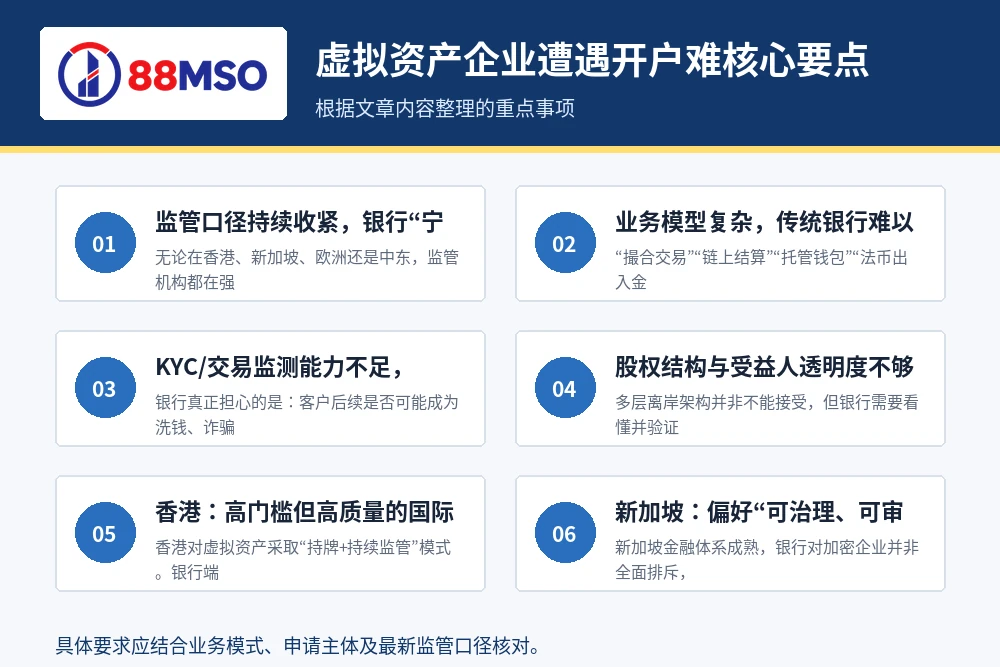
1. Regulatory standards continue to tighten,Banks “would rather do less,Don’t want to make a mistake”
No matter in Hong Kong、Singapore、Europe or the Middle East,Regulatory agencies are strengthening monitoring of virtual asset-related capital flows.。Banks serve as the first risk control gate,Facing potential fines、Reputation risk and cross-border regulatory investigations,Entry barriers will inevitably be raised。
2. Business model is complex,Difficult for traditional banks to quickly understand
“Transaction matching”, “on-chain settlement”, “managed wallet” and “fiat currency deposits and withdrawals” are not intuitive to the bank’s due diligence team.。If a company cannot convert business process diagrams into、Funding path、Visualization of risk control nodes,Banks usually directly determine "non-assessable risk"。
3. Insufficient KYC/transaction monitoring capabilities,Trigger persistent doubts
What banks are really worried about is:Whether the customer may become a money launderer in the future、Scam、Sanctions circumvention channels。If the company lacks mature KYC、On-chain address screening、Report suspicious transactions、blacklist mechanism,Even if the preliminary review is passed,It is also easy to be restricted or closed in the later period.。
4. Insufficient transparency in shareholding structure and beneficiaries
Multi-tiered offshore structures are not unacceptable,But banks need to understand and verify the ultimate beneficiary (UBO)、Source of Funds (SOF) and Source of Wealth (SOW)。I can't explain just one part of it,Account opening may be suspended。
what kind of bank,What counts as “encryption business compliance-friendly”?
"Friendly" does not mean "loose",RatherHave clear admission criteria、Communicable process and stable service capabilities。Can be evaluated from the following six dimensions:
- regulatory fit:Whether virtual asset business customers are clearly accepted under the local regulatory framework。
- Product matching:Whether to support multi-currency accounts、Cross-border payments、API、High frequency settlement。
- Risk control interfaceability:Whether to recognize third-party on-chain compliance tools and corporate self-built monitoring mechanisms。
- Team professionalism:Is there an account manager and compliance team dedicated to covering VASP/FinTech?。
- Ongoing operational stability:Whether there have been frequent "one-size-fits-all" withdrawals of crypto customers in history?。
- cost and efficiency:Account opening time、Minimum deposit、Account maintenance fee、Are transaction rates reasonable?。
Bank and regional paths to support virtual asset business
one、Hongkong:High threshold but high quality international hub
Hong Kong adopts a “licensing + continuous supervision” model for virtual assets。Bank requirements for applicants usually include:Clear license plate path、Local substantial operations、Improve the AML/KYC system、Traceable funds flow description。The advantage is,Once passed,The account has high gold content,Strong cross-border settlement capabilities。
Suitable for objects:Plan for long-term expansion in Asia、Requires HKD/USD clearing、Companies that want to deeply integrate with Hong Kong’s regulatory framework。
Practical Tips:Don’t just submit a “company introduction”,A “regulatory mapping document” (business activities corresponding to regulatory obligations) should be prepared、Transaction Monitoring Strategy、Suspicious transaction handling SOP。
two、Singapore:Preference for “governable、Auditable” institutional clients
Singapore’s financial system is mature,Banks are not completely hostile to crypto companies,But emphasis on governance and audit availability。for high-quality applicants,Especially if a mature compliance center has been established、A company with an institutional customer base,Relatively higher acceptance。
Suitable for objects:B2B payment、Institutional custody、Cross-border settlement platform、An enterprise with standardized financial and auditing systems。
three、Switzerland and Liechtenstein:Traditional private banking system superimposed on digital asset services
This type of jurisdiction has conducted early research on digital asset financial services.,Some banks have stronger digital asset understanding capabilities。The disadvantage is that the threshold and cost are generally not low.,and customer background、Strong reliance on funding sources and legal advice。
Suitable for objects:High net worth services、Family office structure、Asset management and custody related businesses。
Four、United Arab Emirates (especially Dubai):Fast growth、Strong internationalization,However, the material integrity requirements are high
The Middle East market has attracted a large number of virtual asset companies to move in in recent years。Some banks are becoming more open to compliant licensed entities,But approval focuses more on “business substance”:office、team、local business contract、Compliance officer configuration, etc.。
Suitable for objects:Hope to expand capital and customer network in the Middle East、A team with a solid operational plan。
five、UK and some EU countries:Pay attention to licenses and continuous disclosure capabilities
Europe is not entirely consistent。Overall,The bank will check the local regulatory status of the company、KYC framework and transaction monitoring arrangements;Whether to accept the application will still be independently evaluated by the bank based on business and risk。on the contrary,It is often difficult for "only registered shell companies" to obtain long-term stable accounts。
six、USA:Opportunity and complexity coexist
The U.S. banking system is clearly stratified,different states、The policies of different banks vary greatly。For crypto companies,High compliance costs、Review carefully,But if the business model is clear and meets compliance requirements,Still have access to quality financial services。
Key points:Don’t take “being able to open an account” as your goal,"Being able to use the account stably for a long time" should be regarded as the core KPI。
Organize account opening materials according to bank due diligence items
Many companies were rejected,Not because of the business itself,It’s that the submission method does not comply with the bank’s due diligence logic.。It is recommended to prepare at least the following material packages:
- business description:Product form、Customer type、transaction process、Fund flow diagram。
- Compliance system documents:KYC/EDD、Sanctions Screening、Suspicious transaction monitoring、Record Retention Policy。
- Licensing and regulatory pathways:Already licensed/applying for license、Basis for exemption、Summary of legal opinions。
- Management and UBO information:Proof of identity、Resume、No crime/negative information statement。
- Finance and Auditing:business plan、revenue model、Audit statements (or management accounts)。
- Proof of technical risk control capabilities:On-chain tracking tools、Address risk score、Freezing and disposal mechanism。
The five most common account opening misunderstandings
- Myth 1:Open an account first and then make up for compliance。The reality is that compliance frameworks come first,Banks are willing to open their doors。
- Myth 2:Only emphasize growth,No explanation of risk control。Banks are more concerned about risk controllability,rather than short-term GMV。
- Myth 3:Multi-layer architecture "cannot understand"。The structure can be complex,But it must be transparent and verifiable。
- Myth 4:Ignoring continuous due diligence。Opening an account is not the end,Subsequent abnormal flow will also result in quotas or account closure.。
- Myth 5:One set of materials is available for all banks。Different banks have different risk appetites,Need customized presentation。
Practical path:Global bank account opening roadmap from 0 to 1
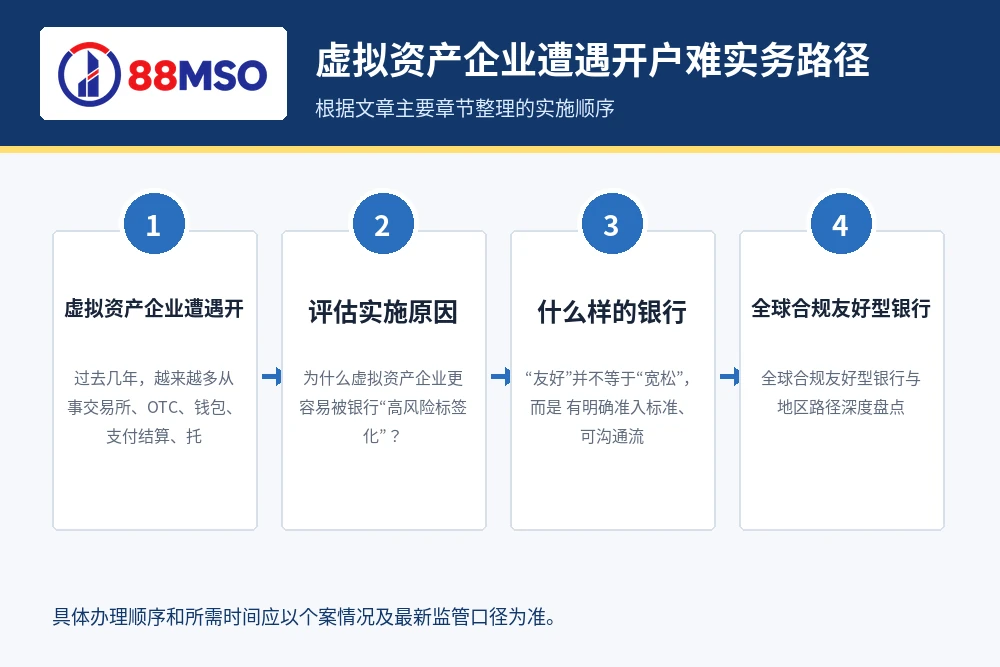
Stage 1:Positioning and screening (1-2 weeks)
Clarify business attributes (transaction、hosting、pay、technical services)、Target currency、Main counterparties and regions,Then filter the list of matching banks,Avoid blind overseas investment。
Stage 2:Compliance physical examination and reinforcement (2-4 weeks)
Conduct a system gap assessment,Complete KYC/AML documentation、Transaction Monitoring Rules、customer tiering model。Provide additional legal advice and external audit support when necessary。
Stage 3:Material submission and interview (2-8 weeks)
Communicate with bank relationship managers and compliance teams,Focus on answering "How to verify the source of funds", "How to deal with high-risk customers" and "How to report abnormal transactions"。
Stage 4:Management after account opening (continuous)
Date of construction、Quarterly Account Health Check、Annual policy update mechanism,Ensure account sustainability。Experience shows,Enterprises that have done a good job in governance after opening an account,Obtain credit subsequently、Faster payment channels and multi-account layouts。
Why can professional compliance consultants significantly shorten the cycle?
Virtual asset companies often face licenses at the same time、bank、tax、Four lines of cross-border operations。If there is no mature compliance team internally,It is prone to the problem of "complete files but incoherent logic"。The value of professional organizations lies in:regulatory language、banking language、Open business language,Reduce duplicate parts。
With long-term services such as 88MSO/88MSOHong Kong financial licenseExample with a team working on a cross-border compliance project,Usually the license plate path、Organizational structure、AML system、Integrated design of account opening strategy,Help enterprises complete the "reviewable" process before entering the bank、explainable、Compliance preparations that can be implemented。This kind of preliminary work,It is often more time- and cost-saving than “repairing after rejection”。
Conclusion:Opening an account is not about “looking for connections”,But "build a system"
The virtual asset industry is entering the stage of "institutional competition" from "barbaric growth"。Companies that can truly ride through cycles in the future,Not the best at telling stories.,Rather, it is the one that best provides verifiable evidence of compliance.。There are indeed banks around the world that are more crypto-friendly,But the premise is that they are friendly,always:you deserve to be trusted。
If you are facing difficulties in opening an account,You might as well change your mind - build a compliant base first,Then match bank channels。Account opening should be checked separately、Financing、Access conditions for payments and clearing;Complete compliance information does not mean that the bank is committed to accepting the application。
FAQ:High-frequency issues in opening accounts for virtual asset companies
Q1:No local license,Can I open a bank account first?
Available in some areas,But the difficulty increases significantly。Most banks will require clear license application procedures and legal advice.,Prove business legitimacy and sustainability。
Q2:After being rejected by a bank,Will it affect other bank applications?
uncertain,However, if the reason for rejection is material authenticity or major compliance deficiencies,May have knock-on effects。It is recommended to fix the problem first,Initiate the next round of applications。
Q3:Does the startup team have no chance at all?
Not so。Start-ups can improve their pass rate through "low-risk business entry + strong compliance structure + transparent financial plan",The key is to prove that you have long-term governance capabilities。
Q4:What is the most likely behavior to trigger risk control after opening an account?
Abnormally large transactions in the short term、Frequent communication with high-risk addresses、Lack of customer due diligence、The transaction purpose is inconsistent with the declaration,All are high-risk signals。
Read more:Overseas bank account opening services and compliance requirements。