简体中文
简体中文 繁體中文
繁體中文 English
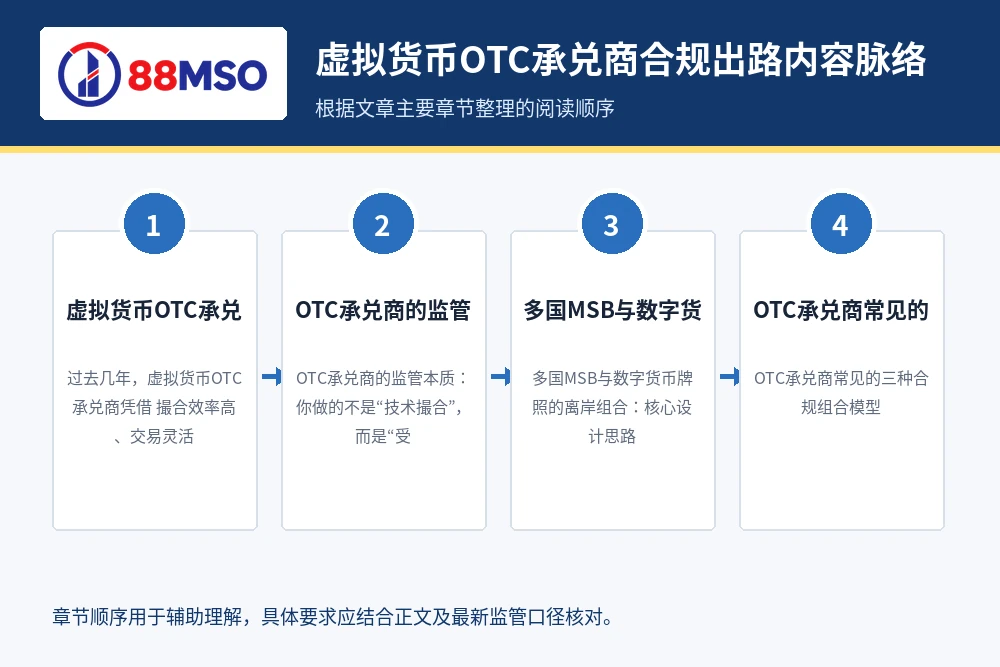
virtual currencyOTC acceptor,Why are we standing at a “compliance watershed”?
past few years,Virtual currency OTC acceptor relies onHigh matching efficiency、Flexible trading、Fast cross-border capital flowsand other advantages,Quickly fills the need for large-amount exchanges outside the exchange。However,As global regulators weigh in on crypto assets、Fund transfer business and anti-money laundering system continue to increase,OTC business has moved from "traffic logic" to "license logic"。
Many teams will encounter the same set of problems after their business grows.:Bank accounts are frequently scrutinized、The cooperative payment channel is unstable、Customer origin is restricted、The link for fiat currency deposits and withdrawals is broken、He was even forced to close his business due to "unlicensed operation"。in the final analysis,OTC acceptance is not a single “currency intermediary”,but involvesmoney services、Cross-border payment、Customer asset transfer、KYC and transaction monitoringcomprehensive financial behavior。
therefore,A truly sustainable way out,It’s not the end of “finding a license plate”,but to establishMulti-Country MSB+ Crypto License + Offshore company structure + AML internal control systemcombination plan。This article will take a practical perspective,Dismantling how OTC acceptors build a more robust global compliance base。
The regulatory nature of OTC acceptors:What you are doing is not "technical matching",but “regulated financial services”
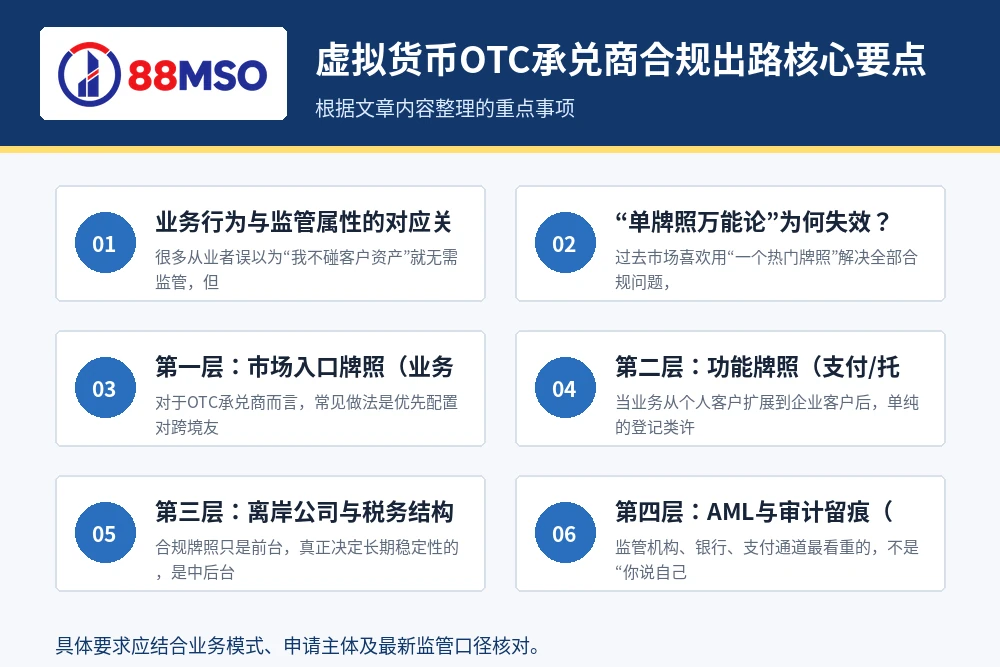
1) Correspondence between business behavior and regulatory attributes
Many practitioners mistakenly believe that "I don't touch client assets" so there is no need for supervision.,But in most jurisdictions,The following behaviors may trigger licensing obligations::
- Provide customers with exchange quotes for legal currency and virtual assets;
- Collection and payment、Third party transfer、Cross-border clearing arrangements;
- Match large transactions and charge service fees or spreads;
- Provide stable currency settlement channels to institutional customers;
- Configure multi-regional payment paths for high-net-worth customers。
These behaviors usually fall intoMSB (Money Services Business)、VASP (Virtual Asset Service Provider)、payment institution、Within the regulatory framework for electronic money or chartered financial businesses。in other words,The core risk of OTC acceptors is not transaction risk,RatherRegulatory mismatch risk。
2) Why is the "single license plate omnipotent theory" invalid?
In the past, the market liked to use "one popular license" to solve all compliance issues.,But the reality is:Regulatory boundaries vary widely between countries,Banks’ due diligence standards are also different。Registration or filing in a country,Unable to naturally cover account openings in another region、Acquisition or institutional cooperation requirements。
For example,You may have obtained a digital currency license somewhere,But if the main customers are in North America and Asia,The funds are transited through Europe,The bank will continue to ask questions:Do you have legal marketing capabilities where your customers are located?、Who are eligible to receive funds and transfer payments?This is why "multi-license layering" is needed,Instead of "single license bet"。
Offshore combination of multi-national MSB and digital currency licenses:Core design ideas
first floor:Market entrance license (business access)
For OTC acceptors,A common approach is to prioritize cross-border-friendly MSB systems (such as North American-related paths) and licenses from jurisdictions with clearer encryption business licenses.,Form a "legal business entrance" that can be recognized by the bank。
What this layer solves is:Are you qualified to do this business?。
second floor:Functional license (payment/escrow/exchange)
When the business expands from individual customers to corporate customers,A simple registration license is often not enough。You may need to pay more、electronic money、Managed or Brokerage Property License,Match the complete link of "receipt - clearing - settlement - delivery"。
What this layer solves is:Are your business processes compliant and closed-loop?。
third floor:Offshore companies and tax structures (risk control and efficiency)
Compliance license is just the front desk,What really determines long-term stability,It is the middle and back-end architecture。Through reasonable allocation of offshore holding companies、operating entity、Intellectual Property Subjects and Settlement Entities,Tax optimization can be done legally、Isolation legal liability、Improve financing and M&A feasibility。
What this layer solves is:Is your organizational structure sustainable for expansion?。
fourth floor:AML and Audit Traces (Explainability)
regulatory agency、bank、Payment channels are most important,Not "you said you were compliant",It's about whether you can produce verifiable evidence:Customer due diligence documents、Transaction monitoring records、Suspicious transaction reporting process、training log、Internal audit report, etc.。
What this layer solves is:when being censored,Can you "explain clearly"。
Three common compliance combination models for OTC acceptors
Model A:Asset-light start-up (start-up team)
- Applicable objects:Transaction volume is still growing、Team streamlined、Do a regional test first。
- Typical configuration:1 main operating location MSB + 1 offshore holding company + basic AML system。
- Advantages:lower cost、Quick deployment。
- risk:Bank tolerance is limited,Subsequent expansion requires quick license renewal。
Model B:Cross-border payment type (medium-sized team)
- Applicable objects:Already have stable B-side customers,Requires multi-currency payment and stable settlement。
- Typical configuration:Multi-national MSB/payment license + regional operating entity + full-time MLRO/compliance officer。
- Advantages:Easier to connect with banks and payment channels。
- risk:Internal control requirements have increased significantly,Documentation and system investment cannot be saved。
Model C:Institutional platform type (large-scale team)
- Applicable objects:Target service agency customers、Home office、Mining companies、cross-border trade entities。
- Typical configuration:Multi-jurisdictional license matrix + complete risk control system + global coordination of legal and taxation。
- Advantages:High brand credibility,Greater space for financing and mergers and acquisitions。
- risk:Long construction period,Requires long-term budget and professional consultant support。
Bank account opening and payment channels:The “second license” that determines the life and death of OTC
The most painful thing for many OTC teams is not getting cards.,But "I still can't open an account after getting the license"。The reason is:The bank’s risk perspective is different from the license approval logic。The bank is more concerned aboutClarity of funding sources、counterparty risk、Geographical sanctions risk、Suspicious transaction handling capabilities。
To improve material consistency and review communication efficiency,It is recommended to prepare the following materials simultaneously:
- Clear business flow chart (fiat currency deposit、Currency delivery、Settlement path);
- Customer tiering system (retail/high net worth/institutional) and KYC standards;
- Restrictive policies in high-risk countries or sanctioned areas;
- Description of on-chain transaction monitoring tools and address screening mechanism;
- Suspicious transaction identification、upgrade、Reporting and freezing process。
In practice,The value of professional service organizations lies in translating "compliance language" into "risk narratives that banks can understand"。For example, 88MSO and its 88MSO team have long-term services in Hong Kong and overseas financial license projects,Usually, the account opening logic is embedded in the license application stage.,Avoid the "license has been obtained"、The structural problem of "accounts are cut off"。
Anti-Money Laundering (AML) is not a cost center,But a business moat
The four most easily overlooked AML shortcomings in OTC
- Only account opening KYC,Not doing continuous due diligence:Customer risk profile has not been updated for a long time。
- Only look at the address on the chain,Don’t care about currency side behavior:Ignore the matching of bank flow and transaction purpose。
- Rules are too static:Missing pairs of abnormal frequencies、Split the order、Dynamic monitoring of jump accounts。
- No traces of closed loops:No investigation records after anomalies are discovered、No treatment conclusion、No review mechanism。
Implementable AML construction checklist
If you want to pass more bank and institutional scrutiny over the next 12 months,It is recommended to give priority to completing the following "basic four-piece set":
- Develop and implement a risk-based (RBA) customer tiering model;
- Set enhanced due diligence (EDD) trigger conditions and approval permissions;
- Establish a transaction monitoring parameter library,Calibrate thresholds by month;
- Form a suspicious transaction reporting mechanism and internal training system led by MLRO。
When the AML system is upgraded from "document compliance" to "operational compliance",Your OTC business will be more credible in the eyes of institutional clients,Bargaining power will also be significantly improved。
Tax and legal boundaries for offshore portfolios:Compliance optimization,Not regulatory arbitrage
Offshore structures are often misunderstood as “avoiding regulation”,This is extremely risky in the current environment。The correct approach is:conducted within the legal frameworkReasonable matching of operating entities and profit attribution,Ensure substantial operations、Directors' decisions、contract performance、Data retention can be audited and verified。
Focus on the three red lines:
- Don’t let the “recipient、Service subject、"Contract subject" has been misaligned for a long time;
- Don’t ignore economic substance requirements (office、personnel、decision evidence);
- Don’t mix high-risk businesses with low-risk entities,Avoid joint freezing。
Mature teams usually adopt a hierarchical structure of "controlling layer-operation layer-settlement layer",And combined with local reporting obligations and audit requirements,Establish a unified compliance ledger。
Execution roadmap from 0 to 1:How OTC acceptors complete upgrades in 90-180 days
Stage one:Diagnosis and Blueprinting (Weeks 1-3)
Organize existing business flows、Customer structure、Fund path and risk points,Identify target markets and prohibited markets,Determine license priority and main structure。
Stage 2:Licenses and entities are advanced simultaneously (weeks 4-12)
Start company establishment and license applications in key jurisdictions,Prepare due diligence documents for directors and shareholders in advance,Establish the first version of AML/KYC policy。
Stage three:Account opening and system access (weeks 8-16)
Promote bank account opening in parallel、Deployment of payment channels and on-chain risk control tools,Ensure transaction monitoring rules are consistent with the business model。
Stage four:Trial operation and compliance stress testing (weeks 16-24)
Pass small-scale real transaction verification process,Conduct suspicious transaction drills、Internal audit and document enhancement,Then gradually expand the transaction size。
Conclusion:The next round of competition in the OTC industry,What we are fighting for is “compliance capitalization capabilities”
The growth logic of virtual currency OTC acceptors is changing:past speed、Than channel、spread;The future will be more importantIntegrity of Compliant Assets——How many verifiable license capabilities do you have?、Risk control ability、Cross-border settlement capabilities and institutional collaboration capabilities。
"Multinational MSB + Digital Currency License + Offshore Compliance Structure" is not just for qualifications,It is to upgrade the business from "highly volatile trading business" to "auditable、Financing available、Financial infrastructure that can be globally coordinated。For teams that want to operate in the long term,This is not optional,But a must-answer question。
If you are preparing to enter or upgrade OTC acceptance business,It is recommended to complete the compliance route assessment as early as possible,And collaborate with a professional team with practical experience in Hong Kong and overseas licenses。Service providers like 88MSO/88MSO that have long been involved in financial licenses and compliance custody,Can help companies supervise、Open an account、Find a more robust balance between internal control and implementation efficiency。
FAQ:The 5 most frequently asked questions by OTC acceptors
Q1:Only one overseas MSB,Can we directly do global business?
Usually not recommended。Marketing in different regions、Collection、There are local rules for billing and customer service,It is difficult for a single MSB to cover all scenarios。
Q2:No custody of client assets,Is there no need for a license?
uncertain。As long as it involves legal currency exchange、Collection and payment、Continuous matching and charging,Still considered a regulated business in many jurisdictions。
Q3:What are OTC’s most critical compliance investments?
In the short term, it’s license and account opening.,In the long run, it is the AML operating system。The latter directly determines whether you can stably connect with bank and institutional customers.。
Q4:Will offshore structures be rejected by banks?
Not “one size fits all”。The key is whether the structure is transparent、Is the substance sufficient?、Is the funding path explainable?、Is the tax return complete?。
Q5:Should I apply for a license first or establish internal controls first?
should be promoted in parallel。No internal control,License is difficult to obtain;No license plate,Internal control is difficult to realize。Both must be implemented together in the same project plan。