简体中文
简体中文 繁體中文
繁體中文 English
MSOLicense application materials list:Necessary documents and common supplementary issues
Starting a money service business in Hong Kong (Money Service Operator), MSO),License is not an “optional” administrative procedure,It is the basic threshold for legal business operations.。in reality,Many applicants think that “the company is registered”、Once the office is rented, you can quickly get the license,The result is stuck in the material stage for months or more.。The reason is often not that the company lacks strength,RatherDocument preparation logic does not match regulatory review logic。
This article will focus onHong Kong MSO LicenseApply,System teardown:What documents should be submitted?、What does the supervisor want to verify behind each document?、Which details are most easily overlooked、How to reduce spare parts。For those planning to enter cross-border remittances、Enterprises in the foreign currency exchange or related financial services track,This is a practical list that can be implemented directly。
one、Understand the regulatory perspective first:Why does "materials are complete" not equal to "materials are qualified"?
When Hong Kong regulatory authorities review MSO applications,The core is not about "how many pieces of paper you handed in",It's about whether you can prove the following three things:
- The subject is real and traceable:Clear company structure、Beneficiaries are clear、Source of funds can be explained。
- Fit and Proper for management:Controllers and key personnel have integrity、ability、Compliance awareness。
- Business is controllable and sustainable:In particular, anti-money laundering (AML) and customer due diligence (KYC) mechanisms are enforceable。
in other words,The application document is the "evidence package"。If the materials conflict with each other、information jump、The business logic doesn’t make sense,Even if the number of files is complete,It is also easy to receive notification of supplementary parts, which may even affect the pace of review and approval.。
two、General list of core materials for MSO license application (disassembled by module)
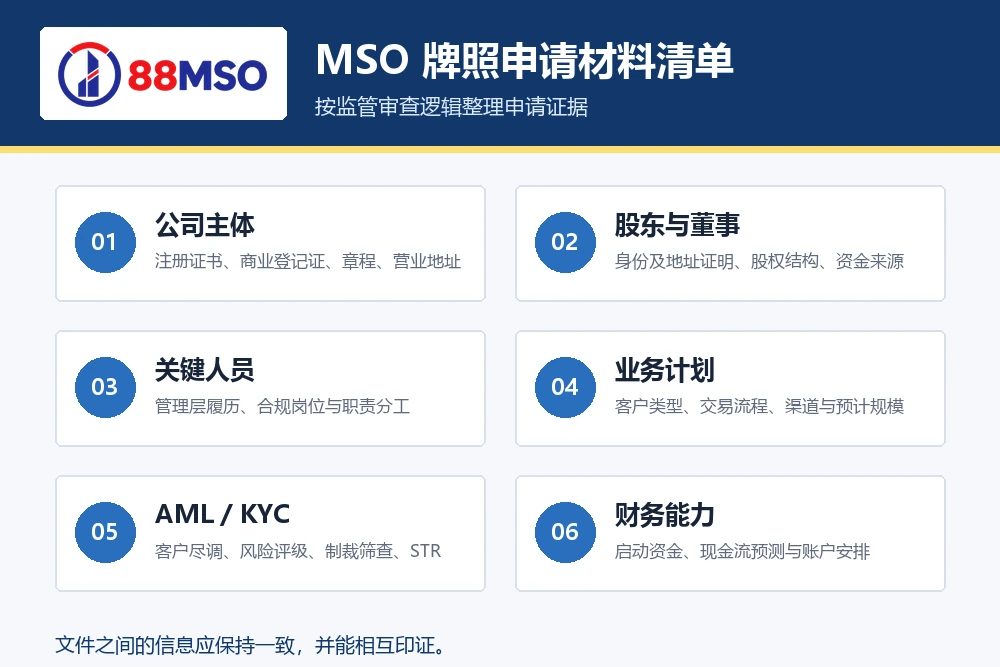
1) Company and legal subject documents
- Certificate of Incorporation (CI)
- Business Registration Certificate (BR)
- Articles of Association
- Latest annual return (if applicable)
- Proof of registered address and business address (lease、Property documents, etc.)
Review focus:Does the company truly exist?、Whether the business address is accessible to supervisory authorities、Whether the company's articles of association support the proposed money service activities。
2) Shareholders、Directors and Ultimate Beneficiaries (UBO) Documents
- shareholder、director、Proof of identity of the final beneficiary (passport/ID card)
- Proof of address (usually required within the past 3 months)
- Equity structure chart (recommended to penetrate to natural persons)
- Source of funds and source of wealth (Source of Funds / Source of Wealth)
- Declaration of no criminal/bad records (depending on individual case requirements)
Review focus:Who actually controls the company、Whether there are "nominal shareholders" obscuring actual control、Whether the funds are subject to money laundering or sanctions risks。
3) Key management personnel and compliance position documents
- Director and Senior Management Curriculum Vitae (CV)
- Relevant experience and qualifications
- Appointment document for Compliance Officer/Anti-Money Laundering Officer
- Organizational chart and job descriptions
Review focus:Is the team “compliant on paper?”、Actual idling”。Supervision is paying more and more attention to whether job responsibilities are enforceable,Rather than whether it is "in name"。
4) Business model and operation description documents
- Business plan (target customers、area、product、channel)
- Transaction flow chart (account opening、Place an order、liquidation、Reconciliation、leaving traces)
- Cooperative bank/payment channel arrangement (if any)
- Estimated transaction size and risk assessment
Review focus:Whether the business matches the scope of the license、Is the transaction path transparent?、Is it auditable?。
5) AML/KYC system documents (the most critical)
- Anti-Money Laundering and Counter-Terrorism Financing Policy (AML/CFT Policy)
- Customer Due Diligence Process (CDD/KYC)
- Enhanced due diligence (EDD) mechanism for high-risk customers
- Suspicious Transaction Monitoring and Reporting Process (STR)
- Sanctions Screening and List Management Mechanism
- Employee training and internal audit system
- Record retention policy (data retention period and access mechanism)
Review focus:Is the system “enforceable”?。A common problem with templated documents is that the terms are beautiful but do not fit the business,Supervisors can identify it by looking at the flow chart or asking questions.。
6) Financial and sustainable operating capability documents
- Proof of start-up capital
- Financial Forecast (Revenue、cost、cash flow)
- Bank account arrangement and fund management mechanism
- Audit or accounting support arrangements (if applicable)
Review focus:Whether the enterprise has the ability to operate stably,Avoid "stopping after receiving the card" or "high-risk fund operation"。
three、8 pitfalls that are most likely to lead to replacement parts or delays
Trap 1:Shareholding structure 'seems clear',In fact, there is a fault”
Many applications only submit one level of shareholder information.,Does not penetrate to the natural person benefit level。When it comes to offshore structures,If intermediate legal documents are missing,The Supervisory Committee requires layer-by-layer supplements,The cycle is significantly lengthened。
Trap 2:Proof of address expired or not in the correct format
Proof of address usually has time window requirements。utility bill、bank letter、Acceptability of government documents varies,and name、The address format must be consistent with the application。
Trap 3:AML policy "copy and paste"
Directly applying his company's template is most dangerous。For example, if you are mainly engaged in small-amount remittances,,But he wrote a risk control model for large institutional transactions;or no high-risk country strategy defined,will be regarded as a system that is not implemented。
Trap 4:Business description is inconsistent with actual plan
The business plan says "Settlement for B-end enterprises",The website displays “Personal Quick Currency Exchange”;Or the reporting area conflicts with the marketing area,will trigger additional explanation and review。
Trap 5:Inexperience of key personnel and no remediation arrangements
If management lacks direct compliance experience,Support through external consultants is recommended、training plan、Dual approval mechanism to fill positions。Otherwise, it will affect the judgment of "fit and proper person"。
Trap 6:Irregular processing of document translation and notarization
Cross-border entities often involve multi-language documents。Translation versions are inconsistent、Not certified as required,This will result in the entire package being returned for re-pickup.。
Trap 7:Ignoring the “post-application inquiry” stage
Many companies only focus on the first round of submissions,Ignore the timeliness and logical consistency of inquiry responses。Inquiry response quality,Often directly determines the efficiency of approval。
Trap 8:Treat license application as a “one-time project”
After obtaining the MSO license, you still have ongoing compliance obligations.。If no sustainable mechanism is established during the application stage,Subsequent annual review、examine、Updates are prone to problems。
Four、Prepare materials according to review logic
Method 1:Draw a “regulatory evidence map” first and then collect documents
It is recommended that each piece of material be mapped to a regulatory issue:What does this document prove? Which document is mutually corroborated? Are there conflicts? This can significantly reduce invalid submissions。
Method 2:Establish unified version management
Company information、Equity ratio、Address writing、Job titles must be consistent across the board。in practice,A large number of patches are due to "inconsistent versions of different files"。
Method 3:business、Compliance、Financial three-line linkage
Business department writes product process,Compliance team defines risk control nodes,Finance team replenishes funds and reconciliation logic。After the third line closed loop,Document credibility will be greatly improved。
Method 4:Prepare a question bank in advance
Prepare standard answers in advance for high-frequency questions,Such as customer source、Sanctions Screening Tool、High risk transaction threshold、Suspicious transaction reporting process, etc.,Can significantly shorten the round trip time。
Method 5:Choose a compliance support team with practical experience
MSO application is more than just a "form filling service",It is also a regulatory communication project。A team familiar with Hong Kong’s regulatory standards and case experience,Ability to avoid most structural problems in the early stages。Like the 88MSO practice system that 88MSO relies on,Long-term focus on Hong Kong financial license and compliance implementation,The value lies in translating “complex regulatory language” into an executable application path for enterprises.,Instead of just stacking materials。
five、Recommended application time planning (reference)
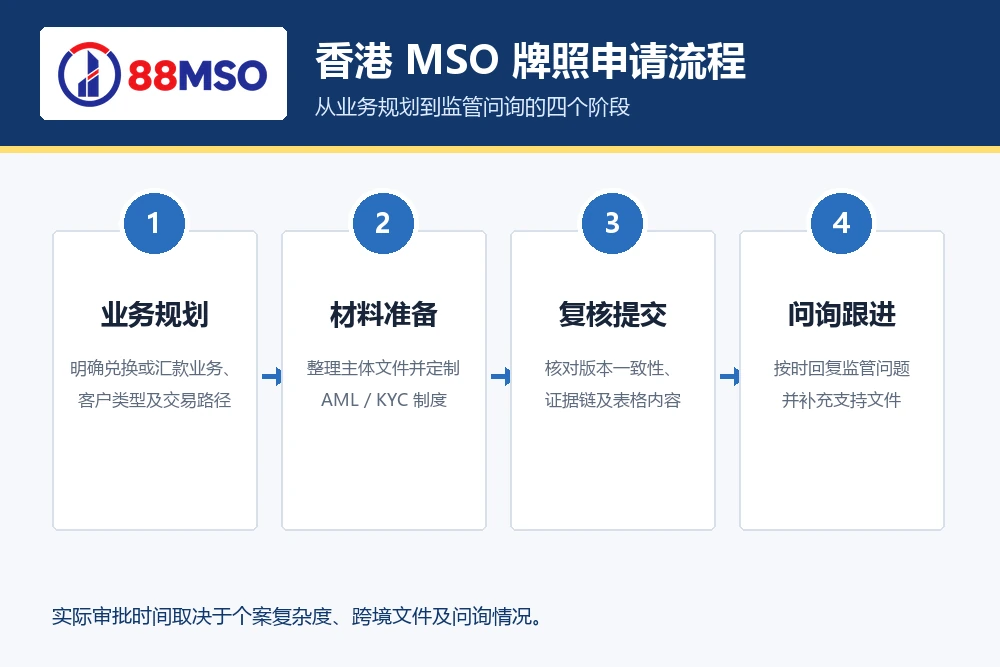
- Weeks 1-2:Determine business model、Equity structure、Arrangement of key personnel
- Weeks 3-6:Collect master files、Complete AML/KYC system customization、Put together financial forecasts
- Weeks 7-8:Internal audit and consistency check、Check for omissions and fill in the gaps、Formal submission
- After submission:Supplementary explanations and document updates based on the inquiry rhythm
illustrate:The actual cycle depends on the complexity of the case、Equity Hierarchy、Difficulty of cross-border document authentication varies。The sooner you make structured preparations,The greater the opportunity to compress overall time。
six、Conclusion:The nature of competition for MSO licenses,It’s a competition on “compliance execution”
The current financial regulatory environment in Hong Kong continues to strengthen transparency and traceability,MSO license application has been upgraded from "complete materials" to "complete system"。Enterprises want to reduce spare parts and caliber conflicts,The key is not the file thickness,But lies in:
- Whether it can prove the true control relationship and source of funds;
- Is there an executable AML/KYC mechanism?;
- Whether to integrate the application stage and subsequent continuous compliance design?。
If you are planning to enter the Hong Kong money services market,It is recommended to build the application package with "regulatory review thinking" as early as possible。Put the difficulties ahead、Make the chain of evidence solid,It is usually more time-saving and cost-effective than repeatedly repairing parts later.。major、system、Practice-oriented compliance preparation,This is the real “customs clearance password” for MSO licenses。
FAQ:The 4 questions that applicants are most concerned about
Q1:No financial background,Can I apply for an MSO license?
Can,However, management and compliance positions need to supplement proof of ability.。By bringing in experienced personnel、External Compliance Advisor、Institutionalized training to improve feasibility。
Q2:Can templated AML files be used?
Can be used as a drafting reference,But it cannot be submitted directly。Must be combined with your customer type、Trading scenario、Customized rewriting of regional risks。
Q3:Will the offshore company structure affect the approval?
does not necessarily affect,But it will increase the information penetration requirements。The key point is that the equity chain is complete、Beneficiaries are clear、Source of funds can be verified。
Q4:Will everything be fine once you get the card?
no。Follow-up also involves ongoing compliance、record keeping、System update、Training and internal monitoring。During the application stage, the system should be established according to long-term operation standards.。