简体中文
简体中文 繁體中文
繁體中文 English
Hong Kong Customs MSO Interview Preparation:business process、AML system and frequently asked questions
Official verification update (August 2026):This article is compiled based on the Hong Kong Customs disclosure system and common material verification points.,Doesn’t involve so-called “ex-supervisor insider channels” or techniques to ensure passage。The focus of the interview is whether the applicant can truly explain the business、How funds flow and AML/CFT controls are implemented。 For specific rules, seeHong Kong Customs Supervision Information on Money Service Operators。
Many people are preparing to apply for a Hong Kong MSO license (Money Service Operator).,Money Service Operator License) for enterprises,The really stressful part is often not "filling in the form",RatherHong Kong Customs Interview。Many applicants mistakenly believe that:As long as the company information is complete、Director’s background is clean、Office rented,will pass smoothly。actually,The interview is a key step regulators use to determine whether you “truly understand and can perform compliance”。
Simply put,Customs does not just look at whether you have regulatory documents,It depends more on whether you have the ability to implement the system。It is precisely because of this,Many companies will say "it looks beautiful on paper",Situation where the interview got stuck"。
This article is based on MSO licensing and anti-money laundering information disclosed by Hong Kong Customs.,Organize business processes、Source of funds、Interview preparation matters such as customer due diligence and record keeping。Applicants should be able to describe actual business,and map the answers todocument、Responsibilities and performance records;These preparations do not constitute a guarantee of passing the interview or being approved。
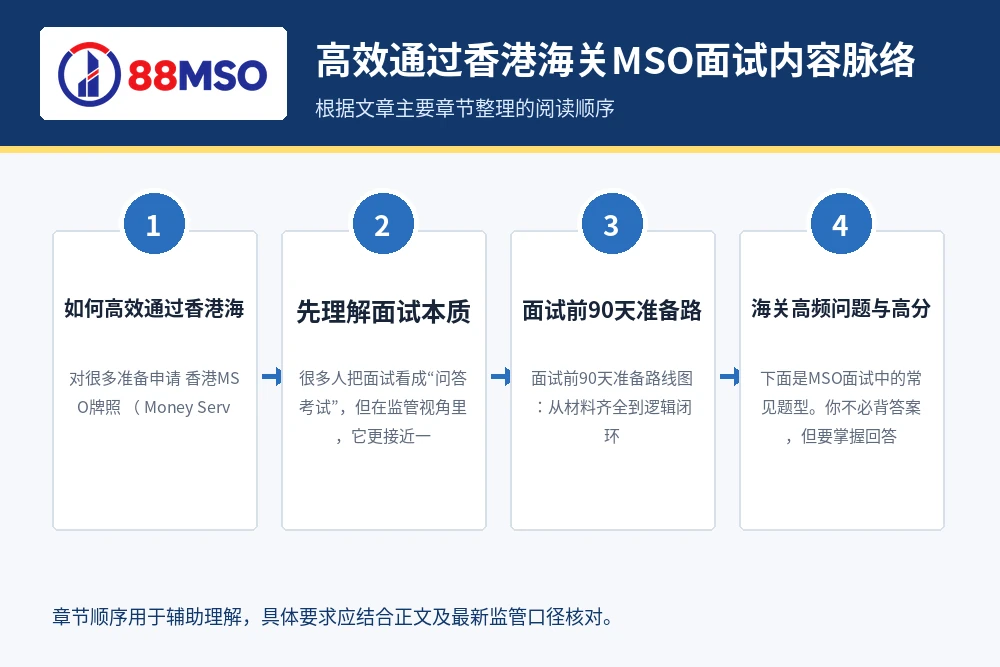
one、Understand the nature of the interview first:What exactly is the customs "testing"?
Many people regard interviews as "question and answer exams",But from a regulatory perspective,it's closer onceStress testing of operating capabilities and compliance governance capabilities。Core assessment generally revolves around the following four main lines::
- Is compliance awareness real?:Do you understand money laundering in the MSO industry?、Terrorist financing、Risks such as fraudulent fund transfers。
- Is the system enforceable?:Does your AML/KYC policy match your business model?,Instead of template copy。
- Are key positions competent?:Especially the person in charge、Compliance Officer、Does the operations manager know the boundaries of responsibilities?。
- Is the going concern sound?:Includes customer screening、Transaction monitoring、Report suspicious transactions、record keeping、Training mechanism, etc.。
If you only prepare "what is the definition?",Without preparing "specifically how to do it",Interviewers are usually quick to identify your lack of practical skills。
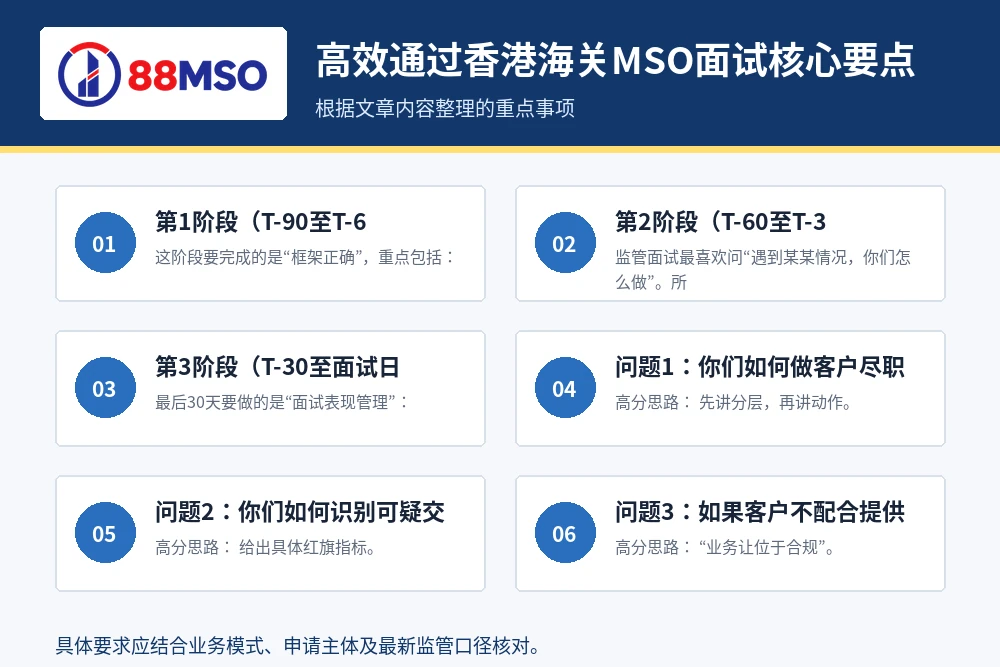
two、Prepare a roadmap 90 days before the interview:From complete materials to logical closed loop
1) Phase 1 (T-90 to T-60):Build a compliance framework
What needs to be accomplished at this stage is “correct framework”,Highlights include:
- Clarify business scope:money transfer、exchange、online or offline、Service areas and customer groups。
- Complete first draft of AML/KYC policy:customer identification、risk rating、Continuous due diligence、Suspicious transaction processing。
- Clarify organizational structure:Who is responsible for account opening review?、Who is responsible for transaction review?、Who is the final approver。
- Establish a record-keeping mechanism:Customer information、transaction flow、Review record retention period and retrieval process。
The key here is not "write more",But "write accurately"。For example, if you do cross-border small-amount remittances,In the policy, there is a large section devoted to the scenario of high-net-worth private banks.,This is an obvious mismatch。
2) Phase 2 (T-60 to T-30):Transform systems into processes
Supervisory interviews like to ask "When encountering such and such a situation,What do you do?”。So you have to break down the system into executable actions:
- Customer Onboarding SOP:What documents to collect、How to check authenticity、Who will do the second review and approval?。
- High risk trigger conditions:For example, frequent order splitting、Abnormal trading countries、agency trading behavior。
- Suspicious transaction reporting link:Discovery—Review—Internal Upgrade—Record—External Report。
- rejection mechanism:Under what circumstances will it be suspended?、When to terminate a relationship。
It is recommended to prepare at least 3 real business scenario drills,Make sure the person in charge can give consistent answers。
3) Phase 3 (T-30 to interview day):Mock Q&A and evidence solidification
What you need to do in the last 30 days is “Interview Performance Management”:
- Conduct at least 2 rounds of mock interviews (pressure questioning)。
- Unify speaking skills for key positions,avoid inconsistencies。
- Prepare supporting evidence:training records、Internal approval template、Risk Rating Sample Form。
- Check file version consistency (one of the most common points lost)。
three、Customs high-frequency questions and high-scoring answer structure
The following are common question types in MSO interviews:。You don't have to memorize the answer,But you need to master the answer structure:Principles + Processes + Triggering Conditions + Recording Traces。
Question 1:How do you do customer due diligence (KYC)?
High score ideas:Let’s talk about layering first,Let’s talk about actions again。
- Standard customer:Identity verification、Proof of address、Fund usage description。
- high risk customers:Enhance due diligence (EDD),include funding sources、Transaction purpose、Beneficial owner penetration。
- Continuous monitoring:Not "open an account once",Instead, it is regularly reviewed and compared with trading behavior.。
What the interviewer wants to hear is how you judge "risk escalation",Rather than just saying "We will strictly enforce the policy"。
Question 2:How do you identify suspicious transactions?
High score ideas:Provide specific red flag indicators。
- Multiple split transactions close to the declaration threshold in a short period of time。
- Transaction purpose and client occupation、Income levels are obviously inconsistent。
- Fund transactions involve high-risk jurisdictions or unusual intermediary accounts。
One more thing:Once the threshold is triggered,System marking + manual review + MLRO upgrade processing,form a closed loop。
Question 3:What should I do if the customer does not cooperate in providing information?
High score ideas:“Business takes a back seat to compliance”。
Answerable:First explain the regulatory requirements and give a time limit for replacement.;Transactions will be restricted if payment is not made within the time limit.;If there are signs of circumvention, terminate the relationship and file a suspicious transaction report as appropriate.。Key points reflected:you have business judgment,But the bottom line is clear。
Question 4:How do you train frontline staff?
High score ideas:Frequency、content、assessment、track。
- New employee induction training (compulsory)。
- Quarterly Update Training (Policy Changes、case review)。
- Assessment mechanism (test + spot check),Requires supplementary training if not up to standard。
Regulatory agencies attach great importance to the execution ability of "people",Training records are important evidence。
Four、The five most common score-losing minefields (many companies have stepped on them)
Minefield 1:templated file,Unable to correspond to actual business
For example, writing complex organizational business processes,But you actually only do small personal remittances;or the policy cites non-applicable regulations。The interviewer will tell you the truth when he asks。
Minefield 2:The person in charge “only understands business”,Don’t understand compliance”
MSO interview,If the person in charge cannot explain the basic AML logic,Will directly affect regulatory confidence。At least it must be able to explain the company's risk points and control actions.。
Minefield 3:inconsistent caliber
The director said "high-risk customers will not be dealt with",The compliance officer said, “It can be done but EDD is required”,Inconsistency can be seen as internal governance deficiencies。
Minefield 4:Just talk about principles,Don't talk about leaving traces
Supervision focuses on evidence。You said "we have training",But no sign in、courseware、test record,Equivalent to no。
Minefield 5:Ignoring behavioral details during interviews
be late、The material cannot be found temporarily、answer in circles、Correct each other frequently,These may be interpreted as lack of preparation and mismanagement。
five、Interview preparation points:Match system requirements to implementation evidence
- Use flow charts to explain key links:Clearer than verbal description,Can quickly establish a sense of professionalism。
- Prepare 1-2 real risk cases:Explain how you identify、Dispose、Review,Best reflects actual combat capabilities。
- Establish an “escalation mechanism” narrative:who discovered、Who reviews、who decides,Avoiding a “responsibility vacuum”。
- Emphasize continuous improvement mechanism:The system is not a one-time draft,Instead, iterate based on regulatory updates and business changes。
in our observation,A team that can explain clearly "how to correct the system after discovering the problem",It’s usually easier to gain the interviewer’s trust。
six、Why more and more companies choose "full-case managed preparation"
MSO license application is more than just paperwork,More like a cross-functional project:legal affairs、Compliance、operations、IT、Finance needs to be coordinated。If we rely entirely on internal exploration,Frequently asked questions are:
- File can be written,But it cannot be implemented;
- Can answer in interview,But I can’t stand the questioning;
- Lack of continuous maintenance mechanism after obtaining the license,Subsequent annual reviews and spot checks are stressful。
therefore,More and more applicants in the market prefer to be accompanied by professional teams throughout the process.。Take 88MSO as an example,The 88MSO behind it has long been focusing on the compliance practice of Hong Kong financial licenses.,Covering MSO、SFC、Insurance brokers and money lenders, etc.。For applying companies,The value of this type of team goes beyond “improving first-time pass rates”,It is more about helping enterprises establish a sustainable compliance operation system.,Reduce subsequent regulatory risks and rectification costs。
seven、Practical checklist on the day of the interview (can be followed directly)
data level
- Latest versions of all submitted documents (paper + electronic)。
- Organization chart、Job Responsibilities Description、Approval flow chart。
- KYC sample form、Risk rating template、Suspicious transaction processing template。
People level
- Ensure attendance is consistent with declared information。
- Identify the main respondent and the supplementary person,Avoid rushing to answer。
- unified terminology:EDD、STR、Consistent wording such as continuous due diligence。
expression level
- Conclusion first,expand later,Finally give evidence。
- Do not give hard answers to uncertain questions,It can be stated that "it will be added after review according to internal procedures"。
- Avoid exaggerated promises,Emphasis on "implementation based on risk-based principles"。
Conclusion:Key to passing the interview,Not "will answer",But "can prove"
The core of Hong Kong Customs MSO interview,It’s never a test of whether you remember the laws and regulations,But to judge whether you are real、Sustainable compliance management capabilities。A team with a really high pass rate,Usually have three characteristics:
- System and business are consistent(Not templated stacking);
- People and processes aligned(Not a piece of cake made on the spot);
- oral agreement with evidence(Not an empty promise)。
If you are in the critical period for MSO application,It is recommended to shift from "material preparation thinking" to "regulatory review thinking" as soon as possible。Treat the interview as a system demonstration,not just a question and answer。This is how you get it,Not just the license plate itself,It is also a compliance framework that can support long-term and healthy business growth.。
FAQ:The 4 questions that applicants are most concerned about
1. No financial background,Can I apply for an MSO license?
Can,However, sufficient compliance capabilities and professional teams need to be built。What supervision values is “competence”,Rather than a single academic qualification label。
2. How long will it take to get the results after the interview?
Depends on the complexity of the case and the availability of supplementary parts。If fewer questions are exposed during the interview、Complete information,The overall process is usually more controllable。
3. Is it necessary to hire outside consultants?
Not mandatory,However, if the company lacks local compliance experience,External consultants can significantly reduce trial and error,Especially in terms of interview preparation and system implementation。
4. Once you get the card, is it "once and for all"?
no。MSO is an ongoing regulatory industry,Annual review still needs to be done in the future、training、Transaction monitoring and policy updates,Only in order to operate steadily in the long term。