简体中文
简体中文 繁體中文
繁體中文 English
introduction:MSOIt’s no accident that the license plate was “rejected”,The problem often lies in the lack of depth in the AML solution
Carrying out exchange and remittance business in Hong Kong (Money Service Operator, MSO),The license application seems to be a standard process of "submit materials and wait for approval",But what really determines success or failure,It’s often not that the materials are “incomplete”,But whether the compliance system is true or not。in,AML Anti-Money Laundering Solutionis the core of the review core。Many applicants think that they only need to apply a template、Add a few pages of institutional text,will pass the approval,As a result, problems such as "insufficient risk identification", "unenforceable control measures", "governance structure not matching the business scale" were pointed out during the substantive review process.,Eventually leading to rejection or long-term shelving。
This article will review from a practical perspectiveHong Kong MSO LicenseCommon reasons why applications are rejected,And provide an executable AML solution writing methodology。For companies that are preparing to apply or have entered the supplementary stage,This is a “physical examination checklist” that can be directly compared and optimized。
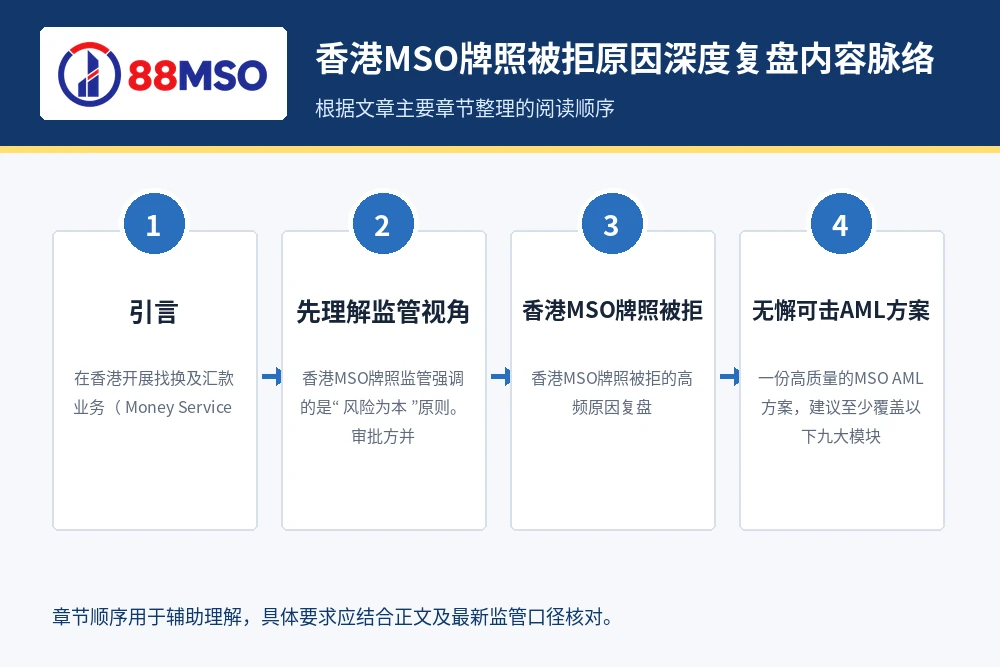
one、Understand the regulatory perspective first:What exactly are the approving agencies looking at?
Hong Kong’s MSO license supervision emphasizes “risk-based"in principle。The approving party does not just look at how many pages of the system you have written.,It depends on whether you have the following three abilities::
- Ability to identify risks:Can customers be accurately identified?、area、channel、product、Money laundering and terrorist financing risks in transaction scenarios;
- Ability to control risks:Is there any correspondence?、layered、Actionable controls,rather than empty slogans;
- Continuous governance capabilities:Is there a long-term operating mechanism?,For example training、audit、monitor、Reporting and continuous optimization。
in other words,Approval is not a “documentation competition”,But "system verification"。This is why many application documents “look professional”,but still not passed。
two、Review of the high-frequency reasons why Hong Kong MSO licenses are rejected
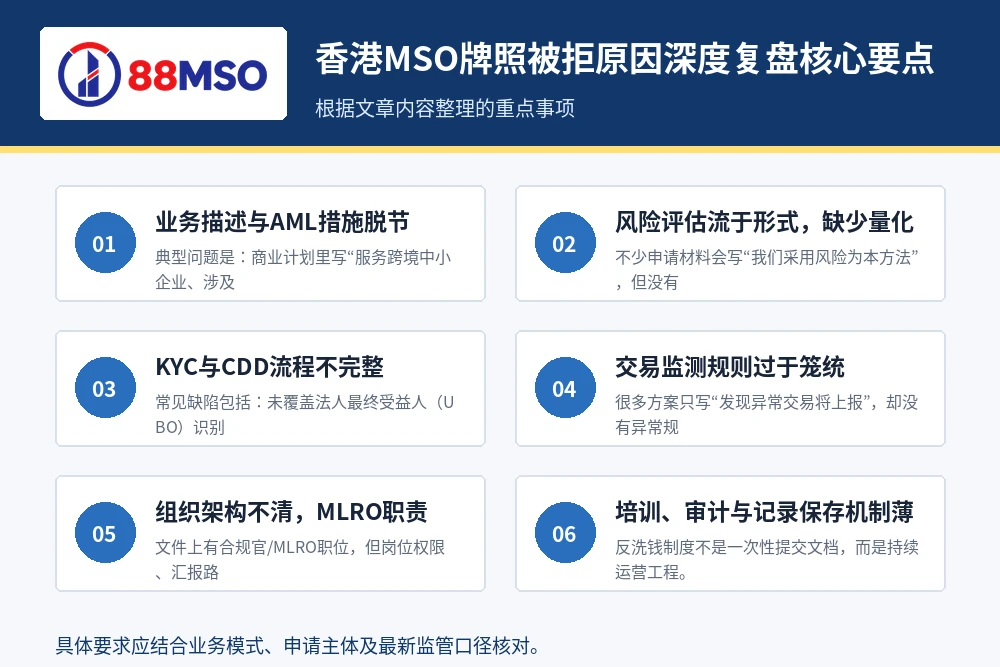
1. Business description is disconnected from AML measures
Typical questions are:The business plan says “Serving cross-border small and medium-sized enterprises”、Involving high-frequency small-amount remittances”,But AML policy still remains in ordinary retail scenarios,Cross-border link verification is not reflected、Beneficiary identification、Key control points such as identification of abnormal payment paths。
essential crux:Not based on real business modeling,AML solution and business model "two skins"。
2. Risk assessment becomes a mere formality,Lack of quantification and classification logic
Many application materials will say "We adopt a risk-based approach",However, no specific grading standards were given:Which customers are classified as low/medium/high risk? How to set the weight of scoring factors? What is the threshold that triggers Enhanced Due Diligence (EDD)?
essential crux:Lack of risk assessment methodology,Resulting in subsequent KYC、Transaction monitoring、Review and upgrade cannot be implemented。
3. Incomplete KYC and CDD processes
Common defects include:Uncovered legal entity ultimate beneficiary (UBO) identification、Undefined high-risk customer review frequency、No provision for data expiration update mechanism、No account opening and exit mechanism is designed.。
essential crux:Treat KYC as “account opening action”,Rather than "life cycle management"。
4. Transaction monitoring rules are too general
Many plans only say "abnormal transactions will be reported if found",But there is no exception rule base:such as split transactions、short term reshoring、Geographical anomaly、Account agent operation、No identification rules have been established for transaction rhythm that does not match the customer profile, etc.。
essential crux:"Monitoring" is not designed as an executable process,This makes it impossible for both the system and humans to operate。
5. Unclear organizational structure,MLRO responsibilities idling
Compliance Officer/MLRO position on file,But the position authority、reporting path、The isolation mechanism from the business line is not clear,Especially in small teams, it is easy to appear "nominal independence".、"Practical Subordination" Issue。
essential crux:Governance structure does not reflect checks and balances,Impact on regulatory trust。
6. training、Weak audit and record-keeping mechanisms
The anti-money laundering system is not a one-time document submission,It is a continuous operation project。In the absence of an annual training plan、Internal spot check mechanism、Improve closed loop and record retention policies,The supervisory committee will judge that the system cannot be effective in the long term.。
essential crux:Only reapply and pass,No emphasis on license duration compliance。
three、The core structure of the AML solution
A high-quality MSO AML solution,It is recommended to cover at least the following nine modules:
1. Compliance governance and three lines of defense
- Board/Management Compliance Responsibility Statement;
- front line business、Second-tier compliance、Boundaries of third-line audit responsibilities;
- MLRO Appointment、Permissions、Escalation and reporting and independence arrangements。
2. Enterprise Level Money Laundering Risk Assessment (EWRA)
- risk dimension:client、region、product、channel、trading behavior;
- Scoring method:Qualitative + Quantitative,Clarify weights and thresholds;
- Risk heat map and corresponding control matrix。
3. Customer Due Diligence (CDD) and Enhanced Due Diligence (EDD)
- Personal/corporate customer KYC information list;
- UBO identification standards and penetration levels;
- Enhanced verification of high-risk customers (source of funds、source of wealth、business reasonableness)。
4. Continuous due diligence and triggering mechanism
- Regular review cycle (differentiated according to risk level);
- Trigger review event:Change of address、Abnormal transactions、Change of control, etc.;
- Data update and freezing/exit process。
5. Sanctions screening and list management
- Screening before account opening、Screening during transactions、Regular batch re-screening;
- Hit ranking processing:true hit、false positive、Upgrade review path;
- Screening traces and audit traceability。
6. Transaction monitoring and abnormal warning
- Rule base (amount、frequency、geography、behavioral deviation);
- Scenario-based case (split transfer、Third party payment and collection、Short-term multi-point transfer);
- Early warning handling SOP and time limit requirements。
7. Suspicious Transaction Reporting (STR) Mechanism
- Internal reporting process:Frontline discovery—compliance research and judgment—MLRO decision-making;
- External reporting standards、Timeliness and confidentiality requirements;
- "Tipping-off" control。
8. training、Assessment and cultural construction
- New employee induction training、Annual refresher training、Job specific training;
- Testing and accountability mechanisms;
- Frequency of intensive training for high-risk positions。
9. Internal audit and continuous improvement
- Annual audit plan and sampling strategy;
- Discover problems - rectify - review closed loop;
- System version management and regulatory update response mechanism。
Four、How to turn "paper system" into "executable plan"
1. Replace long slogans with flowcharts
Will open an account、Transaction monitoring、Abnormal upgrade、STR judgment made into a flow chart,Clarify the person responsible for each step、time limit、output file。It is easier for supervisors to determine whether the system is operational。
2. Use "threshold + case" to improve persuasiveness
For example:A single-day cumulative amount exceeding a certain amount triggers a first-level warning;Multiple transactions close to the threshold within 7 days trigger secondary review。With typical cases to illustrate the processing path,Can significantly improve the credibility of practical operations。
3. Match system capabilities with human capabilities
If the team is small,Be upfront about where automated screening is being used、Which aspects are manually reviewed?,And reflect the double verification or random inspection mechanism,Avoid expressions of "inflated ability"。
4. Reserve "answer space" for regulatory inquiries
High-quality programs often respond to regulatory FAQs in advance:Why was this risk classification chosen? What is the estimated proportion of high-risk customers? How to avoid false positives and false negatives? This can reduce the number of patches。
five、Reversal strategies in the patch phase:How to repair efficiently after being questioned
If you have received supplementary documents or objections,Don’t rush to “add pages”,Instead, fix them in the following order:
- Map one by one:Compare regulatory issues to the system chapter one by one,Avoid answering questions you don’t mean;
- Repair key gaps first:Prioritize strengthening risk assessment、CDD/EDD、Transaction monitoring、MLRO governance;
- Submit evidentiary attachments:flow chart、form template、Early warning example、training plan、Audit template;
- unified caliber:business plan、Operation manual、AML policies must be consistent,Avoid "files fighting each other"。
six、Three details that companies most easily overlook
- Ignoring regional risk dynamic updates:After the change of cross-border business area,Risk ratings and monitoring rules need to be updated simultaneously;
- Neglect of record keeping integrity:Not only save customer information,Also save the decision-making process、Review Opinions and Disposal Timeline;
- Ongoing compliance costs after neglecting licenses:Approval is just the starting point,annual review、training、Spot check、System optimization requires continuous investment。
seven、From application approval to long-term stability:Why is it recommended to introduce a practical compliance team?
MSO compliance cannot be accomplished by “writing legal documents”,it requires regulatory understanding、business understanding、The system understands the combination of the three。Many businesses rely on templates during the application period,After getting the license, I found out that the system could not be implemented.,On the contrary, it will increase the cost of later rectification.。
In Hong Kong Financial Compliance Practice,Service team with local practical experience,Usually can significantly improve efficiency in the following aspects:Early stage architectural design、AML system customization、Response to inquiries、Post-license maintenance and annual review coordination。Take 88MSO (88MSO), a team that has long been focused on the custody of Hong Kong financial licenses as an example.,Its value is not in "ghostwriting documents",It’s about translating regulatory language into corporate executable processes.,Help enterprises move from "passing review" to "long-term compliance operation"。
Conclusion:Executable AML solutions,The core is verifiable、Executable、sustainable
Hong Kong MSO license rejected,It is often not because the company has no business potential,Rather, compliance expression and execution capabilities have not been fully proven.。To improve the pass rate,The key is not to pursue document thickness,Instead, establish a risk control system that matches the business:There is a way、There is a process、There is evidence、There is a closed loop。
If you are preparing to apply、Supplementary rectification or post-license optimization stage,You might as well use the framework of this article to do a comprehensive review。Just upgrade AML from "application materials" to "business system",Helps reduce patchwork and supports ongoing compliance。
FAQ:The 4 questions that applicants are most concerned about
Q1:Is the more detailed the AML plan, the better?
no。The key is to match the business、Executable、Can leave traces。Vacant stuffing can easily be identified as templated content。
Q2:Is it difficult for a small team to meet regulatory requirements?
uncertain。Small teams can achieve clear division of labor、External audit support、Systematic screening tools to meet requirements,The key point is to have clear governance logic。
Q3:Is it guaranteed to be approved after the supplement is made?
If structural repairs can be made in response to regulatory opinions,and submit verifiable evidence,There is usually significant room for improvement。
Q4:Do I still need to continue to optimize AML after getting the license?
must。regulatory environment、Customer structure and transaction risks are changing,Continuous optimization is the prerequisite for the stable operation of licenses。