简体中文
简体中文 繁體中文
繁體中文 English
英国FCA Why has the EMI license become a “must compete” for cross-border payment companies?
Against the background of continued tightening of payment regulations in Europe and globally,EMI (Electronic Money Institution) regulated by the British FCA (Financial Conduct Authority),Electronic Money Institution) License,Many cross-border payments have become、digital wallet、B2B payment platform、The key threshold for aggregated payment service providers to enter the international market。Especially for those who want to take on funds from European clients、Build local clearing capacity、For enterprises that improve the success rate of bank cooperation,EMI is not just a "license",It is also the core asset of business credibility and valuation level.。
But the reality is:Many applicants fall into misunderstandings during the preparation stage - treating EMI as an "upgraded version of company registration",Ignored the FCA’s governance structure、Anti-money laundering system、An in-depth review of financial segregation mechanisms and IT resilience。The result is often repeated replacements、Application period extended,Even rejected。
This article will focus onApplication process、Regulatory Sandbox Testing、Notes on fund isolationThree core modules,Make an executable panoramic analysis,And combined with common pain points of cross-border institutions,Help you establish an application path closer to FCA review logic。
First clarify:What exactly does an EMI license do?,What can't be done?
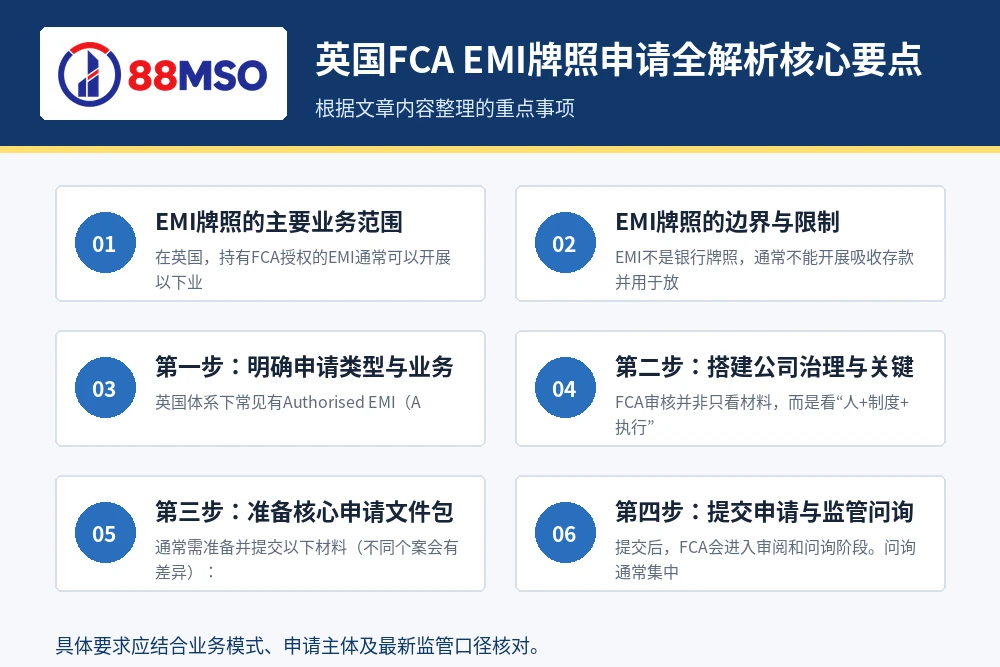
The main business scope of EMI license
in the UK,EMIs holding FCA authorization can usually carry out the following businesses::
- Issue electronic money (such as prepaid balances、wallet balance);
- Provide payment services (transfer、Acquiring、money transfer、Dropshipping, etc.);
- Provide account functions (IBAN/local collection account capabilities,Depends on partner bank and structure);
- Provide digital payment products for businesses or individuals。
Boundaries and restrictions of EMI licenses
- EMI is not a banking license,Banking business that takes deposits and makes loans is generally not allowed;
- Client funds must be compliantly segregated (Safeguarding),Not to be used as working capital;
- Anti-money laundering、Sanctions Screening、Transaction monitoring and other obligations are ongoing and frequent;
- Even if you have a license,It does not mean that you can automatically enter the market of all countries.,Local cross-border regulatory requirements still need to be considered。
UK FCA EMI application process:Key steps from 0 to approval
first step:Clarify application type and business model
Common paths under the British system include Authorized EMI (AEMI) and Small EMI (SEMI).。For most people who want to operate on a large scale、For organizations that expand cross-border business,AEMI has more long-term value。When the FCA looks at applications,Pay great attention to whether you "know what you are doing" - including who your target customers are、How the funds flow、Where is the risk control node?、Whether the technical architecture can support business growth。
Step 2:Establish corporate governance and key functional personnel
FCA review does not just look at materials,Instead, look at “people + system + execution”。Common key positions include:
- Board of Directors and Senior Management:Payment or financial services experience required;
- Compliance Officer/MLRO Function:Responsible for anti-money laundering、Report suspicious transactions、regulatory communications;
- Risk control and audit functions:Cover operational risks、Fraud risk、Outsourcing risks;
- IT and information security manager:Reflect system availability、Data security and emergency capabilities。
If the management resume does not match the business,It is a high-frequency factor that leads to supplements and doubts.。
Step 3:Prepare core application package
Usually you need to prepare and submit the following materials (different cases will vary):
- Business plan (3-year financial forecast、revenue model、cost structure);
- Project Description (Program of Operations);
- Safeguarding Policy;
- AML/CTF policy and KYC process documents;
- Risk Management Framework and Internal Control Manual;
- IT architecture、network security、Business Continuity and Disaster Recovery Plan;
- Outsourcing management policies and third-party due diligence materials;
- Shareholder structure、Ultimate Beneficiary (UBO) Disclosure and Proof of Source of Funds。
At this stage, it is recommended to upgrade "writing files" to "making systems":The files must be logically consistent,Otherwise, the FCA will quickly identify “templating traces” in inquiries。
Step 4:Submit applications and regulatory inquiries
After submission,FCA will enter the review and inquiry stage。Inquiries usually focus on:
- Whether customer capital flows are physically isolated from the company’s own funds;
- Does the KYC layering match the customer risk profile?;
- high risk countries、Restrictive measures for industries and transaction scenarios;
- Are fraud and chargeback mechanisms enforceable?;
- Outsourcing service providers (including cloud services、payment channel provider) has sufficient control?。
The time cost of many projects is not "before submission",And in "Inquiry response quality"。The more accurate the reply、The more evidence chain can be provided,The higher the approval efficiency。
Step 5:Approval is not the end,It is the starting point for continued supervision
After getting the EMI license,Enterprises will enter the continuous compliance stage,Includes periodic reports、audit、Policy updates、Incident reporting (such as major operational disruptions), etc.。If business model、Equity structure、Significant changes in key personnel,It may also trigger prior or subsequent reporting obligations.。
Regulatory Sandbox:Who is suitable to participate? How to improve pass rate?
The nature of the sandbox:Validate innovation and regulateability in a controlled environment
The UK regulatory sandbox is not a “green channel”,Instead, innovative financial products will be introduced in a limited scope、Conduct real market testing with controllable risks。The FCA’s focus is not on “how new you are”,But “Does your innovation bring consumer value?”,And the risk is controllable、"Correctable"。
Typical scenarios suitable for sandbox application
- New cross-border settlement paths (such as more efficient multi-currency clearing and settlement mechanisms);
- AI-driven transaction risk identification and anti-fraud engine;
- New KYC/identity verification technology (taking into account conversion rate and compliance strength);
- Embedded financial payment products for small and medium-sized enterprises。
The most common misunderstandings in sandbox applications
- Just talk about technology,Not talking about consumer protection:FCA will ask you how to pay if something goes wrong、How to appeal;
- Test target is ambiguous:Missing quantitative KPIs,Such as fraud rate reduction target、User loss threshold;
- Missing exit mechanism:How to log off safely after a failed test、How to handle existing customer funds;
- Compliance “behind”:Treat AML/KYC as after going online,Usually not acceptable。
Practical suggestions for improving sandbox success rate
It is recommended to use "regulatory language" to design test plans:
- Clearly define the test population、Transaction size、Risk exposure cap;
- Develop real-time monitoring and exception handling SOPs;
- Set up user notification and consent mechanism (transparent disclosure of test attributes);
- Create an auditable data footprint,Facilitates FCA review;
- Preset "trigger threshold",Immediately suspend or downgrade services once the limit is exceeded。
Fund isolation (Safeguarding) is the “life and death line” of EMI audit
Why is the FCA so strict on segregating funds?
EMI institutions hold client funds,rather than freely available company funds。The core of supervision is to prevent the transmission of institutional operating risks into customer capital losses.。In other words,Even if the company has problems,Client funds should also be kept as unaffected as possible。
Common ways to implement fund isolation
- Segregated Account Act:Store client funds in designated segregated bank accounts,Separate from company operating accounts;
- Insurance/Security Law:Cover the security of customer funds through insurance or comparable guarantee mechanisms that comply with regulatory requirements。
In practice,Segregated account laws are more common,But for the account structure、Reconciliation frequency、Fund allocation authority control requirements are very detailed。
High frequency risk points:Many organizations fail in these details
- "Short-term commingling" of client funds and the company's own funds;
- Reconciliation is not timely,As a result, accounting deviations have not been corrected for a long time.;
- Unclear identification of fund ownership under multiple payment channels;
- Refund、Chargeback processing conflicts with quarantine mechanism;
- The data caliber of the financial system and the trading system are inconsistent。
Implementable fund isolation and internal control list
- Daily (or more frequent) automated reconciliation and exception warnings;
- Double review + authority leveled fund allocation approval;
- Standardization of customer fund identification rules (including multiple currencies);
- Monthly stress testing:Simulate extreme refund and channel interruption scenarios;
- Independent Audit Tracking Fund Segregation Enforcement Consistency。
Anti-money laundering and KYC:What the FCA really looks at is not “whether there is a system”,It’s about “whether the system is effective?”
In EMI filing and ongoing supervision,AML/KYC is a “continuous scoring item”。The FCA usually makes judgments from the following perspectives::
- Whether customer access is tiered (individual/enterprise、industry、area、transaction size);
- Whether high-risk customers have enhanced due diligence (EDD);
- Are transaction monitoring rules dynamically updated?,rather than a one-time launch;
- Whether the sanctions list screening covers account opening、Transaction、The entire inventory review process;
- Is there a statute of limitations and evidence chain for suspicious transaction reporting (SAR)?。
For companies doing cross-border payments,It is recommended to KYC、Transaction monitoring、Device fingerprint、Behavioral risk control linkage,Forming a three-stage control of “access + transaction + withdrawal”。This will not only make it easier to pass regulatory scrutiny,Also helps reduce fraud losses and channel rejection rates。
Time and cost estimates:How to do more realistic project management?
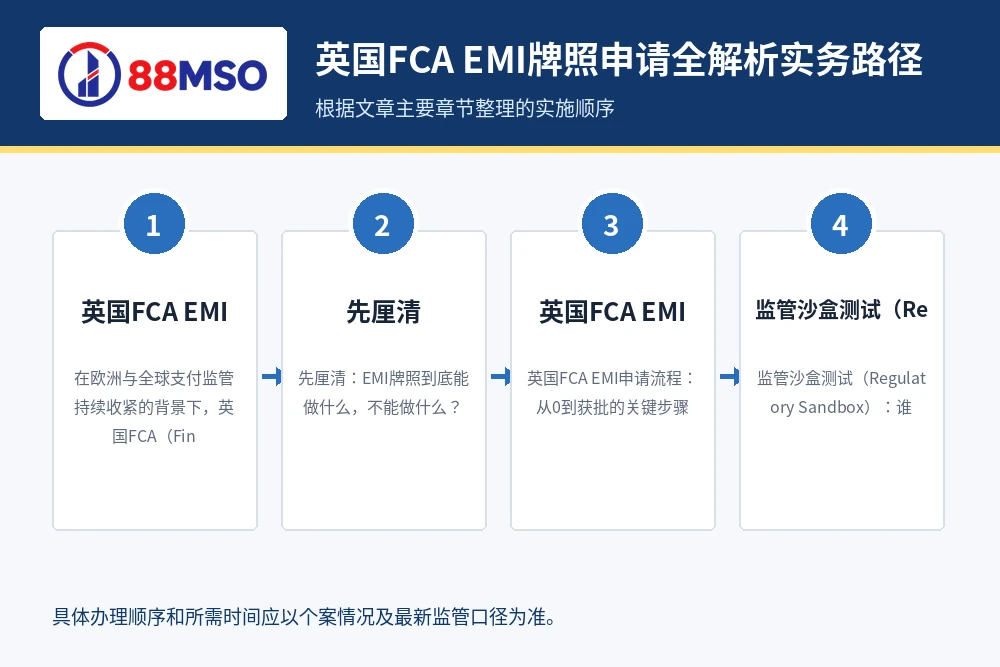
EMI projects are not "submit and approved"。Enterprises should reserve sufficient buffers in budget and schedule:
- Preparatory period:Governance setup、Documentation、System transformation;
- review period:Regulatory inquiry round trip、Addendums and revisions;
- Implementation period:Bank/payment channel docking、Internal control goes online、staff training。
If the company’s original compliance foundation is weak,Later rectification costs are often higher than the one-time construction costs in the early stage。For teams that want to have a multi-jurisdictional presence such as Hong Kong and the UK,Recommend adopting a “portable compliance framework” from the start,Avoid redoing a system every time you enter a market。
Practical suggestions for cross-border institutions:How do the UK EMI and Hong Kong license arrangements work together?
Many companies will assess UK EMI at the same time、Hong Kong MSO or other financial license paths。The core idea is not "which is easier?",It’s about “which one better matches your customer structure?、Funding Pathways and Regulatory Exposures”。
Take the typical customers served by 88MSO as an example,A common practice is:First clarify the main operating market,Redesign license and physical structure,Finally unified AML、KYC、Fund Segregation and Auditing Standards。This will be expanded to Hong Kong in the future、When in Europe or other regions,Compliance systems can be reused,Significantly reduce duplication of investment。
For management,The real competitiveness is not to obtain a single license,Rather, it is about establishing sustainable compliance management capabilities.。This is why more and more institutions are choosing full case management or phased coaching by consultant teams with cross-jurisdictional experience.。
Conclusion:Obtain FCA EMI license,It’s just the starting point for international payment capabilities
Difficulties in applying for a British FCA EMI license,Never fill in the form,It depends on whether you have "supervisory verifiable" operational capabilities:Clear business boundaries、Trusted governance team、Enabled AML/KYC mechanisms、Audit-proof fund segregation process,And a test plan that is controllable and retreatable in innovative scenarios。
If you are planning to enter the UK or European payments market,It is recommended to do three things as early as possible:Do a compliance gap assessment first、Make another application roadmap、Finally, implement it systematically。Compared with "express delivery",This method can reduce rework,Shorten the actual approval cycle,and for subsequent financing、Bank cooperation and global business expansion lay a solid foundation。
Read more:UK EMI/PI Payment License Application Guide。