简体中文
简体中文 繁體中文
繁體中文 English
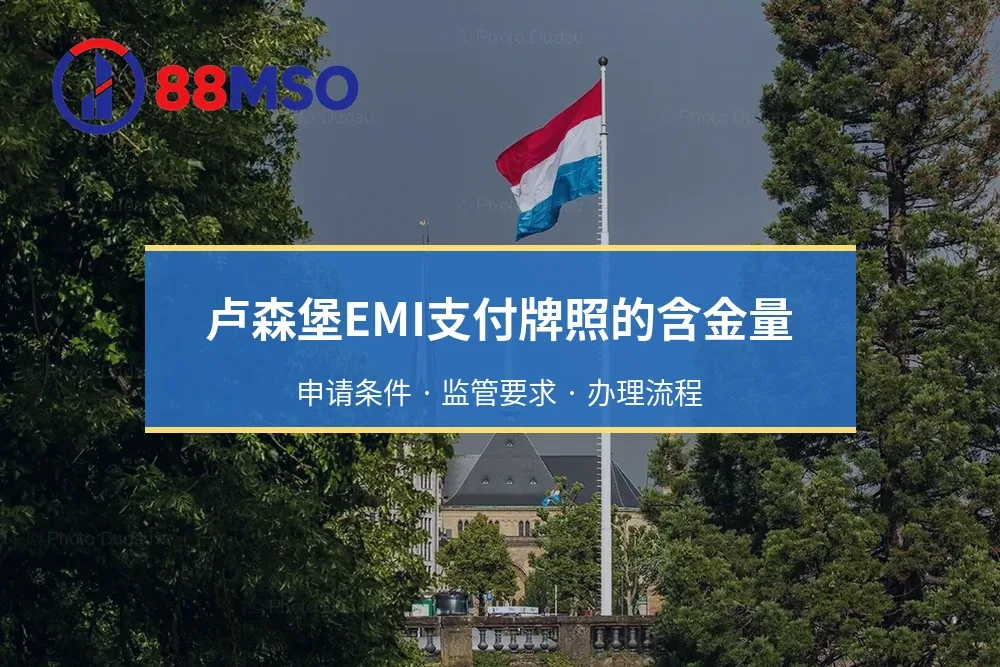
Luxembourg EMIPay the value of the license:Why is it the “hard currency” of the European payment circuit?
Businesses planning to issue electronic money or provide payment services in Luxembourg,EMI (Electronic Money Institution) should be checked against the proposed business,Electronic money institution) authorization、Payment service permissions and CSSF requirements。electronic wallet、Merchant acquiring and cross-border services must check the applicable scope and procedures respectively.,EMI authorization cannot be expressed as financing、Guarantee of bank acceptance or business cooperation。
A common misunderstanding among many companies on their expansion path:Just look at the application speed,Regardless of the subsequent value of the license plate。short term,The threshold appears to be lower in some jurisdictions;But in the medium to long term,regulatory intensity、Depth of bank cooperation、investor recognition、Cross-border traffic efficiency,Only then does it really determine the “gold content” of the license.。This is exactlyLuxembourg EMI licenseThe core reasons for continued strength in the European financial services ecosystem。
This article will start from the regulatory position、Application threshold、core process、Compliance pain points to implementation strategies,System analysis of the practical path for Luxembourg EMI license,Helping businesses build an executable European payments compliance blueprint。
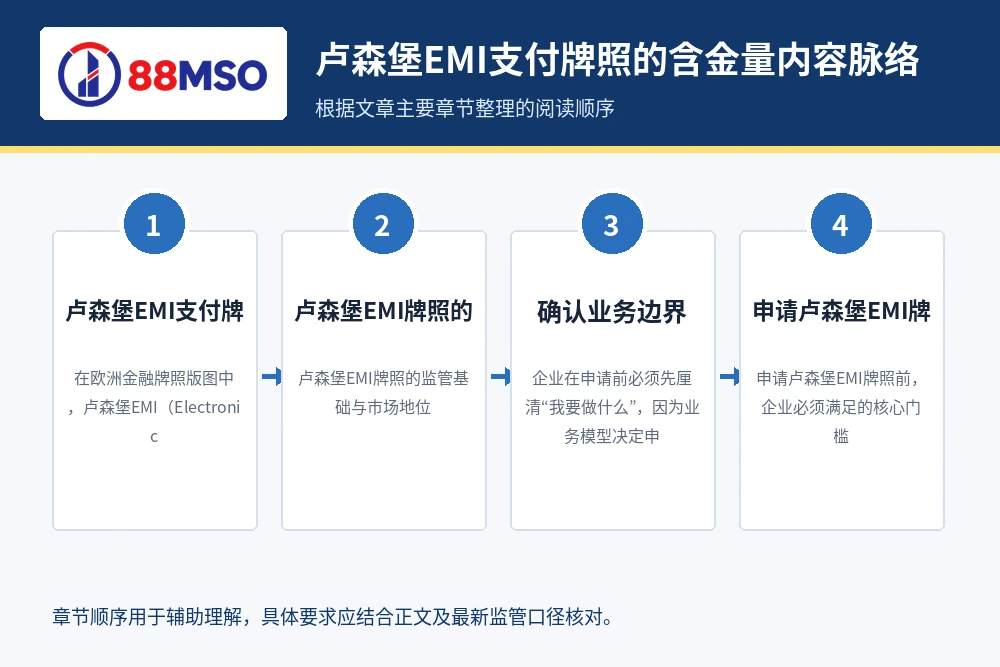
one、Regulatory basis and market position of Luxembourg EMI license
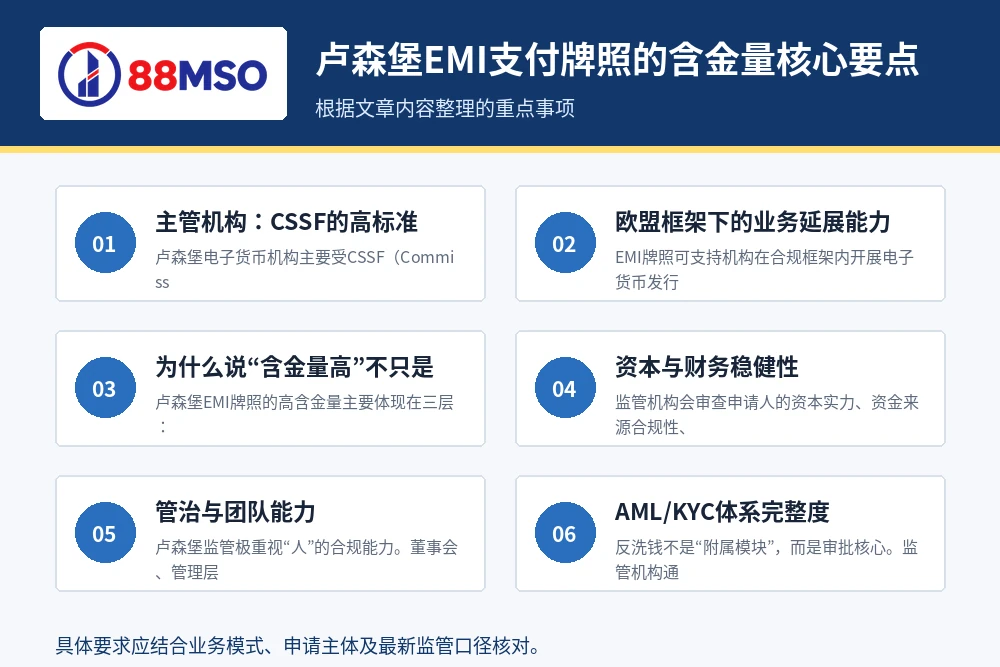
1. competent authority:CSSF’s high standards of supervision
The Luxembourg Electronic Money Institution is mainly regulated by the CSSF (Commission de Surveillance du Secteur Financier)。CSSF is known for its rigorousness in the European financial regulatory system、Known for prudent and continuous supervision,Pay particular attention to institutional:
- Governance structure and substantive operations(Not a "shell license")
- Fund security and customer asset isolation mechanism
- Anti-money laundering and counter-terrorism financing (AML/CFT) system maturity
- IT and operational resilience(outsourcing、data、network security)
From the perspective of investors and banks,Being regulated by CSSF itself is a credit endorsement,This is also the fundamental reason why Luxembourg’s EMI license has more pricing power than some “low threshold” jurisdictions.。
2. Business extension capabilities within the EU framework
EMI license can support institutions to carry out electronic currency issuance and payment services within a compliance framework。If the architecture and processes are designed properly,Companies can use the EU regulatory coordination mechanism to promote cross-border business expansion,Service scope covers multiple European markets。For cross-border e-commerce、SaaS platform、international money transfer、For platform payment service providers,This kind of "single point landing"、The ability to expand regionally is of great strategic value。
3. Why is "high gold content" not just a brand effect?
The high value of the Luxembourg EMI license is mainly reflected in the third layer:
- Compliance content:Regulatory expectations are high,Can force companies to buildContinuous Compliance System;
- Business value:Easier access to international banks、card organization、Opportunities for clearing partners;
- Capital content:in financing、mergers and acquisitions、Institutional valuation in progress,High-quality license assets are more recognized。
two、What can I do with Luxembourg EMI? Business boundaries and common patterns
Companies must first clarify “what do I want to do” before applying?,Because the business model determines the application materials、Organizational Structure and Regulatory Inquiry Key Points。generally,Luxembourg EMI can cover the following directions (specifically subject to regulatory approval scope):
- Issue electronic currency (such as wallet balance、prepaid value);
- Execute payment transactions (including account-to-account、Scenarios such as card-based payment);
- Provide payment accounts and related payment tools;
- for the platform、Merchant、Overseas companies provide embedded payment capabilities;
- Develop cross-border payment services based on compliance framework。
But special attention is needed:EMI is not a "universal license"。Relating to regulated investment services、lending、When engaging in activities such as insurance distribution,Often additional permission or licensing arrangements are required。In the early stage of the project, a professional team conducts license boundary diagnosis,Often costly rework at a later stage can be avoided。
three、Before applying for Luxembourg EMI license,Core thresholds that companies must meet
1. Capital and Financial Soundness
Regulators will review the applicant’s capital strength、Funding Source Compliance、Sustainability and financial resilience under stress scenarios。In addition to minimum capital requirements,Companies should also prepare:
- Clear description of capital structure and shareholder background;
- Financial forecasts and key assumptions for the next 2-3 years;
- Liquidity management and capital replenishment plan。
2. Governance and team capabilities
Luxembourg supervision attaches great importance to the compliance capabilities of “people”。Board of Directors、Management、Compliance Officer、Risk control manager、AML person in charge and other key positions,Requires experience and competencies that match the business scale。The common reason for failure is not that the business model is inadequate,It’s that the team’s experience cannot support regulatory expectations.。
3. AML/KYC system integrity
Anti-money laundering is not an “auxiliary module”,But the core of approval。Regulators usually focus on:
- Customer risk rating model (individual/enterprise/high-risk areas);
- KYC and Continuous Due Diligence Process;
- Suspicious transaction monitoring and reporting mechanism;
- Sanctions List Screening and Hit Processing Process;
- Independent Audit and Employee Training Program。
For cross-border payment companies,Whether transaction monitoring rules truly match business scenarios (rather than templated files),It is the key factor that determines the efficiency of approval。
4. IT systems and outsourcing management and control
EMI business is highly dependent on technology infrastructure。Regulators will require companies to demonstrate system availability、Data security、access control、Disaster recovery capabilities and outsourcing management (especially cloud service and core payment module outsourcing)。If there is a disconnect between system documentation and actual operations,The regulatory inquiry cycle will be significantly lengthened。
Four、Luxembourg EMI application process:The landing path from 0 to 1
Stage one:License feasibility assessment and architecture design
The task at this stage is not to "fill in the form",Rather, it determines whether the project has the application value and feasibility of implementation.,include:
- Business activity mapping and permission boundary confirmation;
- Equity structure、Tax and operating entity design;
- Key Staffing and Recruitment Plans;
- cooperative bank、payment channel、Technology supplier feasibility assessment。
Stage 2:Application material preparation and pre-communication
Common materials include business plans、Compliance Manual、AML policy、Internal control documents、IT security documents、financial forecast、Due diligence information for shareholders and management, etc.。High-quality application documents should be “regulatory readable”、Logic closed loop、Can be implemented on the ground”。
Stage three:Formal submissions and regulatory inquiries
After submission, it usually enters multiple rounds of inquiry stages.。Regulatory issues tend to focus on:
- Are transaction flows consistent with capital flows?;
- How to isolate and protect customer funds;
- How to manage high-risk customers and high-risk areas;
- How to divide the boundaries of responsibilities under outsourcing arrangements。
Response speed and professional depth at this stage,Directly affects the approval cycle。
Stage four:Post-approval launch and ongoing compliance
Getting cards is just the beginning。EMI institutions need to continue to meet regulatory requirements in daily operations,Includes periodic reports、audit、Policy updates、Personnel training and system optimization。Many institutions “get licenses quickly”、Difficult to operate”,The root cause lies in the lack of executable compliance operation design in the early stage。
five、Three major practical issues that enterprises are most concerned about
1. How long is the application cycle?
There is no unified answer,Depends on business complexity、Data completeness、Team maturity and regulatory inquiry round-trip efficiency。generally,Highly customized、Projects with complex cross-border scenarios have longer cycles。in practice,The more solid the preparation in advance,The more time and cost can be saved later。
2. Are the costs “unaffordable”?
Luxembourg EMI does belong to a high standard license,The cost goes beyond the application fee,Also includes team building、System compliance transformation、Audit and ongoing monitoring costs。But in the long run,If the company's goal is to operate on a large scale in Europe,This type of investment often corresponds to stronger business certainty and financing capabilities.。
3. Are start-ups suitable to apply directly?
If the business has not yet been finalized、Volume model is unstable、Weak team,It is recommended to complete the minimum viable compliance architecture (MVP Compliance) first,Then enter the formal application。Blind sprinting will only increase the cost of trial and error。
six、Strategy comparison of Luxembourg EMI and other European paths (short version)
Many companies will compare "Luxembourg vs other EU jurisdictions"。Simply put:
- If the target isQuick test of the waters,May tend towards markets with lighter processes;
- If the target islong term brand、Institutional Cooperation and Capitalization,Luxembourg has more obvious advantages;
- If the business involvesComplex cross-border capital flows,The trust dividend brought by high standards of regulation is usually greater。
therefore,License decision-making is essentially a matter of “strategic matching”,rather than "which is the cheapest?"。
seven、From Hong Kong to Europe:Collaborative compliance ideas for overseas financial institutions
For businesses with established business base in Hong Kong or Asia,Entering Luxembourg is not an isolated move,Instead, it should be included in global license portfolio management。for example:Hong Kong business focuses on local regulatory compliance and regional capital flows,European business focuses on EMI framework and multi-country payment expansion,Both passed unified AML standards、KYC rules and risk control data governance achieve synergy。
In such cross-jurisdictional projects,What is really scarce is a team that “understands licenses + understands implementation + understands sustainable operations”。Judging from the project experience of 88MSO and its 88MSO professional team,The most easily overlooked thing by companies is not the application text.,It’s about post-application operational compliance—including annual review rhythm.、Policy updates、Closed loop of audit interface and personnel responsibilities。Put these designs into the license plate project in advance,Often more cost-effective than backfilling、more secure。
eight、List of common failure points:avoid detours
- The business plan is too idealistic:Revenue forecasts are divorced from market reality;
- The file is heavily templated:Compliance system does not match actual processes;
- "nominal appointment" of key positions:Unable to prove actual ability to perform duties;
- Reliance on outsourcing is too high:Insufficient core control;
- Overlooking the ongoing compliance budget:Operational pressure increased sharply after approval。
Enterprises should check these risks during the project approval period,and put the materials to be replenished、Responsible personnel and rectification matters are included in the application plan。
Conclusion:Luxembourg EMI is not a "quick license",But a "value license"
The true value of Luxembourg’s EMI payment license,It’s not about the step of “getting the certificate”,But it lies in whether it can help enterprises establish cross-border payment capabilities.、Gain institutional trust、and operate stably in the long term。For payment institutions targeting the European market,This license is more like a system project:regulatory logic、Capital logic and business logic must be unified。
If your goal is to build a sustainable global payments landscape,So instead of chasing short-term speed,It is better to prioritize building high-quality and compliant bases。only this,Only then will the license change from a "cost center" to a "growth engine"。
FAQ:Luxembourg EMI License High Frequency Questions and Answers
Q1:What typical scenarios can Luxembourg EMI cover?
Commonly used include e-wallets、Prepaid balance、Platform payment and settlement、Cross-border merchant payment collection, etc.,However, the specific scope is subject to the approved license content.。
Q2:Is it necessary to have a local team in Luxembourg?
Usually requires substantial local operational capabilities that match the business,Key functions cannot be completely “hollowed out”。
Q3:After obtaining the license, do I still need to continue to supervise and submit reports?
need。Includes periodic reports、audit、AML update、Internal control optimization, etc.,This is the norm for EMI compliance operations。
Q4:Which area of investment should cross-border payment companies give priority to?
Prioritize investment in the construction of AML/KYC and transaction monitoring systems,Secondly, governance structure and IT compliance capabilities,These three items directly affect approval and long-term operational quality.。