简体中文
简体中文 繁體中文
繁體中文 English
Why is it “increasingly difficult” for mainland companies to open bank accounts in Hong Kong? Let’s first look at the regulatory logic in 2026
past few years,Many mainland business owners feel the same way:Hong Kong bank account openingThe threshold is not “suddenly raised”,But the audit logic becomes more sophisticated。By 2026,Banks no longer only look at “whether the company is established”,Instead, we focus more on “whether the business is real”、Are the funds explainable?、Is the transaction sustainable?、Is the risk controllable?”。
Official verification:The regulatory scope covered by this article、Application Information and Ongoing Obligations,should beHong Kong Monetary Authority Anti-Money Laundering and Customer Due Diligence InformationThe current published information shall prevail。
in other words,What the bank really wants to answer is:Will this company bring compliance risks and reputational risks to itself in the future?。therefore,If you still use the "templated information + simple instructions" from the early years to apply,easily rejected,I couldn't even get a chance for an interview.。
This article will break down the system and explain why mainland companies are refused to open bank accounts in Hong Kong.6 core reasons,And provide corresponding solutions and practical suggestions,Help companies improve their pass rates under the regulatory environment in 2026。
Reason one:Incomplete KYC information,and insufficient “information consistency”
The first thing a bank does during the account opening process is a KYC (Know Your Customer) review。Many companies do not have “no data”,But there is a contradiction between the data:For example, the shareholder's address certificate is inconsistent with the ID card address.、The company's business description does not match the contract content、The upstream and downstream invoice dates do not match the transaction description。
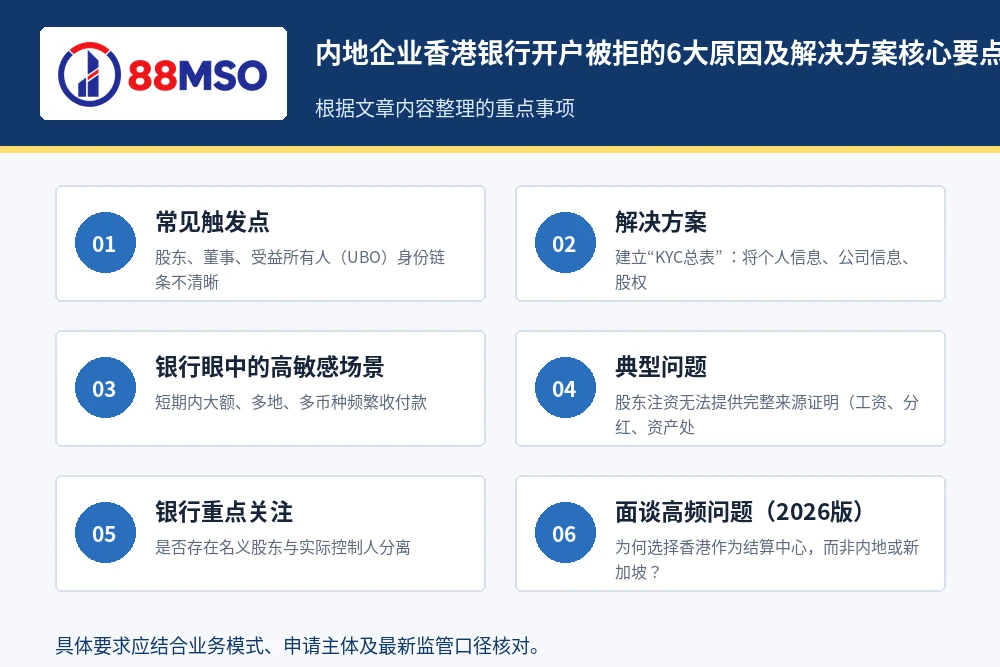
Common trigger points
- shareholder、director、The identity chain of beneficial owner (UBO) is unclear
- Articles of Association、Business registration、NNC1/Annual Return Document Versions Are Inconsistent
- Insufficient explanation of the relationship between the mainland parent company and the Hong Kong company (holding、Related party transactions、Intellectual property ownership is unclear)
- Information translation is not standardized,Key terms are inconsistent
solution
- Establish a "KYC master list":personal information、Company information、equity path、Unify business models into one version management file。
- Prepare a “three-piece set of evidence”:Business contract + invoice/order + logistics/delivery voucher,Prove that the transaction is real。
- Conduct consistency pre-review:Before the interview, a professional compliance consultant will check page by page.,Reduce rejections caused by “low-level conflicts”。
in practice,Teams like 88MSO that have long been handling financial compliance documents,Usually, we will first help companies conduct a "pre-account opening compliance physical examination",Deal with foreseeable risks in advance,It is more efficient than remediating after being rejected。
Reason two:Business model is “high risk”,But lack of risk explanation
It does not necessarily mean that high-risk industries will not be able to open an account.,The problem is that many companies only say "we do cross-border trade/consulting/technology services",However, the source of funds cannot be clearly stated、Customer structure、Transaction chain and risk control mechanism。When banks are unable to determine risk boundaries,The safest thing to do is to refuse。
Highly sensitive scenarios in the eyes of banks
- Large amount in short term、many places、Frequent payments in multiple currencies
- Cryptoassets、OTC exchange、Gray area behaviors such as third-party collection and payment
- "No office、No team、"No real operation" but high turnover is expected
- The newly established company claims to have a large number of overseas customers,But no historical transaction proof
solution
- Do business white paper:Clearly describe products/services、Customer area、Transaction currency、billing cycle、Capital flow path。
- Declaring transaction size in stages:Open an account with conservative turnover first,Apply to increase the limit after operations are stable.。
- Add substantial business certificate:lease、employment contract、Official website、System background screenshot、Supply chain contracts, etc.。
Reason three:Insufficient explanation of funding sources,Unable to meet "traceability"
In the bank review in 2026,“Source of Funds” and “Source of Wealth” are the top priorities。Common misunderstandings among companies are:Thinking that "the money belongs to my company" is enough。in fact,What the bank wants isThe path can be traced back、Use can be explained、Transactions are verifiable。
Typical questions
- It is impossible to provide complete source proof for shareholder capital injection (salary、dividend、asset disposal, etc.)
- Frequent exchanges between affiliated companies,But there is no reasonable business purpose statement
- There is a payee/payer that does not match the declared business in the historical flow.
- Large cash transactions or “personal account bridging”
solution
- Draw a money flow diagram:From upstream repayment to Hong Kong account to downstream payment,explained step by step。
- Prepare supporting documentation:Audit report、tax records、bank statement、Shareholder Asset Certificate、Dividend resolution。
- Avoid mixing personal accounts:Establish a closed loop of company accounts,Reduce the cross-over of non-commercial funds。
Reason four:The company structure is complex,Difficulties in identifying UBO (ultimate beneficiary)
Multi-tiered offshore structures are not uncommon in tax and investment arrangements,But for banks,If you can’t quickly identify “who actually controls the company?”,will be defined as high-risk customers。Especially when it comes to BVI、cayman、trust、When making arrangements,If disclosure is insufficient,The probability of rejection increases significantly。
Banks focus on
- Is there separation between nominal shareholders and actual controllers?
- Are there politically exposed persons (PEPs) or sanctions risk associations?
- Does the structure have an obvious empty shell layer with “no commercial substance”?
- Is key jurisdiction information verifiable?
solution
- Submit complete equity penetration chart:Mark shareholding ratio、control relationship、Voting Rights Arrangements。
- Provide legal documents simultaneously:trust deed、shareholders agreement、Beneficiary Statement、Director resolution。
- Minimize unnecessary layers as much as possible:Organize the structure before opening an account,Reduce interpretation costs。
Reason five:Interview answers are “templated”,Lack of operational details
Many company materials are well prepared,But failed in the interview session。The reason is that the answer is too "empty":For example, "We do international trade" and "Customers are all over the world",But when the bank asked the top five customers、Single amount range、Account period arrangement、return mechanism,The person in charge couldn't answer。
High-frequency interview questions (2026 edition)
- Why choose Hong Kong as a settlement center,Rather than Mainland China or Singapore?
- Estimated number of transactions per month、average amount、What are the main currencies?
- Is there a clear payment and collection plan for the first 3-6 months?
- Will you accept third-party payments? How to do customer due diligence?
solution
- Conduct a Q&A practice before the interview:Do at least 1-2 rounds of simulation,Make sure the caliber is consistent。
- Recruit someone familiar with the business:It is best to be the actual person in charge,and not just executives。
- Let data speak:Prepare forecast cash flow statement、customer list、Order pace and cost structure。
Reason six:Single account opening strategy,Bank matching error
Different banks versus industries、scale、Currency、Regional risk appetite varies widely。Many companies only focus on “well-known banks”,Ignoring its own stage and business characteristics,Leading to "the material is OK but the strategy does not match"。
Common strategy misunderstandings
- Only apply to one bank,After being rejected, I temporarily found an alternative.
- There is no distinction between the requirements of "receipt account" and "settlement account"
- There is no priority plan to prepare multiple currencies and online banking permissions
- Ignore banks’ differences in access to industry labels
solution
- Develop A/B/C account opening path:Synchronous planning of main applicant bank + alternative bank。
- Choose a bank based on business scenarios:trading、Serve、Platform businesses adopt differentiated account opening strategies。
- Include “long-term maintenance capabilities” in your options:Includes subsequent explanations、Annual review information、Compliance response speed。
A practical checklist to improve the success rate of account opening in Hong Kong in 2026
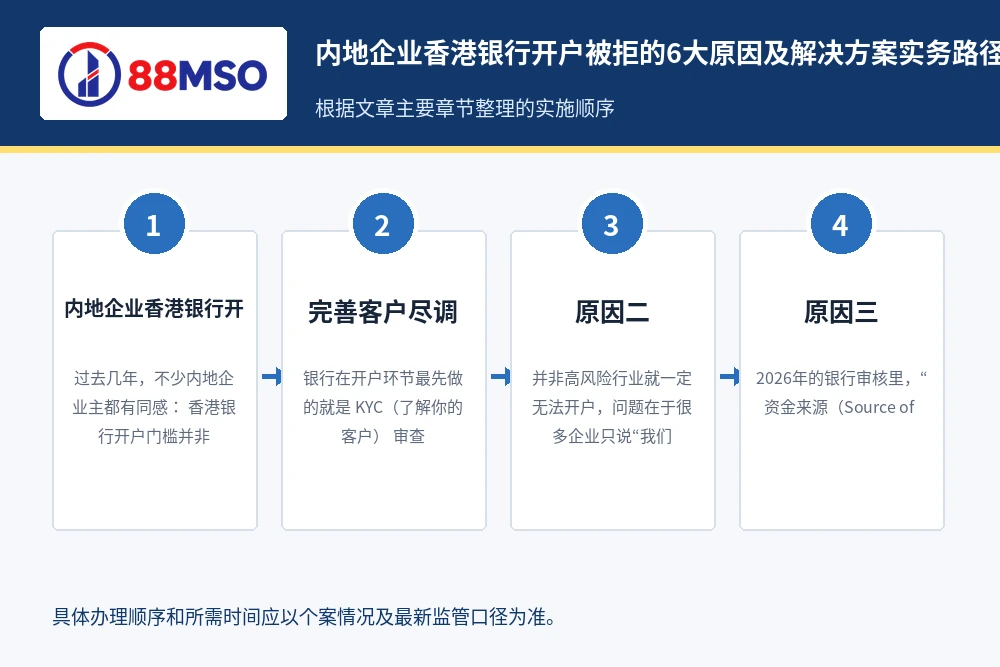
If you want to increase your pass rate all at once,You can prepare according to the following list:
- main file:Company registration certificate、Business registration certificate、Charter、Register of Directors and Shareholders、due diligence form。
- personal files:Director/shareholder identity certificate、Proof of address、Resume、Tax resident information。
- business documents:contract、quotation、bill、Logistics voucher、Official website and business plan。
- Funding documents:History、Proof of capital injection source、audit report、tax records。
- Compliance documents:KYC process description、Anti-Money Laundering Policysummary、Suspicious transaction identification mechanism。
For companies planning to carry out financial-related business in Hong Kong for the long term,It is recommended to integrate bank account opening and license planning into an integrated design。For example, the future involves payment、exchange currency、Fund custody、Cross-border clearing and other scenarios,The sooner you establish a compliance framework,Subsequent expansion will be smoother。88MSO and the team behind it are in MSO、SFC、insurance broker、Experience in Money Lenders etc. Licensing Practices,It is also often used to assist customers in connecting the whole process of "account opening - compliance - business implementation"。
Can I still make amends after being rejected? Can,But we need to talk about methods
Being rejected does not mean that you will never be able to open an account.。The key is to get the rejection reason (or rejection lead) first,Make targeted corrections,Rather than "re-invest as is"。
- If rejected due to inconsistent information:Unify file versions first,Additional explanation letter。
- If rejected due to unclear source of funds:Complete the source certificate and funding path map before applying.。
- If rejected due to industry sensitivity:Add transaction evidence、Reduce initial cost、Optimize bank matching。
- If you are rejected due to failed interview:Change interview representatives and conduct professional drills。
Important reminder:Frequent "blind investment" in multiple banks in a short period of time will leave an unfavorable record。It is recommended to complete compliance repairs first,Submit according to the strategy。
Conclusion:The essence of opening an account in Hong Kong,is “verifiable business credibility”
Hong Kong bank account opening in 2026,It’s not about relationships,It’s not about luck,It’s about the company’s compliance capabilities and operational transparency.。As long as you can prove that "the business is genuine、Funds clear、Risk control in place、Reliable team”,The pass rate will be significantly improved。
For mainland enterprises,The optimal path is usually not a single point of preparation,But putCompany structure、Bank account opening、Compliance system、future licensePut it in the same blueprint and advance it。This not only makes it easier to open an account,It can also lay a more solid foundation for subsequent cross-border expansion and capital deployment.。
FAQ:The 4 issues that mainland companies are most concerned about
1. Newly established Hong Kong company,no running water,Can I open an account?
Can,But use business proof to replace historical water flow,For example, a signed contract、Order、Customer communication records、Estimated cash flow, etc.。
2. Do I have to go to Hong Kong for an interview to open an account?
Depends on bank policy。Some banks support remote processes,However, high-risk industries or complex structures usually still require interviews.。
3. Rejected by a bank,Will it affect other banks?
possible。If you apply frequently in a short period of time,May trigger tighter scrutiny。It is recommended to fix the problem first before applying to the next company。
4. Will it be settled once and for all after opening an account?
no。The bank will continue to monitor account activity,Abnormal transactions、Data expired、Business deviation from the declaration scope may result in quotas or even account closure.。