简体中文
简体中文 繁體中文
繁體中文 English
introduction:Why do Estonia’s new MTR regulations in 2026 deserve great attention?
Official verification update (August 2026):The transition period for Estonia’s old MTR/VASP path has ended on June 30, 2026。From July 1, 2026,The provision of crypto asset services in Estonia must obtain a CASP authorization granted by Finantsinspektsioon or other EU member states' competent authorities under MiCA.,MTR registration cannot continue to be used as a new project application path。 For specific rules, seeEstonian Financial Supervisory Authority MiCA crypto asset services licensing page。
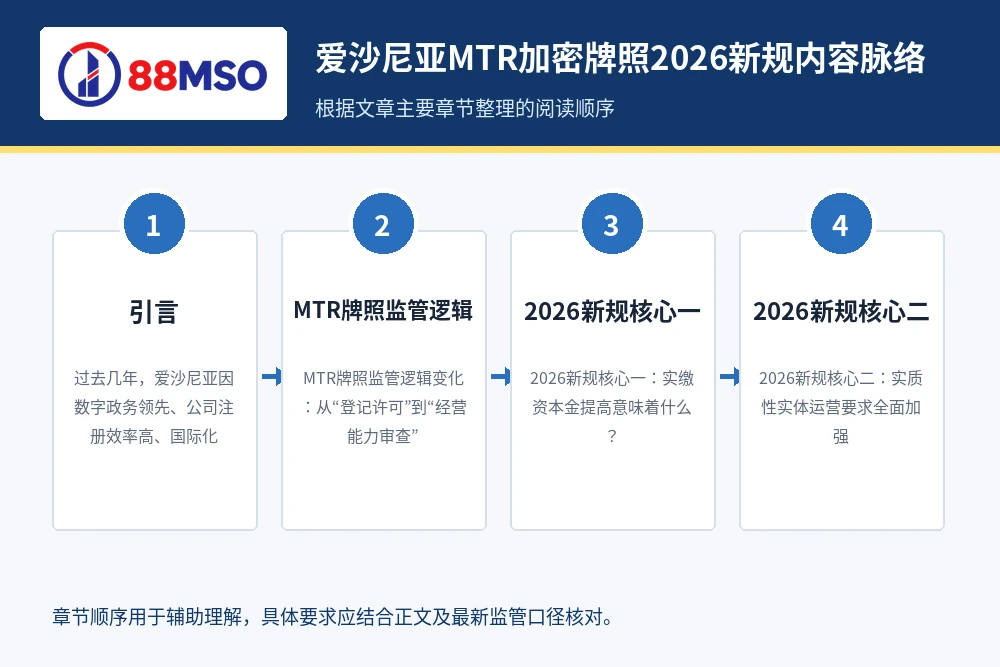
past few years,Estonia leads the way with digital government、Company registration is highly efficient、Strong degree of internationalization,It once became a popular jurisdiction for European encryption companies to lay out licenses.。But from the perspective of regulatory logic,Europe’s attitude towards virtual asset service providers (VASPs) has gradually shifted from “encouraging innovation” to “strong supervision + high transparency”。In this context,The market pays close attention toEstoniaMTR encryption license2026 new regulations,The core changes focus on two keywords:Increase in paid-in capitalandSubstantive entity operations。
For businesses,This is not a simple “increase in application costs”,But the compliance system、governance structure、Systematic reconstruction of operating models and cross-border business paths。If you still use "light entity"、low investment、The old model of outsourcing operations,Will face obstacles in license approval in the future、Increased pressure to renew licenses,Even business interruption risk。
This article will start from the policy intention、Key terms、corporate impact、Five dimensions of landing paths and common misunderstandings,Comprehensive interpretation of the 2026 new regulations,and provide executable response plans,Helping crypto projects planning to enter the European market、trading platform、OTC service providers and payment technology companies complete strategic adjustments ahead of schedule。
one、Changes in MTR license regulatory logic:From "Registration License" to "Business Capability Review"
1.1 Policy motivations behind the new regulations
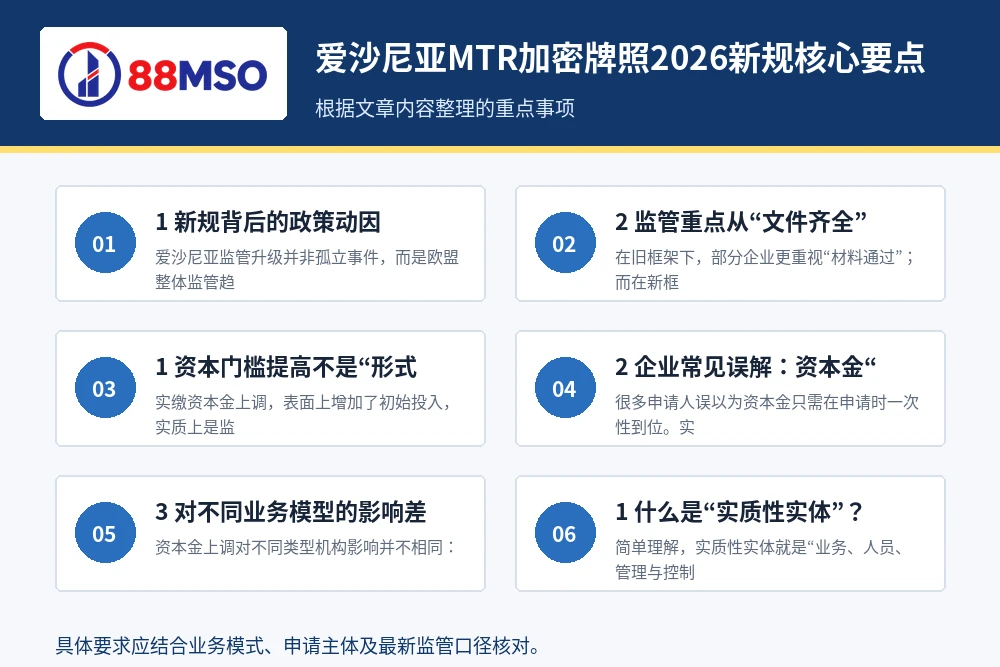
Estonia’s regulatory upgrade is not an isolated incident,It is part of the EU’s overall tightening of regulations。As cross-border flows of crypto assets accelerate,Regulatory agencies are more concerned about the following issues:
- Anti-money laundering and counter-terrorism financingIs the risk controllable?;
- Is there a phenomenon of “empty shell license holding” on the platform?;
- Customer asset security、Are transaction monitoring and risk disclosures adequate?;
- Whether the licensed institution has the ability to continue operating,rather than short-term arbitrage。
therefore,The 2026 new regulations are not a single-point fix,Rather, by raising capital thresholds and entity requirements,Gradually clear out participants who do not have long-term capabilities。
1.2 The focus of supervision has shifted from “complete documents” to “practical and verifiable”
under the old framework,Some companies pay more attention to "material passing";And under the new framework,Supervision pays more attention to “operational authenticity”。this means:
- Not only must there be institutional documents,There must also be traceable execution records;
- More than just a local address,Verifiable personnel and management activities are also required;
- More than just capital commitments,There must also be a real and continuous maintenance mechanism。
Such changes are particularly critical for cross-border teams:In the future, the “remote management + local name” model will become increasingly difficult to support long-term compliance.。
two、Core 1 of the 2026 New Regulations:What does the increase in paid-in capital mean?
2.1 Raising the capital threshold is not a “formal threshold”,It’s a risk buffering mechanism
Increase in paid-in capital,Ostensibly increased initial investment,In essence, supervision requires licensed institutions to have stronger risk-bearing capabilities.。For crypto businesses,market fluctuations、technical glitch、liquidity shocks andCompliance and rectificationwill cause financial pressure。After increased capital requirements,The organization must demonstrate that it has:
- Ability to cover basic operating costs;
- Financial resilience to deal with unusual transactions or customer disputes;
- Continuous investment in compliance、Budget space for risk control and system construction。
2.2 Common misunderstandings among enterprises:The capital is “available only once”
Many applicants mistakenly believe that capital funds only need to be paid in one lump sum when applying.。actually,Supervision often pays dynamic attention to capital status,Highlights include:
- Is the source of funds clear?、explainable、auditable;
- Whether the funds are suspected of short-term lending or "bridge investment";
- Whether net assets continue to meet regulatory thresholds during operations。
therefore,Enterprises should establish a capital management system,Conduct regular financial health checks,Avoid compliance risks triggered by improper cash flow arrangements。
2.3 Differences in impact on different business models
Capital increases have different impacts on different types of institutions:
- Deal matching platform:Need to invest in higher system security、Transaction monitoring and customer service capabilities;
- Escrow and Wallet Services:Customer asset security responsibilities are heavier,Higher capital and internal control requirements;
- OTC and payment channels:Cross-border capital flows are complex,AML and counterparty due diligence costs increase significantly。
Enterprises should combine their own business structures,Conduct a three-line budget of “capital + compliance + technology”,Rather than just applying for the lowest cost。
three、Core 2 of the 2026 New Regulations:Comprehensive strengthening of operational requirements for substantive entities
3.1 What is a “substantial entity”?
Simple to understand,A substantial entity is a “business、personnel、"Management and control" actually exists locally。It usually manifests itself in:
- Have stable office space and verifiable operating facilities;
- Key positions (such as compliance、Risk control、Operations) have local or sustainable performance capabilities;
- The decision-making process of the board of directors and management can be recorded、Can be reviewed;
- Core business processes do not completely rely on third-party outsourcing。
3.2 Why does supervision emphasize local substance?
Because the biggest problem with "empty shell license" is that the responsibility cannot be traced。Once money laundering risks occur、Customer complaints or system incidents,It is difficult for supervision to intervene quickly。The nature of substantive requirements,It is to make licensed institutions bear enforceable liability for business consequences.。
3.3 Direct impact on corporate organizational structure
Under new regulations,Enterprises often need to restructure their organizational design,including but not limited to:
- Identify directors、Boundaries of responsibilities between management and compliance officers;
- Establish localized reporting lines and regular meeting mechanisms;
- Move high-risk functions (customer access、suspicious transaction review) into internal controls;
- Improve audit trail,Ensure that evidence can be provided immediately during regulatory spot inspections。
This means that the era of “getting a card and it’s over” is over,The future is “competition in licensed operating capabilities”。
Four、AML/KYC requirements are upgraded simultaneously:Applying for a license is just the starting point
4.1 KYC moves from identity recognition to “continuous due diligence”
In the context of new regulations,KYC is no longer just about verifying identity documents during the account opening process,But full life cycle management:
- Customer risk stratification (low、middle、high risk);
- Continuous monitoring of trading behavior and iteration of rules;
- Enhanced due diligence (EDD) for high-risk customers;
- Regularly review customer information and beneficial owner information。
4.2 AML system construction requires more “executability”
Supervision is not just about “having a system”,Pay more attention to “whether the system is functioning”。Enterprises should focus on implementation:
- Suspicious transaction identification rule base and early warning threshold;
- Internal escalation reporting path (frontline-compliance-management);
- Suspicious transaction report (STR) timeliness management;
- Closed loop of employee training and assessment。
If the company plans to deploy in Hong Kong at the same time、European and other jurisdictions,It is recommended to establish a unified compliance base,Then make differentiated patches according to territorial rules,Avoid compliance distortion caused by multiple systems running in parallel。
five、Enterprise response roadmap:From “rushing time to apply” to “sustainable license holding”
5.1 Phase 1:Compliance Gap Diagnosis
First do a “current situation-goal” assessment,Key inspections:
- Does the capital structure support the new threshold?;
- Are local entities and staffing up to standard?;
- Does the AML/KYC process have an evidence chain?;
- Whether technical systems support transaction monitoring and audit trails。
5.2 Second stage:Governance and institutional reconstruction
Upgrade the system from "templated documents" to "scenario-based SOPs",For example:
- Customer access SOP (including rejection policy);
- SOP for hierarchical handling of abnormal transactions;
- Outsourcing management and third-party due diligence SOP;
- Regulatory inspection response SOP。
5.3 The third stage:Operation implementation and continuous maintenance
It is recommended to establish a quarterly compliance review mechanism,to capital、Risk control、training、Closed-loop management of audit findings。A truly solid institution,Often it is not the “fastest to apply”,Rather, “the rectification speed is the fastest、"The one that leaves the most complete traces"。
six、Cross-border compliance perspective:Why do companies start to adopt the "multi-jurisdictional license synergy" strategy?
As regulatory complexity increases,More and more companies no longer bet on a single jurisdiction,Instead, it adopts the layout method of "business layering + license synergy"。For example:Carrying out certain virtual asset businesses in Europe,At the same time, configure a matching financial compliance path in Asia (such as Hong Kong),To satisfy customers in different markets、Review requirements for banks and institutional partners。
in this process,The value of professional consultants is not only reflected in “application agency”,What's moreCross-jurisdictional system mapping、Timetable design and risk priority management。Judging from the practical experience of 88MSO behind 88MSO,Before enterprises enter the highly regulated market,If the licensing strategy can be completed first、AML framework、Linkage planning for bank account opening feasibility and subsequent annual review and maintenance,The overall implementation efficiency and stability are usually significantly higher than the path of "get the cards first and then make up the lessons"。
seven、Common Risks and Pitfalls List
- Just look at the application cost,Not counting licensing costs:Follow-up compliance maintenance is the bulk of long-term expenses.;
- Ignoring proof of source of funds:Capital is in place but the source is unclear,may still be questioned;
- Over-reliance on outsourcing:Key control links cannot be completely externalized;
- No regulatory communication mechanism:Lack of unified caliber and quick response after an abnormality occurs;
- Weak cross-border data and privacy management:Easily trigger additional compliance risks。
Conclusion:Under the new regulations in 2026,Compliance capabilities will become a core asset for crypto companies
Estonia’s new MTR encryption license 2026 regulations send a clear signal:The future of regulatory competition,It’s no longer “who submits the form first?”,It’s about “who is more capable of long-term、transparent、Operate auditably”。Increase in paid-in capital,Screening for financial resilience;Substantive entity operating requirements,Screening is based on governance and execution capabilities;AML/KYC upgrade,Screening is based on risk control and responsibility-bearing capabilities。
For companies that want to tap into the European market,The most important thing now is not to wait and see,Instead, start compliance restructuring as soon as possible:Complete capital and physical planning ahead of time、Establish verifiable AML/KYC mechanisms、Design cross-jurisdictional collaborative routes。Only treat compliance as business infrastructure,Rather than the process of getting a card,Only in this way can we achieve stable growth in the new regulatory cycle.。
If an enterprise pays attention to the implementation of compliance in Hong Kong and overseas at the same time,It is recommended that those with practical experience be given priority、A professional team that can cover the entire link of "application-account opening-annual review-continuous compliance",Avoid double losses of time and cost due to strategic fragmentation。Raising regulatory thresholds is not scary,The real watershed lies in:Have you built compliance capabilities?,Reached the strategic level in advance。