简体中文
简体中文 繁體中文
繁體中文 English
Hong Kong Financial Compliance Calendar 2026:Why “Time Management” Is Compliance Management
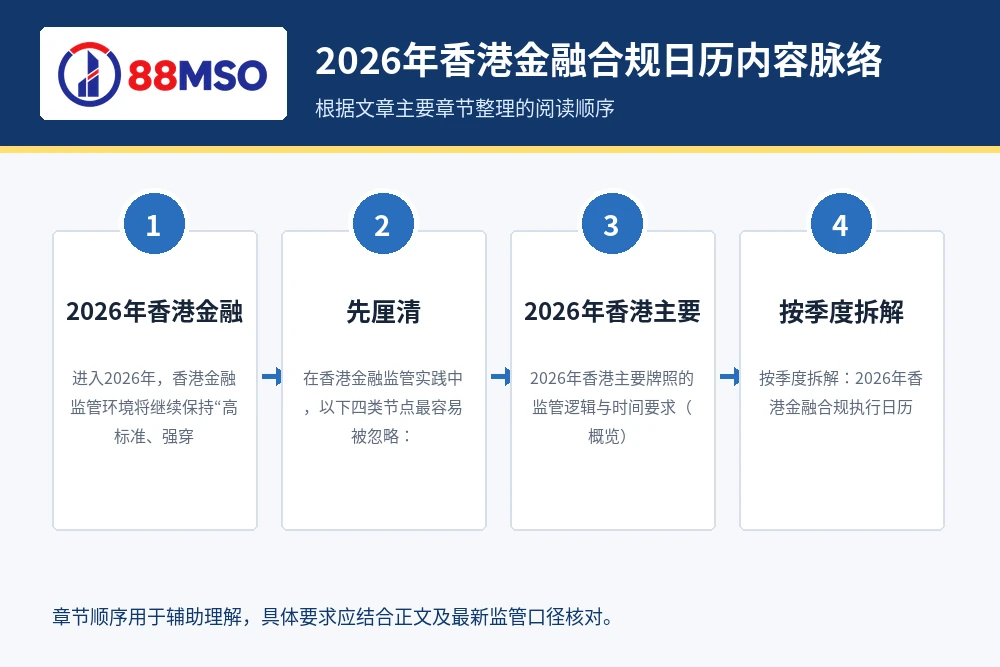
Entering 2026,Hong Kong’s financial regulatory environment will continue to maintain “high standards”、Strong penetration、The main tone of "re-implementation"。For licensed institutions,What really widens the gap,It’s often not whether you know the regulations,It’s about whether the regulatory requirements can be metevery time node:When will the annual review documents be submitted?、When will the responsible person’s information be updated?、When to submit audited financial statements、when based onFATF "Anti-Money Laundering"、International Standards on Counter-Terrorism Financing and Counter-Proliferation Financing"Complete internal training and risk assessment。
When many companies expand their business,Focus on “getting the cards first”,But neglected the systematic engineering of "continuous compliance after obtaining the license"。Results frequently asked questions include:Preparation of license renewal materials is lagging behind、Supervisory inquiry response is overdue、Audit reports are inconsistent with regulatory standards、Changes in directors and compliance officers were not filed in a timely manner,eventually resulting in a fine、Licensing conditions tightened,It may even affect the stability of bank accounts and the promotion of cross-border business.。
therefore,A clear annual compliance calendar,More than just an internal management tool,It is also the underlying capability for the stable operation of enterprises.。This article will focus on the mainstream financial license types in Hong Kong,Sorting out the key annual reviews in 2026、Renewal and financial report submission process,and provide executable quarterly planning templates,Help enterprises upgrade from "reactive response" to "active compliance"。
one、First clarify:The four types of compliance nodes that companies are most likely to ignore in 2026
In the practice of financial supervision in Hong Kong,The following four types of nodes are most likely to be ignored::
- Annual license fee and renewal period:Failure to pay on time or delay in renewal application,Will directly affect the validity of the license。
- Annual returns and company statutory documents:Includes annual return、Business registration renewal、Company secretarial and registered address maintenance。
- Financial audit and regulatory reporting:It’s not just about “handing in a financial report”,Also involves submission format、Depth of disclosure and traceability of capital flows。
- AML/KYC Ongoing Obligations:Customer due diligence、Suspicious transaction monitoring、staff training、Independent reviews, etc., must form verifiable records。
If the company holds multiple licenses at the same time (such as MSO + money lender,or SFC license + insurance broker),The above nodes will overlap each other,Time conflict is obvious,It must be managed through "unified ledger + responsible person"。
two、Regulatory logic and time requirements for Hong Kong’s major licenses in 2026 (overview)
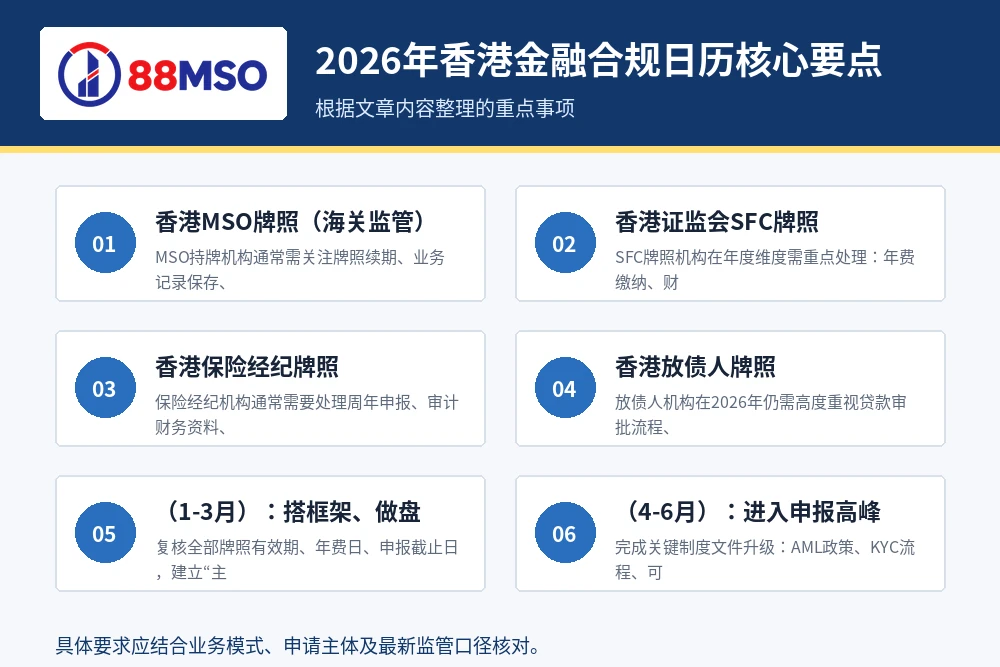
1) Hong Kong MSO license (customs supervision)
MSO licensed institutions usually need to pay attention toLicense renewal、business record keeping、Transaction monitoring、Suspicious Transaction Reporting and Anti-Money Laundering System Effectiveness。2026 is recommended at least in advance3-4 monthsStart renewal preparations,Ensure shareholder structure、Director information、Office space and internal policy documents are updated simultaneously。
2) Hong Kong Securities and Futures Commission SFC license
SFC license agencies need to focus on the annual dimension:Annual fee payment、Financial Resource Rules Related Declarations、Audit financial report submission、Responsible Officer (RO) and Licensed Representative Information Update、Continuing competency (CPT) records, etc.。If the company has new business lines (such as virtual asset-related activities) to expand,Should assess with a professional team earlier whether additional reporting obligations are triggered。
3) Hong Kong insurance broker license
Insurance brokers often need to process annual returns、Audit financial information、Professional Liability Insurance Arrangements、Continuous training for the person in charge, etc.。The focus of supervision is not only “whether to declare”,It’s more about “whether you have the ability to prove your sales、Customer suitability and complaint handling mechanisms operate effectively”。
4) Hong Kong money lender license
Money lenders will still need to pay close attention to the loan approval process in 2026、Borrower solvency assessment、Contract and disclosure document standardization,and business compliance certificate during license renewal period。If the historical archives are incomplete,Additional inquiries are often faced during the license renewal review stage.。
three、Breakdown by Quarter:Hong Kong Financial Compliance Enforcement Calendar 2026
Q1 (January-March):Build a frame、Take inventory、Set the rhythm
- Review the validity period of all licenses、annual fee date、Application deadline,Establish a "main calendar + reminder mechanism"。
- Completed the first draft of the AML risk assessment for the previous year,Identify high-risk customers and high-risk country exposures。
- Confirm annual audit schedule with auditor,Sort out bank statements in advance、Customer fund ledger and revenue recognition logic。
- Verify directors、shareholder、RO、MLRO、Is the compliance officer’s employment status consistent with the filing information?。
Practical suggestions:What Q1 needs to do is not "submit",But "align"。Once the underlying data caliber is inconsistent,Each subsequent node will be passive。
Q2 (April-June):Entering the pre-review stage before the filing peak
- Completed the upgrade of key system documents:AML policy、KYC process、Suspicious transaction reporting process、Employee Training Manual。
- Promote internal compliance training,Save check-in、Assessment and case records,Meet regulatory spot inspection traceability requirements。
- Enhanced due diligence (EDD) for high-risk customers,Complete beneficiary identification、Fund source and transaction purpose information。
- Perform retrospective checks on historical abnormal transactions,Prepare self-examination instructions or supplementary reports when necessary。
Q2 is the "window period to make up for weak points"。Fix the system and record gaps sooner rather than later,The less pressure there is when submitting materials for Q3/Q4。
Q3 (July-September):Centralized submission period for financial reports and annual review materials
- Submit annual audited financial statements and related regulatory submissions。
- Apply for renewal of expired license、Annual fee payment and update of supporting supporting documents。
- Respond to regulatory agency requests for supplementary documents,Ensure that the response logic is consistent with the initial declaration。
- Check whether there is a risk of "the actual business has changed but the license conditions have not been updated simultaneously"。
Key reminder:Reply speed and quality of repair parts,Often determines the regulatory judgment of an institution’s governance capabilities。It is recommended to establish a "48-hour response mechanism"。
Q4 (October-December):Final review and preview for next year
- Review annual declarations and inquiries,Identify high-frequency issues (such as missing KYC parts)、Transaction classification error)。
- Develop a 2027 compliance budget:audit、law、training、system、Outsourced support costs。
- Complete draft regulatory calendar for next year,And lock the time window of key service providers。
- Submit annual compliance report to the board of directors or management,Form a closed loop of governance。
Four、“Must-do list” for four types of license plates:Practical template to prevent missed nodes
1) Must-do list for MSO organizations
- License validity period and renewal application back-scheduling plan (recommended at least 120 days in advance)。
- Annual review and optimization records of transaction monitoring rule parameters。
- Documentation of suspicious transaction reports (if any) and proof of internal escalation process。
- Employee AML training annual coverage and test results。
2) A must-do list for SFC licensed institutions
- Annual fee payment and license status verification。
- Preparation for submission of audit financial statements and financial resources。
- RO/Licensed Representative/CPT Record Integrity Check。
- Customer asset custody、Information disclosure and appropriateness management document review。
3) A must-do list for insurance brokerage institutions
- Checking the consistency of annual returns and audited financial information。
- Professional liability insurance arrangements and coverage validity review。
- Sales Process Compliance Sampling (Audio Recording、inform、signature(signature))。
- Complaint handling ledger and rectification closed-loop records。
4) A must-do list for money lenders
- Check the consistency of license renewal materials and business practices。
- Completeness of borrower’s due diligence and repayment ability assessment files。
- Contract terms、Fee Disclosure、Legality review of collection process。
- Standardization of overdue and impairment management records。
five、Financial report submission is not an “accounting action”,Rather, it is a regulatory credibility test.
Many institutions mistakenly believe that submitting financial reports only requires "correct numbers",In fact, supervision pays more attention to three things::
- Data is interpretable:Changes in income structure、Are abnormal cost fluctuations supported by business logic?。
- Funds traceable:client funds flow、Is the company’s working capital flow clearly layered?。
- Controls are verifiable:Is the system actually implemented?,rather than paper compliance。
therefore,Enterprises should establish a "finance-compliance-business" linkage mechanism in 2026。The business department shall issue a transaction description before the audit.,Compliance department completes sampling verification,Financial report collection,Can significantly reduce the probability of repair parts。
six、Regulatory trends in 2026:From "formal compliance" to "substantive compliance"
According to recent regulatory and enforcement trends,In 2026, the following directions may continue to be strengthened::
- for high risk customers、Penetrating verification of cross-border funds and complex equity structures。
- Outsourcing arrangements (compliance outsourcing、Technology outsourcing、Customer Service Outsourcing) Responsibility Traceability。
- Hold management accountable:Not only look at the system,It also depends on whether the board of directors can effectively supervise。
- Strict treatment of “recurrence” of historical issues。
this means,Enterprises cannot just "supply documents temporarily" before filing,Instead, embed compliance into daily operations。The more we plan for globalization,、Institutions that export capital overseas,The more we need to operate Hong Kong as a “high-standard compliance model market”。
seven、How to build an enterprise’s own “2026 Compliance Operation Map”
It is recommended to adopt a three-tier management approach:
- first floor:regulatory calendar layer- List all external deadlines (renewals、annual fee、Report、training)。
- second floor:internal delivery layer——Split each deadline into data preparation、preliminary hearing、Review、Four steps to submit。
- third floor:Accountability and early warning layer——Set responsible person、substitute、Overdue warning rules and upgrade paths。
In practice,More and more companies will choose to cooperate with professional compliance service agencies,Form a dual-track model of “internal team + external consultants”。Take the 88MSO service system behind 88MSO as an example,Its value is not only in applying for a license,What’s more important is to renew、annual review、Anti-money laundering、Financial reporting and regulatory communication are combined into an integrated custody process,Reduce the time and opportunity costs of enterprises caused by information gaps。
eight、Common Errors and Correction Suggestions (FAQ)
Q1:Just submit before the deadline,Is it definitely okay?
uncertain。If the material is incomplete、Logical conflicts or missing key files,Regulatory supplements will lengthen the approval cycle。It is recommended to allow at least a 4-8 week buffer period。
Q2:Can the annual review and renewal be left to administrative colleagues to handle independently?
Not recommended。Laws involved in annual review and renewal、finance、business、AML multi-dimensional information,Must be coordinated by the compliance officer,Introduce external professional review when necessary。
Q3:No suspicious transactions occurred,Don’t you need to do AML annual work?
mistake。AML is a continuing obligation,Even if suspicious transactions are not reported,Also complete a risk assessment、training、Sampling inspection and system update。
Q4:How do multi-license groups avoid duplication of work?
A unified data base can be established:same customer profile、Same beneficiary identification standard、Same training file system,Then output differentiated submission documents according to each regulatory caliber.。
Conclusion:Turn "time node" into "competition barrier"
Hong Kong’s financial regulatory environment in 2026,Opportunities for well-prepared companies,This puts pressure on companies that have to cope with temporary changes。A truly mature licensed institution,There will be an annual review、Renewal and submission of financial reports are regarded as windows for demonstrating governance capabilities,Rather than a year-end sprint task。
If you are planning an MSO、SFC、Insurance brokerage or moneylender business,It is recommended that you start now to establish a year-round compliance calendar,Lock key nodes in advance、Responsible persons and external support resources。Only by making compliance into a system,Only in this way can we operate stably in a high-standard market like Hong Kong.,and lay a replicable regulatory credit foundation for global development.。