简体中文
简体中文 繁體中文
繁體中文 English
Why should Hong Kong’s 149 asset management institutions pay attention to the threshold of “distribution compliance”?
in Hong Kong,holdCategory 1 (dealing in securities) / Category 4 (advising on securities) / Category 9 (providing asset management)Licensed organization,Often referred to as "149 Asset Management Agency" in the industry。As global asset allocation demand rises,More and more institutions hope to introduce overseas fund products into the Hong Kong market,Or serve cross-border investors through the Hong Kong platform。However,"Be able to sell" and "sell in compliance with regulations" are completely different things.。Once the regulatory red line is touched,Minor rectification、suspend business,In severe cases, the license may be revoked、Criminal liability and civil compensation go hand in hand。
Especially in the context of tightened supervision in recent years,Hong Kong Securities and Futures Commission(SFC) Sales behavior of intermediaries、Product due diligence、duty of suitability、Increasing requirements for information disclosure and ongoing monitoring。For 149 asset management institutions,Cross-border distribution of overseas funds is not just a matter of business expansion,It’s also the issue of “license lifeline”。
This article will start from the regulatory framework、business scenario、Typical red line、Five levels of practical risk control and organizational governance,System dismantling of how 149 asset management institutions in Hong Kong distribute overseas fund products in compliance with regulations,Helping you create a sustainable balance between growth and compliance。
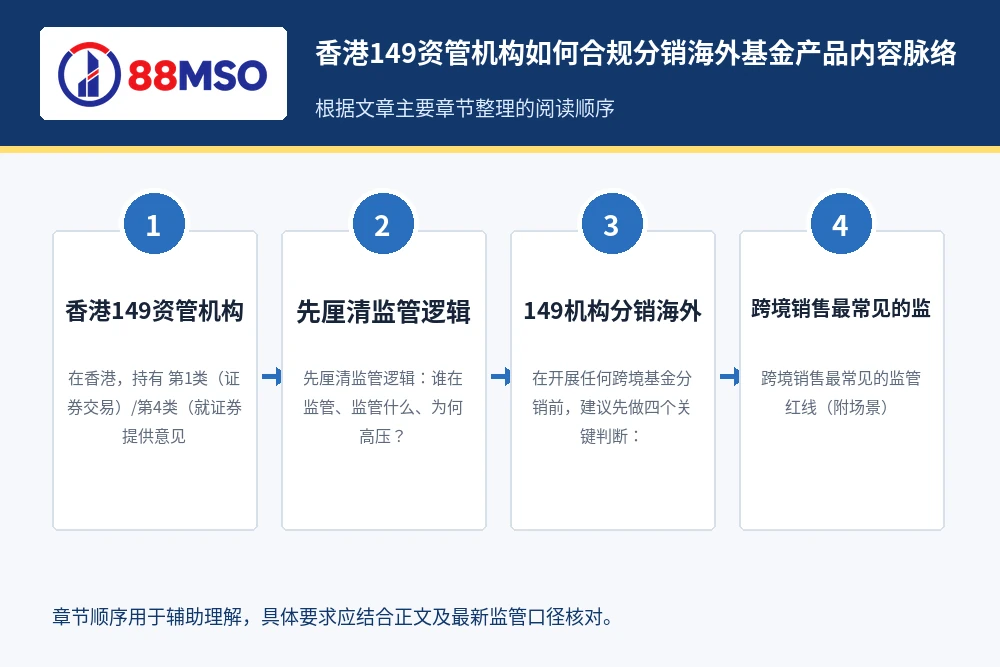
one、First clarify the regulatory logic:who is supervising、What to regulate、Why high pressure?
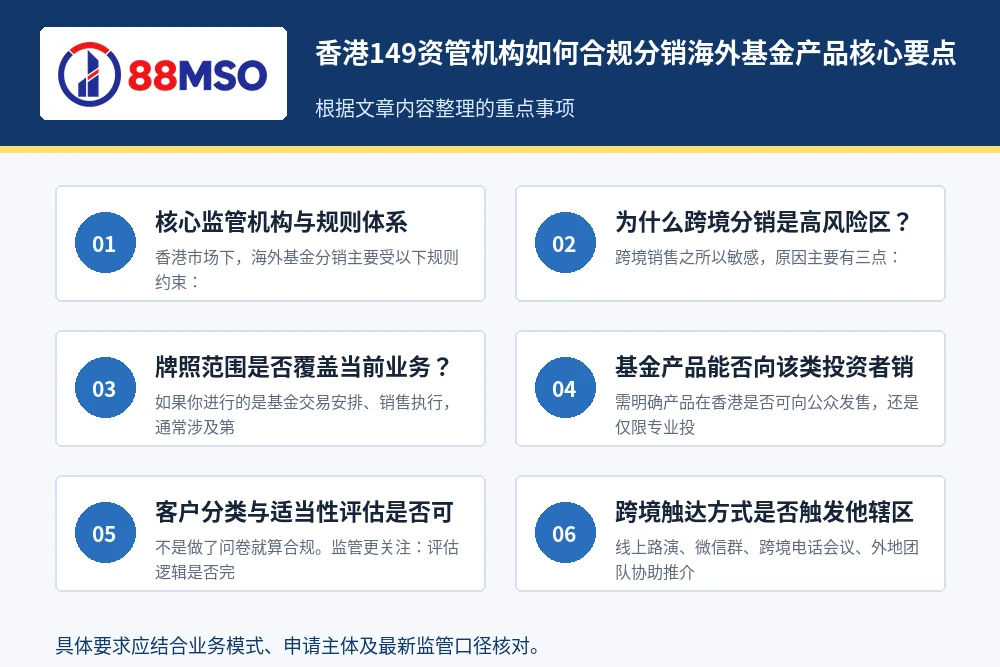
1. Core regulatory agencies and rules system
Under the Hong Kong market,Overseas fund distribution is mainly governed by the following rules:
- Securities and Futures Ordinance (SFO):Define scope of regulated activities、Licensing Requirements and Enforcement Basis。
- SFC Code of Conduct:Provision for intermediary sales、Show off、appropriateness、Standards of conduct such as conflict of interest management。
- Fund Offering and Marketing Related Codes/Circulars:including advertising、Fund Description Document、Continuous disclosure obligations, etc.。
- Anti-money laundering and counter-terrorism financing requirements (AML/CFT):Customer due diligence、Suspicious transaction monitoring、record keeping、Continuous review。
Simply put,SFC does not only look at “whether the product is legal”,Pay more attention to “whether the sales process is compliant”。The problems of many organizations are not with the products themselves,It's in the sales chain:Who contacts customers、how to communicate、How to leave traces、How to prove appropriateness。
2. Why is cross-border distribution a high-risk area?
Why cross-border sales are sensitive,There are three main reasons:
- regulatory overlay:Hong Kong rules + product registration place rules + customer location rules concurrently。
- information asymmetry:Overseas fund structure is complex,underlying assets、Valuation and liquidity are harder to penetrate。
- Difficulty in dividing responsibilities:Issuer、administrator、Distributor、Compliance responsibilities between introducers are easily blurred。
therefore,149If organizations only regard themselves as “channels”,and ignore the legal obligations of intermediaries,It is often easiest to step on the line。
two、149 "Four Access Questions" for Institutions Distributing Overseas Funds
Before undertaking any cross-border fund distribution,It is recommended to make four key judgments first:
1) Does the scope of the license cover the current business?
If you are conducting a fund trading arrangement、sales execution,Usually involves Category 1;If you give investment advice,Involving Category 4;If you manage client assets and allocate related funds at the same time,It involves Category 9。in practice,A common question asked by many organizations isIn the name of "information sharing",Actual conduct of regulated advice or solicitation。
2) Can fund products be sold to this type of investors?
Need to clarify whether the product can be sold to the public in Hong Kong,Or only professional investors (PI)?。Different customer groups correspond to different disclosure and sales standards。If products limited to professional investors are "disguised retail promotion",Very high risk。
3) Can customer classification and suitability assessment be evidenced?
It doesn’t mean that you are compliant just by taking the questionnaire.。Supervision pays more attention to:Evaluate whether the logic is complete、Is the conclusion consistent with the transaction?、Are records traceable?。"The client signs to confirm that he bears his own risk" does not exempt the intermediary from its legal obligations.。
4) Does the cross-border access method trigger license requirements in other jurisdictions?
Online roadshow、WeChat group、Cross-border conference call、Overseas teams assist with promotions, etc.,may trigger supervision at the customer’s location。Many organizations ignore this,Leading to “Hong Kong Compliance、Double risks of "overseas violations"。
three、The most common regulatory red lines for cross-border sales (with scenarios)
Red line one:Implementing "substantial sales" without obtaining appropriate licenses
Typical scenario:The institution uses the name of "Market View Sharing Meeting",Answer specific product returns by unlicensed personnel、Subscription arrangement、Customer adaptation suggestions。
Risk point:Constituting unauthorized conduct of regulated activities,May trigger disciplinary action and criminal liability。
Red line two:Reducing professional investor recognition to a mere formality
Typical scenario:Release only based on the client's verbal declaration that "the assets are qualified",No verification of asset certificates、Not reviewed periodically。
Risk point:PI exemption conditions expired,Institutions need to bear liability for mis-selling。
Red line three:Promotional materials "profit-oriented",Risk disclosure weakens
Typical scenario:Marketing materials highlight historically high earnings、Retracement control 'looks good',However, liquidity risks are not equally displayed、Valuation model limitations、Exchange Rates and Redemption Limitations。
Risk point:constitute misleading statements or unbalanced disclosures。
red line four:KYC done,but not "sustained"
Typical scenario:Due diligence is completed when opening an account,The client’s occupation will not be updated for many years to come.、Source of funds、Changes in transaction purpose and beneficial ownership。
Risk point:Breach of ongoing due diligence obligations,Overlaying AML enforcement risks。
red line five:Product due diligence stops at “looking at the materials”
Typical scenario:Only fund monthly reports and PPTs are accepted,Unchecked manager governance、Escrow arrangements、Valuation mechanism、Side pocket mechanism、material adverse event。
Risk point:Unable to prove that the institution has fulfilled its due diligence obligations。
red line six:Outsourcing and introducer management are out of control
Typical scenario:Relying on third parties to introduce customers,Commission structure is not transparent,Uncontrolled communication skills。
Risk point:Even if the violation was committed by a third party,Licensed institutions may still be held accountable for “insufficient supervision”。
Four、A practical framework for compliant distribution:From "system documents" to "executable processes"
1. Establish a “three-tier product access mechanism”
- first floor:Legal and regulatory adaptation(Sellable customer group、geographical restrictions、Sales method restrictions)
- second floor:Risk penetration due diligence(Strategy、Liquidity、Valuation、lever、counterparty、legal structure)
- third floor:Sales Adaptation Matrix(Different customer risk levels correspond to available product pools)
The key point is:Product approval conclusions must be linked to the frontline sales system,Avoid “the system says no”,The system is able to place orders”。
2. Streamline suitability obligations、Systematize
It is recommended to cover at least the following aspects:
- Customer risk tolerance assessment (including financial、experience、Target、liquidity preference)
- Product Risk Rating Methodology (Reviewable、explainable)
- Risk mismatch early warning and secondary confirmation mechanism
- High-risk product upgrade approval (such as management or compliance review)
- The whole process leaves traces (recording、summary、Confirmation、Screenshots of key communications)
3. Strengthen the linkage between KYC/AML and transaction monitoring
AML in cross-border fund distribution is not an “account opening action”,but continuous engineering。It is recommended that 149 institutions combine customer due diligence with trading behavior:
- Identify abnormally large/frequent redemptions and redemptions
- Pay attention to capital flows in high-risk jurisdictions
- Monitor third-party payments、Avoidance patterns such as structured split subscription
- Triggering the Suspicious Transaction Report (STR) assessment process
This is also the part most commonly sampled and verified during regulatory on-site inspections.。
4. Control "people" and "words":Frontline sales are the first risk point
A more perfect system,If those on the front lines don’t understand the borders,It will also fail。suggestion:
- Customized training based on position:RM、investment advisory、Compliance、Each operation has its own focus
- Create a banned list:Such as "guaranteed capital", "guaranteed income" and "redeemable at any time"
- High-risk communications must be audio-visualized and randomly checked
- Incorporate compliance metrics into performance,Rather than just looking at sales scale
five、How to deal with the "grey area problem" in cross-border scenarios?
Ash Ward 1:Does online content marketing count as solicitation?
If the content has a clear product orientation、Action guidance (such as account opening link、Subscription path、Special person to follow up),Often closer to solicitation。Institutions should distinguish between “brand educational content” and “product sales content”,Apply a stricter review mechanism to the latter。
Ash Ward 2:Can overseas affiliated companies assist with sales?
Can collaborate,But the premise is that the boundaries of responsibilities are clear、Customer access path compliance、Data transfer is legal、Responsibility can be audited。If an unlicensed entity performs key sales actions,Extremely risky。
Ash Ward 3:Customers proactively request to buy,Is there a suitability exemption?
No simple exemption。Even if the customer "takes the initiative",Intermediaries still need to demonstrate that they have performed necessary risk disclosures and suitability assessments,Meet at least regulatory verifiable minimum standards。
six、Establish a compliance governance system that can be verified by supervision
What supervision really values is not the quantity of documents,But "Can you prove that you continue to do the right thing?"。149 Institutions can build governance capabilities from the following dimensions::
- governance structure:The board of directors/management regularly review cross-border distribution risk reports。
- three lines of defense:Frontline self-control、Compliance and risk control review、Internal audit independent inspection。
- Data and Systems:Unified customer view、Transaction monitoring rule base、Audit trail log。
- event management:complaint、mismatch trade、Closed-loop rectification of abnormal marketing and other incidents。
- regulatory communications:Timely self-examination of major matters、Self-reporting and remediation。
For most small and medium-sized organizations,The difficulty lies in "knowing what to do",But it lacks implementation methods and resource integration capabilities。at this time,With the help of a professional team that has been deeply involved in financial compliance in Hong Kong for a long time,It will significantly shorten the distance between system and implementation.。Take the practical capabilities relied on by 88MSO as an example,its application for license、Compliance framework establishment、AML process optimization and subsequent annual review support,Often helps organizations transform "compliance costs" into "business certainty"。
Conclusion:Competition in cross-border fund distribution,Ultimately it’s a competition for compliance capabilities
Hong Kong 149 asset management institutions distribute overseas funds,It’s no longer about “who has more products?”、"Who has the most channels?" It's so simple,It’s a competition to see who can sustain in a complex regulatory environment.、Auditably executed correctly。Match from license plate、Product access、KYC/AML、suitability assessment,Talking to the front line、Cross-border collaboration and continuous monitoring,Every link may determine whether the business can go far.。
Remember a word:Compliance is not a brake on business,It is the foundation for the long-term growth of cross-border business.。When your system can be implemented、execution can be proven、Demonstrate regulatory acceptance,Cross-border distribution is truly sustainable。
FAQ:The 4 most frequently asked questions by 149 organizations
Q1:Only serving professional investors,Can many processes be simplified?
Can differ on some disclosure and sales requirements,But it does not mean "low compliance"。PI recognition、appropriateness、Anti-money laundering、Core obligations such as the authenticity and completeness of information still exist。
Q2:Overseas funds have been legally registered in other countries,Can Hong Kong distribution be quoted directly?
cannot be directly equated。You still need to verify the marketability of the product to the target customer group in Hong Kong、Disclosure Integrity and Sales Practice Compliance。
Q3:Do all sales audio and video recordings have to be saved?
Stratified retention and retention policies should be established based on business risk levels。high risk products、Higher standards of management are recommended for highly controversial links。
Q4:If the historical process is imperfect,Is it too late to make corrections now?
There's enough time。Completion of gap assessments should be prioritized、Risk classification rectification and high-risk business stop loss,and establish phased deliverables,To reduce subsequent law enforcement and reputational risks。
Read more:Hong Kong Securities and Futures Commission SFC License Application and Compliance Guide。