简体中文
简体中文 繁體中文
繁體中文 English
Authorized by British FCA Investment Company:Current IFPR capital requirements and CASS client asset protection
Official verification update (August 2026):The FCA has implemented the Investment Firm Prudential Regime (IFPR) from January 1, 2022。"IFPRU 730k" belongs to the old system and the market continues to use the title,Current capital requirements shall be based on the permanent minimum capital under MIFIDPRU、Evaluation of fixed overhead requirements and K-factor requirements,CASS obligations depend on specific authority and whether client funds or assets are held。 For specific rules, seeUK Financial Conduct Authority IFPR Special Topic。
With cross-border wealth management、Brokerage services、Institutional sales and asset allocation business accelerate globalization,British FCA licenseIs an option for cross-border business planning。The old name of the market is "IFPRU 730k"Cannot represent the current unified authorization category。IFPR is a prudential system for investment companies,Business permissions still need to be applied for and verified item by item.;Obtaining FCA authorization does not automatically guarantee bank cooperation or other market access.。
But in reality,Many applicants focus on “getting the license” itself,But it ignores two things that FCA really values :Sustained capital adequacyandCustomer Funds (CASS) Protection Mechanism。If these two items are not understood properly,Even if the license is approved,Follow-up supervisory spot checks、Significant compliance pressure may also arise during the audit or business expansion phase。
This article focuses on British investment company authorization、Current IFPR prudential requirements and applicable CASS client money rules,Sort out business permissions、capital assessment、Governance and operating documents。
one、What is the difference between IFPR and the historical IFPRU 730k designation?
"IFPRU 730k" is the same as 730 under the old system,000Historical or market names related to Euro capital tranches,Not the official old name of the current IFPR。IFPR will apply to relevant UK MiFID investment companies from January 1, 2022;It is a prudential regulatory system,It is not a “full financial license” applied for separately.。The following businesses need to check the authorization and capital classification respectively.,The old 730k standard cannot be applied uniformly:
- Executing transactions for clients (Dealing as agent);
- Arranging deals;
- May touch client assets or client funds (Holding client money/assets);
- Provide more complex investment services to professional investors or institutional clients。
It should be noted that,The FCA doesn’t just look at “what business you do”,See more "youhowdo business":Customer type、transaction chain、Clearing and settlement path、outsourcing arrangement、Cross-border marketing methods,will affect the scope of authorization and regulatory classification。
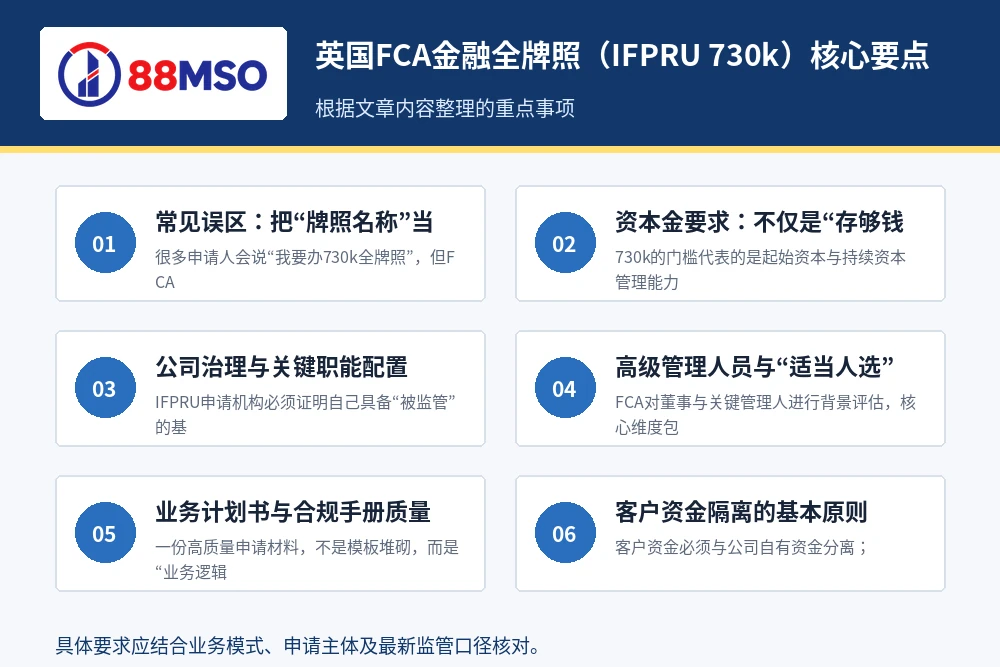
Common misunderstandings:Treat "license name" as a fixed product
Many applicants will say "I want to apply for a full 730k license",However, the FCA assessment is based on activity authority combinations and risk profiles.,It’s not a simple “package approval”。therefore,Early business model design、Permission Mapping and Supervision Interpretation Document,Often determines approval efficiency and subsequent compliance costs。
two、Core conditions for FCA investment firm authorization and current capital assessment
1) Capital requirements:It’s not just about “saving enough money”
Capital should be assessed as per current MIFIDPRU,Unable to use unified 730,000euro threshold。Common examples of permanent minimum capital (PMR) for MIFIDPRU 4.4.1R include:Investment advice that complies with stated authority and restrictions、Portfolio management and other businesses are 75,000GBP;Approved to hold MiFID client funds or assets、Operating MTF and other categories are 150,000GBP;proprietary trading、750 for categories such as underwriting or underwriting commitments,000GBP。These are just common examples,Not a complete form;Specific depository business、There are other stalls such as targeted support etc.,Multiple activities should be checked against the highest level applicable。PMR does not equal full own funding requirement:Also combined with fixed overhead requirements (FOR)、Applicable K-factor requirements and additional funding needs arising from ICARA assessment。Regulatory concerns include:
- Source of funds can be explained、traceable(Proof of shareholder capital injection、bank statement、Legal source description);
- Sustainability of Capital Adequacy(Not only does the application date meet the standards,You must also have the ability to withstand medium and long-term financial pressure);
- Stress test logic(Income fluctuations、customer concentration、Whether operations are sustainable under market shock scenarios)。
In practice,The FCA typically looks at three-year financial forecasts and cash flow models,Pay special attention to "whether optimistic growth assumptions are excessive"。
2) Corporate governance and key function configuration
Institutions applying for FCA investment company authorization must prove that their governance and personnel capabilities are consistent with the authority they intend to apply for.,The point is:
- Clear division of board responsibilities,The governance structure is not a “nominal structure”;
- Compliance、Risk control、Internal audit (can be outsourced appropriately according to scale) responsibilities can be performed;
- Personnel in key positions have real working experience,Can answer regulatory inquiries;
- The conflict of interest management mechanism is documented and can be implemented。
Common regulatory questions are::when business grows、Customer complaints、In case of system failure or fund abnormality,who decides、Who reviews、Who reports externally? If you can't answer,Approval will be significantly slowed down。
3) Senior management and “fit and proper” test (Fit & Proper)
FCA conducts background assessment of directors and key managers,Core dimensions include:
- Integrity records (including historical regulatory matters、litigation、Bankruptcy, etc.);
- Whether ability and experience match the proposed role;
- Is the time investment realistic and feasible (whether “one person with multiple posts” is excessive)。
It is recommended to conduct an internal “regulatory Q&A drill” before submission,Ensure management is committed to the business、risk、The funding path and CASS mechanism have the same caliber。
4) Quality of business plan and compliance manual
A high-quality application material,Not template stacking,It is a closed loop of "business logic - risk identification - control measures - monitoring evidence"。Usually needs to be overridden:
- Target customers and marketing boundaries;
- KYC and customer classification process;
- Trade Execution and Best Execution Policy;
- Complaint handling mechanism;
- Anti-Financial Crime Controls (AML/KYC/Sanctions Screening);
- Outsourcing management and third-party due diligence mechanism。
three、CASS client fund isolation:FCA’s most “real” regulatory focus
In the FCA regulatory system,CASS(Client Assets Sourcebook)It is one of the core rules to protect the security of customer assets.。For institutions involving client funds,CASS is not an “ancillary clause”,But the underlying system for daily operations。
1) Basic principles of customer fund isolation
- Client funds must be separated from the company’s own funds;
- Client fund accounts must be opened in a recognized bank and have legal confirmation documents;
- Institutions are not allowed to use client funds for self-operation or for operational turnover;
- Fund flow、Reconciliation、Exception handling must have a complete audit trail。
2) Key landing points:Bank confirmation letter and legal attributes
The FCA is very concerned about whether the legal nature of customer fund accounts is clear。Usually you need to sign a confirmation document that meets the requirements with the bank,Confirm that the account is a customer fund account,And have corresponding legal protection logic in the event of institutional bankruptcy or liquidation.。
If this step is not handled carefully,No matter how good the system is in the future,,It may also be considered a major defect。
3) Daily client fund calculation and reconciliation (Reconciliation)
The most common problem in CASS practice is "book compliance"、Operational distortion"。Regulators expect to see:
- Calculate customer capital needs regularly according to rules;
- Internal account、bank account、Business system accounts are consistent among three parties;
- A corrective process with a clear time limit after discrepancies are identified;
- The correction process has approval and traces,Not handled verbally。
Simply put,CASS is not written in the manual,But it should be reflected in daily、weekly、Verifiable actions per month。
4) CASS Oversight Officer and three lines of defense
For institutions involving client funds,The FCA generally expects clear arrangements for CASS oversight functions。The mature approach is:
- first line of defense:The business and operations teams perform fund isolation and reconciliation according to procedures;
- second line of defense:Compliance/risk team independently reviews and monitors KRI;
- third line of defense:Internal audits (or independent external reviews) regularly verify effectiveness。
5) CASS audit and supervision report
Institutions are usually required to cooperate with annual CASS audits and fulfill corresponding regulatory reporting obligations.。Auditing focuses more on “whether the system exists” and more on “whether the system is implemented”。If major defects occur,May trigger rectification time limit、business restrictions,and even law enforcement risks。
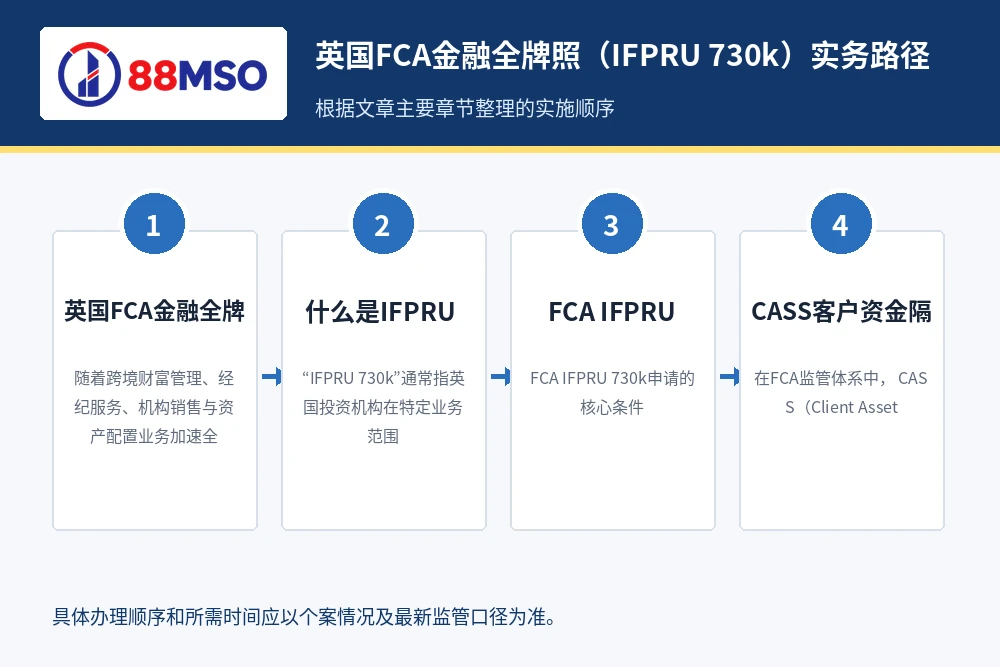
Four、FCA investment company authorization process:Permissions、Capital and client asset arrangements
Stage one:Feasibility diagnosis (2-4 weeks)
- Confirm the mapping of business boundaries and authorized activities;
- Determine whether CASS is triggered and the trigger level;
- Calculate Capital Path、Team configuration and budget。
Stage 2:Document and system establishment (6-10 weeks)
- Writing a regulatory business plan;
- Improve compliance、Risk control、AML、Complaints and Outsourcing Policy;
- Design CASS operation process、Reconciliation mechanism and emergency plan。
Stage three:Submission and inquiry response (3-6 months common)
- Submit application and key manager information;
- Provide supplements and explanations according to the FCA question list;
- Advance bank account simultaneously、Systems and Audit Preparation。
Stage four:Implementation and continued compliance after approval
- The focus in the first year is “stabilizing system operation”;
- Establish regulatory reporting calendar and board of directors compliance reporting mechanism;
- Conduct regular internal training,Avoid "people will change"、Process out of control”。
five、Common reasons for failure:Why do some applications have to be submitted repeatedly?
- The business description is too macro:Unable to explain actual transaction flow and capital flow;
- Management is not familiar with the details:Inconsistency in interview or questioning;
- The CASS mechanism remains on paper:missing system、form、Responsible person、time limit;
- Financial forecasts cannot be trusted:Aggressive growth assumptions、Cost underestimation is obvious;
- Cross-border structures are complex but insufficiently disclosed:Equity、control relationship、Outsourcing chain is opaque。
six、Special reminder for institutions with Chinese and Hong Kong backgrounds
Many companies already hold MSOs in Hong Kong、SFC-related licenses may be in the pipeline for insurance brokers、moneylender business,The problem of “sticking to the old template” often arises when entering the UK market。actually,FCA on customer asset protection、More granular requirements for governance evidence chain and continuous auditing,Cannot simply pan。
This is why more and more institutions choose "Cross-jurisdiction integrated compliance design”:Under the expectation of dual supervision in Hong Kong and the UK,Unified building capital、AML、CASS/Customer Asset Management and Audit System,Reduce repeated rectification costs。Judging from the experience of 88MSO and the 88MSO cross-border compliance services behind it,Make the right regulatory mapping and system connection beforehand,It is often more time-saving than patching vulnerabilities later.、Save more budget。
seven、Continue to meet IFPR and applicable CASS requirements
Permitted activities are determined by the specific authority and restrictions approved by the FCA。Institutions should continue to meet applicable IFPR funding requirements;When client funds or assets are involved,Applicable CASS protections must also be implemented on a case-by-case basis、Reconciliation、Oversight and reporting arrangements。
For financial institutions planning to go overseas,It is recommended to upgrade the project goal from "obtaining certificates" to "sustainable compliance operations":Set business boundaries first,Redetermine the license plate path;Establish capital and governance infrastructure first,Promote market expansion。In this way, in the cycle of tightening supervision,,Truly transform licenses into business moats。
FAQ:Quick answers to frequently asked questions
Q1:How long does it usually take for FCA investment company authorization to be approved?
Depending on business complexity、Depends on data completeness and inquiry response efficiency。In practice, it often takes several months or even longer from preparation to approval.,Complex structures may further extend。
Q2:No contact with client funds,Is there no need to pay attention to CASS?
Even if you do not currently hold client funds,Whether the customer asset rule is “indirectly triggered” should also be reviewed in the business design。Replenishment system after business changes,The cost is usually higher。
Q3:Can the capital be withdrawn after it is received?
It is not recommended to operate according to the "temporary arrival" idea。FCA focuses on sustained capital adequacy and sound operations,Capital management should match actual risk exposure over the long term。
Q4:What’s the most overlooked thing after approval?
Usually daily reconciliation discipline、Governance meeting leaves traces、Regulatory submission time point management,And the upgrade processing mechanism for CASS related exceptions。