简体中文
简体中文 繁體中文
繁體中文 English
introduction:BVI companyRegistration is just the first step,Continued compliance is key
Many companies are completingBVI offshore company registrationback,Often the focus is on opening an account、tax arrangements、Cross-border transaction structure,But ignored an extremely critical annual obligation——Economic Substance Law, ES) Annual Return。in reality,Many companies do not violate regulations intentionally,Rather, fines are triggered because "you think you are not applicable", "you don't know when to declare" and "the information is incompletely prepared"、regulatory inquiries,It may even affect the company’s existence and subsequent business arrangements.。
If you are using a BVI company for holding purposes、Financing、trade settlement、Intellectual property holding or investment layout,Then understanding the ES declaration mechanism is no longer “optional”,It is the “basic threshold” for offshore operations。Especially for those who plan to further apply for Hong Kong MSO、SFC related licenses,Or for companies that build cross-border capital and asset structures,The historical compliance record of overseas entities will directly affect the overall regulatory evaluation。
This article will take a practical perspective,System teardown:Who needs to declare、What to declare、When to declare、How to declare、The Consequences of Misreporting and Underreporting and How to Establish an Annual Compliance Mechanism,Help you get the BVI economic substance declaration right、Be steady、do long term。
one、What is BVI Economic Substance Law? First understand the regulatory logic
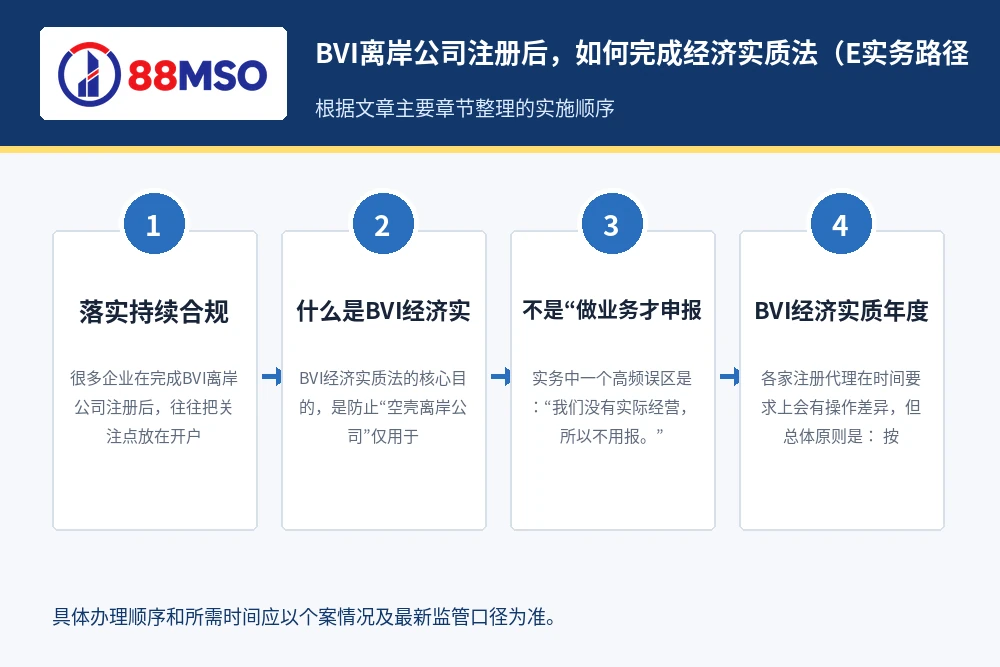
The core purpose of BVI economic substance law,It is to prevent "shell offshore companies" that are only used for profit transfer without real business activities.。Regulators want:If the company engages in specific "Relevant Activities" in the BVI,Sufficient management and operational substance should be reflected locally。
in other words,BVI does not prohibit offshore structures,Instead, it requires architecture and business logic、people management、Match the decision-making process。For businesses,ES declaration is essentially an "annual compliance physical examination":what business do you do、where to manage、Is there corresponding resource support?、Whether it meets the economic substance standard。
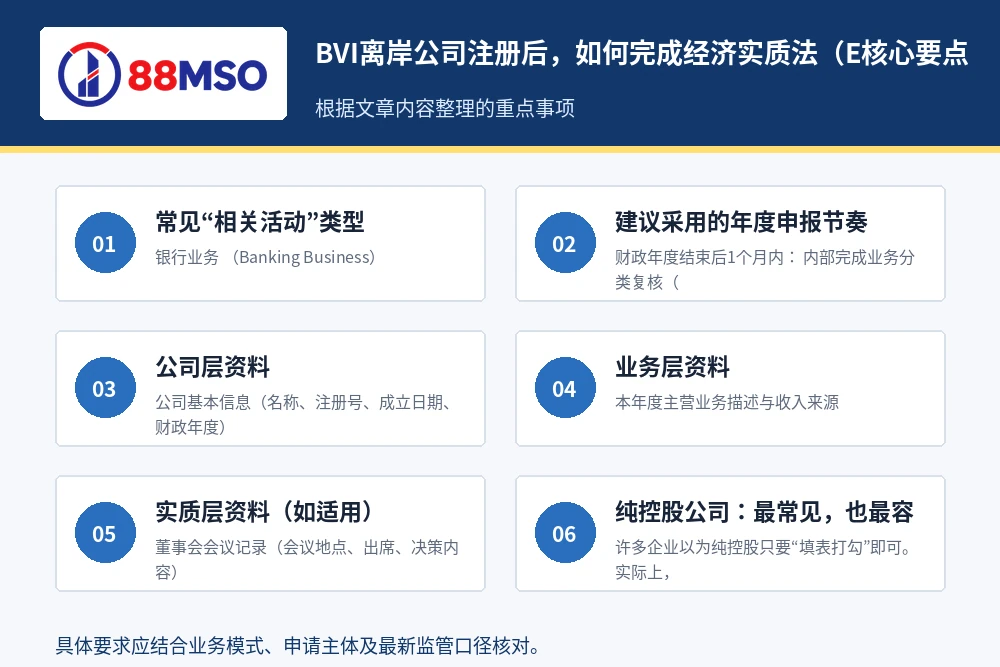
Common types of "related activities"
- Banking Business
- Insurance Business
- Fund Management Business
- Finance and Leasing Business
- Headquarters Business
- Shipping Business
- Holding Business
- Intellectual Property Business
- Distribution and Service Center Business
The easiest thing for many companies to involve isPure Equity HoldingandFinancing/Leasing,Seems simple,However, the reporting standards vary greatly,Misjudgment brings risks。
two、It’s not “declaring only when doing business”,Most BVI companies are required to submit annual information
A common misunderstanding in practice is:“We don’t actually operate,So no need to report。"This is often not accurate。Even if the BVI company does not constitute a situation that needs to meet the full ES test,Annual information confirmation or declaration statement is usually required through registered agent channels.。Whether it “satisfies the substance” and whether it “needs to submit annual information”,It's a problem on two levels。
It is recommended that enterprises complete at least the following three steps of judgment::
- first step:Confirm tax residency status(Whether it can be recognized as a tax resident in other jurisdictions and provide proof);
- Step 2:Confirm whether to carry out relevant activities(Based on the essence of the business rather than the expressions in the company’s articles of association);
- Step 3:Confirm applicable standards(such as pure holdings and high-risk IP companies,Regulatory requirements vary significantly)。
three、BVI Economic Substance Annual Reporting Timeline:The part of an enterprise that is most likely to be tripped up
Each registered agent will have operational differences in time requirements.,But the general principle is:Complete information collection by financial period,Filed by registered agent to BVI international tax authorities。Many companies are "overdue" because their final submissions are late.,It's because it was too late to give the agency the internal information.,As a result, the agent cannot complete the submission on time。
Recommended annual filing rhythm
- Within 1 month after the end of the financial year:Complete business classification review internally (whether related activities are involved)。
- 2-3 months after fiscal year end:Prepare core supporting information (management decision-making、transaction contract、Expenses、Personnel and outsourcing support, etc.)。
- 3-4 months after fiscal year end:Submit the first version of the ES questionnaire and attachments to the registered agent,Reserve time for replacement parts。
- Within 6 months after fiscal year end (common regulatory cadence):Complete formal declaration (subject to registered agent and latest regulatory notice)。
hint:Different companies may differ due to the date of establishment、There is a time difference in the fiscal year setting or business attributes.。Don’t copy dates from “other people’s companies”,The company’s agency notice and current regulatory requirements shall prevail.。
Four、What should I prepare for the annual return? A list of implementable materials
In order to improve the pass rate and reduce repeated replacements,It is recommended to prepare three sets of information: "company level - business level - substantive level"。
1) Company level information
- Basic company information (name、Registration number、Date of establishment、fiscal year)
- Director/shareholder information change record
- Registered address and registered agent information
- Proof of tax residency in other jurisdictions (if applicable)
2) Business layer information
- Description of main business and sources of income this year
- Explanation of classification judgment of relevant activities (why it belongs or does not belong)
- main contract、bill、Fund flow and counterparty information
- Whether there are related transactions and pricing logic
3) Substantive layer information (if applicable)
- Board meeting minutes (meeting location、Attend、decision content)
- Description of Core Income Generating Activities (CIGA) Execution Locations
- personnel、office space、Proof of equipment or outsourced services
- Evidence of operating expenses and management commensurate with the size of the business
in the case ofpure holding company,Relatively simplified criteria usually apply,But it does not mean "zero files";At least it should be proven that the company continues to exist according to law、Fulfill legal obligations and have basic management records。
five、Declaration Difficulties and Responses for Different Business Types
pure holding company:most common,It is also easiest to "take it for granted"
Many companies think that pure holdings only require "filling out forms and ticking boxes"。actually,Supervision will still pay attention:Whether it is indeed a pure equity holding、Is there any hidden financing or management service behavior?、Is there a sound corporate governance record?。If business boundaries are unclear,May be reclassified to a more demanding activity type。
Financing and leasing business:Pay attention to funding sources and decision-making chain
Such companies need to explain their funding arrangements in more detail、Risk control、Contract approval、interest rate or rent formation mechanism。If key decisions are made entirely outside the BVI,and lack of demonstrable management arrangements,Easily questioned for lack of substance。
Intellectual property related business:High-risk areas require special caution
IP businesses are usually subject to stricter scrutiny under the ES framework,In particular, “high-risk IP entities” may face a higher burden of proof and heavier penalties.。It is recommended to evaluate ES and tax impacts simultaneously during the architecture design stage.,Don’t wait until annual reporting season to remedy the situation。
six、Consequences of non-reporting or misreporting:Not just a fine
Companies underestimate ES risks,Often because they only see the “fine amount”,No knock-on effects seen。Common risks include:
- monetary penalty:First-time non-compliance may result in fines;Escalating penalties for continued non-compliance,High-risk types are more severe。
- Supervision upgrade:You may be asked to provide additional explanations、Subject to further review or focus。
- Company survival risk:In serious cases, it may affect the company's good existence.,There is even a risk of delisting。
- Impact of banks and partners:Open an account、Renew account、credit、audit、Investment and financing due diligence may be hindered。
- Cross-license layout is limited:If the company subsequently plans to apply for a financial license in Hong Kong or other jurisdictions,Poor compliance records will become points deductions。
seven、Practical suggestions:Establish a “reusable” offshore annual compliance mechanism
For a single company,It’s okay to handle one declaration manually;For group or multi-entity structures,must be institutionalized。It is recommended to build a mechanism from the following five aspects:
- unified caliber:legal affairs、finance、tax、Secretary and business team use the same business classification standard。
- Ledger management:Archive contracts by month、resolution、cost、People and outsourcing evidence,Avoid year-end surprises。
- Node inversion:Set an internal deadline at least 120 days back from the final filing date。
- Agent collaboration:Pre-qualify your questionnaire with your registered agent early,Identify the dispute points first and then provide evidence。
- Cross-jurisdictional linkage:If a Hong Kong company is involved at the same time、Fund or licensed entity,Consider AML uniformly、Tax and Disclosure Consistency。
In such cross-border compliance projects,Have an offshore structure、A consulting team with practical experience in financial supervision and anti-money laundering in Hong Kong,Can significantly reduce communication costs。Like 88MSO and its professional advisory system,BVI declarations are usually placed in the "overall overseas compliance roadmap" for overall planning and processing.,rather than looking at an annual form in isolation,This is critical to medium- to long-term stable operations。
eight、Common misunderstandings FAQ (recommended collection)
Q1:Our company has no income,Do I still need to file an ES declaration?
There is a high probability that annual information submission or declaration will still be required.。Whether you have income does not mean whether you have a reporting obligation,It should be judged based on the company’s actual activities and agency requirements.。
Q2:BVI companies are managed by a Hong Kong team,Is it necessarily non-compliant?
uncertain。The key lies in the type of business、Whether the decision-making chain and evidence system meet the corresponding standards。Different activity types have different requirements,cannot be generalized。
Q3:Does pure holding have no substantive requirements at all?
no。Pure holdings usually have "simplified requirements" rather than "zero requirements",Necessary governance and statutory obligations fulfillment records still need to be maintained。
Q4:Can I still make up for missed time?
Usually, supplementary reports or corrections can be made under the guidance of the agent.,But may trigger fines or regulatory attention。The sooner we take proactive measures,Consequences are usually more controllable。
Q5:Are ES filing and tax filing the same thing?
no。related but different。ES focuses on whether it has economic substance that matches the business;Tax declaration focuses on tax payment and information disclosure obligations。The two systems need to be managed collaboratively。
Conclusion:Upgrade annual reporting from "task" to "risk control tool"
After BVI offshore company registration,The real test of a company’s ability is not the speed of establishment,But the ability to continue compliance。The annual declaration under the Economic Substance Law seems to be a procedural task,In fact, it connects corporate governance、cross-border tax、Banking relations and future financing license layout。
The safest approach,It’s not about waiting until the deadline to “make up materials on the fly.”,Instead, create a set of reusable、traceable、Auditable annual compliance system。This will not only reduce the risk of penalties,You can also make adjustments at the bank、Demonstrate professionalism and credibility in investor reviews and regulatory communications。
If your company is in the stage of offshore structure optimization or cross-border financial business implementation,It is recommended to conduct annual compliance physical examination as early as possible,Integrate BVI ES reporting with regulatory requirements in Hong Kong and other jurisdictions,Only in this way can we truly realize the "effective architecture"、business sustainability、Risks are controllable”。