简体中文
简体中文 繁體中文
繁體中文 English
Why is Hong Kong company registration still the “first stop” for companies going overseas in 2026?
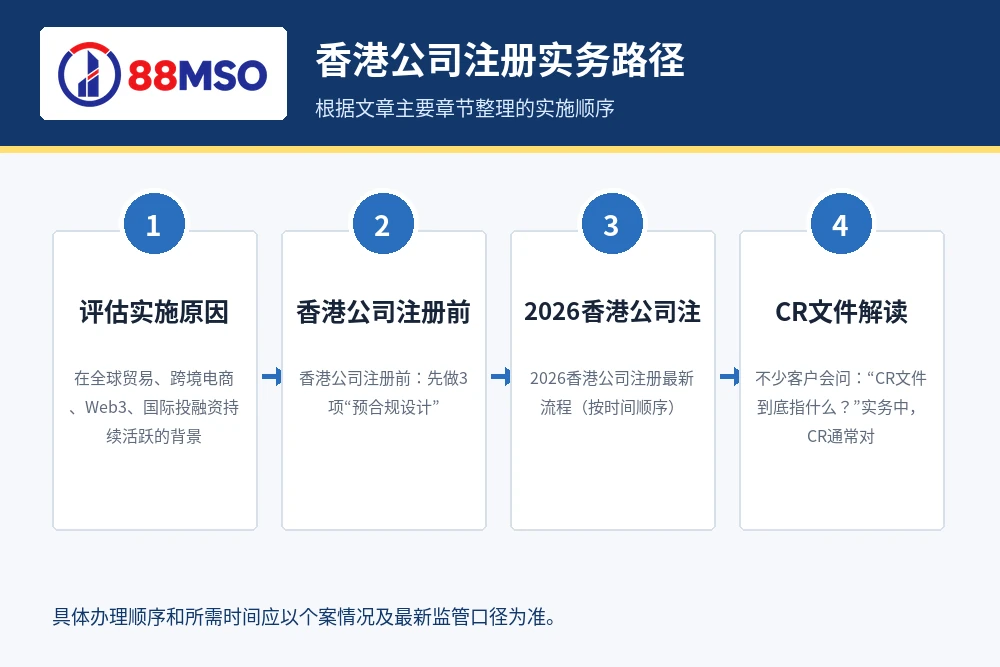
in global trade、Cross-border e-commerce、Web3、Against the backdrop of continued active international investment and financing,Hong Kong remains an important hub for companies to deploy overseas structures。The reason is very direct:The rule of law system is mature、Transparent tax system、Complete international banking network、Closely connected with mainland and global markets。For those who want to “build a compliance entity first”、For companies that are gradually expanding their financial business",Hong Kong company registrationis a typical first step。
but,The regulatory environment in 2026 will be significantly different from a few years ago。Company registration is no longer as simple as “getting the company registration certificate”,Bank account openingpre-trial、KYC due diligence、Beneficiary Disclosure、Business substance description and other links,Determines whether the company can operate smoothly in the future。Many companies are stuck in,Not the registration itself,Rather"Unable to open an account after registration、Unable to collect payment、Unable to maintain compliance”。
therefore,This article will take a practical perspective,System teardownHong Kong company registration process in 2026、fee structure、CR Document (Companies Registrar Document) Key Points,Attached is the bank account opening pre-qualification checklist.,Help you build a "implementable" one-time、Can open an account、Sustainable corporate structure。
one、Before Hong Kong company registration:Do 3 “pre-compliance designs” first
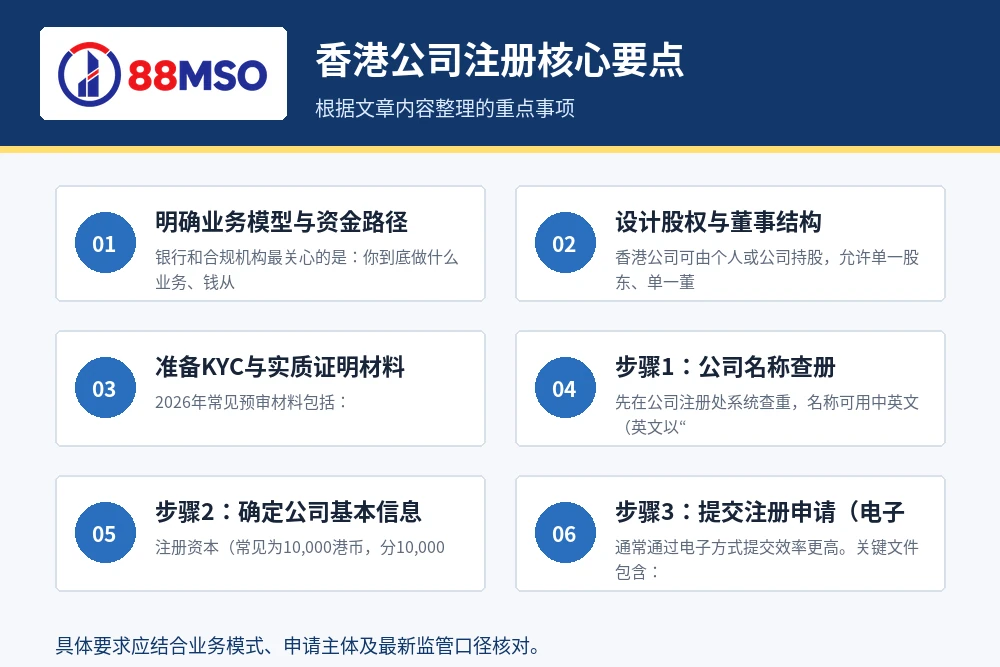
1) Clarify the business model and funding path
Banks and compliance agencies are most concerned about:What exactly is your business?、where does the money come from、where does the money go。It is recommended to formulate a one-page business description before registration.,Include at least:
- Target customer area (Hong Kong、local、Southeast Asia、Europe and America, etc.)
- Core product or service (trade、consult、SaaS、pay、investment, etc.)
- Estimated annual turnover and single transaction range
- Upstream and downstream contractual relationships and settlement methods
This material can be used directly for bank account opening interviews and KYC due diligence.,Significantly reduce repeated patching。
2) Design equity and director structure
Hong Kong companies can be held by individuals or companies,Single shareholder allowed、Single director (natural person)。But from the perspective of account opening and long-term governance,It is recommended to consider:
- Whether to separate the actual controller from the executive director
- Whether to introduce future investors to reserve equity
- Whether financing is facilitated through an offshore holding structure (such as BVI/Cayman)
If you plan to apply for a financial-related license in the future (such as MSO、SFC、moneylender、insurance broker, etc.),Early equity clarity is particularly critical。Teams like 88MSO/88MSO that are deeply involved in financial compliance services,Usually "license feasibility" and "bank acceptance" are considered together during the registration stage.,Avoid late restructuring costs。
3) Prepare KYC and substantive certification materials
Common pre-trial materials in 2026 include:
- Proof of identity and address of shareholders/directors
- Personal resume (especially related to finance、pay、Crypto business)
- Source of funds (Source of Wealth/Source of Funds)
- business contract、Invoice sample、Official website/product description
Many applications are delayed,Not because of missing data,But "logical inconsistency"。For example:Business Called B2B Software Services,But the turnover estimate is more like high-frequency retail payment;Or the background of the shareholder has nothing to do with the business,Banks will increase risk ratings。
two、The latest process of Hong Kong company registration in 2026 (in chronological order)
Step 1:Company name search
First check for plagiarism in the Company Registry system,The name can be in Chinese or English (the English name ends with "Limited",Chinese ending with "Limited Company")。Practical suggestions:
- Avoid names similar to those of licensed financial institutions
- Try to be consistent with the future brand,Reduce trademark and domain name conflicts
- Involving "bank、Insurance、Be especially careful with sensitive words such as "trust"
Step 2:Determine basic company information
- Registered capital (commonly 10,000Hong Kong dollar,Score 10,000share)
- shareholder、director、company secretary
- Hong Kong registered address (must be a Hong Kong address)
- Nature of the company’s business (can be written as General trading/Consulting, etc.)
Notice:Hong Kong limited companies must appoint a Hong Kong company secretary (can be acted by a licensed secretarial company)。
Step 3:Submit registration application (electronic or paper)
It is often more efficient to file electronically。Key files include:
- Incorporation Form NNC1
- Articles of Association Articles of Association
Normally,Electronic registration can complete approval in a shorter time;Paper takes longer。
Step 4:Get core documents
Will get it after approval:
- Certificate of Incorporation
- Business Registration Certificate
This marks the company’s “legal establishment”,However, this does not mean that all businesses can be directly operated。If regulated activities are involved,Corresponding license is still required。
Step 5:Produce corporate suite and internal governance documents
It is recommended to complete the synchronization:
- stock certificate、Register of shareholders、List of Directors
- First board resolution
- Significant Controllers Register (SCR)
These materials are not only used for compliance filing,Banks are often asked to check。
three、CR file interpretation:Which documents are the most critical?
Many customers will ask:“What exactly does a CR document mean?” in practice,CR usually corresponds to the relevant filing and disclosure documents of the Hong Kong Companies Registry (Companies Registry)。The following are the most common、The most critical categories:
1) NNC1:Incorporation form
This is the core file when registering,State the company name、Registered address、Capital structure、First Director/Shareholder Information。When opening an account, the bank will focus on checking whether the NNC1 is consistent with the actual KYC information submitted.。
2) NAR1:annual return
The company needs to submit annual returns every year after its establishment.。If overdue,May incur fines and affect company reputation。For companies planning to apply for financial licenses or financing,Whether NAR1 is submitted on time is the basic compliance indicator。
3) Director/Secretary/Registered Address Change Document
If it involves changes in directors、Secretary change、Registered address update,Need to report to CR according to regulations。A common problem in practice is "Internal changes have,Not filed externally”,This creates a risk point when banks review。
4) Significant Controllers Register (SCR) related records
Hong Kong companies need to keep important controller information and cooperate with law enforcement agencies in accessing it。Although the SCR is not a public document,But its integrity is increasingly important in compliance reviews。
5) Articles of Association and equity-related resolutions
If there is an increase in capital、Equity transfer、preference share arrangement,Relevant resolutions and charter revisions should be standardized simultaneously。Banks and audit institutions will use this to determine whether corporate governance is genuine、auditable。
Four、2026 Fee List:Don’t just look at “Registration Quote”
“Ultra-low-price registration packages” are common on the market,However, companies often increase their budget later due to hidden expenses.。It is recommended to divide costs into four tiers:
1) Government fees (rigid)
- Companies Registry Related Fees
- Business registration certificate fee
Government fees will be adjusted annually according to the policy,It is recommended to refer to the current official standards.。
2) Company secretary and registered address service fees (annual)
This is a necessary cost for Hong Kong companies to continue operating,Usually charged annually。The price difference comes from the depth of service:Address only,Or include annual review reminders?、Document archiving、Change reporting assistance, etc.。
3) Accounting audit and tax declaration
In principle, Hong Kong companies need to audit accounts and file taxes。Even if "no operation",It should also be handled according to procedures,Avoid later tax risks。Cross-border business enterprises are advised to make tax planning as early as possible,Avoid profit attribution disputes。
4) Bank account opening and compliance support costs
Document notarization may occur during the account opening stage.、translate、Due diligence repair parts、Expenses for interviews, counseling, etc.。For high-risk industries (such as payments、virtual assets、High-frequency cross-border payment collection),Professional pre-trial services can often save a lot of time and costs。
five、Bank account opening pre-qualification:Check business and supporting documents
in reality,Many companies have successfully registered their companies,Account opening was rejected or put on hold for a long time.”。Therefore, it is recommended to open an account before,Adopt the "registration + pre-examination parallel" strategy。
6 issues that banks are most concerned about
- business authenticity:Are there real trading scenarios?、Contracts and customer sources
- Funding Transparency:Is the source of start-up capital clear and traceable?
- Beneficiary clarity:Is the UBO (ultimate beneficiary) clear?
- Industry Risk Rating:Does it involve sensitive countries?、Sensitive industries
- Transaction logic consistency:Does the business description match the expected turnover?
- Ongoing Compliance Capabilities:Do you have basic AML/KYC internal control awareness?
Suggested list of pre-review materials for account opening
- Company registration documents:CI、BR、NNC1、Charter
- Identity certificate of directors and shareholders、Proof of address、Career background
- Business plan (1-3 pages is sufficient)
- Upstream and downstream contracts、bill、Proof of logistics/service delivery
- Official website、Product introduction、Social media links (if any)
- Estimated monthly turnover、Main currencies、Payment country
Common rejection reasons and corrections
Cause A:Complete information but insufficient explanation。
correction:Supplementary explanation of "Transaction Closed Loop",For example, from customer acquisition、Sign a contract、Complete path from delivery to collection。
Reason B:The ownership structure is complex and changes frequently。
correction:Stabilize the structure first,Open an account again;Issue legal opinions or board resolutions when necessary。
Reason C:The business involves financial attributes but no planning license。
correction:Clarify business boundaries,If regulatory activities are involved,Corresponding license plates should be promoted simultaneously。
six、Compliance maintenance after registration:Avoid "success immediately out of control"
The real risks for Hong Kong companies,Often appears after registration。It is recommended to establish an annual compliance calendar:
- Annual reporting (NAR1) time point
- Business registration certificate renewal
- Make accounts、audit、tax filing cycle
- Director/shareholder/address change filing
- KYC information update and cooperation with bank annual review
If the company plans to upgrade to a financial licensed entity (such as MSO or SFC related license) in the future,Internal compliance systems should be established as early as possible,such as customer due diligence、Transaction monitoring、Suspicious transaction reporting process, etc.。The 88MSO system where 88MSO is located,It is the integrated idea of "registration-account opening-license-continuous compliance" that helps enterprises reduce duplication of investment。
seven、2026 Practical Advice:Registration strategies for different types of businesses
1) Cross-border e-commerce/trading enterprises
priority guarantee contract、logistics、Complete invoice chain,When opening an account, emphasize the actual logistics of goods and the path to repayment.,Avoid being misjudged as a shell or channel company。
2) Technology/SaaS companies
Prepare for product demo、Subscription Agreement、Terms of Service and Privacy Policy,Explain to banks the business logic of “no physical logistics but continuous service delivery”。
3) High net worth family offices/investment holdings
Focus on proof of source of funds and tax residency planning,It is recommended to design offshore structure and dividend path in advance,Reduce future adjustment costs。
4) Teams planning to enter the financial business
During the company registration stage, the licensing roadmap and staffing (such as future needs such as RO/MLRO) must be considered.,Avoid subsequent company reset due to mismatch of entities。
FAQ:Frequent questions about Hong Kong company registration and CR documents
Q1:How long does it usually take to complete Hong Kong company registration?
Electronic filing is usually faster,The specific time is affected by the completeness of the data and the pace of review and approval.。If the preliminary information is fully prepared,,Overall efficiency will be significantly improved。
Q2:How much is the appropriate registered capital? Do you need to pay in full?
A common practice is to set a moderate registered capital and not pay it in immediately。The key is not the size of the number,It depends on the size of the business、Whether the contractual responsibilities match。
Q3:Can non-Hong Kong locals register?
Can,But you must have a Hong Kong registered address and company secretary arrangements。In actual operations, it is recommended to configure a stable compliance liaison mechanism。
Q4:What should I do if the CR file is lost?
You can apply for a search or obtain additional documents through formal channels.。It is recommended to establish electronic + paper dual filing,Easy to open an account、audit、Quick call when financing。
Q5:Register or open an account first?
Legally, register first and then open an account,However, it is strategically recommended to “simultaneous pre-examination”。That is, prepare account opening materials and business description before registration,Reduce subsequent waiting。
Conclusion:Upgrade "successful registration" to "successful sustainable operation"
Hong Kong company registration in 2026,It has already been upgraded from "document processing" to "compliance engineering"。The truly efficient path is:Standardization of registration process + Standardization of CR file management + Pre-examination of bank account opening + Institutionalization of follow-up maintenance。These arrangements serve to identify materials、Responsibility and reporting nodes;Bank account opening、Financing and licensing applications are still subject to their own independent review。
If you want to avoid detours,It is recommended to choose a service team that is familiar with Hong Kong’s financial compliance ecosystem in the early stages of establishment.,In particular, it can cover company establishment at the same time、Account opening guidance、One-stop consulting model for license consultation and continuous compliance management。For overseas companies,This is not an "additional cost",Rather, it is a necessary investment to reduce trial and error and compliance risks.。