简体中文
简体中文 繁體中文
繁體中文 English
introduction:Why “minimum capital verification” becameBEThe first watershed for approval?
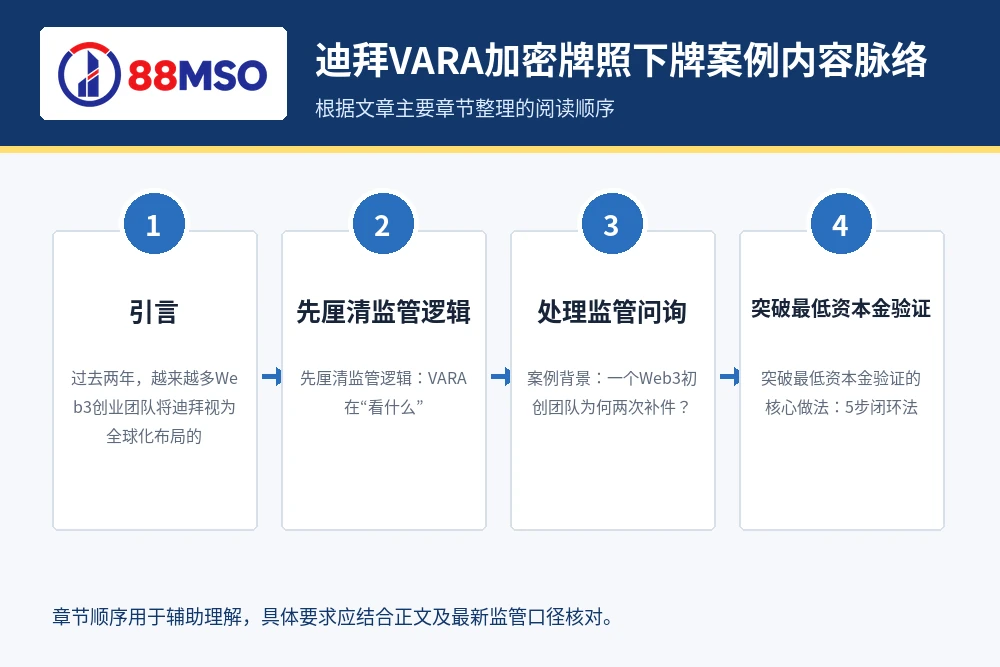
past two years,More and more Web3 entrepreneurial teams regard Dubai as a key location for globalization.。The reason is very direct:The regulatory framework is gradually becoming clearer、The policy is highly open、The aggregation effect of international funds and talents is obvious。But many teams only found out after actually entering the application process,The easiest thing to get stuck on is often not the business model statement.,Nor is it a technical white paper,RatherMinimum Capital Verification。
Under the framework of Dubai VARA (Virtual Assets Regulatory Authority),The focus of supervision is not “whether you have a financing story”,It’s “Do you have the skills that can be verified?”、can be traced、Capital capabilities for sustainable operations”。For start-up teams,this means:Even if the product is in the right direction、Excellent team background,If capital structure、Source of funds、Bank flow and audit standards cannot form a consistent closed loop,You may also be asked to make replacements,Even extend the approval cycle。
This article is based on capital、Source of funds、Correspondence between account information and institutional documents,Explain the things to check before applying for Web3 team。The following preparatory scenario is used to explain the data gap,Not a customer approval record,Does not claim to correspond to 88MSO actual projects or regulatory approval results。
one、First clarify the regulatory logic:VARA is "looking at what"
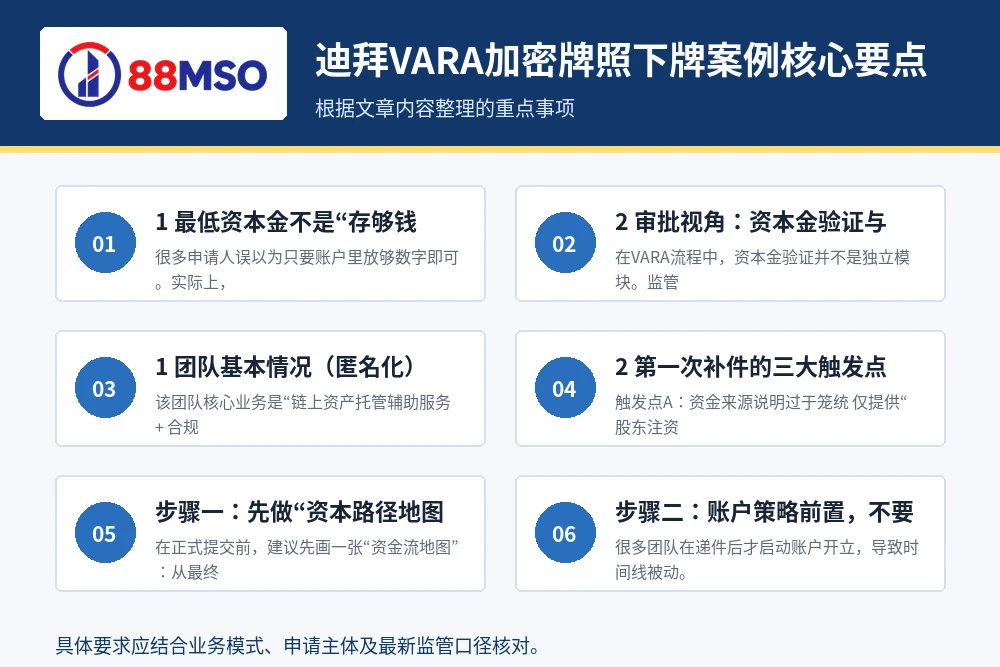
1.1 Minimum capital is not as simple as “saving enough money”
Many applicants mistakenly believe that all they need to do is put enough numbers in their account.。actually,VARA pays more attention to three things:
- authenticity:Are the funds truly available?,Rather than short-term "bridge" or temporary lending。
- Source compliance:Where does the funding come from?,Whether the beneficial owner (UBO) and historical path can be completely proven。
- Continuity:Whether the funds can support future operations,Not a "one-time balance prepared for approval"。
1.2 Approval Perspective:Capital verification and AML/KYC are linked
In the VARA process,Capital verification is not an independent module。Regulation often associates this with anti-money laundering (AML)、Customer Due Diligence (KYC)、governance structure、Cross-check the risk control system together。That is to say,If your financial documentation and AML policy、Internal control process、Board resolutions contain conflicting contents,Even if the amount reaches the target,May still trigger additional review。
two、Application preparation scenario:What evidence still needs to be verified for sufficient funds?
2.1 Proposed business and capital materials
For example,A team planning to develop virtual asset related services,It is necessary to first determine whether the specific activity falls within the scope of VARA supervision and the applicable license category。Even if the account balance is sufficient after financing,The source of funding should still be checked、Account subject、Can legal documents and capital uses correspond to each other?。
2.2 Three types of inconsistencies that should be checked before submission
- Trigger point A:Funding source description is too general
Only provide "Shareholder Capital Injection Certificate",The relationship between historical transfer paths and intermediate accounts is not detailed。 - Trigger point B:Corporate structure is inconsistent with bank documents
After the updated holding structure at the group level,Bank KYC information is not synchronized。 - Trigger point C:The audit caliber is inconsistent with the application form caliber
Described on the application form as "Operating Reserves",The audit instructions are marked as "short-term borrowing to be converted into shares"。
The focus of verification is to form traceable、consistent chain of evidence,Balance screenshots cannot be used in place of complete source and purpose descriptions.。
three、Breaking through the core practices of minimum capital verification:5-step closed loop method
step one:First make a “Capital Trail Mapping”
before formal submission,It is recommended to draw a "fund flow map" first:From the final investor to the application main account,Every path can be explained、Can be corroborated、Traceable。The map should cover at least:
- Identity of the investor (individual/institution)
- Nature of investment source (operating profit、financing、Asset disposal payment)
- Transfer account and time node
- Currency conversion record (if any)
- Final settlement account balance certificate
This step may seem like “paperwork”,In fact, it determines the efficiency of approval communication。Regulatory authorities are most afraid of “toothpaste-like repairs”,Giving logical material in one go significantly reduces uncertainty。
Step 2:Account policy front-end,Don’t wait until the package is delivered before contacting the bank
Many teams only start account opening after submitting the package.,Causes timeline to become passive。A more reliable method is:
- Plan in advance the division of labor between local operating accounts and group capital accounts
- Prepare a statement of purpose for opening an account consistent with VARA standards
- Synchronously improve UBO、director、Authorized signatory materials
- Prepare additional AML documentation for encryption-related businesses
Pay special attention here:"KYC acceptability" from the bank's perspective and "capital verifiability" from the regulatory perspective are highly coupled。Account policy front-end,It can avoid rework due to inconsistent flow caliber in the later stage.。
Step 3:Rewrite your capital statements in “audit language”
Start-up teams commonly use financing language to describe funds,But supervision is more accepting of audit logic。It is recommended to rewrite capital materials into a three-tier structure:
- legal layer:Shareholders resolution、Capital increase documents、Company registration documents、Board authorization
- Finance level:bank statement、Capital verification certificate、Audit report or accountant’s confirmation letter
- Compliance layer:Funding Source Statement、AML screening records、Key Transaction Notes
If the three layers of materials can confirm each other,It will be easier for the approver to judge that "the funds are real and sustainable"。
Step 4:Create a “Reflective Question List”,Simulate supervision Q&A in advance
An internal Q&A can be conducted before submission.,Answer at least the following questions:
- If the main shareholder’s funds come from the last round of Token exit,How to prove legality and tax treatment?
- If the funds have ever passed through an offshore SPV,What is the business rationale for a middle tier?
- If the account balance has fluctuated significantly recently,How to explain and prove that it does not affect the minimum capital requirements?
- If there are plans to issue multiple licenses in the future,,How do you ensure funds are not double-counted or double-committed?
Step 5:Establish a post-submission inquiry and version management mechanism
After submission, an internal person in charge can be designated,Will regulatory issues、Required supporting documents、Responsible person and response deadline are uniformly recorded。The actual response period shall be implemented according to the regulatory notice;The following matters are internal management arrangements,Not an official time limit:
- After receiving the inquiry, confirm the type of problem and the person responsible
- Prepare response framework according to regulatory notification deadlines
- Complete evidence update and consistency review before submission
- Unified version control,Avoid "mistransmission of old files"
Many projects are not “difficult because of the materials”,But "lose in response speed and consistency management"。
Four、Four details that startup teams are most likely to overlook
4.1 Timing risks of “loan to capital” arrangement
For efficiency, some teams,First use shareholder borrowings to meet initial funding,Plan for subsequent share transfers。If the timing is not designed properly,May be considered to have insufficient capital stability。Suggested in legal documents、Accounting treatment、Synchronous design of regulatory disclosures,Avoid conflicting descriptions。
4.2 Only “screenshots” and no “chains” will be given as proof of funds.
Screenshots from a single bank prove that the strength is limited。Should be combined with bank letter、statement、transaction flow、letter of explanation,Form an evidence package that “can understand the timeline”。
4.3 Ignoring cross-border tax and beneficial owner disclosures
Common shareholder structures in multiple locations for Web3 teams,If tax resident status、UBO disclosure is incomplete,Will directly affect the credibility of funding sources。Capital verification is essentially transparency verification。
4.4 “Template” of compliance documents,Out of touch with real business
It is becoming easier for supervision to identify “general templates”。AML policy、risk assessment matrix、customer tiering model,Must be consistent with the actual product process,Otherwise, no matter how sufficient the capital proof is,,It may also be subject to increased scrutiny because of doubts about overall governance capabilities.。
five、Manage capital material preparation by stage
The following preparation stages are divided according to work dependencies:,Does not represent official processing times or fixed approval cycles:
- Stage one:Build a capital path map,Sort out shareholders and SPV structure,Identify historical funding flaws。
- Stage 2:Complete account strategy、First draft of core legal documents and funding source description。
- Stage three:Audit/accountant caliber calibration,Form application materials with consistent versions。
- Stage four:Conduct regulatory Q&A simulations and prepare supplementary plans。
- Stage five:Officially submitted and launched the inquiry and version management mechanism。
When planning business in Hong Kong and Dubai simultaneously,Can sort out subjects that are common to all jurisdictions、Funding sources and governance information,Then add them according to local rules.。It cannot be presumed that the completeness of materials in one place will be recognized by another place.。
six、A practical checklist for Web3 founders (self-check before submission)
- Does the minimum capital amount meet the requirements of the corresponding business type?
- Whether the funds have been stably deposited in a verifiable account,And do you have a complete flow chart?
- Identity of investor、COUGH、Is tax residency information consistent and provable?
- Are there circumstances that cannot be explained by “temporary bridge funding”?
- legal documents、audit documents、Is the text on the application form exactly the same?
- Does the AML/KYC policy truly match the business model?
- Are you ready for the version management and response SOP for patch scenarios?
If the answer to any of the above is uncertain,It is recommended not to rush to deliver the parcel。What evidence should be identified first,And arrange the preparation plan according to the actual complexity;No preset unified preparation time。
Conclusion:Minimum capital verification,The test is actually “compliance management capabilities”
Dubai VARA licensevalue,Not in “getting the certificate” itself,Rather, it is a stress test for an enterprise’s global compliance capabilities.。Minimum capital verification looks like a financial issue,In fact, corporate governance、Funding Transparency、AML system、Comprehensive reflection of cross-border structural design capabilities。
For the Web3 startup team,A truly effective strategy is not to "make do with improvised materials",Instead, use regulatory language to reconstruct the foundation of the enterprise.:Funding paths can be traced、System documents are executable、Operational readiness can be quantified。This will not only improve the consistency of application materials with regulatory requirements,It can also lay the foundation for the subsequent expansion of financial compliance layout in Hong Kong and other jurisdictions.。
When you treat capital verification as a "corporate physical examination" rather than an "approval task",Helps reduce replacement parts,Subsequent business risks will also be lower。This is exactly the core principle that professional compliance service organizations have long emphasized.:Prepare the evidence chain first,Let’s talk about growth rate again。
FAQ:5 questions founders care about most
Q1:Do funds have to be frozen for a long time?
Not necessarily "frozen",But must demonstrate that regulatory requirements are met and operations can be sustainably supported。The key is stability and verifiability,instead of short-term display balance。
Q2:Can group funds be used to support start-up entities?
Can,However, the legal relationship must be clearly stated、Usage of funds、Internal authorization and accounting,Avoid “nominal support”、"substantially unavailable" concerns。
Q3:There are records of asset realization on the chain in history,Will it affect my application?
does not necessarily affect。The core lies in whether a complete compliance certificate can be provided,include sources、Trading platform records、Taxation and Fund Accounting Explained。
Q4:Should I apply for a license first or build an AML system first?
should be promoted in parallel,Even AML should be properly prepended。Capital verification and AML review are linked,Backfill systems often lead to material conflicts。
Q5:If you want to apply for a Hong Kong license in the future,Can current materials be reused?
Part of it can be reused,Especially UBO、Source of funds、Governance structure and internal control framework。However, it is necessary to adjust the caliber and localize the reinforcement according to local regulatory requirements.。