简体中文
简体中文 繁體中文
繁體中文 English
Hong Kong MSO license transfer:Why is the "old money exchange shop in the core area of Mong Kok" worthy of attention?
Official verification update (August 2026):An MSO license is not an asset that can be freely transferred away from the licensed company.,Acquiring a company does not mean that the buyer can "take over and start business"。Shareholders still need to be checked before and after the transaction、director、ultimate controller、Changes in business location and major information,and handle notifications as required by Hong Kong Customs、Apply or reassess。 For specific rules, seeHong Kong Customs Supervision Information on Money Service Operators。
in Hong Kong,Money Service Operator (MSO)The license is controlled by the Hong Kong Customs and Excise Department,Business usually covers exchange、Cash and cross-border capital flow scenarios such as remittances。For investors who want to quickly enter Hong Kong’s financial services market,Instead of applying for a license from scratch and waiting for approval,It’s better to pay attention to”License + mature stores + operation team"Integrated transfer opportunities。Especially in high-traffic areas like Mong Kok、Core business district with high transaction frequency,The commercial value of established exchange shops is often not only reflected in the license plate itself,This is reflected in its stable customer base、store location、Brand reputation and historical compliance record。
but,"You can start business immediately after taking over" does not mean "zero risk and no threshold"。MSO licenseTransfer is essentiallyregulatory compliance、Business due diligence、deal structure、Follow-up operationsFour-in-one systems engineering。If you only look at the store flow or location,Don’t look at the anti-money laundering system、Customer Due Diligence Process (KYC)、Historical suspicious transaction declaration (STR) mechanism and customs communication records,Difficulties in maintaining the license plate may easily arise in the future.,even affect business continuity。
This article will be based on the typical scenario of "the sale of a long-established exchange shop in the core area of Mongkok",Dismantling the takeover path、Risk points and implementation strategies,Help investors、family office、Cross-border payment teams and financial entrepreneurs make more secure decisions。
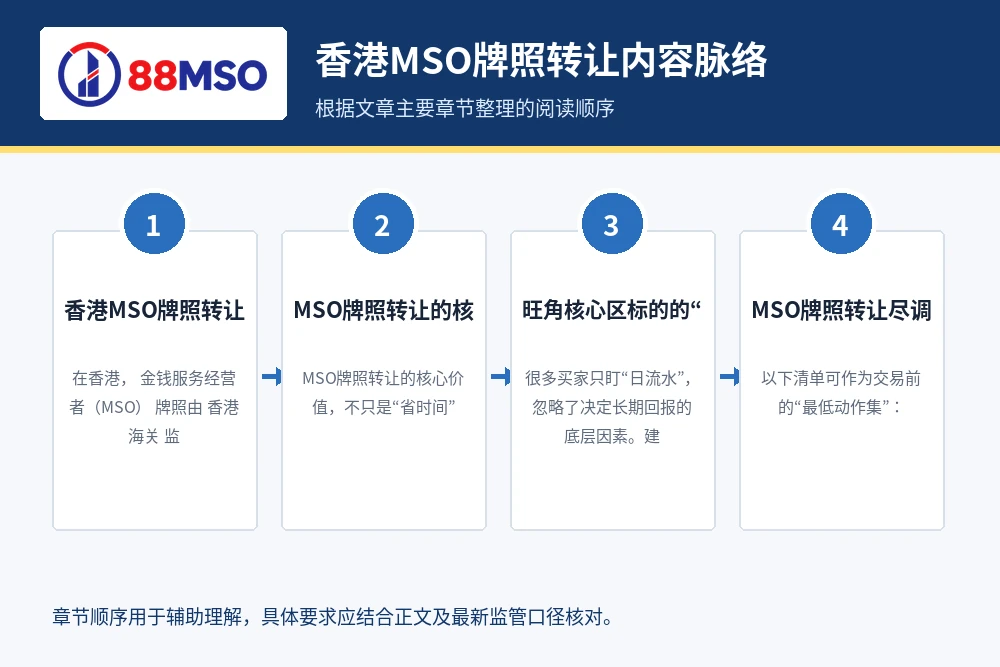
one、The core value of MSO license transfer,More than just "saving time"
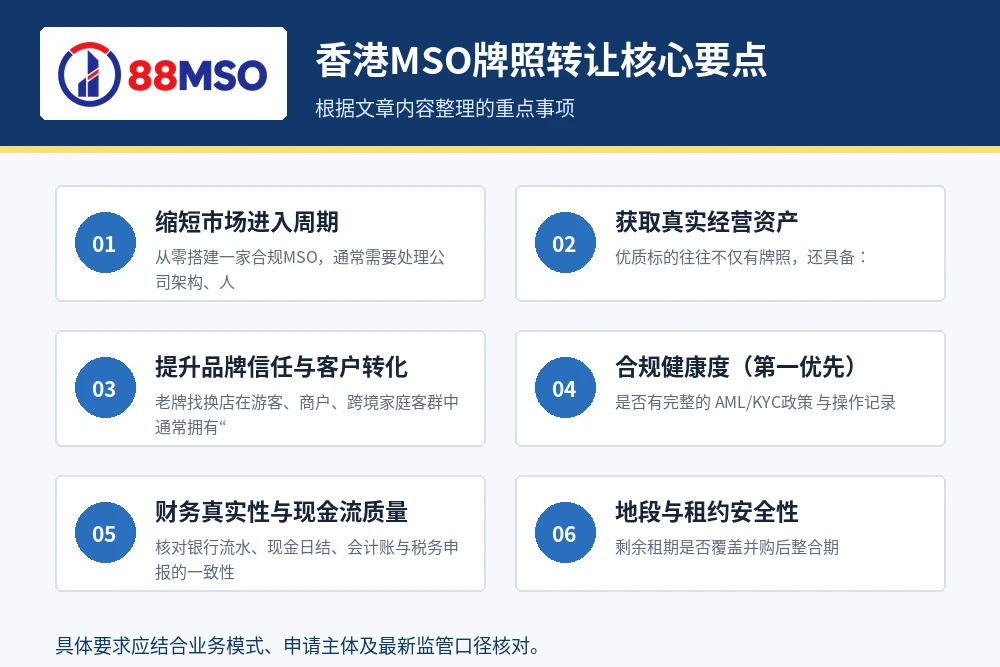
1. Shorten market entry cycle
Build a compliant MSO from scratch,Usually needs to deal with corporate structure、Personnel appointment、Institutional documents、Venue and system configuration and other aspects。If a mature entity is taken over through mergers and acquisitions or equity transfers,Theoretically, the preparation time can be significantly reduced,Generate cash flow faster。
2. Obtain real operating assets
High-quality targets often not only have license plates,Also has:
- Store in core location in Mong Kok (natural customer flow is stable)
- Historical transaction data (facilitates assessment of profit quality)
- Skilled front-line staff and back-office compliance processes
- Existing supply chain and channel resources (such as Huilu、counterparty)
3. Improve brand trust and customer conversion
Long-established currency exchange shop among tourists、Merchant、Cross-border family customers usually have the advantage of “visibility + trust”。For new buyers,This historical accumulation can significantly reduce customer acquisition costs。
two、How to judge the “true value” of an object in the core area of Mong Kok?
Many buyers only focus on “daily turnover”,Ignores the underlying factors that determine long-term returns。It is recommended to evaluate at least the following five dimensions:
1. Compliance and health (first priority)
- Are there complete AML/KYC policies and operation records?
- Is identification of high-risk customers in place?,Is there “formal due diligence”?
- Are employees trained regularly?、Keep training records
- Is the suspicious transaction reporting mechanism implemented?,Is the file traceable?
remind:A store with “high profits but weak compliance”,The true valuation may be lower than that of a store with "moderate profits but solid compliance"。
2. Financial authenticity and cash flow quality
- Check bank statements、cash daily settlement、Consistency between accounting and tax reporting
- Split income structure:Exchange price difference、handling fee、Remittance service fees, etc.
- Identify abnormal months (holidays、Unexpected policy impact、One-time large transaction)
3. Location and lease security
- Does the remaining lease term cover the post-merger integration period?
- Are the lease renewal terms and rent adjustment mechanism controllable?
- Whether the property is allowed to continue operating related financial services
4. Customer Group Structure and Sustainability
If the customer source is overly dependent on a single intermediary or short-term tourist flow,Once external changes,Performance fluctuations will be significantly magnified。The ideal structure should take into account retail customers、Merchant customers and stable cross-border customers。
5. Reputation and historical events
Make a public complaint、law enforcement record、Public opinion events will affect future operations。It is recommended to conduct full-link background screening before taking over。
three、MSO license transfer due diligence checklist (practical version)
The following checklist serves as a "minimum set of actions" before trading:
- Licensing and regulatory documents:MSO license status、Renewal record、Regulatory communication records
- Company legal documents:Charter、Shareholder structure、Directors and Beneficial Owners Information
- Compliance system:AML policy、Customer hierarchical management、Transaction Monitoring Rules、Sanctions Screening Process
- Operational documents:SOP、Collection and payment process、Counter operating specifications、Double review mechanism
- Financial and tax information:Audit report、management account、Tax filings and potential liabilities
- Manpower allocation:Stability of key positions、Turnover risk、Incentives and Confidentiality Arrangements
- IT and data:Customer information retention、Log traceability、Permission management and data security
- business contract:lease、supplier、Change control provisions in channel cooperation agreements
If the buyer lacks Hong Kong financial compliance and M&A experience,It is recommended to introduce a consulting team with practical cases to conduct parallel due diligence。Like 88MSO and the 88MSO team behind it,Long-term service in full custody of Hong Kong MSO and other financial licenses,It is often easier to identify the key differences between "tradeable" and "non-tradeable" early on,Avoid late rework。
Four、How to design the transaction structure,Only in this way can we "take over and run"、Operation means compliance”?
1. common paths:Equity transfer vs asset transfer
Equity transferThe continuity of the original entity and its historical operations can be retained,But it may also take on historical risks;Asset transferRisk cuts are clearer,However, the implementation cycle and procedure complexity may be higher。The specific selection needs to be combined with the history of the target、Comprehensive judgment on regulatory requirements and tax implications。
2. staged payment mechanism
It is recommended to adopt the structure of “signing deposit + delivery payment + performance/compliance betting balance”,and set clear trigger conditions,For example:
- Key compliance documents delivered complete
- Lease and core contract changes completed
- Regulatory communication matters are completed as planned
- No significant historical risk exposure within a certain period after delivery
3. Transition Arrangements (TSA)
The old club provides 1-3 months of transition support,common in:
- Supply chain and channel handover
- Staff training and stable schedules
- Maintenance of key customer relationships
- Coordination in response to regulatory inquiries
five、90 days after taking over:Upgrading "able business" to "sustainable growth"
Phase 1 (1-30 days):Stable operation
- Verification counter process and fund flow closed loop
- Inventory of high-risk customers and historical abnormal transactions
- Update permission matrix,Close operational loopholes
Phase 2 (31-60 days):Strong compliance
- Rework the customer risk rating model
- Upgrade transaction monitoring thresholds and early warning rules
- Organize AML/KYC retraining for all employees and leave traces
Phase 3 (61-90 days):Amplification length
- Optimize exchange rate strategy and product mix
- Hierarchical operation of high net worth and merchant clients
- Evaluate cross-border payment and multi-license collaboration paths
For companies planning to expand into Hong Kong and overseas markets in the long term,MSO should not only be a "single point of business",Instead, open an account with a bank、Cross-border settlement、Collaboration will be formed in the layout of SFC or insurance-related licenses in the future。The value of a professional organization lies in promoting "obtaining a license" to "stable business operation"。
six、Common misunderstandings:Why Many Deals "Look Cheap",It’s very expensive later”
- Misunderstanding 1:Just look at the price,Don’t look at historical compliance。Low-priced bids may imply high rectification costs。
- Misunderstanding 2:Only look at current profits,Don’t look at the lease and personnel stability。Once a local store loses its core employees,Service quality will decline rapidly。
- Misunderstanding 3:Treat "license transfer" as an ordinary store transaction。MSO is essentially a regulated financial business,Compliance failure is extremely costly。
- Misunderstanding 4:Ignoring post-closing governance。No 90-day integration plan,Often leads to customer loss and risk control failure。
seven、Conclusion:It’s not difficult to buy a “license”,It is difficult to buy "sustainable management capabilities"
“A well-established currency exchange shop in the core area of Mongkok is for sale,"Just take over and start business" is indeed an efficient way to enter the Hong Kong financial services market.,But what really determines success or failure,It’s not “whether the takeover was successful”,But "whether to transform historical assets into future capabilities?"。
A high-quality MSO license transfer,Three points should be met at the same time:Regulatory sustainability、Cash flow is verifiable、Growth is replicable。When you look at the target with an M&A mindset instead of a “leave-picking mindset”,Only then will we have a better chance of turning this type of transaction into long-term value.。
If you are evaluating a specific target,It is recommended to start compliance as early as possible、legal affairs、Parallel due diligence on the four lines of finance, taxation and operations,Establish an integrated plan before and after closing。For those who want to shorten the decision-making cycle、A team that reduces trial and error costs,Use professional support like 88MSO/88MSO who are deeply involved in Hong Kong’s financial licensing practices,Risk boundaries can often be identified faster and delivery success rates can be improved。
FAQ:5 issues investors are most concerned about
Q1:After MSO license transfer,Can it really be opened immediately?
"Opening immediately" depends on delivery completeness、Store operation connection、Are the personnel and systems in place?。It is recommended to reserve a transition period,Avoid compliance gaps。
Q2:Is the Mong Kok store necessarily better than other areas?
Mong Kok has the advantage of crowd flow,But rents and competition are also higher。The lease should be viewed comprehensively、Customer group structure、Historical Profit and Compliance Quality。
Q3:How to judge whether the data provided by the seller is true?
Multi-source cross-validation is required:bank statement、accounting、tax records、System log、Sample transaction voucher。
Q4:What is the most likely problem after taking over?
Usually KYC execution is inconsistent、Insufficient staff training、The transaction monitoring threshold follows the old rules and does not adapt to the new strategy.。
Q5:Do outside consultants need to be involved throughout the process?
If the transaction amount is large、Time constraints or buyer’s lack of local experience,It is recommended to introduce a consulting team with practical experience in Hong Kong MSO to participate in the whole process.。