简体中文
简体中文 繁體中文
繁體中文 English
US MSB registration preparation:FinCEN Filings and State-Level Licensing Boundaries
Official verification update (August 2026):FinCEN MSB registration is a federal registration,It is not an approval of the business model or an endorsement of “successful licensing”,Nor is it a substitute for money transmission licenses that may be required by states.。The following content is used to illustrate material preparation and regulatory boundaries,Not a customer approval record,Nor does it represent a guarantee of registration or bank cooperation.。 For specific rules, seeUS Financial Crimes Enforcement Network MSB registration information。
Before starting a money services business for U.S. customers,You should first determine whether it belongs to the MSB category specified by FinCEN.、Are there applicable exemptions?,and whether additional state licensing is required.。US MSB registration and anti-money laundering requirementsIt is a different process than bank account opening review.,Federal registration does not automatically confer banking access or national operating status。
This article is based on the application preparation scenarios for cross-border digital asset business.,Explain business boundaries、Funding path、AML system、Personnel Responsibilities and Material Consistency Check Method。Scenarios are only used to explain preparations,Does not claim to correspond to 88MSO customers、Actual approved projects or completed transactions。
one、Clarify the concept first:What exactly is a US MSB license?
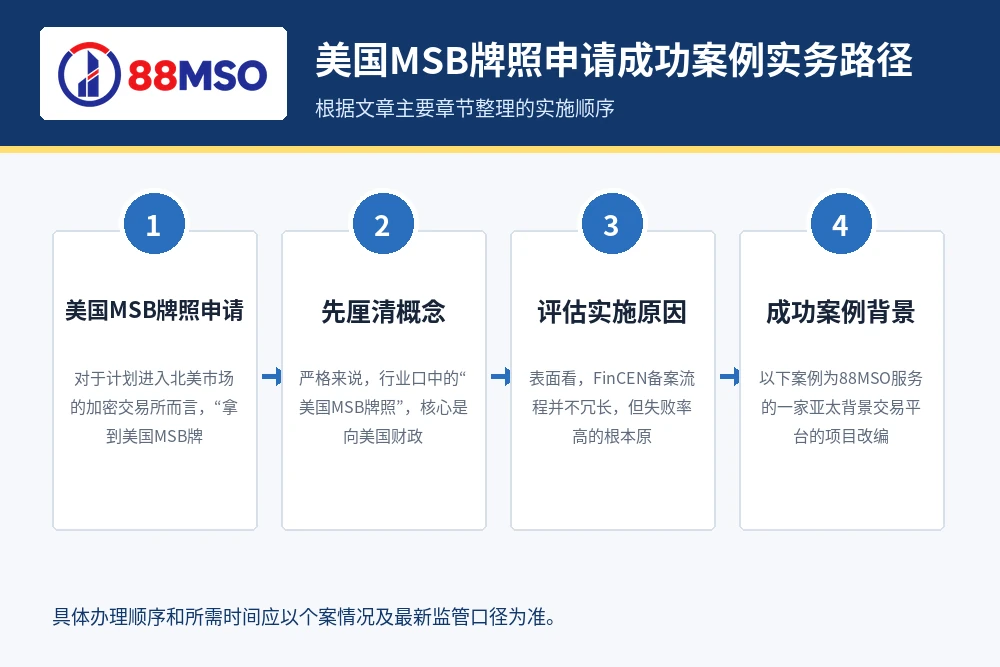
strictly speaking,The "US MSB license" in the industry's mouth,The core is subordinate to the U.S. Department of the TreasuryFinCEN (Financial Crimes Enforcement Network)Complete Money Services Business registration。Commonly involved businesses include:
- Currency Exchange
- Remittance and Fund Transmission (Money Transmission)
- Prepaid instrument related services
- Some virtual currency related fund service activities
For crypto exchanges,FinCEN usually focuses on whether it touches the regulatory boundary of "money services business",Especially the conversion between legal currency and virtual assets、User fund transfer、Cross-border transfer routes, etc.。What needs to be emphasized is:MSB registration does not mean that you can operate “unrestrictedly” throughout the United States.,Different states may also involve additional Money Transmitter License (MTL) or other local obligations。
two、Why do many exchanges “seem to be simple but repeatedly rework” in the FinCEN process?
Registration form completion and ongoing compliance are separate matters。Applicants should organize registration information separately、Assess applicable anti-money laundering obligations,and align business descriptions with actual operations;Successful submission of the form cannot be understood as approval of the business model.。
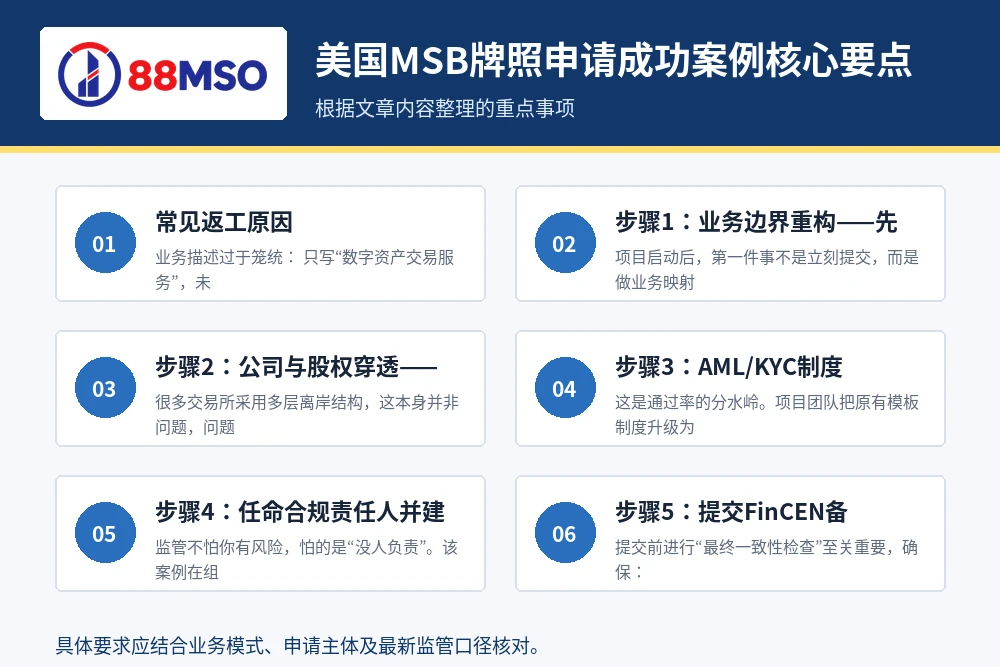
Common reasons for rework
- Business description is too general:Just write "Digital Asset Trading Services",Unspecified fund flow、Clearing and settlement path、third party role。
- Beneficial owner information is unclear:Insufficient penetration of ownership structure,Incomplete description of offshore structure。
- AML system template:Apply template directly,Not combined with its own high-risk scenarios (such as high-frequency small-amount splits)、Mixer address inflow) develop control measures。
- Missing KYC hierarchical logic:There is no mechanism linking risk levels to transaction limits。
- Hollowing out compliance positions:MLRO/Compliance Officer Responsibilities、Reporting lines and accountability mechanisms are unclear。
three、Application preparation scenario:Material verification for cross-border digital asset services
The following is a list of business issues that digital asset service entities planning to enter the U.S. market may need to clarify:,For reference when preparing internally;Not a client project disclosure:
- Business form:Cryptocurrency trading for overseas users + legal currency deposit channel
- target market:US and some Latin American users
- Initial pain points:No clear path to U.S. compliance、Bank communication is blocked、Risk control rules are dispersed among technical and operational teams
- core goals:Complete MSB filing,Establish a compliance framework that can connect banks and payment institutions
Preliminary document verification requires a clear description of the applicant、Specific services、Risk Control and Ongoing Supervision Arrangements,Generic compliance slogans cannot be substituted for verifiable business information。
Four、6 Steps to Check for FinCEN Registration Preparation and Continued Compliance
Step 1:Business Boundary Reconstruction—First Define “What Are You Supervised?”
Before preparing registration information,Business mapping can be organized first:
- User deposit source (bank card、Third party payment、On-chain transfer)
- Fund flow (escrow account、clearing node、Withdrawal path)
- Platform role (matchmaker、Custodian、agent)
Only business boundaries are clear,Only then can we determine the FinCEN filing category and subsequent state-level licensing strategies.,Avoid subsequent major risks of "inconsistency between actual operating status and filing statement"。
Step 2:Company and Equity Penetration—Explain “Invisible Risks” First
Many exchanges use multi-tiered offshore structures,This in itself is not a problem,The problem is insufficient explanation。When checking material consistency,The following documents can be prepared according to the actual structure:
- Group structure chart (including control relationships、voting rights、beneficial owner)
- Resumes of key executives and declaration of no bad records
- Division of functions of each entity (technical、operations、market、Compliance)
Step 3:AML/KYC system “from template to executable”
The AML system should be formulated based on actual business scenarios,Avoid using generic templates directly as implemented controls。Highlights that can be checked include:
- Customer Due Diligence (CDD) and Enhanced Due Diligence (EDD):by region、Profession、Source of funds、Trading behavior scoring stratification。
- Suspicious transaction monitoring (STR/SAR trigger logic):Set exception threshold、Behavioral profiling and manual review closed loop。
- Sanctions Screening:Access list screening tool,Cover account opening、Log in、Withdrawal and other key nodes。
- "Travel Rules" Collaborative Ideas:Record and leave traces of identifiable counterparty information。
- record keeping mechanism:Ensure that KYC and transaction records meet retention period and retrieval requirements。
Step 4:Appoint a compliance officer and establish a governance structure
Responsibilities arrangements need to be consistent with actual ability to perform duties。You can check the following items when preparing internally:
- Appoint a compliance manager with relevant experience (including MLRO function)
- Establish a quarterly compliance reporting mechanism,Report directly to management
- Define technology、operations、Boundaries of Legal Affairs’ Responsibilities in the Anti-Money Laundering Process
Step 5:Submit FinCEN filing and conduct consistency review
It is crucial to do a "final consistency check" before committing,make sure:
- Filing information and official website disclosure、User Agreement、Privacy policy consistent
- Business description is consistent with actual product functions
- Entity name、address、The person in charge information is consistent with the supporting documents
in practice,Many problems are not caused by regulatory standards being too high,But different departments of the company have inconsistent statements to the outside world.,Leading to a decrease in compliance credibility。
Step 6:Complete "operational-level compliance implementation" within 90 days after filing
The real difficulty is not "getting registration",but “continued compliance with requirements”。The customer completed the process as planned after filing:
- Employee AML training and assessment
- High-Risk Country/Region Access Policy Update
- Internal escalation process drill for suspicious transaction reports
- Compliance Questionnaire Response Template for Banks and Payment Partners
five、3 key points to check for registration preparation and business operations
1) Supervision looks at “system capabilities”,Not a "single application"
FinCEN filing is not a one-time action,It’s about proving your ability to operate stably in the future.。system、process、system、People must support each other。
2) Business expansion speed must be slower than compliance maturity speed
Compliance should be integrated into product change and release processes。Before adding new features or services,Business categories should be re-evaluated、Funding paths and applicable requirements;Existing registrations cannot automatically cover all newly added businesses.。
3) Cross-jurisdictional collaboration is the norm for overseas exchanges
US MSB is just one piece of the North American puzzle。For organizations headquartered in Hong Kong or Asia,It is often necessary to coordinate Hong Kong licenses、Bank account opening、Tax and data governance issues。Synchronize the design of U.S. filings with the overall cross-border compliance structure,Much more efficient than "headache doctor"。
six、Common misunderstandings:These 5 cognitive biases are most likely to lead to subsequent passivity
- Misunderstanding 1:With MSB, you can freely develop your business in the United States。——In fact, state regulatory requirements often cannot be ignored。
- Misunderstanding 2:Filing first,AML will be replenished later。——Most cooperative institutions will first review your AML practical ability。
- Misunderstanding 3:Collect KYC as a disposable ID card。——Continuous due diligence and transaction monitoring are the core。
- Misunderstanding 4:Compliance is only a matter for the legal department。——Technical risk control、customer service、Participate in all operations。
- Misunderstanding 5:You can get by just by copying other people’s files。——The business structure of each platform is different,Templates cannot be applied directly。
seven、Provide a practical checklist for overseas crypto exchanges (can be directly compared internally)
Preparation checklist before applying
- Complete the full link diagram of business flow and capital flow
- Clarify beneficial ownership and control relationships
- Build hierarchical KYC and EDD rules
- Establish a suspicious transaction identification and reporting process
- Prepare compliance officer appointment and responsibilities documents
Pre-submission consistency checklist
- Official website information、Terms and Policies、The filing information is consistent
- address、Telephone、Email and other subject information are accurate
- Product functions are consistent with the registered business description
- Key documents are traceable、auditable、Updatable
Operation list after filing
- Annual AML training and internal review mechanism
- Dynamic management of high-risk users and high-risk areas
- Regular backtesting and iteration of transaction monitoring rules
- Standard package for due diligence questionnaires for banks/payment institutions
Conclusion:MSB filing is not the end,It is the starting point for compliant overseas operations
FinCEN Federal Registration、State Level Licensing、Banks’ due diligence and ongoing anti-money laundering obligations should be judged separately。Clear materials and enforceable systems help explain the business,However, it does not replace the independent decision of the competent authority or bank.。
When planning business in Hong Kong and North America at the same time,The permission boundaries of each jurisdiction can be organized separately、Funding path、Customer areas and internal controls。88MSO’s service scope includes requirements sorting、Document coordination and process communication;The specific delivery shall be subject to agreement between both parties.。
FAQ:High-frequency issues regarding MSB and FinCEN registration in the United States
Q1:How long does US MSB filing usually take?
The registration preparation and submission time depends on the completeness of the information and the specific business;Subsequent state licensing and bank account opening are separate procedures。Should be arranged in accordance with FinCEN’s current filing rules and applicable deadlines,No commitment to a fixed processing or approval cycle。
Q2:Can I do MSB without a local US team?
Can be advanced,But more rigorous main arrangements are needed、Responsible person setting and operational compliance mechanism,In particular, banks and payment partners will have stricter due diligence procedures.。
Q3:Do pure on-chain businesses also need to pay attention to MSB?
If it involves legal currency exchange、Fund transfer、Behaviors such as transferring value on behalf of users,MSB obligations generally need to be assessed with emphasis。It is recommended to conduct regulatory boundary analysis during the product design stage。
Q4:What else to do after getting MSB?
Continuous enforcement of AML/KYC、Update risk assessment、staff training、Suspicious transaction reporting mechanism maintenance,and assess state-level licensing needs by business expansion.。