简体中文
简体中文 繁體中文
繁體中文 English
USAMSB vs Canadian MSB:North American compliance route selection for foreign exchange and currency companies going overseas
For foreign exchange platform、OTC team、Cross-border payment service provider、For stable currency settlement projects and transaction matching Web3 companies,The North American market has always been highly attractive:Large customer base、Payment infrastructure is mature、High financial activity。But "the greater the chance,The higher the compliance threshold” – especially when it comes toMoney Services Business (MSB)hour,Many companies fall into misunderstandings in the first step:Just look at the license plate and "whether it can be done",But they ignored “whether it can continue to operate after completion”。
This article will focus onAmerican MSB andCanadian MSBregulatory differences、Application requirements、operating costs、AML/KYC practice、Bank account availability、business adaptabilityCompare systems,and provide an executable decision-making framework。For companies planning global layout,This is not just a matter of license plate selection,It is also a compliance strategic issue in the next 3-5 years.。
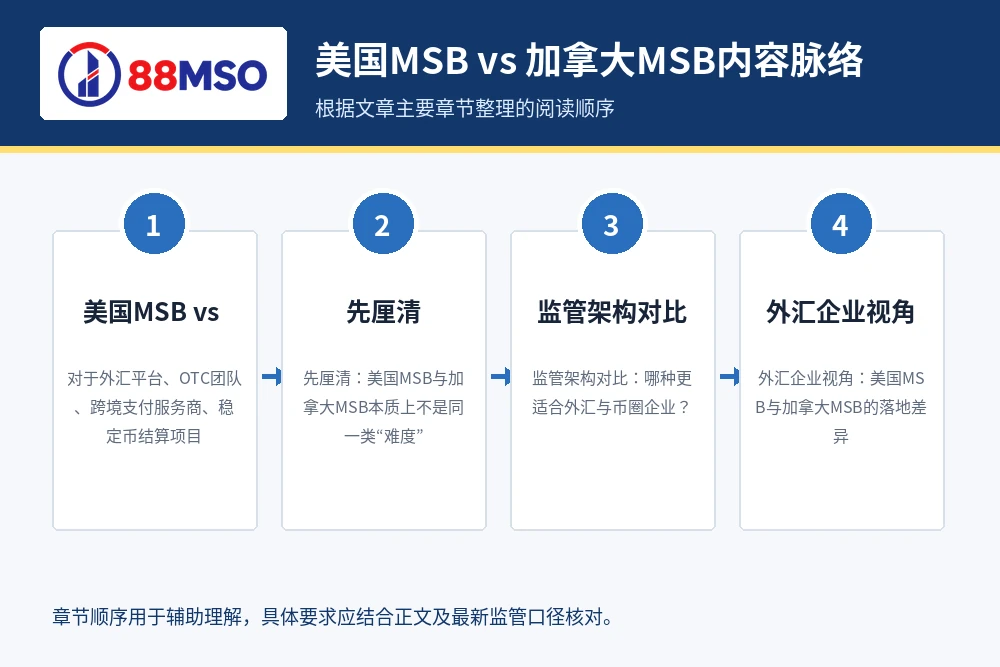
one、First clarify:American MSB and Canadian MSB are not essentially the same type of "difficulty"
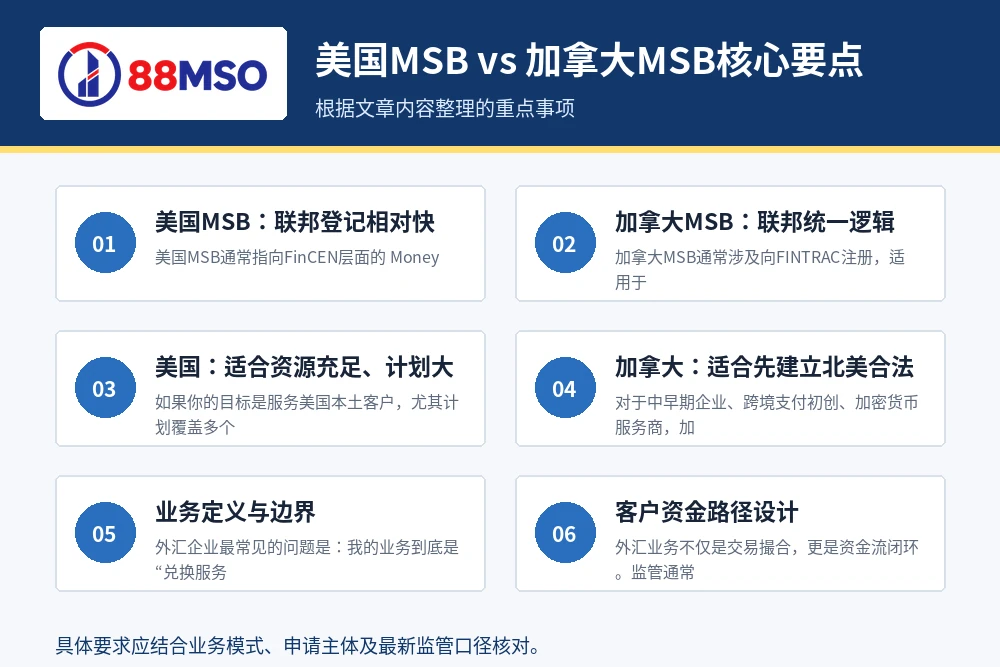
1. MSB USA:Federal registration is relatively quick,But state regulation dictates operational complexity
US MSB usually points to FinCEN level Money Services Business registration。Many companies mistakenly believe that “they can operate across the United States after obtaining a federal MSB.”,This is not actually the case。The regulatory structure in the United States isfederal+statetwo-tier system:
- federal level:Register with FinCEN,Create an AML program、Submit suspicious transaction reports, etc.;
- state level:Most states have separate licensing requirements for businesses such as Money Transmitter,Net capital involved、margin、audit、Background review of person in charge, etc.。
The conclusion is:The MSB threshold in the United States is as low as the "registration starting point",Difficulty lies in “multi-state expansion and continued compliance”。
2. Canadian MSB:The unified logic of the federation is stronger,Regulatory paths are more predictable
Canadian MSBs typically involve registration with FINTRAC,Suitable for foreign exchange exchange、money transfer、Virtual currency trading and other businesses。compared to the united states,Canada is clearer on “federal unified regulatory logic”,Institutional friction for enterprises operating across provinces is relatively low。
But this does not mean it is simple。Canada also attaches great importance to anti-money laundering and counter-terrorism financing,Enterprises are required to establish effective:
- Customer Identification (KYC) Mechanism;
- Continuous transaction monitoring and risk rating system;
- Suspicious Transaction Reporting (STR) Process;
- Compliance officer responsibilities and training mechanism。
in short:The difficulty with Canada’s MSB lies in “system integrity”,The difficulty of MSB in the United States lies in the "fragmentation of regional supervision"。
two、Comparison of regulatory frameworks:Which one is more suitable for foreign exchange and currency circle companies?
USA:Suitable for sufficient resources、Team planning massive multi-state infiltration
If your goal is to serve domestic customers in the United States,Especially plans to cover multiple states,Or follow-up to connect institutional liquidity and local payment networks,The American path has more room for business imagination。But must be prepared:
- Higher compliance budget (legal、license、audit、technical monitoring);
- Longer multi-state implementation cycle;
- More complex license maintenance and regulatory communication mechanism。
Canada:It is suitable to establish a legal entrance to North America first.、A team that gradually expands
For early to mid-stage companies、Cross-border payment startup、Cryptocurrency service provider,Canada is often regarded as the “first stop for compliance in North America”。The reason is:
- Regulatory logic is relatively centralized,Governance framework is highly replicable;
- Initial compliance costs are often more controllable;
- More suitable as a "compliance model area" in international business。
three、Foreign exchange business perspective:Differences in implementation between American MSB and Canadian MSB
1. Business Definition and Boundaries
The most common questions asked by foreign exchange companies are:Is my business "exchange service", "remittance service" or "payment channel service"? Different definitions determine different regulatory obligations。Different states in the United States have different business definitions and exemption conditions,Canada’s caliber under the federal framework is relatively stable.。
2. Customer fund path design
Foreign exchange business is not just about transaction matching,It’s a closed loop of capital flow。Supervision will usually ask:
- Are client funds segregated?
- Is there any third-party collection and payment agency?
- Who is the ultimate controlling party in a cross-border link?
In US multi-state mode,Different states may have different requirements for fund custody and transfer structures.;Although Canada is relatively unified,However, it is equally strict in identifying suspicious transactions and retaining documents.。
3. Bank account opening and clearing cooperation
Both the United States and Canada,Bank cooperation has never been about "you must open an account if you have a license"。Banks are more concerned about:Is your AML system auditable?、Is the trading model interpretable?、Is the beneficial ownership structure transparent?。The failure of many projects is not due to application,Rather, they will lose due to subsequent bank due diligence.。It is recommended that enterprises simultaneously design account opening materials and transaction monitoring framework during the license planning stage.,Avoid the embarrassment of “getting the license but not being able to collect payment”。
Four、The perspective of currency circle enterprises:High risk points of virtual currency business
1. Not all "encryption related" can be processed with the same set of MSB logic
There are various forms of enterprises in the currency circle:Fiat currency deposits and withdrawals、Over-the-counter exchange、hosting、Payment settlement、Stablecoin cross-border transfer、On-chain brokerage services, etc.。Regulatory attention usually focuses on two things:
- Fund source traceability(Source of Funds);
- Reasonability of transaction purpose(Purpose &; Pattern)。
Both the United States and Canada have included virtual currency business in areas of high concern,The difference mainly lies in the regulatory implementation method and license combination path。
2. Travel Rule and on-chain monitoring capabilities are becoming “entry barriers”
More and more financial institutions require VASP-related companies to have on-chain address risk identification、Sanctions list screening、Abnormal behavior alarm and evidence retention capabilities。Do you deploy compliant technology systems?,Often directly affects whether banks and payment institutions are willing to cooperate。
3. High-risk customer stratification is the core of compliance in the currency circle
It is recommended to adopt the "three-tier customer classification" idea:
- low risk:Basic KYC + transaction threshold monitoring;
- medium risk:Enhanced due diligence (EDD) + source certification spot checks;
- high risk:Strengthen approval + continuous review + restrict transactions when necessary。
This type of mechanism applies to both the United States and Canada,It is also the most frequently asked part of regulatory inspections.。
five、Cost and cycle:The three most common things companies underestimate
1. The “certification cost” is only a small part of the total cost
The real big deal is often continued operations:Compliance officer team、audit、System Procurement、training、Legal updates、Reporting mechanism maintenance。Especially when the United States expands into multiple states,Marginal costs will rise rapidly。
2. The time cost comes from "repeated supplements" rather than "first submission"
Many application delays are not intentional by the regulators,But the company material logic is inconsistent:Conflict between business model description and capital flow diagram、Incomplete beneficiary disclosure、AML policy disconnected from actual systems。Do enough compliance structure sorting in the early stage,Can significantly shorten the overall cycle。
3. Team cognitive costs are often overlooked
If the founding team only regards compliance as a "legal task",Follow-up business、product、Technology can easily conflict with regulatory requirements,Causes rework。The right approach is to embed compliance into product design and transaction processes,Instead of remediating it after it goes online。
six、How to choose:A practical model for route decision-making in North America
first step:Clarify target market and customer composition
Your customers are residents of North America,Or does global users include North American traffic? If we focus on local customers in the United States,,The American path is more necessary;If mainly international customers、North America is a strategic entrance,Canada might be more suitable。
Step 2:Define business types and capital flow patterns
foreign exchange、Cross-border remittance、Fiat currency deposits and withdrawals、Stablecoin settlement,Different businesses trigger different regulatory obligations。Complete the business boundary definition first,Let’s talk about license efficiency again。
Step 3:Assess budget and organizational capabilities
If you have a mature compliance team and continuous investment capabilities,U.S. multi-state expansion route may be considered;If more emphasis is placed on controlled start-up and rapid formation of a closed loop of compliance,Canadian routes are generally more stable。
Step 4:Simultaneously design the trinity solution of "license + account opening + AML system"
Only licenses, not banking and risk control,It is a typical failure mode of going overseas.。The mature approach is to build a complete link from Day 1。
seven、Practical suggestions:Key Checklist to Reduce the Chance of Rejection and Delay
- business model description:Clearly indicate the source of the customer、transaction path、Fee structure、Risk control node;
- Capital flow diagram and role description:Who receives payment、who liquidates、Who hosts,One picture explains it clearly;
- AML/KYC Policy and SOP:Not just template files,Need to correspond to real systems and personnel responsibilities;
- Sanctions screening and suspicious transaction mechanisms:threshold、rule、Upgrade path、The submission process must be executable;
- Ongoing training and internal audit program:Prove that you have long-term compliance operations capabilities。
in this process,It is particularly important to choose professional consultants with cross-jurisdictional experience。Take 88MSO and its compliance service team (88MSO), an institution that has long been involved in the implementation of financial licenses and AML, as an example.,Its value is usually not in the "fill in the form",It is about helping companies reduce path deviations from a strategic level.:Determine the regulatory route in advance,Redefine company structure,Finally, it comes to account opening and operation,Avoid "certificate"、Business can’t run”。
eight、US MSB and Canadian MSB,Can you "walk on two legs"?
Can,But in stages。For most companies,A more realistic way is:
- Stage 1:First complete the compliance loop in a jurisdiction with a clear regulatory path (commonly Canada);
- Stage 2:Precipitated transaction data、Risk control records、Audit materials;
- Stage 3:Reentering multi-state expansion in the United States,Gradually improve market coverage。
The advantage of doing this is:You can enter more complex markets with "proven compliance capabilities",Improve trust between banks and partners。
Conclusion:real choice,Not "Which license is cheaper?",It’s about “which path is more sustainable?”
There is no absolute advantage or disadvantage between American MSB and Canadian MSB.,Only if it matches your business stage、Customer structure and organizational capabilities。If foreign exchange and currency circle companies want to operate in North America for a long time,You must apply for a license、Anti-money laundering system、Bank cooperation、Technical monitoring should be viewed as an overall project。
If you are planning to launch in North America,It is recommended to complete a "Compliance Feasibility Physical Examination" first:Examine business models from a regulatory perspective、Examine capital flow from a bank’s perspective、Examine internal processes from an audit perspective。only this,Going overseas is not a short-term move,It is the starting point for sustainable growth。
FAQ:The 5 most frequently asked questions by businesses
Q1:After getting MSB from the United States,Can you serve customers across the United States immediately?
uncertain。Federal registration does not automatically satisfy state requirements,Many businesses still require state licensing or compliance assessments。
Q2:Is a Canadian MSB necessarily simpler than an American MSB?
Typically more centralized in regulatory structures,But AML enforcement is not lenient。Whether it's "simple" depends on the complexity of your business and the quality of your preparation。
Q3:The currency circle project only does on-chain exchanges.,Don’t touch fiat currency,Do you still need to pay attention to MSB?
need。Whether supervision is triggered depends on the specific business role、Customer relationships and value transfer methods,You can’t judge based on “on the chain” alone。
Q4:Forex and Crypto Hybrid Business,Which license should I get first?
It is usually recommended to first select the main path based on the main source of income and main risk exposure.,Redesign of supplementary licenses and cross-district structure。
Q5:How to improve the success rate of bank account opening?
The core is "interpretable、traceable、Auditable":Clear transaction logic、Complete KYC/AML、Stable internal governance and reporting mechanism。