简体中文
简体中文 繁體中文
繁體中文 English
Synergy effects of Hong Kong’s 149 license portfolio:Why do asset management companies need a one-stop financial compliance layout?
Accelerating global capital flows、Against the backdrop of continued growth in demand for cross-border wealth management,Hong Kong as an international financial center,It remains an important location for the establishment and expansion of Asian asset management institutions.。More and more managers are beginning to pay attention to "Hong Kong License No. 1/4/9" (often referred to as "149 combination") strategic value:It is not just a superposition of three license plates,It’s also from fundraising communication、Complete business closed loop from investment advice to asset management execution。
Many institutions early on viewed licensing efforts as “compliance costs.”,But when the business becomes institutionalized、cross-border、After the productization stage,Does the license structure match the business model?,Often directly determines the efficiency of fundraising、Customer trust、Channel cooperation depth and long-term valuation。It is precisely because of this,More and more asset management companies no longer adopt the "single license"、Phased patch compliance”,But turn toOne-stop financial compliance layout,Design organizational structure in a systematic way、Staffing、Institutional processes and ongoing supervision mechanisms。
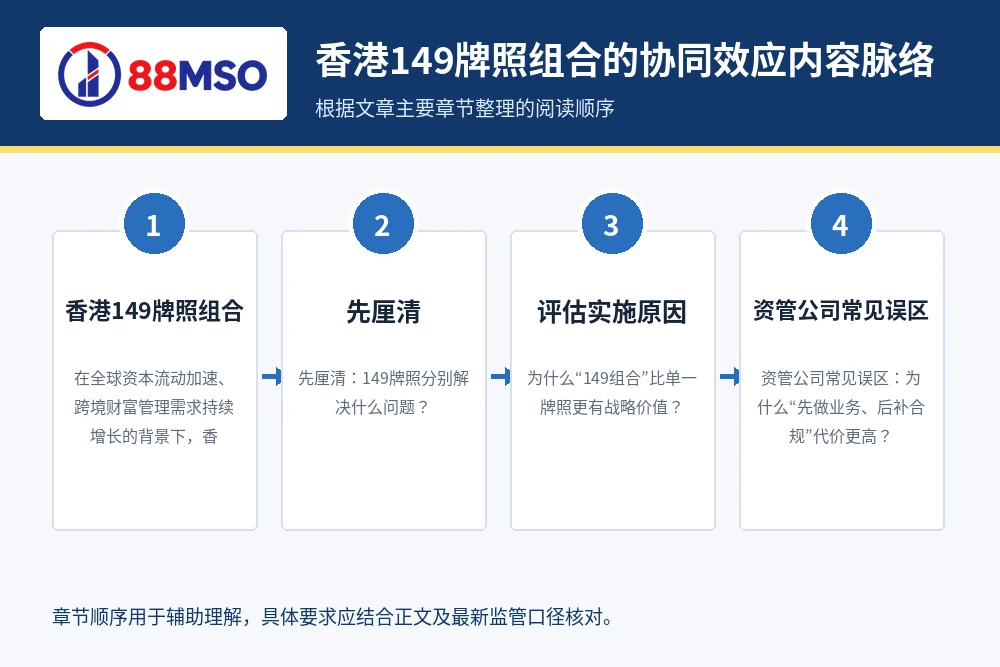
one、First clarify:What problems does the 149 license plate solve?
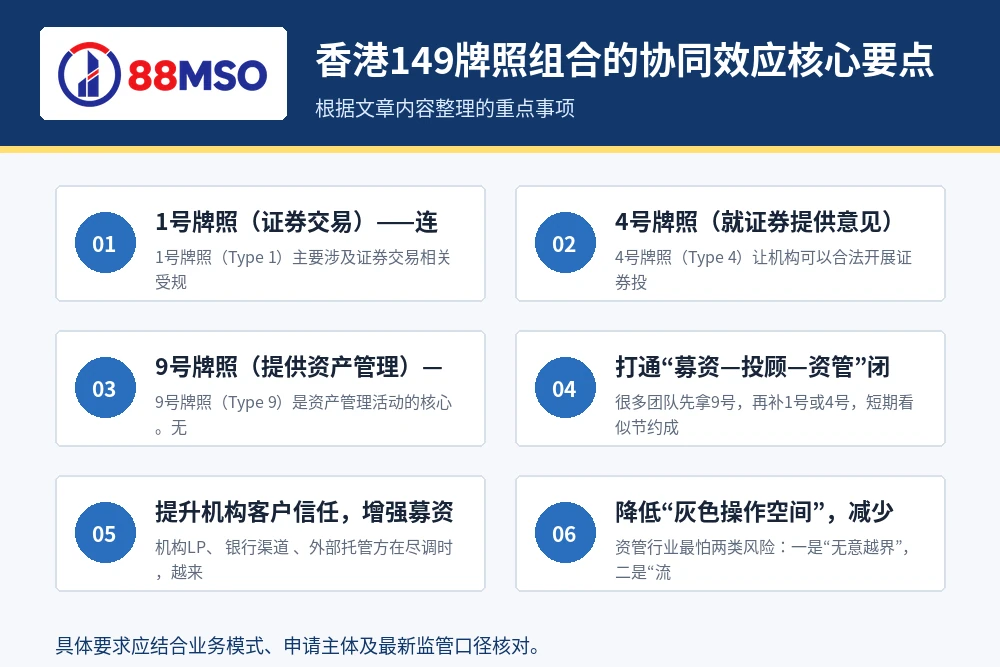
License No. 1 (Securities Trading) - Connecting Markets and Trading Capabilities
Type 1 license mainly involves regulated activities related to securities trading。For asset management companies,Its value is not just “whether it can be traded”,What's more:
- Support and Brokerage、channel、Institutional clients carry out more standardized business collaboration;
- Execute for certain strategies、Order routing、Trading arrangements provide a basis for compliance;
- Enhance the professional image and bargaining power of institutions in the capital market ecosystem。
License No. 4 (providing advice on securities)—Establishing compliance boundaries for “investment research output” and “consulting services”
Type 4 license allows institutions to legally carry out securities investment opinion-related activities。Its core significance lies in:
- Transform investment research results from “internal capabilities” into compliant products that can serve external parties;
- Support institutions to carry out investment consulting、strategic communication、Research services and other businesses;
- With high net worth clients、family office、When communicating with institutional LPs,Reduce the risk of “cross-border expression”。
License No. 9 (providing asset management) - the core license for asset management business
Type 9 license is the core of asset management activities。Whether it is a managed fund、discretionary portfolio,Or build a multi-strategy account system?,No. 9 license is usually the key threshold。It brings not only access qualifications,Even more:
- Statutory confirmation of treasury management responsibilities;
- risk control、Valuation、hosting、Supervisory constraints on the entire process including reporting;
- The trust endorsement of institutional brands in the professional investor market。
two、Why is the "149 combination" more strategically valuable than a single license?
1. Open up the closed loop of "fundraising-investment consulting-asset management",Reduce business breakpoints
Many teams take No. 9 first,Add number 1 or 4,Seems to save costs in the short term,However, in actual operation, it will be found that there are breakpoints in the business chain。For example:Can manage assets but cannot legally provide complete investment advisory services in certain scenarios,Or lack of corresponding license support when connecting channels,Resulting in limited customer experience and conversion efficiency。
The core advantage of 149 combination lies in the complete business logic:Front-end communication has boundaries,Mid-range recommendations are qualified,Back-end management has a grip。for institutions,This directly improves the replicability of the business model。
2. Improve institutional customer trust,Enhance fundraising and partnership capabilities
Institutional LP、Bank channel、During due diligence, the external custodian,Pay more and more attention to “license structure and business consistency”。If the organization relies on outsourced licensing channels or temporary cooperative arrangements for a long time,Often seen as unstable governance、Compliance flexibility is too great。149 combinations can significantly improve the impression of due diligence,Especially in the following scenarios:
- Institutional investor due diligence (ODD/DDD);
- Cross-border channel cooperation access;
- Product distribution and joint management negotiations。
3. Reduce "grey operating space",Reduce regulatory and reputational risks
The asset management industry is most afraid of two types of risks::The first is “unintentional crossing of boundaries”,The second is the “process gap”。Under a single license structure,Employees in marketing、road show、research release、It’s easy to step on the line when communicating with customers;After the 149 combination cooperated with the standardized system,,Can more clearly demarcate the boundaries of different activities,Reduce the probability of being questioned for "operating without a license" or "operating outside the scope"。
4. Allow flexibility for product innovation and cross-border expansion
Competition among asset management institutions in the future,Not just a competition for yields,It is also a competition of structural capabilities.。Can new strategies be rolled out quickly?、Adapt to new customer groups、Connect with new markets,Depends on whether the compliance framework is set up in advance。The 149 combination is equivalent to opening up the key interfaces first,Structure for follow-up funds、offshore platform、Cross-border distribution and joint investment advisory provide an institutional foundation。
three、Common misunderstandings among asset management companies:Why “do business first”、Is it more expensive to "comply with compliance later"?
Misunderstanding 1:Use the passage first to run,Will be formalized later
Channel mode can really shorten the time early on,However, in the middle and later stages, it is easy to have unclear customer attribution.、Insufficient information isolation、Issues such as blurred boundaries of responsibilities。Once regulatory inquiries or customer disputes occur,Traceability costs are extremely high。
Misunderstanding 2:Treat license application as a one-time item
Many teams underestimate the ongoing obligations after licensing。Hong Kong Securities and Futures Commission supervision emphasizes "continuous compliance",including but not limited to:
- Responsible Personnel (RO) and Core Function Configuration;
- Internal Control Manual、Transaction monitoring、Conflict of Interest Management;
- financial resource requirements、audit report、Regular declaration;
- record keeping、client suitability、Complaint handling mechanism。
If there is only "goal of getting cards",There is no “licensed operating system”,Subsequent maintenance costs will increase exponentially。
Misunderstanding 3:Just look at the application fee,Not looking at comprehensive compliance costs
What really affects the quality of operations,Not a one-time application fee,but the total compliance costs over the next three years.,including personnel stability、System execution、external audit、System tools and supervisory communication efficiency。The significance of one-stop planning,It is to incorporate these variables into the design at an early stage,Avoid “getting cards cheaply”、Expensive rectification”。
Four、One-stop financial compliance layout,Where exactly is the "station" located?
For asset management companies,One-stop service is not a “packaging agency”,Rather, it transforms regulatory requirements into operational、auditable、Scalable management system。The following five layers should usually be covered:
1) License plate structural layer:Match business model
First define who you are as a customer、what product、What channel,Then push back the license portfolio and business boundaries。The 149 portfolio is suitable for institutions that want to form a complete asset management service chain.,Instead of "take one first and then talk"。
2) Governance and personnel level:RO and key positions are sustainable
Supervision focuses on “who is responsible、How to be responsible、Whether it truly performs its duties?”。therefore,RO、Compliance、Risk control、operations、Finance and other positions cannot be assigned in name only,A responsibility matrix and substitute mechanism must be established,Avoid "single point of failure"。
3) System and process layer:Write rules into daily actions
Compliance manuals are not for archiving,but for execution。Customer access、Investment research and development release、investment decision、Transaction review、Valuation check、Information disclosure、Abnormal reporting,There should be traceable processes and trace-keeping mechanisms。
4) Technology and recording layer:Verifiable、traceable
in a regulatory environment,"Have done it" does not mean "can be proven to have done it"。mail、meeting minutes、Investment Committee Records、Risk alarm processing、Authorization approval log,All require systematic management,Ensure that evidence chains can be quickly extracted during audits and inspections。
5) Continuous maintenance layer:annual review、declare、Integrated change management
Many organizations are undergoing personnel changes、Equity adjustment、Ignore the reporting time when business expansion,Trigger unnecessary risks。Maintain license plate、annual review、Regulatory communication included in annual business plan,It is a standard feature of mature asset management platforms.。
five、149 portfolio and cross-border business:Why do asset management companies need “pre-compliance” more?
Currently, the goal of many managers is “Hong Kong license + overseas fund raising + multi-market allocation”。This type of model has higher requirements for compliance and consistency,Common challenges include:
- Differences in definitions of marketing and advisory conduct across jurisdictions;
- Cross-border data and customer information transfer compliance;
- Product Description、Unified language and standards for risk disclosure and investor suitability;
- Responsibility division and accountability mechanism under multi-agent collaboration。
If there is a lack of integrated design,It is easy for institutions to comply in a market、Another market steps down。The significance of the 149 combination is to first establish a solid base in Hong Kong.,extend outward。For teams planning global layout,Choose consulting agencies with practical experience to coordinate and promote,It is often more stable than "purchasing each link separately"、faster。
six、How to implement:A 6-step roadmap for asset management companies
- Step 1:Business diagnosis——Sort out customer types、Strategy scope、Charging model、channel path,Clarify the boundaries of regulated activities。
- Step 2:License plate and main body design——Determine whether combination 149 is applied for simultaneously、Phased application or merger and acquisition entry,And complete the design of corporate governance structure。
- Step 3:RO and core team set up——Assess the qualifications of the person in charge、Resume consistency、Arrangement of Residing in Hong Kong and Duty Performance Certification Mechanism。
- Step 4:Institutional documents and internal control system construction——Form an executable compliance manual、Risk control framework、Voting and transaction process、Information disclosure standards。
- Step 5:Application and communication management——High-quality preparation materials,Respond to regulatory inquiries with a unified approach,Shorten the cycle of repeated parts replacement。
- Step 6:Post-licensed operation and maintenance——Establish annual review、training、audit、Report、Long-term mechanism for change management。
in practice,The reason why 88MSO and the professional team behind it (such as the service system that has been deeply involved in Hong Kong’s financial compliance implementation for a long time) have attracted market attention,Not because of “agent speed”,Rather, it can translate regulatory language into executable business actions for enterprises.,Help organizations avoid detours,Improve the overall success rate from application to operation。
seven、Conclusion:149 is not a "license plate puzzle",It is the underlying project of asset management competitiveness.
The true value of Hong Kong’s 149 license portfolio,It’s not about “getting two more cards”,Rather, it lies in building a compliant operating system that is in sync with the asset management business model.。It allows organizations to raise funds、Investment research、A stable closed loop is formed between transactions and management,It also makes the business face supervision、audit、Be more resilient during market fluctuations。
For those who wish to operate in the long term、Cross-border expansion、For asset management companies that improve their institutional level,One-stop financial compliance layout is not optional,It’s a strategic necessity。System planning sooner,The better we can take the initiative in the future of tightening regulations and escalating competition.。
FAQ:The 4 issues that asset management teams are most concerned about
Q1:Is the 149 portfolio suitable for all asset management companies?
uncertain。If the business is limited to a single regulated activity,A single license may be sufficient。But if you plan to cover fundraising communications、The entire chain of investment advisory output and asset management,The 149 combination is usually more suitable for long-term development。
Q2:Can the 149 combination be advanced in stages?
Can,But we should first make an overall blueprint,Avoid subsequent structural rectifications caused by historical arrangements。Phased progress is not "split advancement",But "advance on the same goal path"。
Q3:Why is RO configuration always difficult?
Because RO is not just a matter of qualifications,It is also a matter of actual performance of duties.。Supervision pays more attention to “continuous responsibility”,Including stationing arrangements in Hong Kong、time investment、Professionally record and manage engagement。
Q4:What is the most overlooked risk after taking a card?
Ongoing maintenance。Many risks come from "relaxation after obtaining a license",If the declaration is delayed、Process execution interruption、Inadequate record keeping。It is recommended that license maintenance be included in annual KPI and governance meetings。