简体中文
简体中文 繁體中文
繁體中文 English
Hong Kong Asset Management License No. 9 (Dajiu vs Xiaojiu):Why does this watershed determine the upper limit of your business?
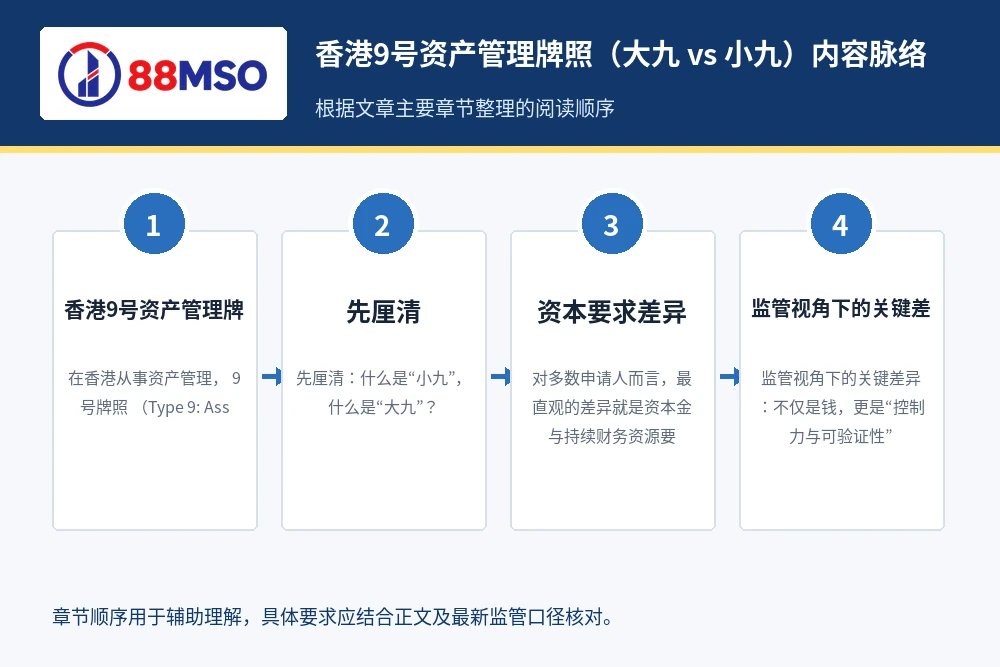
Engage in asset management in Hong Kong,No. 9 license plate(Type 9: Asset Management) is an almost unavoidable core license。But in practice,What the market often says"Big Nine" and "Little Nine",Not reallyHong Kong Securities and Futures Commission(SFC) official term,It is a popular distinction between different business models in the industry.:whetherhold client assets,Often the critical dividing point。
Many organizations in their initial planning,Just look at "whether you can get a license",Ignoring the subsequent capital pressure、Escrow arrangements、audit cost、Staffing、Difficulty in system construction and regulatory communication。There are two common results::First, “the selection of license plate types is broad”,Leading to long-term high fixed costs;The second is "the license plate structure is too small",Subsequent business expansion is limited,Re-architecting is more expensive。
This article will start from the regulatory logic、capital difference、organizational requirements、Common Misunderstandings and Application Strategies,System dismantling of the practical differences between "Big Nine vs. Little Nine",Help you make more robust decisions during the project establishment stage。
one、First clarify:What is "Xiaojiu",What is "Big Nine"?
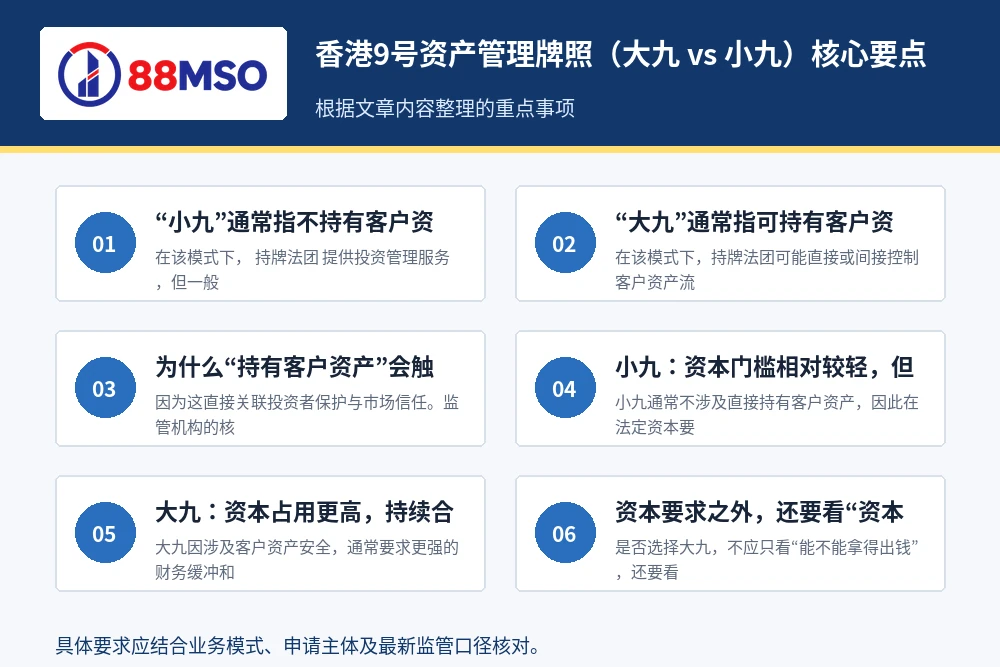
1) "Xiaojiu" usually refers to the No. 9 license structure that does not hold client assets
In this mode,Licensed corporations providing investment management services,But generallyNo direct contact or custody of client funds/securities。Client assets are usually held by an external custodian、Brokerage、Processed by trustee or fund administrator。Licensed companies focus on investment decisions、portfolio management、Research and risk control suggestions。
2) "Big Nine" usually refers to the No. 9 license structure that can hold customer assets
In this mode,A licensed corporation may directly or indirectly control the client’s asset circulation chain,Regulatory attention will increase significantly,Includes client asset segregation、trusteeship system、Authorization to sign、Reconciliation mechanism、Internal audit and exception handling processes, etc.。in other words,Once you encounter the question "Who owns the money and securities?",SFC review intensity will be significantly increased。
3) Why does “holding client assets” trigger higher regulatory thresholds?
Because this is directly related to investor protection and market trust。Regulators’ core concerns include:
- misappropriation risk:Customer assets are mixed with the company’s own assets。
- operational risk:Unclear authorization、System defects lead to misallocation or misallocation。
- Liquidity risk:There is a mismatch between customer redemption and actual asset dispatch。
- Compliance risk:Anti-money laundering、Transaction monitoring、Abnormal transaction reporting mechanism is not in place。
two、Capital requirement differences:The core financial threshold of Dajiu vs Xiaojiu
For most applicants,The most intuitive difference is capital and ongoing financial resource requirements.。Although the specific amount and applicable rules should be subject to the latest laws and case communication,But in practice it can be understood like this:
1) Xiaojiu:The capital threshold is relatively light,But it’s still not a “low-cost license”
Xiaojiu usually does not involve directly holding client assets,Therefore, the statutory capital requirements are relatively moderate.。Many entrepreneurial managers、Family office extension business、Boutique Strategy Management Company,Will start from Xiaojiu,To reduce initial capital occupation and operation and maintenance burden。
But be careful:Xiaojiu does not mean "light compliance"。SFC on the investment decision-making process、Conflict of Interest Management、Valuation policy、Risk disclosure、Suitability management still has strict requirements。Especially under cross-border fundraising and complex product strategies,The depth of compliance materials will not be significantly reduced due to "Xiaojiu"。
2) Dajiu:Capital usage is higher,Ongoing compliance costs rise step by step
Dajiu is involved in customer asset security,Typically requires stronger financial buffers and internal control systems。In addition to the higher capital requirements required during the application stage,After obtaining the license, you must continue to meet the liquidity requirements、net capital、Financial reporting and other regulatory requirements。If the business scale expands,background control、audit、System investment will also increase simultaneously。
In practice,Many institutions underestimate the "ongoing cost of big nine" - thinking that it is a one-time investment to get the license.,In fact, the real challenge lies in the subsequent "long-term stable operation"。
3) Beyond capital requirements,Also look at “capital efficiency”
Whether to choose Dajiu,Don’t just look at “whether you can make money”,It also depends on capital efficiency:
- Does your strategy really require self-sustaining client assets?
- Can the same business goals be achieved with an external hosting/administrator?
- Will the business be upgraded to require direct control of asset links in the next 12-24 months?
- Capital remains in the licensed company,Will it squeeze investment and market expansion budgets?
three、Key differences from a regulatory perspective:not just money,It’s more about “control and verifiability”
1) Customer asset separation and custody mechanism
Big nine,Supervision will focus on verifying whether client assets are completely separated from company assets,Are there clear hosting arrangements?、Account permission matrix、Double review mechanism、Daily/weekly reconciliation system and exception escalation process。Although Xiaojiu has less direct access to assets,However, it still needs to prove that its management instructions and execution chain are clear and traceable.。
2) Internal control and three lines of defense
Dajiu’s requirements for governance structure are more “substantial”:front desk、Risk control compliance、Internal audit/review whether the three lines of defense are truly independent、Whether to leave traces、Is it auditable?。SFC pays particular attention to the fact that "systems are not just hanging on the wall",But to be able to run.”。
3) Responsible personnel (RO) and core function configuration
Regardless of the big nine or the small nine,Responsible personnel (RO) must have corresponding qualifications and practical capabilities。But in big nine mode,RO must not only understand investment strategies,Also be able to explain client asset control、Risk isolation、emergency response process。In other words,Team structure should match business complexity。
4) Ongoing supervisory communication and reporting obligations
Big nine companies are making routine declarations、Changes in major matters、Audit communication is usually more frequent、more refined。If an abnormal event occurs (such as an operating error、Asset misallocation、system interruption),Reporting timeliness and remediation mechanisms will directly affect regulatory evaluation。
Four、Common business scenarios:Are you more suitable for Dajiu or Xiaojiu?
Typical situations suitable for doing "Xiao Jiu" first
- Strategy initial stage,Management scale is still small,Verify the product and fundraising model first。
- Already have cooperation with mature custodian banks/brokers,No need to directly hold client assets。
- Team resources are limited,We hope to build a “light asset + strong research” framework first。
- Business focuses on investment consulting and portfolio management,Not responsible for clearing and custody functions。
More typical of "Big Nine"
- Business models naturally require contact or control of customer asset flows。
- Integrated management by customer groups、Execution and account control have clear needs。
- The organization has a complete middle and backend、Audit and system capabilities,Able to undertake high regulatory requirements。
- Medium and long-term planning clearly requires multiple strategies、Multiple products、Cross-market management platform。
five、Frequent misunderstandings in application and landing
Myth 1:Take Xiaojiu first,Talk about it later
If your business model will trigger the need to hold customer assets within half a year,Doing Xiaojiu first may lead to repeated applications、Structural redo、Customer agreement re-signing,The overall time and cost are higher。
Myth 2:Dajiu just pays a little more capital
mistake。What Dajiu really adds isFull-link compliance operation costs,including institutions、personnel、system、Audit and regulatory communication skills。Capital is just the “ticket”,Not the full cost。
Myth 3:Templated documents can be used across all cases
SFC pays more attention to business substance and enforceability。Copy the template、Process does not match reality,Often exposed during the inquiry stage,Lengthening the approval cycle。
Myth 4:Ignore the rhythm of license maintenance and annual review
Getting cards is just the beginning。Ongoing compliance (including internal review、Personnel change record、Financial and Risk Reporting) is a long-term project。Many institutions are most likely to have compliance flaws due to unfamiliar processes in the "first year after obtaining the license"。
six、How to develop a more secure licensing path? an executable framework
Step 1:Do business “penetration diagram” first
flow of funds、instruction flow、settlement flow、Hosting flow is clear,Confirm whether you will actually access customer assets。Don’t just read the text of the contract,It depends more on the operational reality。
Step 2:Conduct business scenario testing for 12-24 months
Conservative、neutral、Calculation of three radical growth scenarios:management scale、Number of customers、product complexity、Staff expansion and system load。Determine whether Xiaojiu will "soon be out of use"。
Step 3:Synchronously design RO and compliance functions
License is not an isolated approval matter,But organizational capability verification。RO、Compliance、Risk control、operations、Finance needs pre-collaboration,Avoid “The application was approved,The team can’t handle the business”。
Step 4:Change "Application Successful" to "Sustainable Operation Successful"
The best solution is not the lowest threshold,It’s the threshold that matches your strategic stage.。True cost optimization,Is to reduce subsequent rework and regulatory friction。
seven、Conclusion:There is no absolute advantage or disadvantage between Dajiu and Xiaojiu.,Only the "fitness" level
Back to the core issue:Do you need to hold client assets?? This will directly determine the capital requirements、Depth of internal controls and long-term operating costs。For most institutions,The correct order should be:Decide on business model first,Redefining the license structure,Final capital and team allocation。
In Hong Kong’s regulatory environment,The application and maintenance of No. 9 license increasingly emphasizes “substantive compliance”。Professional team with cross-license experience,Often helps companies avoid path deviations in the early stages。Judging from 88MSO and its long-term service experience,The truly efficient solution is not “the fastest way to get a certificate”,Rather, apply from、Integrated design from implementation to annual review and maintenance,Ensure that enterprises expand steadily under the premise of compliance。
FAQ:4 practical questions about Hong Kong License No. 9 (Big Nine/Little Nine)
Q1:Is Xiaojiu completely prohibited from touching client funds?
The core principle is to avoid the factual state of "holding client assets"。The specific boundaries need to be combined with the account structure、Authorization Arrangement and Practical Operation Judgment,It is recommended to do legal and compliance confirmation during the design stage。
Q2:Take Xiaojiu first,Will it be difficult to upgrade Dajiu in the future?
feasible,But the difficulty depends on your existing governance structure and historical compliance record。If the early system leaves insufficient traces、Team configuration is weak,When upgrading, you will usually encounter many requirements for patches and rectifications.。
Q3:Does RO have to be in Hong Kong full-time?
Typically required to meet SFC requirements for competency、Requirements for performance of duties and supervisorability。Full time or not、Length of stay in Hong Kong、Reporting chain, etc.,Implementation should be combined with specific business forms and regulatory communication results。
Q4:Is Dajiu necessarily "more advanced" than Xiaojiu?
uncertain。If your business model does not require holding customer assets,Blindly doing big nine will only increase costs。"Appropriate" license plate is more important than "looking high-end"。