简体中文
简体中文 繁體中文
繁體中文 English
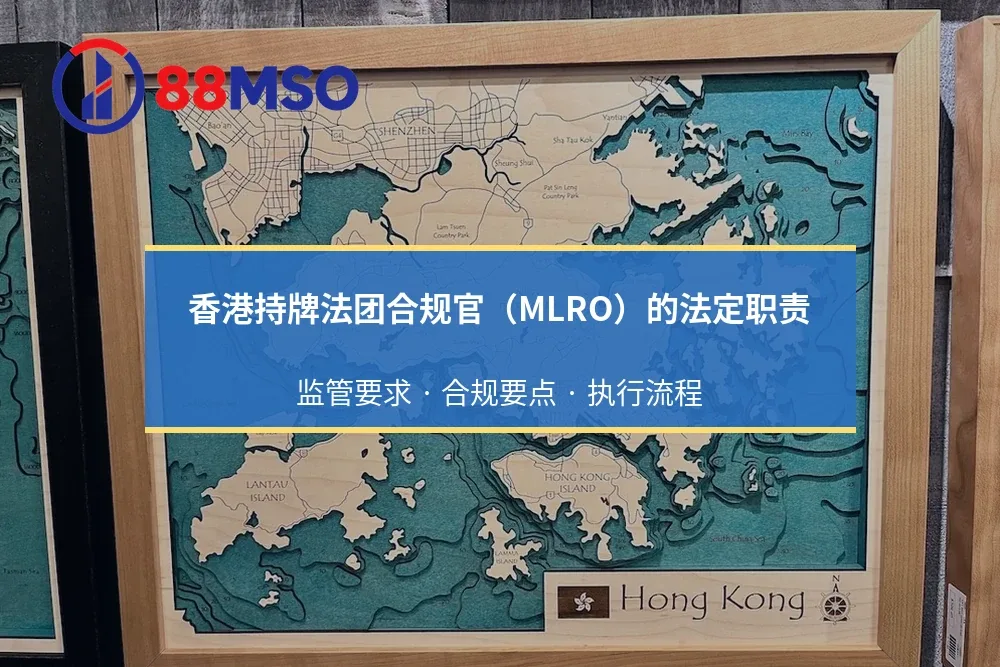
introduction:Why MLRO has become the “first responsible position” for compliance of Hong Kong licensed corporations
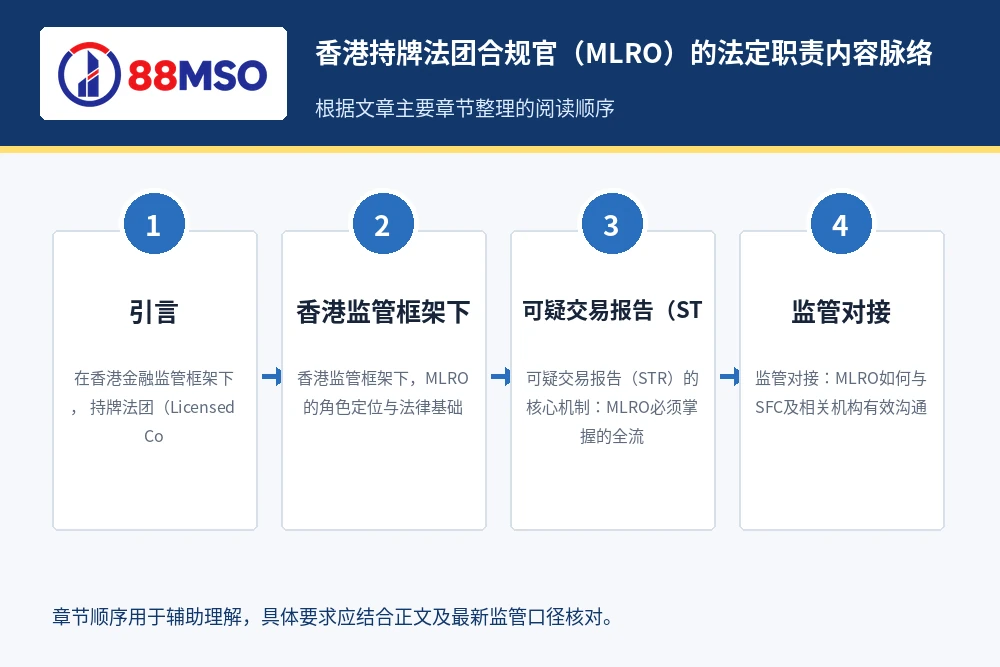
Under Hong Kong’s financial regulatory framework,A licensed corporation must not only pursue business growth,It is also necessary to continue to prove that it hasauditable、traceable、ExecutableofAnti-money laundering and counter-terrorism financing (AML/CFT) capabilities。In the past, many institutions viewed compliance as “backend support”,However, as regulatory enforcement becomes more stringent、Cross-border capital flows complicate、Cryptoassets and third-party payment ecosystem expansion,The compliance function has shifted from a “cost center” to a “bottom line”。
In this system,Compliance Officer (MLRO)is a key role。MLRO is not only the core node of the internal risk identification and escalation mechanism,It is also the institutions and regulatory agencies、Critical interface between law enforcement agencies,Especially reflected inSuspicious Transaction Report (STR)Handle and follow-up regulatory communications。If the MLRO fails to perform its duties properly,The risk does not stop at “documentation defects”,and may escalate to license risk、Director liability risks and even criminal risks。
This article will focus onHong Kong licensed corporationregulatory logic,An in-depth breakdown of MLRO’s statutory responsibilities in linking STR and regulation、operating standards、Common misunderstandings and optimization paths,Help management、RO、Compliance teams build a more robust compliance enforcement framework。
one、Under Hong Kong’s regulatory framework,MLRO’s role and legal basis
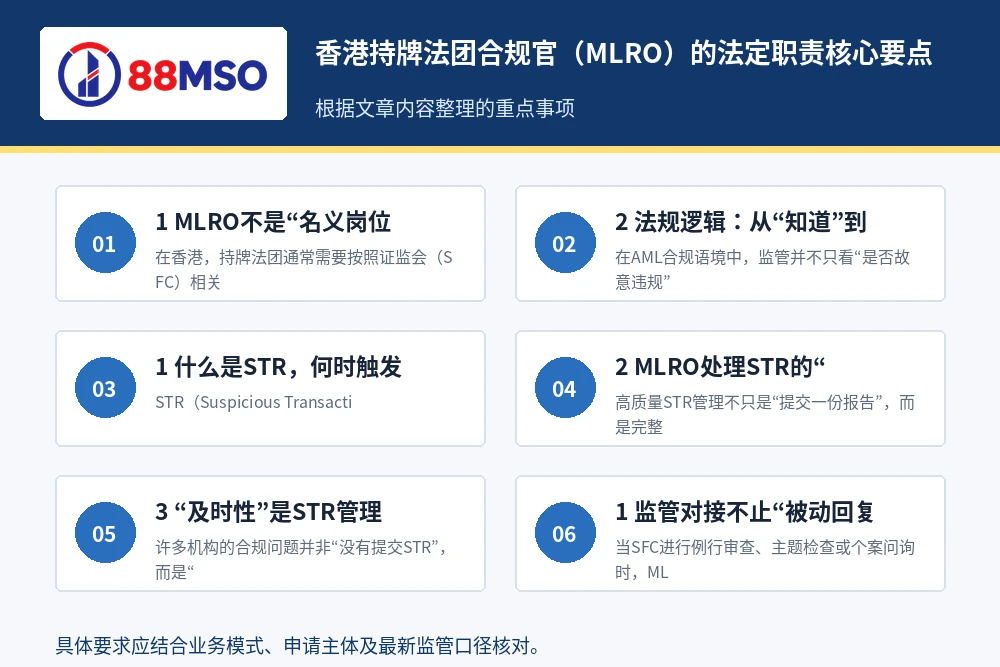
1.1 MLRO is not a “nominal position”,Rather, it is a position of real responsibility within the governance structure
in Hong Kong,Licensed corporations are usually required to comply withSecurities Regulatory Commission(SFC) Relevant Guidelines to Establish AML/CFT Framework。Although MLRO is not equivalent to the regulatory responsibility of RO (Responsible Officer),However, its duties have obvious “substantial performance” requirements.,include:
- Establish and maintain suspicious transaction identification、Report、Assessment and reporting mechanism;
- Coordinate internal abnormal transaction information flow and evidence chain management;
- Submit STR to Hong Kong Joint Financial Intelligence Unit (JFIU) when necessary;
- Liaise with management on high-risk cases、legal advisor、External audit and regulatory communication;
- Promote employee AML training and system updates,Ensure "systems and practices are consistent"。
1.2 Legal logic:Extension of responsibility from "know" to "should know"
In the context of AML compliance,Supervision does not only look at “whether there are intentional violations”,It also depends on whether the institution has established a reasonable system to identify risks.。That is to say,Even if there is no clear evidence of subjective malice,If the organization ignores abnormal signals for a long time、Failure to upgrade investigation in time、STR process idling,Both the MLRO and senior management may face severe accountability。
therefore,The core of MLRO's responsibilities is not to "judge correctly in every transaction",It's about establishing a demonstrable process:Have standards、There is a record、There is an upgrade、There is a review。
two、The core mechanism of suspicious transaction reporting (STR):The whole process that MLRO must master
2.1 What is STR,When is the reporting obligation triggered?
STR (Suspicious Transaction Report) is an organization's way of identifying customers、trade、When the source or destination of funds shows suspicious signs of money laundering/terrorist financing,Formal report submitted to JFIU。Trigger points are usually not "proven violations",But appearreasonable suspicion。
Common trigger scenarios include:
- Repeated changes to customer identity information,and unable to provide a reasonable commercial explanation;
- Transaction structure significantly complicated,Purpose does not match customer profile;
- Multiple split transactions in a short period of time are suspected of circumventing monitoring thresholds;
- High-risk jurisdictions have frequent capital flows and lack economic substance;
- Abnormal third-party payment and collection behavior,The capital chain has obvious breakpoints。
2.2 “Five-step closed loop” of MLRO processing STR
Quality STR management is more than just “submitting a report”,But a complete closed loop:
- first step:Internal reporting--front、operations、customer service、Risk control submits suspicious incidents through internal channels;
- Step 2:initial screening——MLRO checks customer files、transaction flow、KYC/CDD update status;
- Step 3:Upgrade investigation——Initiate enhanced due diligence (EDD) when necessary,Assess risk intensity and urgency;
- Step 4:Decision reporting——form written judgment,Decide whether to submit STR and whether to take account restriction measures;
- Step 5:Leaving traces and follow-up——Keep investigation records completely、Judgment basis、Communication minutes and follow-up monitoring arrangements。
For supervision,The most important thing is:What did you base your judgment on at that time? Is it adequately documented? Did you act in time?
2.3 “Timeliness” is a high-frequency enforcement point in STR management
The compliance issue for many institutions is not “failure to submit STR”,but "commit too late"。When abnormal transactions have continued to occur、Make a supplementary report only after the funds have been transferred across the border,Regulators will question the risk sensitivity of MLROs and management and the effectiveness of internal controls。
therefore,It is recommended that organizations set internal timeliness SLAs,For example:
- Complete the initial screening within 24 hours after the abnormal event is triggered;
- High-risk cases will be upgraded and evaluated within 48-72 hours;
- Submit STR “as soon as possible and without undue delay” after reaching filing threshold。
three、Regulatory docking:How does MLRO communicate effectively with SFC and related agencies?
3.1 Regulatory docking is more than just “passive reply”,It is also a demonstration of proactive compliance management capabilities.
When the SFC conducts a routine review、During subject inspection or case inquiry,MLRO is often the first communication window。Excellent regulatory docking should reflect three points::
- consistency:institutional text、System parameters、Employee rhetoric is consistent with actual execution;
- Verifiability:Documentary evidence for each judgment、Approval traces、Logging support;
- Improveability:There are rectification plans for historical issues、Milestones and Responsible Persons。
3.2 Key preparation checklist for MLROs in regulatory inquiries
It is recommended to prepare according to the three levels of "system-sample-evidence":
- Institutional level:AML policy、STR process、Customer Risk Rating Model、EDD standard;
- sample layer:Randomly select medium and high risk customer files、Past STR cases、Dismiss case;
- evidence layer:Training sign-in、System warning log、meeting minutes、Rectification tracking report。
Pay special attention to:Supervision usually conducts spot checks on cases where "STR has not been declared but there have been abnormal signals",To determine whether the MLRO is independent、prudent judgment。
3.3 Cross-departmental collaboration:MLRO cannot "fight alone"
The connection between STR and supervision involves front-office business、operations、technology、legal affairs、Internal Audit and Board of Directors。If the information island is serious,MLRO has strong professional capabilities,It is also difficult to form effective compliance results。In practice, the following mechanisms can be established:
- Monthly AML risk meeting (including RO、internal audit、IT、Business leader);
- "Pre-admission review" mechanism for high-risk customers;
- "24-hour escalation" system for major abnormal events;
- Quarterly Board Compliance Briefing,Ensure governance is informed and decision-making。
Four、Common misunderstandings:Why do many institutions “have systems but fail to comply with regulations”
4.1 Misunderstanding 1:Think of STR as a "formatting action"
Some institutions pursue "number of declarations",But ignore the quality of the report。If STR lacks trading background、Funding path、Timeline and reasoning logic,Limited substantial value,Instead, it exposes the organization’s lack of analytical capabilities.。
4.2 Misunderstanding 2:Over-reliance on system warnings,Ignore human judgment
Transaction monitoring system is a tool,Not a conclusion。If the threshold setting is rigid、The scenario model is not updated for a long time,Can lead to a lot of false positives/negatives。MLRO should regularly adjust parameters based on business model,And continue to optimize the rules through case review。
4.3 Misunderstanding 3:No "reverse verification" mechanism has been established
Many teams only review “declared STR cases”,However, transactions that were “undeclared but had triggered warnings” were not reviewed.。Supervision pays more attention to the latter,Because this best reflects whether the institution’s risk judgment boundaries are reasonable.。
4.4 Misunderstanding 4:Training becomes a mere formality
If the annual training stops at explaining laws and regulations,It is difficult for employees to identify anomalies in practice。It is recommended to use “scenario-based training”:
- How to deal with simulated customer rejection of replacement parts;
- Simulate the investigation path of high-frequency small-amount splitting orders;
- Simulate the data retrieval process during a surprise supervisory inquiry。
five、Practical suggestions:Build an implementable MLRO performance system
5.1 Institutional layer:Upgrading from "template system" to "business matching system"
The system should reflect the institution’s real business (such as wealth management、Securities Brokerage、Asset management distribution、Cross-border payment collaboration, etc.) and customer structure。The copy-and-paste system is most likely to expose vulnerabilities during inspections。
5.2 Data layer:Get through KYC、Transaction Monitoring and Case Library
The quality of MLRO’s judgment is highly dependent on data integrity。It is recommended to implement at least:
- KYC files and transaction data can be linked and searched;
- Early warning events can be traced to the processing status and responsible person;
- STR case database supports retrieval by risk type,Form organizational knowledge deposits。
5.3 Governance:Clarify board and senior management engagement
Supervision pays more and more attention to "Tone from the Top"。If the board of directors fails to review the AML report for a long time、Not tracking improvement progress,Easily deemed as governance failure。MLROs should promote regular review of key indicators by those charged with governance,For example:
- Changes in the proportion of high-risk customers;
- STR quantity and processing time;
- Overdue rate of unclosed case warnings;
- Training coverage and assessment pass rate。
5.4 External support:Introducing professional compliance advisors at complex stages
When an organization is applying for a license、business transformation、Regulatory rectification or cross-border expansion stage,Internal teams often face capacity and manpower bottlenecks。At this time, an external team with practical experience in financial compliance in Hong Kong is introduced.,Can accelerate system reconstruction and rectification closed loop。Professional organizations that focus on long-term service for Hong Kong financial license compliance (such as 88MSO/88MSO ecological service team) can usually provide system design、A one-stop solution from STR process optimization to regulatory communication support,Help enterprises reduce trial and error costs and improve execution certainty。
six、Conclusion:MLRO value,Not only in "compliance passed",More on "Business Sustainability"
In the operating reality of Hong Kong licensed corporations,The MLRO is in no way a “report submitter”,Rather, it is a key builder of risk governance and regulatory trust.。Connecting with supervision around STR,A truly mature organization will do three things::Early identification、Upgrade quickly、Heavy marks。Not only does this reduce the risk of law enforcement,It can further improve cooperative banks、The trust of institutional investors and international partners in corporate governance capabilities。
For companies that want to deeply explore Hong Kong and cross-border financial markets in the long term,Compliance is not the opposite of business,But business scale、Prerequisites for internationalization。Make the MLRO system deeper and more practical,It’s through the regulatory cycle、The underlying capabilities for steady overseas expansion。
FAQ:High-frequency questions about MLRO and STR
Q1:Does the MLRO have to submit a STR for every unusual transaction?
unnecessary。The key is whether "reasonable suspicion" is formed。But even if it is not submitted,Complete investigation records and reasons for non-declaration should also be kept,Facilitate follow-up audits and regulatory checks。
Q2:Do I have to terminate the customer relationship immediately after submitting the STR?
uncertain。Whether to continue services needs to be based on risk assessment、Comprehensive judgment of legal opinions and regulatory expectations。MLROs should avoid “one size fits all”,However, it is necessary to ensure that risks are controllable and continuously monitored。
Q3:How can small and medium-sized licensed corporations improve their MLRO execution capabilities?
Prioritize three things:Clarify the upgrade deadline、Establish a case review mechanism、Fill in the traces of evidence。Bring in external compliance advisors when necessary,Quickly build an AML operating system that matches your business。