简体中文
简体中文 繁體中文
繁體中文 English

U.S. SEC RIA registration:Federal vs. State Level Thresholds、Form ADV and annual return
Official verification update (August 2026):SEC and state-level investment adviser registration is not simply a hard demarcation of $100 million.。Current rules include mid-sized advisors、buffer、Category-specific and state regulatory differences,Before applying, you should make a case-by-case judgment based on the scale of assets under management and business type.。 For specific rules, seeU.S. Securities and Exchange Commission Investment Adviser Registration Information。
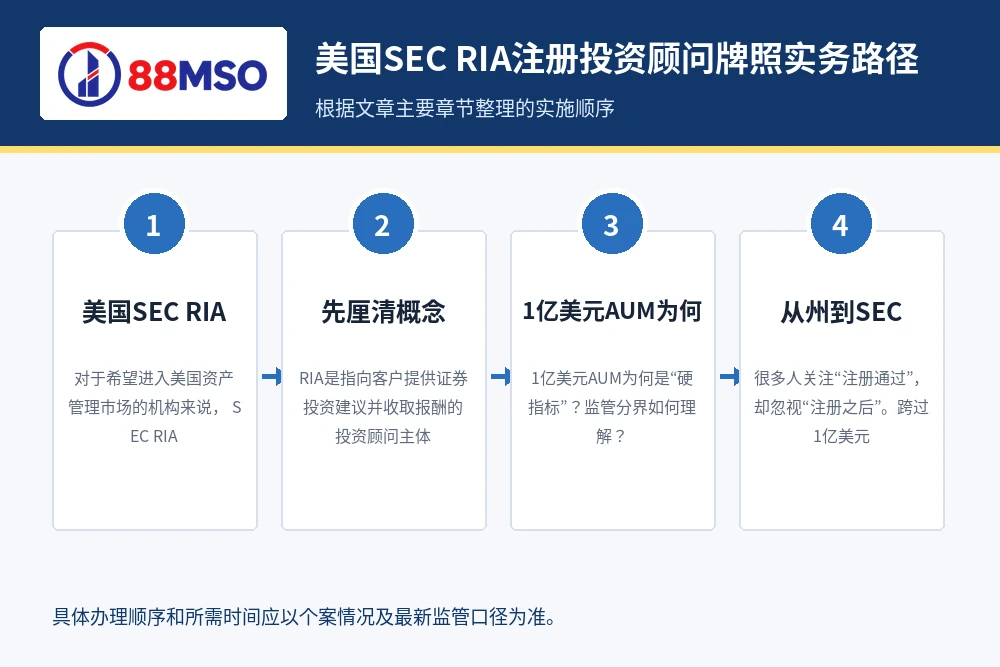
For institutions wishing to enter the U.S. asset management market,SEC RIA(Registered Investment Adviser)It is almost an unavoidable threshold.。The most common question many teams ask in the early stages is:Why is it “$100 million AUM”? Can’t you do it for less than $100 million? What additional annual reviews and continuing obligations will be added after exceeding the limit?
The key to these questions is not just "can I apply?",It’s about whether you understand the logic behind the U.S. regulatory framework:Regulatory layering、Information disclosure、fiduciary duty、Verifiable traces。If you just regard RIA registration as an "admission card",Rather than treating it as a continuously operating compliance system,Follow-up audit、examine、Customer disputes and business expansion,Risks will be amplified。
This article will focus on "US$100 million AUM hard target"and"Annual review obligations"Expand,Systematically sort out the regulatory focus of SEC RIA,And combined with common pain points of cross-border institutions,Provide a more enforceable path to compliance。For the simultaneous layout of Hong Kong andGlobal Licenseof enterprises,We can also learn from the idea of multi-jurisdictional collaborative governance,Establish a unified compliance center。
one、Clarify the concept first:What is a SEC RIA? How is it different from state-level registration?
RIA is an investment advisory entity that provides securities investment advice to clients and receives compensation.。U.S. regulation adopts a "federal + state" two-tier structure:
- SEC regulation (federal level):Usually suitable for larger scale、Consultants operating across state lines or qualifying for specific exemption pathways。
- State-Registered IA:Advisors with smaller AUMs or who operate primarily within a state often go through state registration first.。
In practice,Many institutions mistakenly believe that "SEC RIA must be higher than the state level"。in fact,The level of supervision is not “high or low”,It depends on the size of the business、Customer structure、Region and service type matching。What you should do is choose the registration path that best suits the current stage,And design a mechanism that can smoothly upgrade to the SEC level。
two、Why is US$100 million AUM a “hard target”? How to understand the regulatory demarcation?
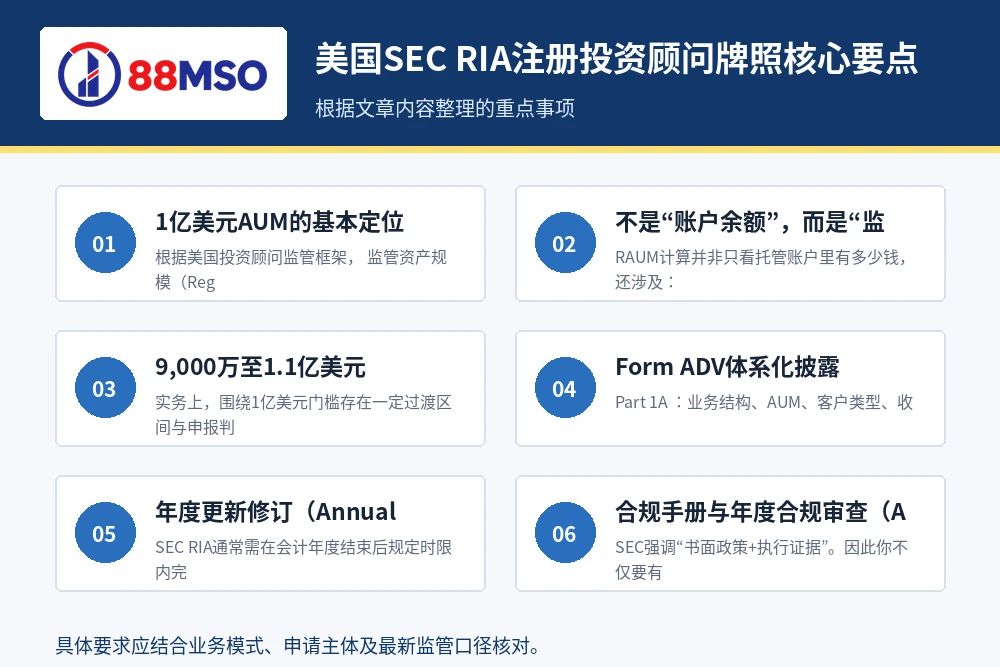
1. Basic positioning of US$100 million AUM
According to the U.S. investment adviser regulatory framework,Regulatory Assets Under Management, RAUM) reaches $100 million,Typically means the advisor should move to SEC level registration (when conditions are met)。This is not a simple marketing number,It is one of the statutory regulatory diversion thresholds.。
2. Not "account balance",But "regulatory caliber AUM"
The RAUM calculation does not just look at how much money is in the custody account,also involves:
- Whether it is a "continuous、Regularly managed” assets;
- Whether to include the creditable portion of non-discretionary accounts;
- Valuation caliber、Exchange rate conversion、Measurement time point consistency;
- Consolidation or splitting boundaries between related entities and consultant arrangements。
3. 9,000Awareness of the “buffer zone” of US$10,000 to US$110 million
In practice,There is a certain transition range and application judgment surrounding the US$100 million threshold.。Enterprises should focus on:Establish AUM monitoring and declaration simulation 6-12 months in advance,Instead of temporarily patching files at critical points。Cross-border teams should pay special attention to the "passive cross-border" problem caused by fluctuations in US dollar assets.。
three、From state to SEC:What new obligations do you really have after crossing the threshold?
Many people pay attention to "registration passed",But ignore "after registration"。After crossing $100 million AUM,The core change is the increase in regulatory intensity and information transparency requirements,Especially reflected in the following modules:
1. Form ADV Systematic Disclosure Requirements
- Part 1A:business structure、AUM、Customer type、TOLL、Structured data such as relationships;
- Part 2A/2B(Brochure):Narrative Disclosure to Customers,Covered services、cost、conflict、Discipline History、Key personnel information;
- Material Changes:Major changes require timely update and disclosure,"One-time filling at the end of the year" is not allowed。
The point is:ADV is not a "form-filling exercise",It is the core window for supervision and customers to understand your business model.,Content must be in accordance with the contract、Investment advisory process、Marketing materials consistent。
2. Annual Amendment
SEC RIA is usually required to complete the annual update of ADV within the specified time limit after the end of the fiscal year.。you need to make sure:
- finance、AUM、Customer classification is consistent with internal MIS;
- Disclosure text and new business of the year、New fee schedule synchronization;
- Historical version archives、Reasons for changes can be traced。
3. Compliance Manual and Annual Compliance Review (Annual Review)
SEC emphasizes “written policies + evidence of implementation”。So you not only need the Compliances Manual,We also need to do retrospective testing every year,For example:
- Transaction monitoring and Best Execution records;
- Conflict of interest management and employee personal transaction monitoring;
- Marketing Compliance (Performance、Testimonials、Third-party traffic);
- network security、Data permissions、Customer Privacy and Incident Response Process。
4. Account book records (Books & Records) and inspection response
SEC inspection is not a "provisional defense",It’s a sampling verification of your daily governance quality.。Common requirements include:
- Customer Agreement、Authorization file、Fee calculation draft;
- Investment decisions and trading instruction links leave traces;
- KYC due diligence、Risk assessment and appropriateness records;
- Advertising release approval、Version management、evidence archiving。
Four、Beyond annual review,4 high-risk points that cross-border institutions are most likely to ignore
1. Apply “overseas parent company logic” directly to U.S. entities
Common misunderstandings about cross-border groups are::The headquarters policy is very complete,However, the U.S. entity has not been localized.。The SEC is concerned about whether entities registered in the United States have independent enforceable mechanisms.,Rather than whether the headquarters PPT is perfect。
2. AUM calculation and expense accrual are not consistent
The front desk uses one caliber to display to the outside world.,Finance is billed according to another caliber,ADV is the third caliber again,This is a very sensitive issue in the inspection。It is recommended to establishsingle source of truth。
3. Marketing materials “advance publicity”
Especially in the age of social media,Teams are prone to expressing performance without compliance approval、Strategy implications or customer endorsements。Regulation is not against marketing,But the requirement of "real、Provable、Can be reviewed"。
4. AML/KYC is only for account opening,No continuous monitoring
Anti-money laundering in investment advisory business is not a one-time action。customer identity、beneficial owner、Source of funds、Trading behavior may change,Continuous due diligence and exception reporting mechanisms must be linked to investment research and operational processes。
five、How to build an “auditable” SEC RIA annual review system?
If you are approaching or crossing $100 million AUM,It is recommended to proceed with "quarterly compliance operations" rather than "end-of-year surprise":
Quarterly execution framework (recommendation)
- Q1:Complete the compliance review of the previous year、Gap rectification plan、ADV update preparation;
- Q2:Focus on testing transactions、Valuation、Charges and Conflict Management;
- Q3:Stress testing the consistency of marketing and information disclosure,Review supplier and outsourcing compliance;
- Q4:Summarize annual evidence chain,Prepare for next cycle of policy revision and training。
Three-tier responsibility mechanism
- Business front line:Responsible for truth、timely、Complete business data entry;
- Compliance and Legal Affairs:Responsible for rule interpretation、Process verification、Sampling testing and rectification tracking;
- Management:Responsible for resource investment、Accountability mechanisms and risk appetite decisions。
This mechanism is particularly important in multi-jurisdictional licensing groups。Take the typical customers served by 88MSO as an example,Companies often involve Hong Kong MSOs at the same time、SFC license or other overseas permission,If unified document standards can be established in advance、KYC tiered strategy and annual review calendar,Costs and friction when expanding across regions will be significantly reduced。
six、Collaborative thinking with Hong Kong and other offshore compliance systems
The realistic path for many asset management teams is the “U.S. + Hong Kong” two-wheel layout.。The key here is not to copy the system,but to establishmappable、convertiblegovernance structure:
- Customer due diligence:Unify underlying fields,Add differences by jurisdiction;
- Transaction monitoring:Unified risk classification,Setting thresholds and triggering actions by domain;
- people governance:RO/Compliance Officer/MLRO clear boundaries of responsibilities,Avoid "everyone is responsible = no one is responsible";
- regulatory communications:Create inquiry response template,Shorten cross-time zone evidence collection and explanation time。
seven、Conclusion:$100 million is not the end,It is a watershed in compliance capabilities.
Crossed $100M AUM,It’s not just a “scale upgrade” for U.S. RIAs,It is also a “governance upgrade”。What you face is not only more frequent information disclosure and annual review obligations,It is also about organizational transparency.、A comprehensive test of data consistency and fiduciary responsibility。
If you are planning a U.S. investment advisor license,Or it is already in the critical range of AUM,It is recommended to do three things as early as possible:Unified AUM caliber、Quarterly annual review preparation、Cross-jurisdictional compliance collaboration。Only in this way can "regulatory pressure" be transformed into "institutional credibility",Raise funds for follow-up、hosting、Channel cooperation and global expansion lay a more stable foundation。
FAQ:The 5 most common questions in practice
Q1:AUM less than US$100 million,Can’t we start investment consulting business?
uncertain。Many institutions can first register and legally operate according to the state-level investment advisory route.,Then transition to the SEC level based on scale and business changes.。
Q2:Can the asset scale of RAUM and external publicity be different?
Definition differences can exist,But there must be a clear statement of caliber,and internal finance、Compliance、Marketing must not contradict each other。
Q3:Is the annual review just about submitting the annual update of the ADV?
no。Also includes review of policy effectiveness、record sampling、training、Continuous work such as closed-loop rectification and management confirmation。
Q4:Which piece of work should cross-border teams make up first?
Prioritize the completion of “data and evidence chain”:No auditable records,No matter how good the system is, it cannot prove itself during inspections.。
Q5:When should external compliance advisors be brought in?
When you approach the $100 million threshold、Prepare to switch regulatory levels、Or when holding multiple licenses at the same time,External consultants can significantly reduce misjudgment and rework costs。