 简体中文
简体中文 繁體中文
繁體中文 English
US federal MSB license vs state MTL license:Why is this the first multiple-choice question for financial companies going overseas?
Pay for plans to enter the United States、money transfer、For companies in the digital asset exchange or related financial services market,The most common question to be asked is:"Is it enough for us to just do MSB registration? Or do we have to get MTL?"
This is not a simple "choose one" question,It's about the business model、Customer location、Capital flow path、Product form、Cost budget and systematic decision-making on future expansion pace。Many companies only saw that the federal MSB (Money Services Business) registration threshold was relatively low in the early stage.,Ignoring the rigid requirements of state-level Money Transmitter License (MTL) in actual operations,Finally, "Can register" appears?、The embarrassing situation of "difficult to develop business"。
This article will start fromApplicable business scope、regulatory logic、Application difficulty、ongoing compliance costs、Time cycle and practical pathComprehensive comparison in six dimensions,Help you determine in which scenario "MSB first" should be used、When is "MSB+MTL parallel" necessary?。For companies that want to steadily advance their North American compliance layout,This is also a key basis for developing budgets and roadmaps。
one、Clarify the concept first:What is the relationship between MSB and MTL?
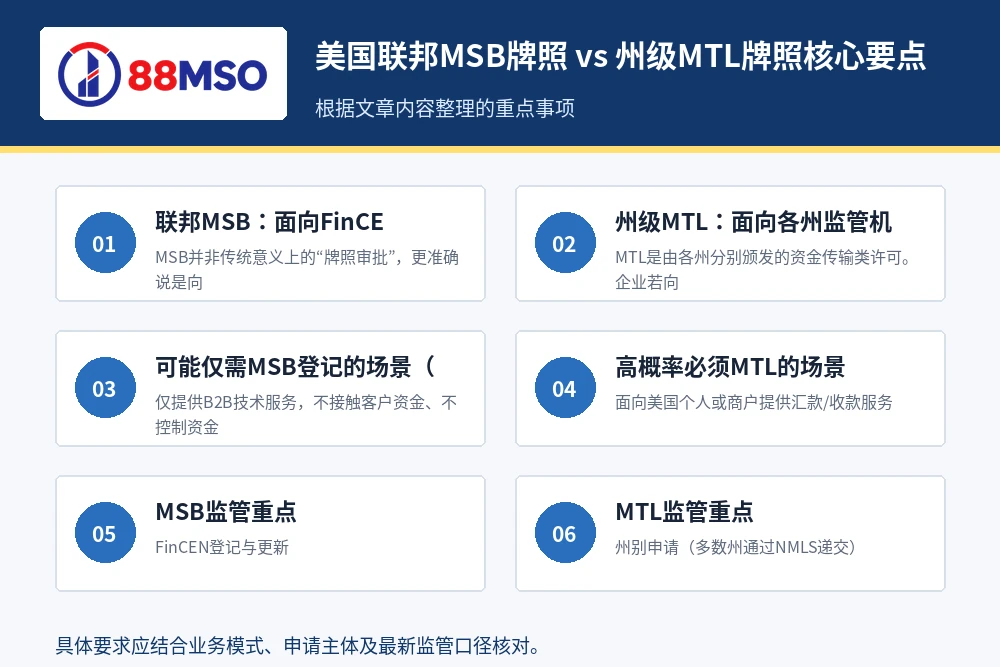
1) Federal MSB:“Registration and Anti-Money Laundering Obligations” for FinCEN
MSB is not a “license approval” in the traditional sense,To be more precise, it is registered with FinCEN, a subsidiary of the U.S. Department of the Treasury.,and fulfill anti-money laundering obligations under the Bank Secrecy Act (BSA)。Common coverage activities include:
- Currency Dealer/Exchanger
- Money Transmitter
- Issue or sell travelers checks、Money order, etc.
- Some virtual currency-related “value transmission” behaviors (depending on the business structure)
The point is:MSB addresses "Identity and AML obligations at the federal level",Does not automatically give you full qualifications to provide money transfer services in each state。
2) State level MTL:"License to Operate" for State Regulators
MTL is a money transmission license issued by each state.。If a business provides payment collection services to residents of a state、transfer、Wallet recharge、Collection and payment、Cross-border remittance and other services,Typically requires state MTL (whether exempt depends on state law definition and business structure)。
In short:MSB partial federal compliance base,MTL intra-state business access。The two are not mutually exclusive,Many modes need to be available at the same time。
two、Comparison of applicable business scopes:Which scenarios require only MSB?,Which ones require MTL?
1) Scenarios where only MSB registration may be required (requires specific demonstration)
- Only provides B2B technical services,No contact with client funds、No control over capital flow
- As a pure technology outsourcer (SaaS) of a licensed institution、Risk control tools)
- Business falls squarely within state law exemptions (heavy reliance on legal advice)
But be careful,Many companies consider themselves “technology platforms”,In practice, the definition of “receiving and transmitting monetary value” was touched upon.,Once recognized as Money Transmission,MTL requirements may still be triggered。
2) Scenarios with high probability of requiring MTL
- Provide remittance/receipt services to U.S. individuals or merchants
- Operating a stored value wallet、prepaid card、Account balance system
- Provide settlement for cross-border e-commerce、Share accounts、Pay on behalf of
- Exchange between legal currency and virtual assets and involving value transfer
- The platform participates in the clearing path as a "fund intermediary"
In practice,The most common misjudgments made by companies are:“We have partner banks / partner licensees,So no need for MTL”。actually,Whether you need MTL depends on your legal role and financial control,Rather than marketing propaganda。
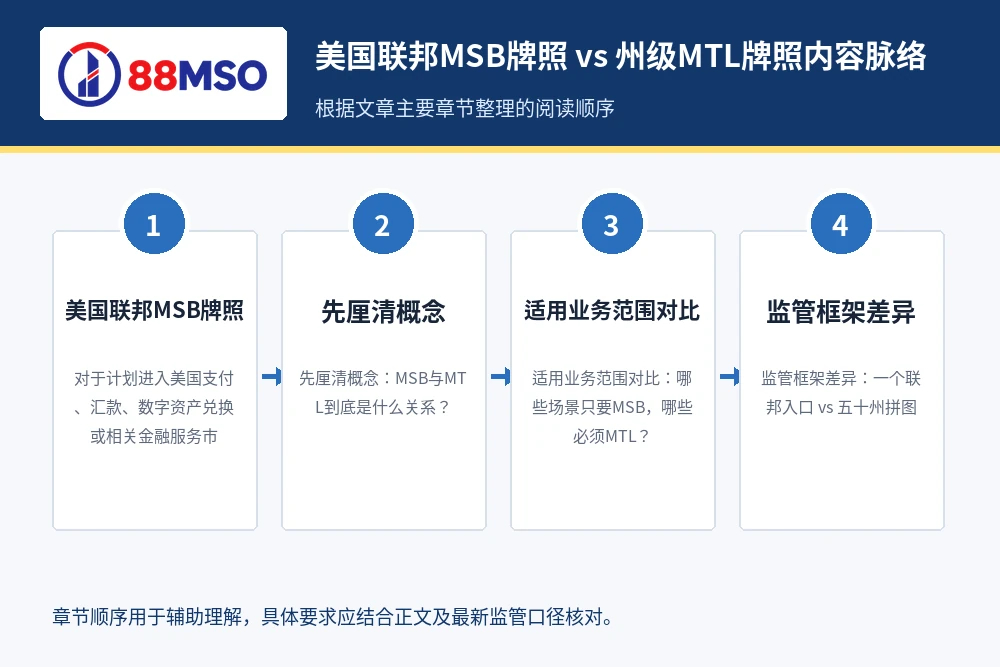
three、Differences in regulatory frameworks:One Federal Entry vs Fifty State Puzzle
1) MSB regulatory focus
- FinCEN Registration and Updates
- Establish and execute an AML compliance program
- Appoint compliance officer (often corresponds to MLRO responsibilities)
- Suspicious Activity Report (SAR) and Cash Transaction Report (CTR)
- staff training、Independent review and record keeping
The core of MSB is not that "everything will be fine once you get the certificate",Instead, continue to meet anti-money laundering penetration requirements.。
2) Key points of MTL supervision
- State application (most states submit through NMLS)
- Minimum net worth/working capital requirements
- Surety Bond
- Executive background checks、fingerprint、financial statements
- State Regulatory Report、Inspection and consumer protection obligations
Because standards vary from state to state,Enterprises often adopt the method of "obtaining state licenses in stages",Starting from the core states,Expand nationwide coverage。
Four、Comprehensive breakdown of compliance costs:Don’t just look at the application fee
1) One-time access cost
MSB:Registration costs are relatively controllable,But if you want to build a compliance system (system、monitor、training、review) still requires professional input。
MTL:In addition to the application fee,Often also includes legal advice、Audit materials、NMLS Process Fees、Background check cost,and state bond arrangements.。
2) Fund occupation and financial threshold
MTL has more direct requirements for capital strength,Especially when applying in parallel in multiple states,Margin and net asset thresholds will create significant financial pressure。For start-up teams,This part is often more important than "application service fee"。
3) Ongoing compliance operating costs
- AML systems and transaction monitoring tools
- KYC/KYB due diligence and list screening
- SAR/CTR submission process maintenance
- annual audit、State filing、License renewal annual review
- Compliance team (in-house or outsourced)
From experience,What really widens the gap is not the timing of taking the cards.,It’s the “stable compliance expenses” every year after getting the license.。
4) Hidden costs:time、Business delays and rectification risks
If the license plate path is incorrectly determined in the early stage,,Late draw、Refactor the contract、The cost of changing product processes is often much higher than the initial one-time planning expense。For cross-border platforms,The time window is the market window,Delay is its own cost。
five、Period and difficulty:MSB fast,MTL is slow and differentiates significantly
Generally speaking,MSB registration period is shorter;MTL varies from state to state、Material depth、Inquiry rounds and corporate governance maturity,Periods may vary from several months to longer。If you travel to multiple states at once,The difficulty of project management will increase significantly。
therefore,A common strategy is:
- first stage:Clarify whether the business constitutes Money Transmission,Complete MSB registration and AML base
- second stage:Apply for key state MTL by market priority
- The third stage:Partner with channels to expand state coverage based on user growth
six、The 5 most common misunderstandings among companies
- Myth 1:“With MSB, we can expand our business across the United States。"--mistake,In-state operations often require MTL。
- Myth 2:“We only do cross-border,No transfers within the United States。” – As long as it reaches state residents and involves value transfer,State regulations may still be triggered。
- Myth 3:"Go online first and then replenish cards。”——Some scenarios will trigger risk control interception by law enforcement and partners.。
- Myth 4:“Being affiliated with a partner means you are completely compliant.。”——The allocation of legal responsibilities and the actual control path need to be reviewed。
- Myth 5:“It’s over once you get the license.。”——Continuous compliance is the key to long-term competitiveness。
seven、How to choose:An implementable decision-making framework
Step 1:Drawing a clear picture of capital flows and legal roles
Who receives payment、Who keeps the accounts、who gives the order、Who assumes customer responsibility。Any design of “collection and payment” or “account balance” must first undergo regulatory mapping.。
Step 2:State implementation matrix
By user state of origin、Cooperation channel states、Settlement Node State Establishment Priority,Avoid resource imbalance caused by “one-time nationwide application”。
Step 3:Cost model front-end
The application fee will be、margin、system、Compliance manpower、Audit and license renewal included in three-year budget,Rather than just looking at first-year investment。
Step 4:AML capabilities precede marketing expansion
Transaction monitoring threshold、suspicious behavior rules、List screening、The case review mechanism should be formed before business volume starts。
Step 5:Establish "license + bank account + risk control system" linkage
Holding a license in the United States does not automatically equal smooth account opening。Banks and payment channels will reversely review your compliance maturity and historical submission quality.。
eight、Special reminder to Chinese and Asian overseas companies
Many Asian teams have strong product capabilities,But in the context of U.S. regulatory,The complexity of “federal-state dual-level regulation” is often overlooked。If your goal is long-term business rather than short-term testing,,It is recommended to build a scalable compliance architecture from the beginning:
- The business contract clearly clarifies the legal identities and responsibilities of each party
- Maintain auditable KYC/KYB、Transaction and risk control evidence chain
- Embed compliance triggers (limits、freeze、review)
- Plan ahead for multi-jurisdictional collaboration (US + Hong Kong + other offshore structures)
Judging from 88MSO and its long-term experience in serving cross-border financial customers,What enterprises need most is not “single license information”,RatherExecutable full-case custody ideas:Apply for a license、AML system、Bank account opening and subsequent annual review maintenance are placed on the same road map,Only in this way can compliance be transformed from a cost center into a business moat.。
FAQ:MSB and MTL high frequency issues
Q1:Do encryption related business,Is only MSB OK?
Depends on whether it constitutes value transfer and the regulatory caliber of the state where it is located。Many states adopt stricter interpretations of virtual currency activities,MTL or equivalent licensing arrangements are often required。
Q2:Get a few states first and then expand,Is it possible?
feasible,It is also a common strategy。The key is to ensure that actual business activities that trigger regulation do not occur in unlicensed states.。
Q3:Does MTL have to be obtained from all 50 states?
uncertain。Should be based on user distribution、Dynamic planning of cooperation channels and business paths,But core state coverage is usually unavoidable。
Q4:Which one should be built first, MSB or AML system?
should be promoted simultaneously。There is no operational AML mechanism,Even if registration is completed, it is difficult to support real trading scenarios。
Conclusion:Choosing the right compliance path,Growth will not “go fast first and then stop”
The U.S. federal MSB and state-level MTL are not simple substitutes.,It’s a compliance puzzle at different levels.:MSB is the basis for identity and AML obligations,MTL is the intrastate business access and consumer protection framework。If companies want to make cross-border payments、Long-term development in remittances or digital finance,“Applicable scope judgment + cost model + continuous compliance capabilities” must be designed as an integrated project。
When you put licensing strategy before products and business models,Many high later rectification costs、The risk of restricted channels and regulatory uncertainty can be resolved in advance.。For all teams preparing to enter the US financial market,this step,The sooner you get it right,Save more money、Save more time,The more stable the pace of growth can be。
Federal registration and state licensing need to be planned separately
Analysis of US Federal MSB License vs. State LevelMTL licensehour,A distinction should first be made between MSB registration at the federal level and state money transmission licenses。Whether a business requires a state license cannot just depend on the state in which the company is registered.,And it should be combined with the location of the customer、Fund transmission path、proxy network、Virtual currency activities and state definitions of related conduct are determined on a state-by-state basis。
State-level applications typically review the controller at the same time、business plan、Anti-Money Laundering System、financial statements、net worth、License investment、Guarantees of Guarantee and Company and Personal Data in NMLS。Guarantee amounts and ongoing reporting requirements vary by state and business size,Therefore the fixed amounts in the article can only be used as historical examples,The formal budget should be based on the current requirements of the target state。
Industry references:U.S. Financial Crimes Enforcement Network (FinCEN):MSB registration。
Read more:Detailed explanation of the tiered requirements for Money Transfer License (MTL) Surety Bond in each U.S. state、US MSB vs Canadian MSB license:Application threshold、Comprehensive comparison of compliance requirements and costs。