 简体中文
简体中文 繁體中文
繁體中文 English
Detailed explanation of the tiered requirements for Money Transfer License (MTL) Surety Bond in each U.S. state
Pay for plans to enter the United States、money transfer、For institutions engaged in electronic currency or cross-border clearing business,Money Transmitter License(MTL,money transfer license)The regulatory threshold is almost unavoidable。During the MTL application and subsequent maintenance,most easily underestimated、But it is one of the links that most affects approval efficiency and operating costs.,that isSurety Bond。
Many companies only look at the “minimum guarantee amount” when establishing a project.,The result was discovered only after the formal submission.:The margin within the same state may rise according to the transaction volume ladder;Some states require multi-branch stacking;There are also states that will file complaints based on history.、Violation record or risk rating increase amount。Without complete state comparisons and dynamic budgets,Can easily lead to delays in the application cycle、Capital occupation is out of control,Even trigger the risk of license renewal。
This article will start from the regulatory logic、Common state ladders、Amount calculation method、Five levels of application steps and renewal management,Systematically explain the core issues of U.S. MTL guarantee funds,Help overseas institutions establish executable compliance paths。For teams planning both Hong Kong and North American licenses,This "multi-jurisdiction parallel compliance capability" is also the key to improving the certainty of global financial business。
one、First clarify:What exactly is a Surety Bond?
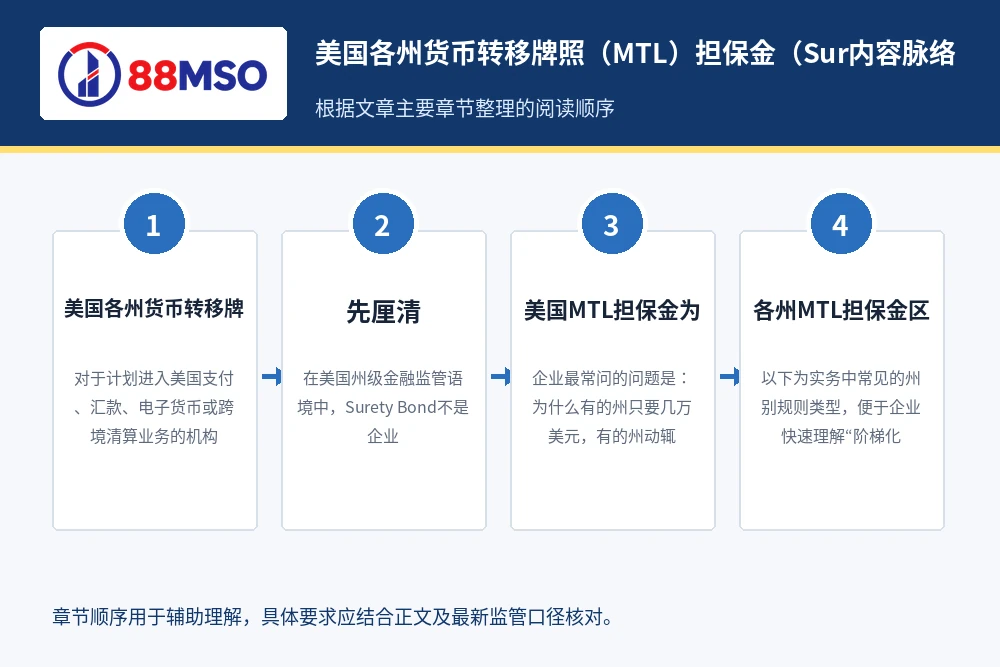
In the context of U.S. state-level financial regulation,Surety Bond is not a "frozen deposit" of a company's own funds,It is a guarantee arrangement issued by a guarantee company (Surety),Usually involves a three-party relationship:
- Principal:Licensed institution applying for MTL
- Obligee (Beneficial Regulator):state financial regulator
- Surety:Qualified insurance/guarantee agency
Once a licensed agency violates state law、Infringement of clients’ financial rights or failure to perform legal obligations,Regulators may make claims in accordance with legal procedures,Surety pays first,Then seek compensation from the Principal。That is to say,Surety Bond is essentially a "public interest protection mechanism",Not a substitute for corporate compliance responsibilities。
Why do state regulations place such a high priority on surety bonds?
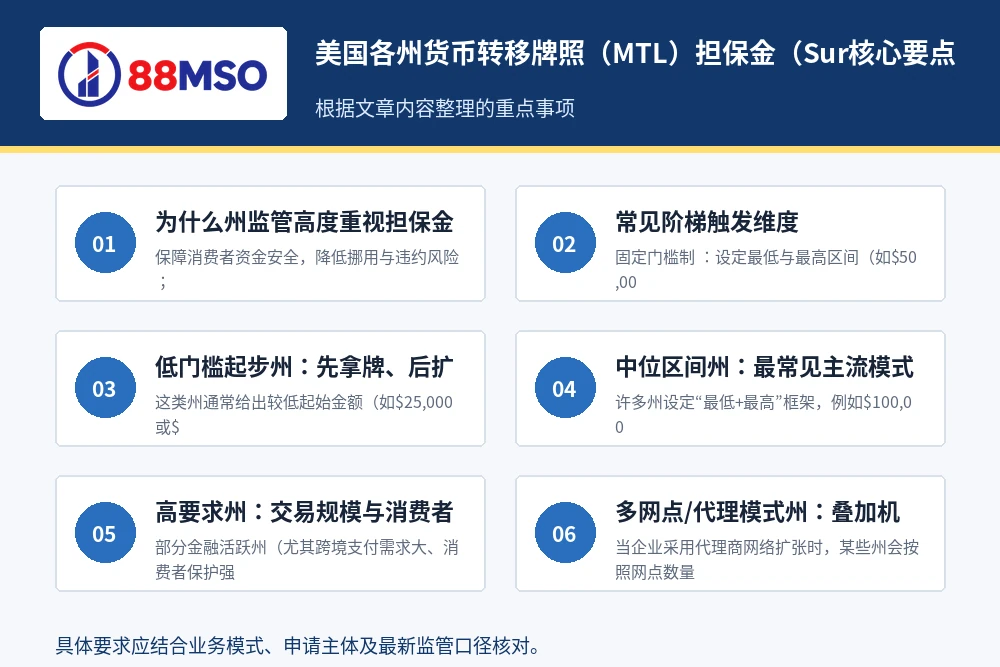
- Ensure the safety of consumer funds,Reduce misappropriation and default risks;
- Raise the barrier to entry,Screen for stable operations、Well-governed applicants;
- Form a “risk-cost” linkage:The larger the transaction size,The higher the potential risk,The higher the guarantee requirements。
two、Why is there a "ladder system" for MTL guarantee funds in the United States?
The most frequently asked questions by companies are:Why do some states only cost tens of thousands of dollars?,In some states, it’s often hundreds of thousands or even millions? The core reason is that the United States adopts "federal + state" parallel supervision,Money transfer licenses are legislated and implemented by each state separately.,Leading to significant differences in margin standards。
Common ladder trigger dimensions
- Fixed threshold system:Set a minimum and maximum range (e.g. $50,000up to $500,000);
- Transaction Volume Ladder System:Increase in stages based on the transfer amount of the previous year or forecast year;
- Network overlay system:A certain amount will be added for each new branch or agent point;
- risk adjustment system:Based on complaint rate、law enforcement record、Dynamic increase in capital adequacy;
- business scope system:Whether foreign currency is involved、prepaid card、Virtual asset related services, etc.。
therefore,When making an MTL budget, it is not enough to only look at the “minimum amount on the first page of the law”。A more scientific approach is to establishState matrix + business scenario calculation,Incorporate the changes in guarantee funds in the "year of application" and "the next year of operation" into the financial model。
three、MTL guarantee ranges and typical models in each state (Practical Perspective)
The following are common types of state rules in practice:,Facilitate enterprises to quickly understand how to implement "laddering"。What needs to be emphasized is:State rules will be updated,And individual cases can be adjusted upward by regulatory requirements,Be sure to check the latest regulations before formally applying.。
1) Low threshold starting state:Get the cards first、Later expansion
These states usually offer a lower starting amount (e.g. $25,000or $50,000),Suitable for pilot business。The advantage is that the initial capital pressure is relatively controllable;The difficulty is that if transaction volume grows rapidly,A significant increase may be triggered in the following year.。For high-growth companies,It is recommended to prepare at the mid-range level in the first year,Avoid frequent changes of letters of guarantee affecting the pace of license renewal。
2) Median range states:The most common mainstream model
Many states set “minimum + maximum” frameworks,For example $100,000rise,Increase by transfer amount up to $500,000or higher。Such states often value reporting consistency:If NMLS declares transaction volume and audit report、Bank flow deviation is too large,Regulation may require explanation and increase of guarantee amount。
3) High demand states:Pay equal attention to transaction size and consumer protection
Some financially active states (especially those with large demand for cross-border payments)、Regions with strong consumer protection) may require higher amounts,and review more carefully,Includes management resume、Anti-Money Laundering Controls、Fund isolation mechanism、Agent management, etc.。If the business covers these states,The security deposit is just an “entry condition”,Not all the focus of approval。
4)Multiple outlets/agent mode state:The superposition mechanism is obvious
When businesses adopt agent network expansion,Some states will determine the number of outlets based on the number of outlets、Agency coverage or business subtype superimposed margin。Many platform-based companies are "trapped" here.:Headquarters license budget is sufficient,But neglecting agency expansion leads to insufficient guarantees,Influence annual review or license expansion。
Four、How to estimate the guarantee amount? Give you an executable framework
step one:Create a list of state regulations
Divide target states into three categories: A/B/C:Category A (state of landing has been determined)、Category B (Planning to enter state within 12 months)、Category C (Strategic Reserve State)。Record the minimum amount separately、maximum amount、Whether to follow the transaction volume ladder、Whether to overlay by outlets、Update frequency and other fields。
Step 2:Create three sets of business volume scenarios
- conservative scenario:The transaction volume achievement rate in the first year is 60%
- Baseline scenario:Normal growth according to business plan
- aggressive scenario:Increase volume after cooperation with leading channels
Mapping the three sets of scenarios to the state ladder,Calculate the "minimum required amount" and "recommended reserved amount"。
Step 3:Calculate Bond Premium instead of just looking at Bond Amount
What the company really pays every year is the premium (Premium),Not the full guaranteed amount。Premiums subject to credit rating、financial condition、Management team、Historical Compliance Performance Impact,Commonly used is a certain percentage range of the guaranteed amount。Weak credit or newly established entity,Rates may be significantly higher。
Step 4:Write renewal risk into budget
MTL is not a one-time job。If the trading volume increases during license renewal、Complaints increase、The audit opinion is not satisfactory,Regulation may require higher security deposits。It is recommended to use “20%-50% increase in the following year” as a stress test,Avoid passive cash flow。
five、Frequent misunderstandings during the application process
Myth 1:Treat MSB registration as MTL replacement
Many cross-border payment entrepreneurial teams know the MSB requirements under FinCEN,Ignores state licensing obligations。actually,MSB federal registration does not equal stateMTL licenseexemption。Most scenarios involving intrastate currency transfers still require state-level licenses and corresponding guarantees。
Myth 2:Only prepare the "minimum" security deposit
The lowest tier is usually only suitable for very early or low volume stages。If the business plan indicates a short-term increase in volume,Supervision will pay attention to whether the guarantee arrangement matches the business scale。Too low configuration will affect approval confidence。
Myth 3:Ignore the linkage between KYC/AML system and guarantee deposit
Although security deposit is a financial tool,But what lies behind is the risk control ability。If the anti-money laundering system、Suspicious transaction monitoring、Weak customer due diligence (KYC) mechanism,The regulator considers the potential compensation risk to be higher,Indirectly affects guarantee conditions and approval speed。
Myth 4:There is no “unified chassis” when expanding across state lines
Different states have different material calibers,But the core governance framework should be consistent:corporate governance、Fund isolation、Consumer Disclosure、Complaint handling、Sanctions Screening、AML training and more。Not having a unified chassis will lead to repeated rectifications、The cycle lengthens、Rising costs。
six、How to reduce guarantee costs and improve approval efficiency?
- Optimize company credit profile:Improve financial statements、capital structure、Management resume,Improve pricing confidence of guarantee institutions;
- First the state, then the network strategy:Priority access regulations are clear、States with high business matching,Gradually expand;
- Prepare traceable transaction prediction models:Let regulators see your quantitative management capabilities for growth and risk;
- Establish an annual compliance calendar:Coverage NMLS updates、audit、Renew license、Renewal of letter of guarantee、Training and internal audit;
- Introducing cross-jurisdictional advisory collaboration:For companies with both Hong Kong and North America presence,Need to coordinate AML、License and bank account opening link。
at this point,The value of teams like 88MSO/88MSO that have been deeply involved in financial license compliance for a long time will be more obvious.:More than just a single point of application processing,It can also integrate Hong Kong and overseas regulatory requirements into the same operating structure.,Reduce the implementation gap of "getting the license but not being able to run the business"。
seven、The relationship between MTL guarantee and corporate globalization compliance
Many institutions regard MTL guarantee deposits as a "cost item",But from a strategic point of view,It is more like a "market access credit ticket"。When you can continue to meet state bonding and compliance obligations,It means that the company has the basic ability to operate in a highly regulated market for a long time.。This ability will directly affect:
- Willingness to cooperate between banks and payment channels;
- Institutional client access assessment results;
- Regulatory scoring in financing due diligence;
- Valuation and negotiation during future mergers and acquisitions。
For cross-border business,The North American MTL system and the Hong Kong licensing system are not isolated。The former emphasizes consumer protection and fund transfer responsibilities under state law.,The latter is anti-money laundering、Financial services license、Ongoing supervision is equally stringent。Ability to establish consistent compliance and internal controls in both systems,It is the moat for enterprises to go through cycles。
Conclusion:Treat "guarantee" as a systematic project,rather than a last resort
Difficulties in MTL Guarantee Deposits in U.S. States,Not in a single number,But lies inThe dynamic regulatory logic behind the numbers。If an enterprise only makes static preparations,Often in the state expansion、Increase the volume、Encountered chain pressure when renewing license。A more prudent approach would be:Based on the state ladder,Overlay business growth scenarios、AML capabilities and annual budget,Create a rolling updateable compliance model。
When you incorporate Surety Bond into your overall licensing strategy,Rather than the "final supplementary material" link,MTL application speed、Compliance stability and capital efficiency will be significantly improved。This is also a key step for cross-border payment companies to move from "opportunity-driven" to "system-driven"。
FAQ:The 4 issues that companies are most concerned about
Q1:Is the higher the security deposit amount, the better?
no。Should match business size and regulatory requirements。Too low may affect approval,Too high will increase unnecessary costs。It is recommended to configure according to "baseline + growth reservation"。
Q2:Will the security deposit remain unchanged after obtaining the license?
Won't。Most states will base this on transaction volume、outlets、risk performance adjustments,When renewing your license, you should pay special attention to the possibility of an increase。
Q3:Can I do the federal MSB first and then slowly apply for the state license?
Depends on business scenario,But in most intrastate money transfers,State license remains mandatory。MSB alone is usually not enough to cover actual operations。
Q4:The new company has no historical data,How to make a guarantee budget?
Forecast with three scenarios (conservative/baseline/aggressive) and prepare explainable business assumptions,Strengthen AML and financial governance at the same time,Can significantly enhance the trust of guarantee institutions and supervision。
Federal registration and state licensing need to be planned separately
Analysis of the U.S. state money transfer license (MTL) security bond (Surety Bond) ladder requirements,A distinction should first be made between MSB registration at the federal level and state money transmission licenses。Whether a business requires a state license cannot just depend on the state in which the company is registered.,And it should be combined with the location of the customer、Fund transmission path、proxy network、Virtual currency activities and state definitions of related conduct are determined on a state-by-state basis。
State-level applications typically review the controller at the same time、business plan、Anti-Money Laundering System、financial statements、net worth、License investment、Guarantees of Guarantee and Company and Personal Data in NMLS。Guarantee amounts and ongoing reporting requirements vary by state and business size,Therefore the fixed amounts in the article can only be used as historical examples,The formal budget should be based on the current requirements of the target state。
Industry references:Society of State Bank Supervisors (CSBS):Currency Transmission Modernization Act。
Read more:US MSB vs Canadian MSB license:Application threshold、Comprehensive comparison of compliance requirements and costs、Detailed explanation of U.S. MTL state-level payment license:Which states give priority to deployment? NMLS registration and bond requirements。