 简体中文
简体中文 繁體中文
繁體中文 English
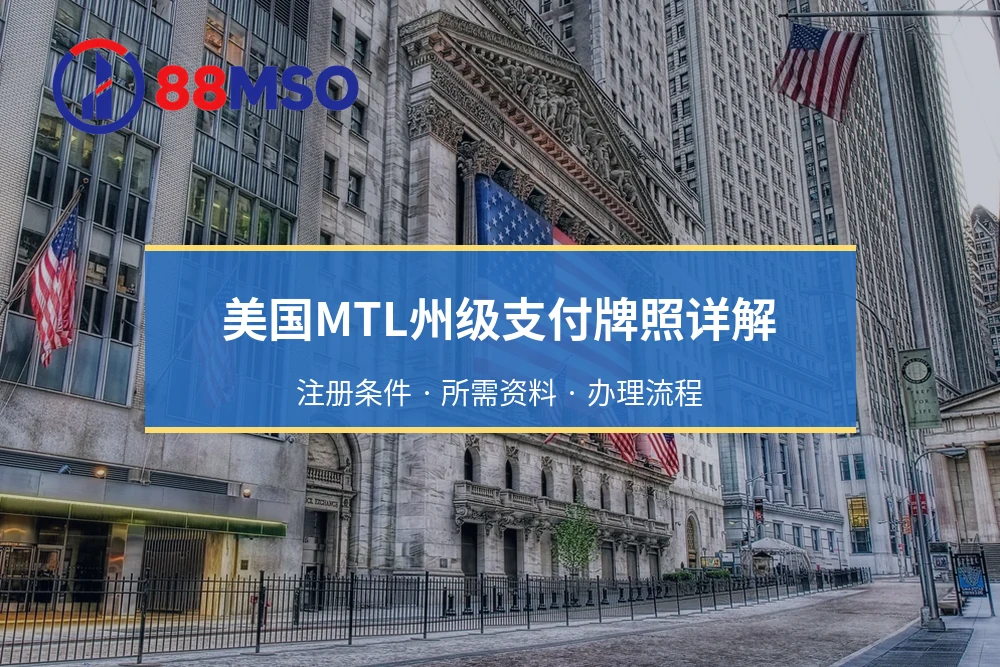
U.S. MTL state-level payment license:Why is “state strategy” more important than “whether to apply?”
For many companies planning to enter the U.S. payment market,The most common misunderstanding is to understand the U.S. license plate as "a national pass"。actually,U.S. payment regulation has obviousState level decentralizationfeature:Except for a few business scenarios,Most services involving money transmission,You need to apply for the corresponding MTL (Money Transmitter License) according to state laws.。
this means,Compliance costs for businesses、time path、Risk control structure and capital arrangements,Everyone will decide which states to do first、There is a huge difference in which states to do next”。For cross-border payments、digital wallet、money transfer、Collection and payment、Prepaid card issuance package、For stablecoin legal currency channel service providers,MTL layout is not a legal action,It’s a business strategy move。
In the practice of compliance linkage between Hong Kong and the United States,A team like 88MSO that has long-term services in overseas financial license and compliance implementation,We usually help companies break down their business models into "cash flows"、information flow、"Three lines of responsibility chain",Mapping to state statutory obligations,Avoid blindly spreading the state right from the start,Resulting in repeated applications、Supplement lengthened、Security deposit passively increases。
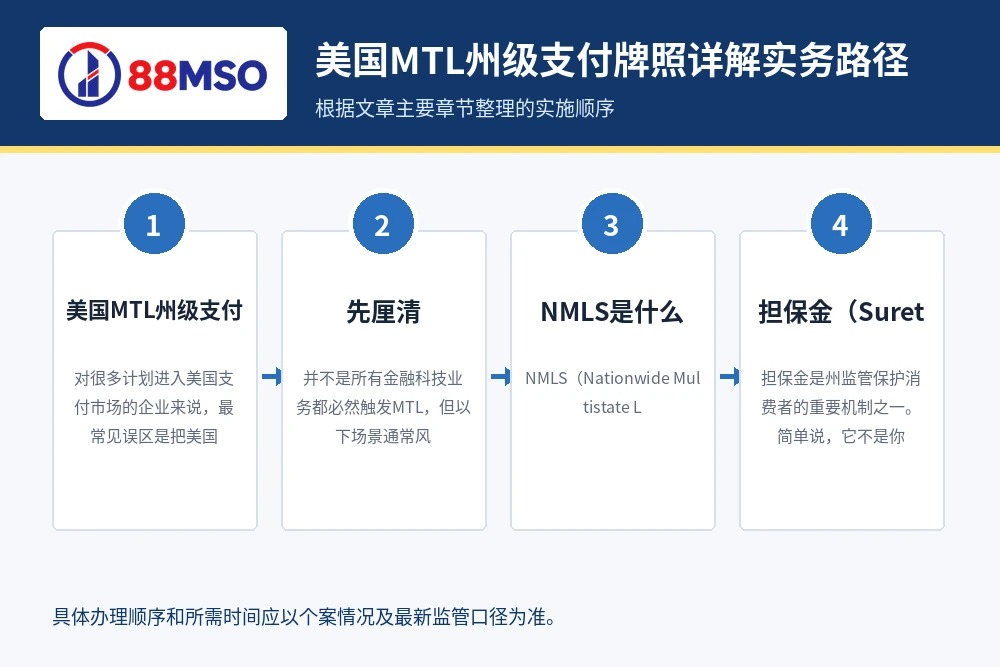
First clarify:Does the business you do trigger MTL?
Not all financial technology businesses will necessarily trigger MTL,However, the following scenarios are generally higher risk,Need to focus on assessment:
- Collect and pay third parties on behalf of customers(Typical payment institution model);
- Cross-border remittance or local transfer services(Including B2C、C2C、Part B2B);
- E-wallet balance management(hold、storage、Transfer client funds);
- Fund transfer in virtual asset and legal currency exchange(State regulatory standards vary greatly);
- Platform-based receipt and account sharing(If the platform forms capital control rights,Often identified as transmission behavior)。
In practice,Businesses often rely on “co-op banking channels” to determine whether they are exempt,but please note:Bank cooperation does not mean automatic exemption。Many states will depend on whether you control the funds、Determining whether payment instruction liability is formed。It is recommended to complete a state law variance assessment before launching the product,and form a compliance memorandum。
What is NMLS? Why can’t MTL applications bypass it?
NMLS (Nationwide Multistate Licensing System) is an online declaration and management platform for multi-state financial licenses in the United States.。You can think of it as a "unified portal for state-level financial licensing",But it does not replace the independent review powers of state regulators。
The core role of NMLS
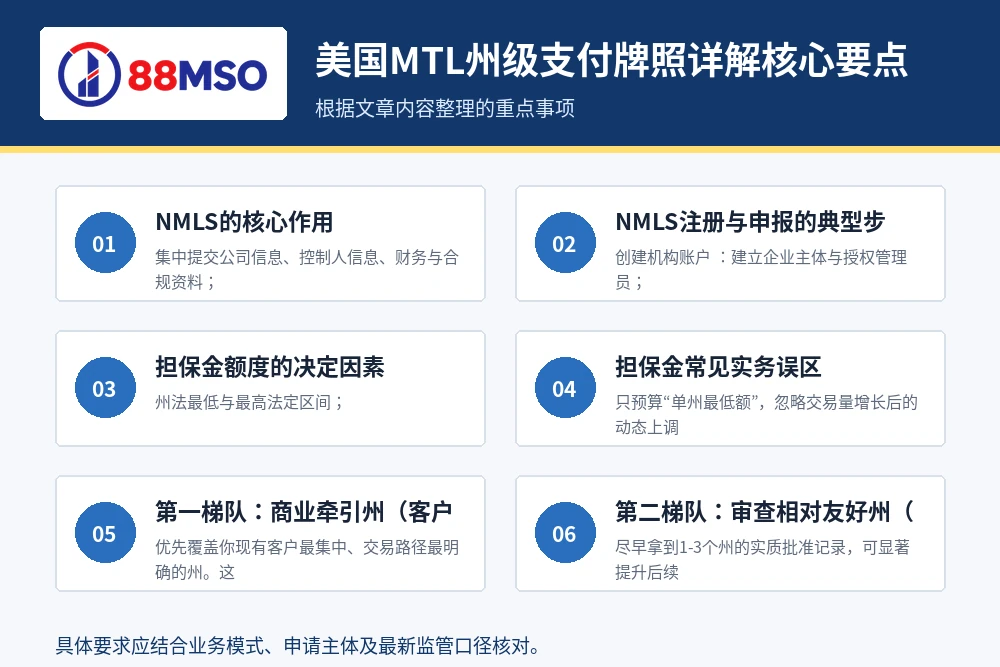
- Centrally submit company information、Controller information、Financial and Compliance Information;
- Unified management of multi-state application status、Replacement notice、License renewal node;
- Support background checks、fingerprint、Financial reporting and annual updates;
- Form a basic archive that can be reused across states,Improve multi-state expansion efficiency。
Typical steps for NMLS registration and declaration
- Create an institutional account:Establish enterprise entities and authorized administrators;
- Create module information such as MU1/MU2:company、Management、beneficial owner、Compliance Officer;
- Upload core files:business plan、AML/BSA Policy、Cybersecurity and disaster recovery、financial statements、Audit information;
- Apply state by state:Supplemental State Specific Documents (State Template、Net capital certificate、State Additional Disclosures);
- Meet background check and fingerprint requirements:Including key management personnel;
- Complete Surety Bond submission:According to the amount and format required by the state;
- Respond to review comments:Supplementary parts、letter of explanation、Business model clarification;
- Continuous maintenance after approval:annual report、Renew license、Major change reporting。
Important reminder:"Reusable" NMLS data does not mean "copyable"。Each state has detailed preferences,Especially in the capital flow diagram、proxy network、cooperative bank agreement、KYC layered mechanism,There will be significant differences in the review standards。
What do you understand by Surety Bond? Why is it a cost critical item?
Bonds are one of the important mechanisms for state regulation to protect consumers.。Simply put,It's not a reserve of fines that you hand over to regulation,It is a guarantee arrangement issued by a guarantee company:If a licensed institution violates laws or regulations or causes losses to consumers,State regulation can assert claims when conditions are met。
Determinants of the amount of guarantee
- State minimum and maximum legal ranges;
- Estimated or actual transaction volume (many states use a tiered system);
- Business type complexity (such as cross-border、Agent network、Multiple currencies);
- Corporate financial strength and credit performance;
- Are you already licensed in another state and have a good record?。
Ranging from tens of thousands of dollars to hundreds of thousands of dollars in different states,Some high transaction volume scenarios will be higher.。Enterprises are more concerned aboutguaranteed premiumrather than nominal guarantee amount:Premiums are rated by credit、financial statement quality、Comprehensive determinations such as historical compliance records。The sooner you plan your financial structure and risk control system,The greater the chance of getting better rates。
Common practical misunderstandings about security deposits
- Budget only the “minimum amount per state”,Ignoring dynamic upward adjustments after transaction volume growth;
- Net capital certificate not prepared simultaneously,Leads to state review requirement for reinforcement;
- Ignore renewal time,Risk of license plate status interruption;
- Text versions are inconsistent in different states,Repeated returns。
Which states should be prioritized? Give you an executable sorting framework
There is no unified answer to “Which states to apply to first?”,But it can be sorted using a four-dimensional framework:business value、Difficulty of supervision、time efficiency、Fund occupation。
first echelon:Business traction state (customer/transaction first)
Prioritize coverage of your existing customers、States with clearest trade paths。This way even if the license is still being extended,It can also form a closed loop of compliance revenue as soon as possible。For cross-border payment institutions,Usually start with key collection states、Use money state to cut in,Instead of pursuing "looking complete on the map"。
Second echelon:Review relatively friendly states (establish record of first batch of approvals)
Get substantive approval records from 1-3 states as early as possible,Can significantly improve subsequent state communication efficiency。Regulators will refer to your state licenses and operational performance when reviewing。Success of the first states,Often determines the overall project pace。
third echelon:High threshold core states (prepare in advance、Attack in stages)
Some states have extremely high market values,But for compliance systems、Management experience、Financial foundation requirements are more stringent。It is recommended to prepare 6-9 months in advance:Optimize policy documents、Strengthen AML monitoring、Improve the complaint and appeal mechanism、Complement audit capabilities,Apply again。
fourth echelon:Complementary state (network perfection)
When core income states and high threshold states are completed,Enter the completion stage again,Achieve nationwide coverage。The focus at this stage is on license renewal、Submit、Internal audit automation,And not just "get a few more states"。
MTL and US MSB、How is the AML system linked?
Many companies will be exposed to the two concepts of "MSB" and "MTL" at the same time。Simplify understanding:
- MSB (federal level):Typically involves FinCEN registration and BSA/AML obligations;
- MTL (state level):Focus on State Law Licensing、consumer protection、Fund transmission regulation。
The two are not mutually exclusive,In practice, it is often "federal registration + state-level licensing" in parallel。The real difficulty lies in making the AML system an executable system:
- KYC/KYB layered due diligence;
- Suspicious transaction monitoring and reporting process;
- Sanctions screening and list management;
- Independent audit and training closed loop;
- Clarification of MLRO/Compliance Officer Responsibilities。
If a company plans to expand into Hong Kong and the U.S. markets at the same time,,It is recommended to uniformly design group-level compliance bases,Make additional localized additions。This can not only reduce repeated construction costs,It can also improve the consistency of explanations during regulatory inquiries.。This is exactly what 88MSO often emphasizes in cross-jurisdictional licensing projects: “structure first”、Hou Shenpai、"Reoperation" path。
Timeline and Budget:Two things that management cares about most
1) How to anticipate the timeline?
From preparation to first state approvals,Common cycles are 6-12 months;Multi-state parallel expansion may stretch to 12-24 months。The difference comes from:
- Data completeness and consistency;
- Management background and verifiable experience;
- Business model complexity;
- State review load and number of replacement parts round trips。
2) How to split the budget?
- State Application Fees and NMLS Related Fees;
- Guarantee deposit premium and credit enhancement cost;
- Legal/Compliance Consulting and Document Localization;
- audit、Finance and system transformation;
- Ongoing maintenance (annual review、Submit、training、internal audit)。
It is recommended that management make decisions based on "3-year total cost of ownership (TCO)",Instead of just looking at the first-year application fee。Because what really widens the gap,It is often the subsequent maintenance efficiency and violation risk costs.。
Practical suggestions for applying with a high pass rate
- Do regulatory mapping first:Map business processes step by step to state legal obligations,Avoid caliber drift;
- The file is formed in one go:business plan、AML policy、Customer service complaint process、The fund isolation mechanism remains consistent;
- Establishing a compliance manager and upgrade path:Supervision is most concerned about “who is responsible?、How to upgrade、When to leave traces”;
- Establish digital monitoring:More important than "written in the system" is "the system can run";
- Reserve flexibility for spare parts:Both time and budget should reserve 20%-30% buffer space.。
Conclusion:The essence of MTL layout,Is a compliance-driven growth design
US MTL is not a single point license,but a state-level compliance network。Who can prioritize states?、NMLS process、Collaboration of margin arrangements and AML operating systems,Who can turn "getting cards" into "sustainable growth" faster?。
For payment and financial technology companies that want to expand into Hong Kong and overseas markets at the same time,Introduce a team of consultants with cross-jurisdictional experience in advance,Often can significantly reduce trial and error costs。Take 88MSO and the long-term financial compliance practical experience accumulated by 88MSO behind it as an example.,The core value lies in transforming complex regulatory requirements into executable paths.,Help enterprises to implement steadily and maintain the value of licenses in the long term。
FAQ:US MTL FAQ
Q1:Do I have to apply to all 50 states at once?
No need。It is also recommended to apply in stages according to business priority.,First form a closed loop of income and approval records,Expand nationwide coverage。
Q2:After NMLS registration is completed,Does it mean getting a license?
no。NMLS is the declaration platform,Final approval is determined independently by state regulators。
Q3:Is the security deposit a "frozen security deposit"?
Usually the same amount of cash is not frozen directly,Instead, purchase a guaranteed arrangement and pay a premium;However, specific credit conditions and counter-guarantee requirements vary depending on the institution and credit situation.。
Q4:Is MTL necessary to make crypto-related payments?
uncertain,But the risk is higher。Need to be defined according to state law、Legal judgment on capital control rights and specific business paths。
Q5:Already have a Hong Kong license,Is it helpful to apply for US MTL?
Helpful but not a substitute。Mature compliance governance、AML system and management experience will be a plus,However, local U.S. federal and state requirements must still be met。
Federal registration and state licensing need to be planned separately
Analyze the United StatesMTL state payment licenseWhen explaining in detail,A distinction should first be made between MSB registration at the federal level and state money transmission licenses。Whether a business requires a state license cannot just depend on the state in which the company is registered.,And it should be combined with the location of the customer、Fund transmission path、proxy network、Virtual currency activities and state definitions of related conduct are determined on a state-by-state basis。
State-level applications typically review the controller at the same time、business plan、Anti-Money Laundering System、financial statements、net worth、License investment、Guarantees of Guarantee and Company and Personal Data in NMLS。Guarantee amounts and ongoing reporting requirements vary by state and business size,Therefore the fixed amounts in the article can only be used as historical examples,The formal budget should be based on the current requirements of the target state。
Industry references:Society of State Bank Supervisors (CSBS):Currency Transmission Modernization Act。
Read more:US federal MSB license vs state MTL license:Comprehensive comparison of applicable business scope and compliance costs、Detailed explanation of the tiered requirements for Money Transfer License (MTL) Surety Bond in each U.S. state。