 简体中文
简体中文 繁體中文
繁體中文 English
Singapore Fund Management Company License:LFMC application path and requirements after RFMC withdraws
Official verification update (August 2026):The Monetary Authority of Singapore has withdrawn the RFMC regime,The original RFMC must be converted into a licensed fund management company (LFMC) according to the transition arrangement;From August 1, 2024,RFMC is no longer a new application path。The old AUM and investor caps covered in this article are only for understanding the historical system,New projects should be evaluated according to current capital market service license and fund management activity requirements。 For specific rules, seeMonetary Authority of Singapore’s Consultation Paper on the Revocation of the RFMC Regime。
In the Asian asset management landscape,Singapore has always been a high-net-worth fund、Jurisdictions of high concern to family offices and cross-border fund managers。Compared to fully licensed fund management companies (LFMC),RFMC(Registered Fund Management Company,Registered fund management company)Because the access path is clearer、Clear business boundaries,It has become the “first to implement” for many small and medium-sized fund management teams.、The first choice for further expansion。
But in reality,Many applicants have typical misunderstandings about RFMC:Think that "registration system" means low threshold、lax censorship;Or just focus on the AUM (Assets Under Management) number,But ignored the team ability、AML/KYC system、Risk governance and ongoing compliance costs。The result is often that the preparation cycle is lengthened,We even encountered major obstacles in communicating with regulators.。
This article will focus onRFMC application conditions、AUM threshold、Organizational structure、Review focus、Common reasons for failure and practical suggestionsDo system sorting,And combined with cross-border business scenarios,Help you plan the "Singapore + Hong Kong" dual hub compliance layout more safely。
one、What is RFMC? Which institutions is it suitable for?
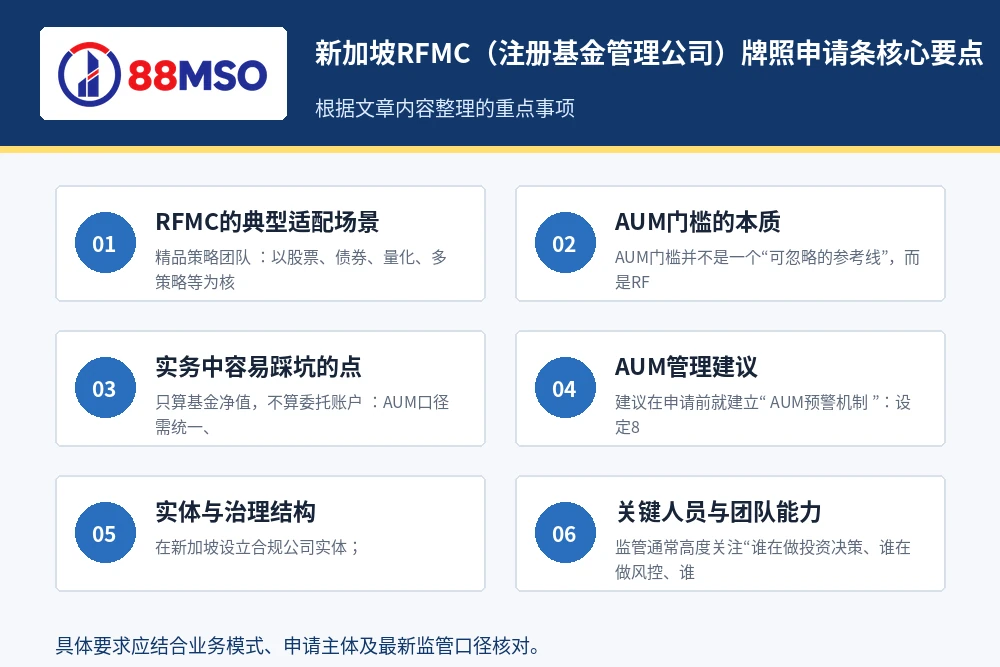
RFMC was once aMonetary Authority of Singapore (MAS)One of the types of regulated fund management entities。Its core features are:Within the specific investor range and AUM cap,Engage in fund management activities。
Typical adaptation scenarios of RFMC
- Boutique strategy team:take stocks、bond、Quantify、Multiple strategies as the core,Management scale is in the early to mid-stage;
- Family capital management platform:Serving a small number of high net worth clients,Emphasis on sound compliance and coordination of tax structure;
- cross-border manager:Want to establish a regulated entity in Singapore,Connecting Southeast Asia and global LP funds;
- Teams spilling over from Hong Kong or other jurisdictions:Adding Singapore’s regulatory grip in addition to the original licensing system,Improve the credibility of fundraising and institutional cooperation。
Simply put,RFMC is not a “low-end license plate”,But a kind ofhave boundaries、have responsibility、Can be advancedregulatory status。If AUM and customer scale continue to grow in the future,Typically leads to a higher level license path。
two、RFMC’s most watched AUM threshold:How do you understand it?
Mention RFMC,The first thing almost all applicants ask is:"What is the upper limit of AUM?" "Is it illegal to exceed it?"
1) The essence of AUM threshold
The AUM threshold is not a "negligible reference line",It is the core boundary of RFMC’s regulatory positioning.。Regulators differentiate via AUM caps:
- Institutional risk spillover capability;
- Strength of investor protection requirements;
- Should managers move to higher levels of supervision?。
2) Potential pitfalls in practice
- Only the net value of the fund is calculated,Not counting entrusted accounts:AUM caliber needs to be unified、auditable、Traceable;
- Short-term excess is not planned:Strategic market conditions lead to sudden growth in scale,If there is no upgrade plan,Compliance risks increase sharply;
- Double counting or missing counting across entities:Involving SPV、offshore funds、Parallel fund time,The penetration diameter needs to be determined in advance;
- Fundraising commitments are confused with paid-in AUM:Regulation focuses on actual assets under management rather than advertised size。
3) AUM management suggestions
It is recommended to establish "AUM early warning mechanism”:Set 80%、90%、95% stratification threshold,Corresponding to different actions (limited to new recruits、Strategic position adjustment、License Upgrade Assessment、regulatory communications)。This is more in line with regulatory expectations than "remediation after exceeding the limit",It also better reflects the professionalism of management。
three、RFMC application conditions:Not just registration,A comprehensive capability review
Registration before RFMC withdrawal is not a form-filling process,It is a comprehensive judgment on whether the institution has the ability to continue to manage the assets of others.。The following are the core dimensions:
1) Entity and governance structure
- Setting up a compliant corporate entity in Singapore;
- Clarify the shareholding structure、Beneficial Ownership (UBO) and Control Relationship;
- Clear responsibilities of the board of directors and management,Avoid the risk of "nominal director/shadow actual control"。
2) Key personnel and team capabilities
Regulation usually pays close attention to “who is making investment decisions?”、Who is doing risk control?、Who is doing compliance monitoring?”。Common requirements include:
- Core management personnel must have experience in fund management or related financial industry;
- invest、Risk control、operations、Compliance at least forms an operational closed loop;
- Personnel resumes should be consistent with the application strategy (for example, the quantitative strategy should have corresponding quantitative risk control and system experience)。
3) Compliance system (AML/KYC is the top priority)
No matter what your strategy is,Anti-money laundering and customer due diligenceAlways the focus of regulatory review。Should cover at least:
- Customer Identification and Continuous Due Diligence (KYC/CDD);
- Enhanced due diligence (EDD) for high-risk customers;
- Transaction monitoring and suspicious activity identification process;
- Sanctions list screening and hit processing mechanism;
- Suspicious transaction reporting and internal upgrade path;
- Compliance training、Record retention and independent review arrangements。
4) Operation and outsourcing management
Many teams will organize fund administration、Valuation、hosting、IT security part outsourcing。Regulation is not against outsourcing,However, it emphasized that “supervisory、Replaceable、Accountable”。therefore:
- Outsourcing due diligence standards and annual re-evaluation are required;
- Critical outsourcing contracts should have service level agreements (SLAs) and contingency clauses;
- Managers cannot “outsource” core responsibilities。
5) Financial stability and sustainable operating capabilities
In addition to start-up capital,Supervision also focuses on whether the institution has the ability to cover fixed costs and compliance investments.。If the business model relies too much on a single customer、single source of income,Or cash flow is under obvious pressure,may affect the review judgment。
Four、RFMC application process:Key nodes from strategic narrative to regulatory Q&A
Stage one:License path matches business model
First determine whether RFMC is in line with the number of customers in the next 2-3 years、policy capacity、Fundraising rhythm matching。If you know that you will break through the boundary soon,It is recommended to plan the upgrade path from the beginning。
Stage 2:Material construction and compliance document preparation
Common include:business plan、Organizational structure、Compliance Manual、AML/KYC Policy、risk management framework、Outsourcing management policy、Conflict of Interest Management Policy, etc.。Documents must not only “have”,It also needs to be “able to execute”。
Stage three:Pre-communication and inquiry response
Regulatory inquiries often focus on:strategy logic、Investor portrait、AUM growth expectations、Competencies for key positions、Abnormal transaction handling process, etc.。Answers need to be consistent、Verifiable、Can be floored。
Stage four:Implementation and continued compliance after approval
Obtaining qualifications is not the end。Annual review will be implemented in the future、reporting obligations、Personnel change record、Policy updates and internal training。The real challenges for many institutions occur precisely “after approval”。
five、Common Reasons for Rejection or Delay:Avoiding pitfalls in advance is more important than remedying them
- "Template application" is serious:Documents are out of touch with actual business,Supervision reveals shortcomings when asked;
- Team resume and strategy do not match:Claim a complex strategy,But there is no corresponding historical performance and system support;
- AUM planning is unreal:Aggressive growth assumptions but no basis for fundraising;
- Hollowing out the AML/KYC process:Just write principle,Do not write threshold、list、Responsibilities、time limit;
- Governance structure is opaque:Complex equity levels、The actual controller cannot explain clearly;
- Neglecting cross-border regulatory convergence:Operating in multiple jurisdictions without a consistent compliance framework。
six、How do RFMC and Hong Kong licenses work together? Realistic propositions for cross-border managers
For many Chinese-speaking teams,Singapore and Hong Kong are not “choose one or the other”,But the functions are complementary。Singapore has obvious advantages in Southeast Asia’s capital and international tax structure;Hong Kong is connecting mainland China’s capital markets、Brokerage ecosystem、Has a unique position in the offshore RMB scene。
therefore,More and more institutions are adopting the “dual-center” approach:Laying out fund management entities in Singapore,Configure relevant financial license capabilities in Hong Kong (such as securities、asset Management、Payment or MSO related compliance support),Realize fundraising、trade、Settlement、Collaboration of compliance governance。
This type of cross-border design places higher demands on compliance consultants:More than just understanding the single license plate rules,More to understandregulatory penetration、Funding path、tax implications、AML conformance and continuous auditing requirements。This is why the market prefers to cooperate with teams with practical experience in multiple licenses.。Take the professional service system behind 88MSO as an example,It has been deeply involved in Hong Kong MSO for a long time、SFC、Supervision practices for insurance brokers and money lenders,It can provide more business-friendly solutions at the level of cross-border financial compliance collaboration and implementation.。
seven、Practical suggestions:Please complete this "RFMC Preparation Checklist" before applying
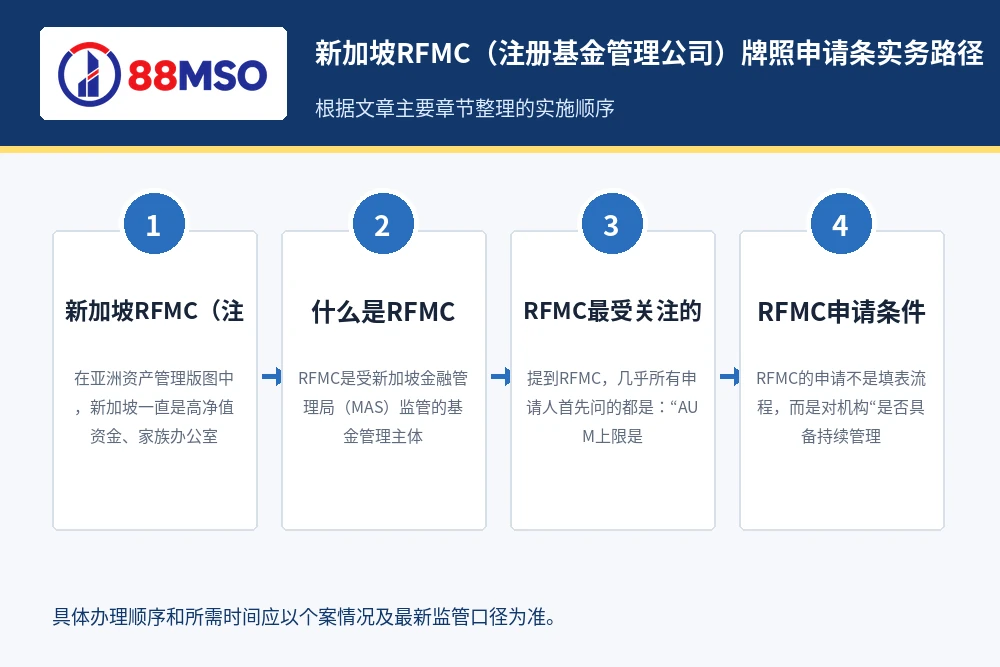
strategic level
- Clarify AUM target and customer structure in the next 24 months;
- Confirm whether RFMC is the phased optimal path;
- Design upgrade and transition plans after the threshold is exceeded。
organizational level
- Be available for key positions and be able to demonstrate competency;
- Documented board governance and authorization matrix;
- Establish four-line linkage of "investment-risk control-compliance-operation"。
Compliance level
- Complete AML/KYC policy、Sanctions Screening Process and Monitoring Thresholds;
- Configure audit trails and record retention mechanisms;
- Develop abnormal event reporting and rectification closed loop。
operational level
- Outsourcing agency due diligence and SLA signing;
- Valuation、Reconciliation、Standardization of NAV calculation process;
- network security、Rights management and data backup implemented。
Conclusion:RFMC is not a “low-threshold shortcut”,It is the starting point of specialization
The value of Singapore RFMC lies in:Provides growth fund managers with a regulatory、Expandable、A starting platform that can be recognized by institutional funds。What really determines success or failure,It’s not “Can you submit the application?”,It’s about whether you have the ability to operate a regulated asset management business stably in the long term.。
If you are planning an RFMC application,It is recommended to shift the focus from "quickly obtaining qualifications" to "sustainable compliance operations" - including AUM boundary management、AML/KYC system、Team competency and cross-border license synergy。This will not only improve the efficiency of approval,It can also establish long-term trust on the fundraising side and institutional cooperation side.。
FAQ:Regarding the high frequency issues of RFMC
Q1:Is RFMC suitable for all fund managers?
uncertain。If you expect rapid expansion of customers and AUM in the short term,May require higher level license path。RFMC is more suitable for clear boundaries、Steady growth team。
Q2:What to do when AUM is approaching the threshold?
It is recommended to set warning thresholds in advance and start upgrade evaluation,Don’t wait until you hit the top and deal with it passively。Supervision pays more attention to “forward-looking management capabilities”。
Q3:Outsourced administration and compliance,Can it reduce responsibility?
cannot。Outsourcing is execution,Not a responsibility。Managers still need to demonstrate ongoing supervision and accountability of outsourced parties。
Q4:Why are the RFMC application cycles so different?
The core lies in material quality、Team fit、Inquiry responsiveness and business complexity。Well-prepared projects are usually more efficient。
Q5:Already have business in Hong Kong,How to collaborate with Singapore RFMC?
Can be stratified by customer、transaction path、Start by separating capital flow and compliance responsibilities,Establish a consistent AML/KYC and governance framework across borders,Reduce regulatory conflicts and operational friction。
Structural selection goes back to investors and assets themselves
RFMC is a term from the old system。New projects should not continue to follow the “application for RFMC” design route;There are zero RFMC screening results in the current public list of the Monetary Authority of Singapore,Fund management business should be re-evaluated according to the current capital market service license and fund management activity requirements。
Compare Singapore Fund Management Company Licenses:LFMC application path and requirements after RFMC withdraws,The number and location of investors should be confirmed first、Subscription and redemption arrangements、Asset type、Manager's location、Tax filing and exit methods。LPF、ELP、VCCs or trusts each solve different problems,It cannot be decided solely by the speed of establishment or the initial cost.。
The landing documents must clearly assign general partners、investment manager、director、trustee、Administrator、Responsibilities of Trustees and Auditors,and process valuations in advance、conflict of interest、Related party transactions、Cost Sharing and Investor Reporting。When it comes to investment immigration or family inheritance,Eligibility rules and benefit arrangements should also be independently checked。
Read more:Offshore family trust structure construction:A guide to the pros and cons of BVI VISTA trusts and Cayman STAR trusts、How does Hong Kong Limited Partnership Fund (LPF) connect with Hong Kong Investment Immigration (CIES)? Compliance Asset Allocation Guide。
Read more:Overseas financial license application and supervision topics。