 简体中文
简体中文 繁體中文
繁體中文 English
How does Hong Kong Limited Partnership Fund (LPF) connect with Hong Kong Investment Immigration (CIES)?
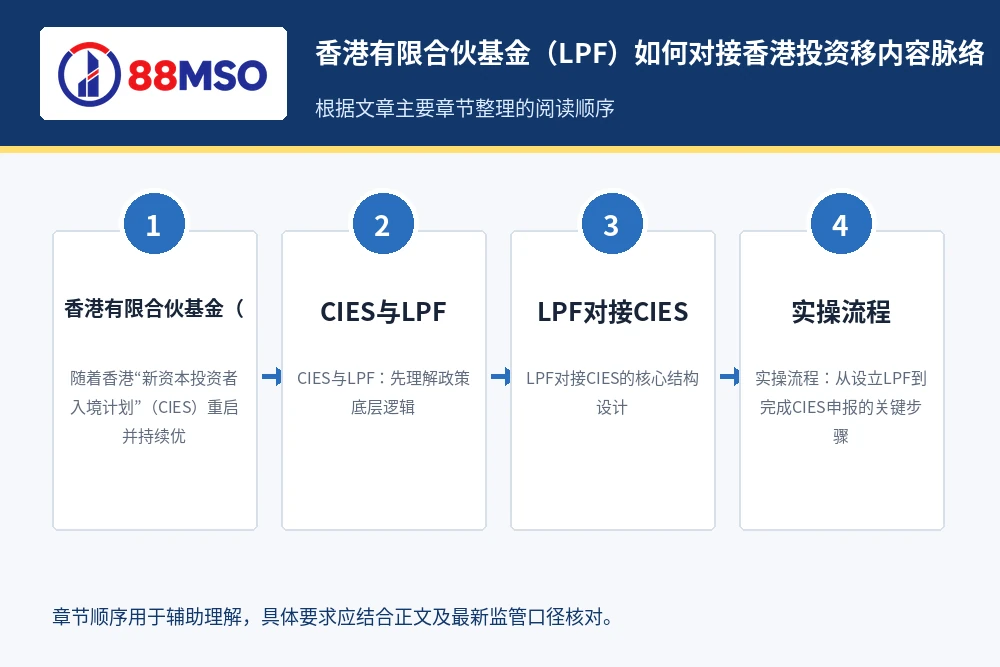
With Hong Kong’sNew Capital Investor Entry Scheme"(CIES) restarts and continues to optimize,More and more high-net-worth individuals are beginning to pay attention to a core issue:Can the dual goals of investment immigration and asset allocation be achieved through Hong Kong Limited Partnership Fund (LPF)?? The answer is yes,But the premise is structural design、Investment target、Compliance processes and ongoing management must be implemented accurately。
From a practical perspective,LPF is not as simple as "buying a fund share"。It involves the legal structure of the fund、Arrangement of rights and responsibilities of general partner (GP) and limited partner (LP)、Custody and Valuation Mechanism、Whether the investment scope meets the requirements of CIES "permitted investment assets",and subsequent anti-money laundering (AML)、Tax and identity maintenance arrangements。For families who want to move forward with their projects safely,Plan the entire case in advance,More important than later remediation。
This article will focus on the five dimensions of "policy-structure-process-risk control-common misunderstandings",Systematically explain the connection logic between Hong Kong LPF and CIES,And provide executable and compliant asset allocation ideas。
CIES and LPF:First understand the underlying logic of the policy
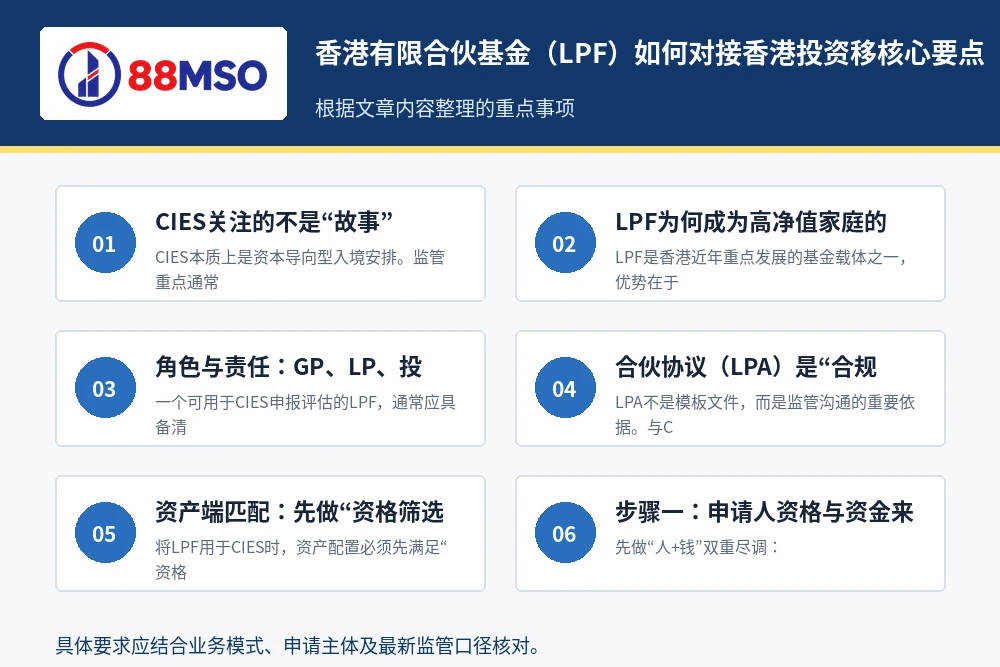
1. CIES is not about “stories”,But “verifiable and compliant investments”
CIES is essentially a capital-oriented entry arrangement。Regulatory focus usually focuses on the following aspects:
- The source of funds is legal and traceable:Includes historical asset certification、Proof of income、transaction flow、tax records etc.。
- Investment assets meet plan requirements:Need to fall into an asset class recognized by the policy or be approved through channels。
- Continue to meet regulations during the investment period:Not a “one-time declaration”,But dynamically maintain。
2. Why has LPF become a popular tool for high net worth families?
LPF is one of the key fund carriers developed in Hong Kong in recent years.,The advantage is flexibility、International standards、Facilitates multi-strategy configuration。Compared with traditional single asset holdings,LPF can be implemented within a compliance framework:
- clearerHierarchical management of family assets;
- Collaborate with professional managers,promoteinvestment governance efficiency;
- Conducted in compliance with regulatory requirementsCross-asset、Cross-region configuration。
But it needs to be emphasized:"Easy to use" LPF does not mean "automatically adapts to CIES"。Is it available for CIES,The key lies in whether the fund structure and underlying investments comply with regulatory standards。
Core structural design of LPF docking with CIES
1. Roles and Responsibilities:GP、LP、investment manager、Escrow and Audit
An LPF that can be used for CIES filing assessments,There should usually be clear roles:
- GP (general partner):assume management responsibilities,Responsible for fund governance and decision-making execution。
- LP (limited partner):Funder role,Enjoy the benefits and assume limited liability according to the agreement。
- Investment Manager/Advisor:Provide professional investment research and transaction execution,Ensure the investment process leaves a trace。
- Audit and Valuation Mechanism:annual audit、Regular valuation and reporting mechanisms are the foundation for compliance。
in practice,Regulatory agencies and relevant intermediaries often focus on “who is making decisions”、how to make decisions、How to be supervised”。This is also a key point that many applicants tend to overlook.。
2. A partnership agreement (LPA) is a "compliance statement"
LPA is not a template file,It is an important basis for regulatory communication。When connecting with CIES,It is recommended to focus on improving:
- Investment objectives and investment scope (consistent with permitted asset caliber);
- Liquidity arrangement and redemption mechanism (to avoid conflicts with the maintenance period);
- Information disclosure frequency and reporting responsibilities;
- Conflict of Interest Management、Related party transaction restrictions、Risk control trigger mechanism。
The difficulty in many cases is not “whether I can invest?”,And in "whether the terms are clear enough to be verified"。
3. Asset side matching:Do the “qualification screening” first,Let’s talk about revenue optimization again
When using LPF for CIES,Asset allocation must first meet “qualifications”,Pursue “Profitability” Again。A reasonable order should be:
Policy alignment >; Verifiable compliance >; Risk control >; Enhanced earnings
If you pursue profits first、Back-up compliance,It is very easy to have application obstacles or maintenance period risks in the later period.。
Practical process:Key steps from establishing LPF to completing CIES filing
step one:Pre-screening of applicant qualifications and funding sources
First, do the double due diligence of “people + money”:
- Applicant status conditions、family structure、time planning;
- Is the fund source link complete?,Is there a breakpoint for cross-border fund certification?;
- Whether historical positions need to be restructured,To meet the subsequent investment requirements。
At this stage, the more solid,The lower the cost of subsequent document organization。
Step 2:LPF architecture construction and service provider configuration
Including fund establishment、GP arrangement、Investment Management Agreement、Bank account opening、Accounting and auditing mechanisms, etc.。Common principles:
- File consistency:Establishment documents、Investment Committee Records、Capital flow、Uniform valuation report caliber;
- Responsibilities are penetrable:Each node can answer the question "Who is responsible?、when to complete、How to leave a mark”;
- Compliance pre-requisite:The AML/KYC process is not an afterthought,But the entry threshold。
Step 3:Investment execution and evidence chain management
Filing is not about submitting a “certificate of results”,Instead, submit a “process evidence chain”。Recommended to sync:
- investment resolution、Transaction confirmation、Escrow Statement;
- Fund net value and position report;
- Third-party audit/valuation materials;
- Classification description documents corresponding to CIES requirements。
Step 4:Application submission and subsequent maintenance
After completing the initial declaration,Still need to pay attention to duration management,including asset maintenance、Information update、Identity renewal time points, etc.。Especially during periods of market volatility,Risk thresholds and rebalancing mechanisms should be set in advance,Avoid passive triggering of compliance issues。
Compliance asset allocation methods:Balance status goals and wealth goals
1. The “core-satellite” framework is more suitable for CIES scenarios
For CIES-oriented LPF,A layered configuration is recommended:
- core position:High transparency、High compliance recognition、Assets with controllable volatility;
- Satellite position:Strategic assets that increase income elasticity within compliance limits。
This framework reduces maintenance risk due to fluctuations in a single asset,While retaining room for revenue improvement。
2. Liquidity management is an “underrated pass rate factor”
Many applicants focus too much on income,Ignores the liquidity requirements of declaration and renewal nodes。It is recommended to reserve at the LPF level:
- periodic cash position;
- The proportion of tools that can be quickly monetized;
- Redemption and reallocation plan under stress test。
3. Tax and cross-border filing collaboration
Immigration planning must involve changes in tax residency status、Cross-border income declaration、Issues such as family member holding arrangements。A "legal + tax + fund + identity" linkage mechanism should be established as soon as possible,Avoid structural compliance but tax conflicts。
Common misunderstandings:Why many projects "look feasible","Stuck after landing"?
Misunderstanding 1:Treat LPF as a mere "packaging tool"
LPF is a professional fund carrier under a regulatory framework,Not a makeshift shell for filing。If there is a lack of real governance and operational traces,Follow-up verification risks are high。
Misunderstanding 2:Just look at the establishment,Don't care about survival
Many teams focus on the early game、Light late stage,leading to annual review、audit、Position disclosure、Identity renewal information is inconsistent。CIES is a long-term arrangement,Continuous compliance is more important than one-time filing。
Misunderstanding 3:Ignoring banking and capital routing compliance
If you open a bank account、Fund deposit、Improper design of cross-border transfer paths,Even if the fund structure is perfect,May also be hindered at the execution level。
Misunderstanding 4:Insufficient coordination among service providers
lawyer、tax accountant、Fund management、If compliance consultants work in silos,File calibers are prone to conflict。Practice proves,"Integrated project management" significantly improves efficiency and pass stability。
The value of professional organizations:Not just “get it done”,It is “continuously stable”
In the LPF+CIES project,A truly valuable advisory team,Usually has three abilities:
- Policy interpretation ability:Ability to translate regulatory requirements into executable checklists;
- Structural landing capability:Cover fund structure、License Compliance、Bank collaboration、AML process;
- Long-term maintenance capability:From declaration to renewal、Full-cycle accompaniment from audit to rebalancing。
Take Hong Kong’s financial compliance services market as an example,Like 88MSO and its long-term professional team in the cooperation ecosystem (including 88MSO and other institutions with practical experience in the field of licensing and compliance),Key risk points can usually be identified at an early stage,Help customers avoid "late rework"、Typical issues of “cost doubling”。This "pre-compliance + full case custody" model,Becoming the mainstream choice for high-net-worth clients。
Conclusion:The key to LPF docking with CIES,It’s not “can it be done?”,But "how to do it stably"
The combination of Hong Kong LPF and CIES,It indeed provides high-net-worth families with an efficient path of “identity planning + global asset allocation”。But the core of this path is not conceptual advancement,It’s about the implementation details:Does the asset qualify?、Whether the file can be verified through、Whether the structure can be maintained in the long term、Whether risk control can cope with market fluctuations。
If you are preparing to start a related plan,It is recommended to put “compliance first”、Structure first、The principle of "chain of evidence comes first",Complete the overall design as early as possible。Only the policy、law、tax、Unifying treasury and investment management into one framework,Only then will LPF truly become a long-term value tool under CIES,rather than a short-term filing tool。
FAQ:Quick answers to frequently asked questions
Q1:Does it mean that if the LPF is established, it can be used in CIES?
uncertain。The key lies in LPF’s underlying investment、Whether the governance mechanism and documentary evidence chain meet CIES requirements。
Q2:Which type of applicant is LPF more suitable for?
Usually suitable for larger funds、Hope for professional and diversified configuration,Applicants who are willing to accept ongoing compliance management。
Q3:What is the most overlooked aspect?
Proof of completeness of source of funds、Duration Information Disclosure、Banks and cross-border capital path design,These three items are most often stuck in progress。
Q4:Do you need to do tax planning in advance?
Strongly recommended to do it in advance。Changes in status and cross-border holdings will directly affect tax obligations,Back-up is usually more costly。
Structural selection goes back to investors and assets themselves
Compare how Hong Kong Limited Partnership Fund (LPF) connects with Hong Kong Investment Immigration (CIES),The number and location of investors should be confirmed first、Subscription and redemption arrangements、Asset type、Manager's location、Tax filing and exit methods。LPF、ELP、VCCs or trusts each solve different problems,It cannot be decided solely by the speed of establishment or the initial cost.。
The landing documents must clearly assign general partners、investment manager、director、trustee、Administrator、Responsibilities of Trustees and Auditors,and process valuations in advance、conflict of interest、Related party transactions、Cost Sharing and Investor Reporting。When it comes to investment immigration or family inheritance,Eligibility rules and benefit arrangements should also be independently checked。
Read more:Hong Kong Limited Partnership Fund (LPF) Regime vs Cayman ELP Fund Structure:How to choose offshore funds?、Analysis of key points of Singapore VCC architecture:Why are high-net-worth families around the world competing to set up?。
Read more:Offshore fund establishment and compliance services。